
BYLINE TIMES IMPACT: Find out about the changes you made happen
The latest Donald Trump White House video, headlined “THEY WALK AMONG US”, is intended to compare immigrants to Aliens. As described by Byline Times US correspondent Heidi Siegmund Cuda last week, the video echoes 1950s, McCarthy era Sci-Fi in tone and content. It also echoes the rhetoric of dog-whistle-blowing, right-wing advocates in this country, back to and including Enoch Powell.
Scrolling in a sinister, green typeface across a dark screen, the “They Walk Among Us” video begins with this announcement: “For 60 years, the US government has kept a closely guarded secret. Aliens have been walking among us, living in our neighbourhoods, and interacting with us in our daily lives. They’ve shopped in the same stores, attended the same classes as our children, and lived seemingly normal human existences. With one exception — they do not belong here.”
But, clearly, unlike in the 1950s, these shape-shifted aliens are not communists in the pay of Moscow (or indeed aliens, of course): the millions who “arrived under the cover of darkness and embedded themselves directly into our society” are migrants, posing “real danger” to “every American family, every community, and the future of our nation”, until “one man finally had the courage to tell the truth” (guess who).

The idea of racial minorities as body-snatchers, posing as neighbours and friends in our midst, is a chilling echo of German Nazi propaganda, which contrasted pictures of identified, orthodox Jews (largely from Eastern Europe) with assimilated, middle-class Jewish people who looked for all the world like ordinary Germans. The idea of a disguised and alien force, secretly infiltrated into society, was crucial to Nazi rhetoric.
In a less melodramatic form, however, the idea of ethnic “others” falsely claiming to be authentic indigenous citizens has been a staple of dog-whistle political rhetoric in Britain for decades, not least from aspirant or actual leaders of the Conservative Party.
Tories on the Dog-Whistle
In a follow-up to his notorious, anti-immigration “Rivers of Blood” speech in April 1968 (in which, of course, he spoke of Britons “made strangers in their own country”, Enoch Powell insisted that “The West Indian or Asian does not, by being born in England, become an Englishman. In law he becomes a United Kingdom citizen by birth; in fact, he is a West Indian or an Asian still.”
In a January 1978 statement clearly intended to dissuade potential Tory voters from voting for the National Front, Margaret Thatcher insisted that “people are really rather afraid that this country might be rather swamped by people with a different culture”.
The othering of immigrants by leading Conservatives is not confined to the Tory Right. In March 2001, claiming to speak for “men and women who despair that their country is being taken from them”, the allegedly centrist Conservative leader William Hague invited his Harrogate audience to “to take you on a journey to a foreign land – to Britain after a second term of Tony Blair”.
But perhaps the most direct echo of the tone, spirit and content of the “They Walk Among Us” was a speech made by one-nation Tory Prime Minister David Cameron in April 2011, in which he painted an ominous picture of happy English communities, disturbed and threatened by strangers in their midst. “Real communities” he insisted “are bound by common experiences … forged by friendship and conversation … knitted together by all the rituals of the neighbourhood, from the school run to the chat down the pub”.
But then, “when there have been significant numbers of new people arriving in neighbourhoods … perhaps not able to speak the same language as those living there … on occasions not really wanting or even willing to integrate … that has created a kind of discomfort and disjointedness in some neighbourhoods. This has been the experience for many people in our country – and I believe it is untruthful and unfair not to speak about it and address it.”
The ‘Great Replacement’
The idea of the sinister stranger, infiltrating settled communities, sometimes posing as a genuine insider, more often all too obviously other, is at the core of the rhetoric of the Great Replacement, the conspiracy theory initially coined by the French writer Renard Camus and now the dominant explanatory theorem of the anti-immigration right. The sudden, shocking realisation of the alien-in-our-midst was anticipated in Mein Kampf, when Hitler wrote of strolling through Vienna and encountering an “apparition” in a black caftan and black locks and asking, first, “Is this a Jew?” but then, “Is this a German?”
In 1999, Renard Camus was researching a travel book in France’s Herault region, and “stumbled on a cluster of veiled Muslim women outside an ancient stone church”, concluding that “they did not belong there” (a phrase echoed in “They Walk Among Us”). From this epiphany, Camus developed his theory that Muslims were taking over from indigenous French and indeed western people in a Great Replacement.
In these cases, it’s not a matter of people looking or behaving the same but being obviously different. For Camus, if North African immigrants “are just as French as I am then French does not mean much” , a formulation echoed by Reform UK’s Head of Policy, the Cambridge academic James Orr, when he asked, in a podcast conversation with Charlie Kirk, “If anyone can become an Englishman, what is an Englishman?”
The idea that immigrants’ origins make them culturally incompatible with the indigenous English has been advocated both by Suella Braverman: “for English to mean something substantial, it must be rooted in ancestry, heritage, and, yes, ethnicity” and Kemi Badenoch: “We cannot be naïve and assume immigrants will automatically abandon ancestral ethnic hostilities at the border, or that all cultures are equally valid. They are not”.
The Powellite idea that a British passport doesn’t make you British was echoed by Gorton Reform by-election candidate Matthew Goodwin when he insisted that migrants who “refuse to assimilate” are “no longer part of our nation … it takes more than a piece of paper to make somebody British”.
In his recent, self-published Suicide of a Nation, Goodwin whisks this argument into what is in effect a 196-page endorsement of the Great Replacement Theory, in which migrants from “inferior, primitive” cultures form an “invasion force” which will bring about “the demographic replacement of the country’s historic majority”.
For Goodwin, like Camus, it’s the difference that rankles: “You walk down a street you once knew and no longer recognise it. You visit the place where you were born yet now feel like a stranger. You hear languages which are not your own. You see customs and cultures you do not share”.
Like Matthew Goodwin, his party leader Nigel Farage promotes the idea that “White Brits will become a minority in this country before the end of the century” — a claim probably originating with Goodwin and discredited in Nafeez Ahmed’s Byline Times expose of his projection. In the same article, Farage argues that “unelected and unaccountable” networks are encouraging institutions to “yield positions of power” to minorities. “Equality has nothing to do with it. The intention is to dominate”.
Who’s to Blame?
As Reform leaders abandon the economic populism they advocated to attract working-class voters , their anti-immigration rhetoric has become both more ethnically-centred (Thatcher’s “different culture”, Braverman’s ethno-nationalism, Goodwin’s “inferior, primitive” backgrounds) and more conspiratorial in tone. In the “Walk Among Us” video, responsibility for both the entry of migrants and their embedment in American society is laid at the door of “countless presidents, congressmen and senior officials” who “knew exactly what was happening” and chose to cover it up and “even accelerate the invasion”.
For Hungary’s now happily ex-prime minister, Victor Orbán, “there are political forces in Europe who want a replacement of population for ideological or other reasons”; more specifically, in the wording of a referendum question, “George Soros wants to persuade Brussels to settle at least 1,000,000 people from Africa and the Middle East in European Union territory, including Hungary”.
George Soros was a bête noir for Orban (who insisted that every electoral opponent was “a Soros candidate” who “dare not admit the identity of his master”). Donald Trump accused Soros of backing the District Attorney in the Stormy Daniels bribery case against him, and Soros was fallaciously accused of funding the caravan of central American migrants who marched to the Mexican American border in 2018.
On 20 June that year, in a fairly comprehensive summary of the Soros conspiracy theory, Nigel Farage told Fox News that the philanthropist was “actively encouraging people to come across the Mediterranean to flood Europe”, in “an organised attempt on a huge scale to undermine nation states, to undermine democracy and to fundamentally change the makeup demographically of the whole of the European continent”, making Soros “the biggest danger to the entire western world”.
In a co-authored book written in his academic days, Matthew Goodwin summarized Orban’s argument, adding that the EU/Soros “plot to flood Hungary and ‘Christian’ Europe with Muslim immigrants and refugees” was part of a quest to “dismantle western nations and usher in a borderless world that is subservient to capitalism”, an analysis which was “not entirely without credence”.
George Soros is of course Jewish, as were many of the alleged and actual former communists jailed and blacklisted during the McCarthy witch hunt (including six of the 10 Hollywood filmmakers imprisoned for refusing to name names to the House Unamerican Activities Committee).
The White House “They Walk Among Us” video is a satirical cartoon, echoing the tropes of a time when the infiltrators were linguistically and facially indistinguishable from the general population. But, directed at migrants today, it serves the same purpose as the McCarthyite rhetoric of the 1940s and 1950s. Both seek to dehumanise alleged enemies within by claiming that, despite how they looked, acted and behaved, they were not really people at all.
In his successful presidential campaigns, Donald Trump asserted that Mexican immigrants were criminal, rapists, and lunatics; now they are aliens in disguise. The first step in any campaign to “other” outsiders is to withdraw their shared membership of the human race.
History warns us what follows.
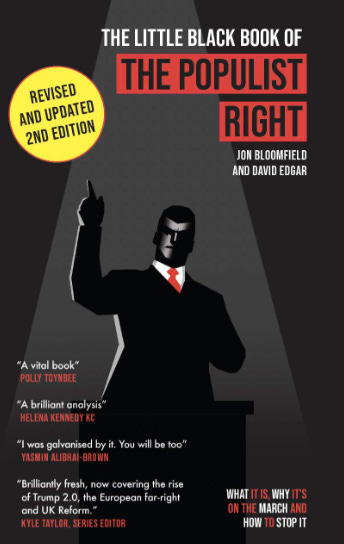
Jon Bloomfield and David Edgar are authors of The Little Black Book of the Populist Right, published by Byline Books and now in a new and updated edition.