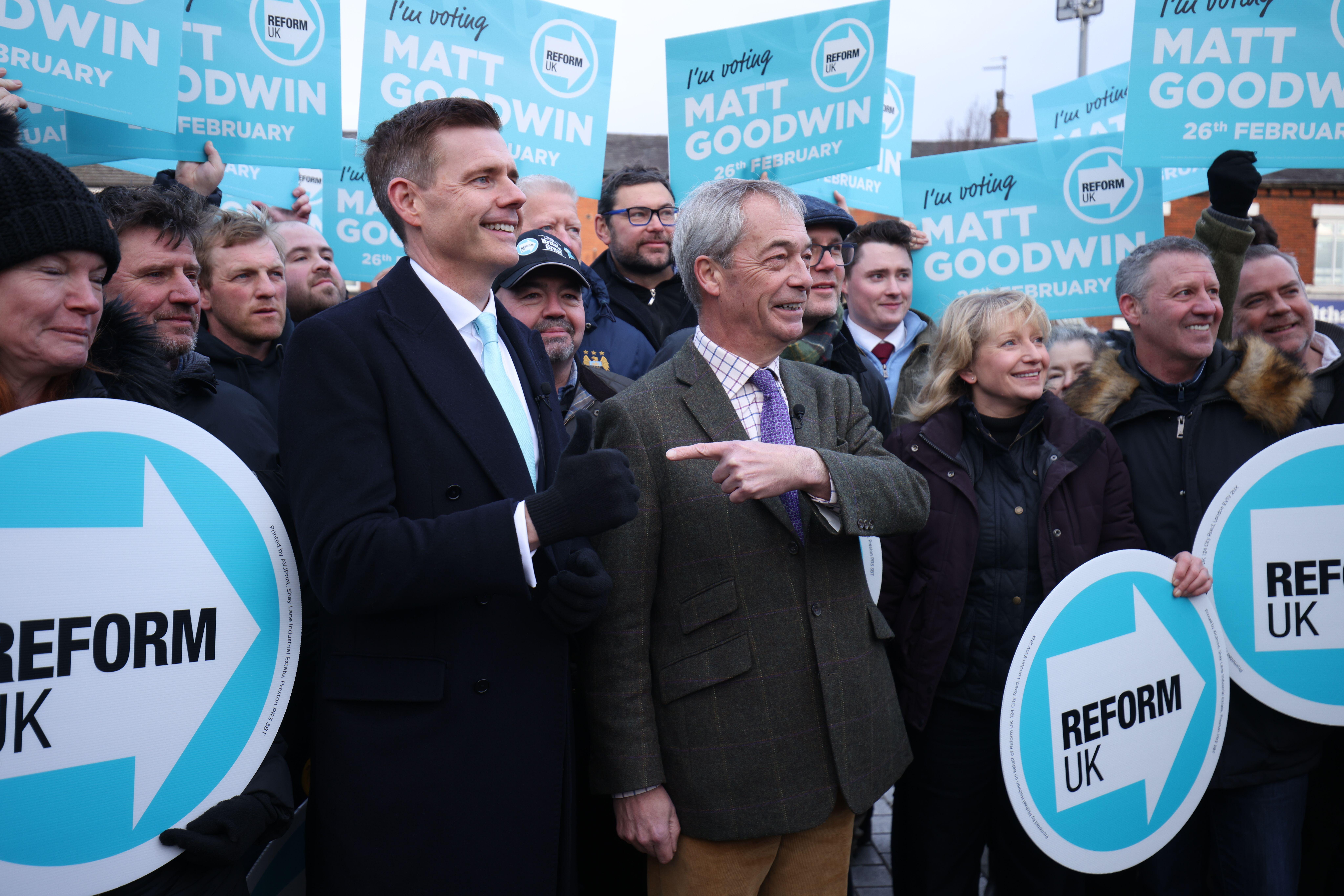

On 3 November 2025, he told a gathering in London’s grandiose Banking Hall that financial services were Britain’s biggest industry, that the City needed deregulating and that rich people needed to be encouraged back to the country. When, in Scunthorpe earlier in the year, he had talked about nationalising steel he’d only meant temporary, partial measures in emergencies. In the City of London, he did not mention his party’s 2024 manifesto commitment to a 50% government stake in public utilities at all.
In conclusion, Farage insisted that the main reason for his speech was to announce the biggest ever programme of welfare cuts, insisting that the idea of Reform as a pro-welfare party was a terrible misunderstanding. After all, his two-child welfare restoration would only apply to “British working couples”.
Part of the point of the speech was to portray Reform as fiscally responsible – the same 2024 manifesto had promised tax cuts of nearly £90billion and spending increases of £50billion, and Farage wanted to dump both those promises. The multi-millionaire group at the top of his party (Tice, Yusuf, Candy) had doubtless encouraged their leader to promise Mail readers that Reform was “shamelessly pro-business and pro-entrepreneur” and would implement measures “that will make wealthy people want to return here and businesses want to invest”.
Ditching the Workers
Something profound is happening here. The whole point of national-populism – the reason why it’s different from (and now overtaking) traditional conservatism – is that it offered left-behind, working-class voters a uniquely attractive, hitherto-unavailable cocktail of social conservative policies on the family, culture and immigration, alongside interventionist, statist policies on the economy.
As Reform parliamentary candidate in the Gorton and Denton by-election Matthew Goodwin used to argue, it was much easier for the right to turn left on economics than for the left to turn right on culture.
So national-populist parties like the Norwegian Progress Party and the Alternative for Germany (AfD) started out as free market advocates and turned increasingly to opposing immigration (in the AfD’s case, seeking votes from decimated working-class communities in the previously communist east). Holland’s Geert Wilders reversed his opposition to the minimum wage and workers’ legal protection, while the Austrian Freedom Party dropped proposals to raise the retirement age. In France, Marine le Pen promised nationalisation and opposed austerity, claiming that the National Front (now the National Rally) was “France’s leading working-class party”.
By the same token, in 2016, Donald Trump offered the biggest infrastructure renewal since the New Deal, and, in 2019, Boris Johnson promised to ‘level up’ the north. By these promises, previously left-wing voters were persuaded that they were not voting for warmed-up Thatcherism or Reaganism, but for a genuine, populist alternative addressing their economic concerns.
As we point out in our Little Black Book of the Populist Right, national populist promises of economic intervention all too often turn out to be empty rhetoric. Viktor Orbán’s Fidesz Government initially raised the minimum wage, built houses, and abolished student fees. Secure in his 2010 super-majority, Orbán then weakened employee and trade union rights and reduced unemployment benefits from nine months to three.
In the first year of Boris Johnson’s levelling-up programme, less than 3% of the Government’s fund was delivered. For many Red Wall Conservative MPs, this lost them their seats, to preserve what Miriam Cates called the economy’s “continued over-reliance on the financial services of the South East”, a reliance Nigel Farage is now keen to encourage.
And Term One Trump’s infrastructure reforms were confined to his unfinished border wall. Apparently, there was a running joke among White House staffers about a proposed “infrastructure week” which never happened. What did happen was a massive tax cut for the rich.
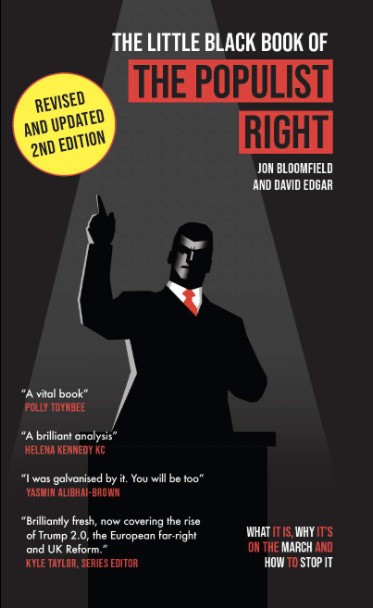
In the updated second edition of our Little Black Book , we argue that national-populism’s economic promises to its working-class voters continue to be broken.
Since 2024, leaders of the National Rally, aware of the need to gain 51% of the French vote to win the presidency, have hit the steak frites trail, lunching with prominent businessmen and abandoning promises on the minimum wage, social housing and retirement at 60.
Aware of the Italian economy’s continued need for imported labour, Giorgia Meloni dropped immigration curbs in 2023 but continued to hammer at LGBT rights and feminist gains, burnishing her anti-Muslim credentials by proposing to ban the burqa and the niqab in public spaces.
In America, the tectonic shift from Trump’s nurturing of his anti-migrant, working-class base to the interests of the super-rich was palpably visible at the inauguration, where the President was surrounded by the socially liberal moguls of Northern California, fronted by Elon Musk, but including the CEOs of Amazon, Google, Meta, Tik Tok and Apple.
Even before the inauguration, it was apparent that Muskovite concerns about harsh immigration controls affecting their supply of qualified Asian programmers set the Tech Bros against the MAGArians. By November, Trump was explaining to Fox News that the H-1B visa – on which a number of Hi-Tech CEOs had entered the country – was necessary to attract “certain talents”, and that he had used the visa to import labour many times himself. Trump’s “Big Beautiful” budget bill was described by Edward Luce of the Financial Times as the “most anti-blue-collar budget in memory”.
Reform’s Double-Shuffle
In Britain, Reform UK’s increasingly Thatcherite practice is buttressed by the theories promulgated daily in his Substack by Matthew Goodwin.
Before his current commitment to today’s Reform UK, Goodwin was a genuine national-populist, suspicious of big business, as well as opposed to ‘woke’ cultural politics and immigration, frequently railing against the evils of unregulated capitalism, “systematic tax avoidance” and “obscene executive pay”.
Alongside Nigel Farage’s new, let-the-market-rip Reform UK, Goodwin has dropped all the pro-tax and anti-obscene-pay stuff now, targeting “the big-state, big-tax, big-immigration economy” (in other versions he adds “Big Regulation”) and advocating a hyper-Thatcherite programme of “lowering the tax burden, slashing the size of the state, and dismantling the regulatory maze that smothers growth and enterprise”.
The re-dressing (or, in Farage’s case, re-re-dressing) of Farage and Faragites as “Thatcherites in Turquoise” begs questions that were asked of the lady herself. Is there not an obvious concurrence between free-market libertarianism and individual social liberty? On immigration, didn’t the founding fathers of free-market libertarianism – Friedrich von Hayek and Ludwig von Mises – promote unfettered, global free trade in goods and people, everything national populism is against?
When the Tech Bros of Silicon valley sided with Hillary Clinton and matched their economic liberalism with social liberalism, hadn’t they got it right? And what are they doing now, siding with culturally nativist, communitarian, authoritarian Bannonites and MAGArians who want to restrict liberties, for women, sexual minorities and Mexican migrants alike?
The Neoliberal/Populist Convergence
Hayek’s libertarian magnum opus The Constitution of Liberty was famously cited by Mrs Thatcher as “what we believe”. How strange, then, to find that the deputy leader of the nativist, German AfD is a member of the Hayek Society and the director of Vienna’s Hayek Institute a leading member of the nationalist, anti-immigration Austrian Freedom Party.
Might there be more of an overlap between right-wing economic libertarianism and authoritarian nationalism than we thought?
In his 2025 book Hayek’s Bastards: The Neoliberal Roots of the Populist Right, the Canadian historian Quinn Slobodian argues that the libertarian/national-populist pact is not just a marriage of convenience, to create an effective coalition on the right; there was a considerable ideological overlap as well. Whatever they said about open borders at the start of their careers, the elder Hayek advised Margaret Thatcher to end all immigration and the elder Von Mises insisted that few white men would want to live in a country with “millions of black and yellow people.”
These eminently national populist opinions were matched by successor Hayekian libertarians for whom – as Slobodian writes – “the social movements of the 1960s and 1970s had injected the poison of civil rights, feminism, affirmative action and ecological consciousness into the veins of the body politic”, thereby further expanding the purview and ambitions of an ever-more bloated, regulatory state.
The convergence went further. Both right-wing libertarians and national populists embrace a hierarchical view of human nature hard-wired by virtue of human genes. As “anarcho-capitalist” Hayekian Murray Rothbard starkly put it: “The egalitarian revolt against biological reality” was a challenge to reality itself, by denying the unalterable character of human nature.
In 2006 Charles Murray – author of the 1994, co-written The Bell Curve – insisted that genetic science would soon demonstrate definitively “how it is that women are different from men, blacks from whites, poor from rich”.
Nafeez Ahmed’s 2025 Alt-Reich (published by Byline Books) traces both right-libertarianism and national populism back to the American eugenicist movement of the late 19th and early 20th century, which proved particularly influential on Hitler.
Belief in the essentially hierarchical character of human capacity provides an easy gateway to authoritarianism. Palantir founder and erstwhile Musk associate Peter Thiel was the only Tech Bro of significance to have supported Trump in 2016, doubtless because of Thiel’s much publicized 2009 claim that freedom and democracy are no longer compatible.
No surprise that Thiel promoted and funded Curtis Yarvin, the dissident Silicon Valley rightist who proposes the liquidation of democracy in favour of an unelected national CEO, as well as selling off state schools, destroying universities, and imprisoning “decivilised populations”. Like the post-Hayekian propagandists quoted above, Yarvin sees racism as merely an acknowledgement of “human diversity”.
In London last year, Yarvin was filmed getting his portrait painted with Blue Labour guru Maurice Glasman.
Tensions in the National-Populist Coalition
So, have national-populists in America, Britain and parts of Europe fully abandoned their USP? And, if so, will they lose the very working-class supporters who provide their political base?
If challenged that he had abandoned the populist economics, Farage might answer that – if you dig deep enough – you’ll detect a distinction in his moral universe between risk-taking entrepreneurs and “big business”. At the launch meeting of Small Businesses for Reform last November, Farage was keen to separate “capitalism” (fine) from “global corporatism” (not so good). In the same way, Matthew Goodwin still drops in references to “economic liberalism” and “hyper-globalisation”. But small businesses aim to become big ones and big ones like to compete in global markets and whether or not Reform’s Red Wall base will buy the distinction between them remains to be seen.
The problem is a real one. As academics Jane Green and Marta Miori point out on the Comment is Freed website, large chunks of the Reform electorate hate the Tories. A Lord Ashcroft poll revealed that a merged Conservative/Reform Party – which should attract 48% if you add their December polling figures together – appeals to only 33% of voters.
TUC polling shows that a ban on zero hours contracts and extension of workers’ rights are both hugely popular with Reform voters. And a recent study of Britain’s party members (by Tim Bale, Paul Webb and Stavroula Chrona) showed a revealing gap between Reform voters and party members on economics, with 56% of Reform party members wanting to cut taxes and spend less on public services, but only 32% of 2024 Reform voters being of that opinion.
As cutting both taxes and public spending are now central Reform aspirations, the fact that under a third of their voters agree with doing so should cause their plutocratic leadership some concern. And it’s worth remembering, when considering the prospects of Reform holding on to its current poll lead, how unpopular Farage’s friend and mentor Donald Trump is in Britain and the rest of Europe with Reform voters’ approval of Trump dropping by 30 points in the first three months of last year.
Young Nigel Farage was inspired to join the Conservatives by listening to the quasi-eugenicist free-marketeer Sir Keith Joseph at school, and has never denied his support for Margaret Thatcher’s reforms (“It was painful for some people, but it had to happen”), although he has tried to row back on charging for NHS services and his view that the catastrophic Truss/Kwarteng budget was “the best Conservative budget since 1986”.
He certainly looked more at home in the Banking Hall than in Scunthorpe, just as Donald Trump looks happiest when surrounded by the gold leaf kitsch of Trump Tower and – now – the made-over White House. Across Britain and America there are millions of victims of de-industrialisation and decline who voted for Farage and Trump because they promised something better for dispossessed working people, especially when US Democrats, UK Labour, and many Social Democratic parties in Europe offer, at best, pale versions of the status quo.
However, as populist promises shrivel and Trump’s megalomaniac tendencies becomes ever more apparent, opportunities to break up the national populist coalition grow.
In New York, Zohran Mamdani has shown the way. A relentless focus on core economic and social issues; speaking in plain language; and seeking to unify around the theme of affordability offers the way for progressives to create new popular alliances.
British polling shows such alliances to be both necessary and popular. By last September, 12% of 2024 Labour voters had defected to Reform, and 10% to the Greens; now the Greens are picking up 15% of former Labour voters, while Reform’s share dwindles to 8%.
In the same poll, the combined intended vote of the progressive parties (Labour, Liberal Democrats, Greens, Scottish and Welsh Nationalists) exceeded the combined Conservative and Reform vote (38% to 33%, with 17% don’t knows).
Tactics might differ within each city or country but across the USA, Britain and Europe it’s the same core story: liberals and socialists need to combine together to create new popular fronts that can fend off illiberal, nationalist populism.
This article is partly based on a new chapter in Bloomfield and Edgar’s revised and updated second edition of The Little Black Book of the Populist Right, published by Byline Books