

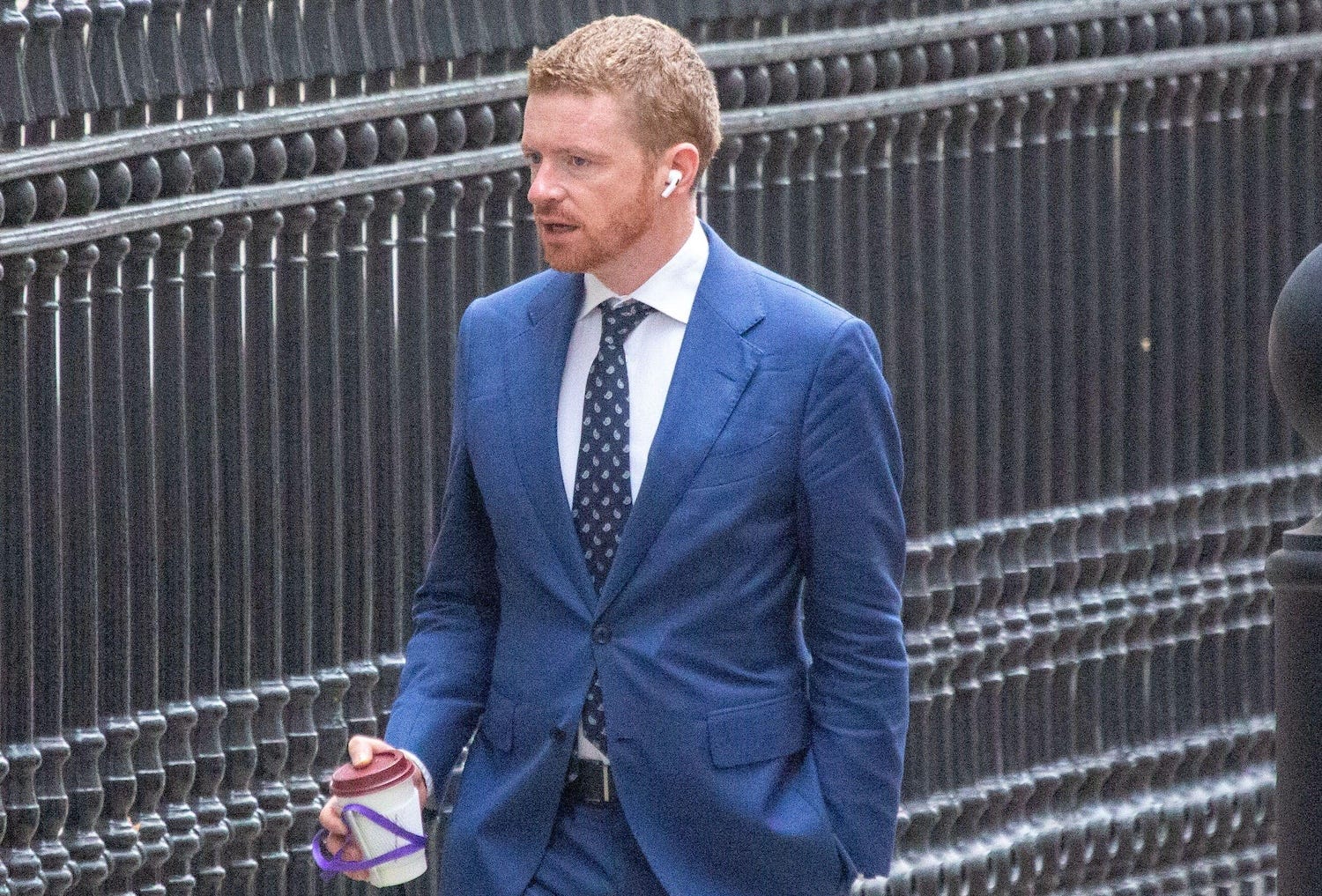
Keir Starmer’s Chief-of-Staff Morgan McSweeney resigned on Sunday afternoon following the fallout from the Peter Mandelson scandal.
McSweeney, who was a close ally of Mandelson, had pushed for his appointment as ambassador to the US, despite his close relationship with Jeffrey Epstein.
As he prepares to leave Downing Street, we re-publish all of Peter Oborne’s reporting on McSweeney, who Oborne identified early on as “the most powerful individual in Britain.”
Long before anyone else, Oborne traced how a backroom strategist had succeeded in seizing the levers of power, while pursuing a factional war against the left and playing into the hands of the nationalist right.

The Sweeney Strategy
There is a serious problem. And, if recent history is anything to go by, it may end up inflicting grave damage on the Starmer premiership. Starmer is much too dependent on his campaign strategist, Morgan McSweeney, who is now the Prime Minister’s Director of Communications.
There is nothing unusual about this. Almost every PM since Tony Blair has employed their version of McSweeney. Alastair Campbell destroyed Blair’s reputation for integrity. David Cameron hired Murdoch henchman Andy Coulson with shameful consequences. Nick Timothy all but lost Theresa May the 2017 election. And Boris Johnson disastrously relied on Dominic Cummings. Of the above, McSweeney most closely resembles Cummings – who drove out the Tory left, stripping the whip from Ken Clarke, Rory Stewart, Dominic Grieve, and others.
In the short-term, Cummings’ project to split the Conservative Party helped Johnson secure his massive election victory in 2019. But in the medium-term, it gave far too much power to the far-right of the party – Patel, Braverman, Jenrick, etc – and removed the Tory soul.
McSweeney has been waging a Cummings-type war against the Labour left. This explains the cynical recruitment of populist Tory Natalie Elphicke; the deranged bid to prevent Diane Abbott from standing as a Labour MP; and the vindictive decision to ban pro-Palestine advocate Faiza Shaheen from running in Chingford and Woodford Green, which handed the seat back to former Tory Leader Iain Duncan Smith. Yet more shocking was the withdrawal of support for Labour’s candidate in Clacton, paving the way for a smooth victory for Nigel Farage and the synchronised dog-whistle attacks against Britain’s vulnerable Bangladeshi community.
McSweeney’s core job is electoral strategy, and I suppose I can see the rationale in mopping up as many voters as possible regardless of how racist or bigoted they are. But Harold Wilson was onto something important when he said the Labour Party was a “moral crusade or it is nothing”.
Wilson, like his great predecessor Clem Attlee, understood Labour is a broad church uniting left and right. There is, moreover, a great deal to be said for doing the right thing and not just the strategic thing. Indeed, Starmer’s promise to put ‘country before party’ involves doing exactly that.
Cummings or Going?
According to lobby reports, Keir Starmer’s Downing Street Chief of Staff Sue Gray is currently engaged in a power struggle against Morgan McSweeney, the Prime Minister’s Director of Political Strategy. There is likely to be an element of truth to this. I have never met either party, but I strongly take the side of Gray. In a properly-run government, a political strategist should not be in Downing Street at all. They should be in party campaign headquarters.
This is especially the case with McSweeney, who has already been responsible for a series of judgments that, while in the short-term interests of Labour, have done unnecessary damage to Keir Starmer’s Government.
The first was the unforgivable decision to pull the Labour candidate out of Clacton and give a free pass to Nigel Farage. The second was to introduce an element of racist bigotry into the election campaign, compromising Labour’s recent message over the racist riots. Sue Gray is quite right to keep McSweeney, and his cynical and crude political calculations, as far away as possible from the daily business of government.
All precedent suggests, however, that he will win. McSweeney has a formidable political machinery behind him – for example, it stares you in the face that the leaks come from his camp. Ultimately, Starmer may have to choose between the two. If he allows McSweeney to force out or downgrade Gray, he will inflict deep long damage on his administration – rather as Boris Johnson did when he hired Dominic Cummings.
Starmer’s Disaster
I predicted in this column in August that Morgan McSweeney would win his power struggle with Sue Gray. He has duly done so, and has replaced her as Keir Starmer’s Downing Street Chief of Staff. This is a disaster for Labour, but even more so for Britain. McSweeney is a political strategist. Such creatures may be useful during election campaigns, but should not be allowed near government. Tony Blair’s Chief of Staff was Jonathan Powell, who had many years’ experience as a diplomat. In Downing Street, he played a distinguished role in creating the Good Friday Agreement.
There is no chance of McSweeney doing anything like that. His consideration is winning votes. This means he will automatically oppose the difficult or unpopular decisions which serious Prime Ministers must make if they are to do their job properly. Starmer’s foolish attachment to McSweeney explains his failure to show leadership as Prime Minister. Instead of using the opportunity granted to him by a massive Commons majority to address Britain’s multitude of problems, Starmer appears to be listening to McSweeney’s advice of not offending voters – thus creating a vacuum inevitably filled by minor or non-existent scandals. For these reasons, Sue Gray was right to try to keep McSweeney at arms length.
McSweeney has established himself as the most powerful individual in Britain. He, not Starmer, sets the tone. This is an awful shame because anybody who loves Britain yearns for good government after the incompetence and moral corruption of the Tory years.
Far-Right Gift
I try not to read mainstream newspapers these days. The reporting is bent, the opinion columns deranged, and you almost never learn anything new or worthwhile. But, the day after Donald Trump won the American presidency for a second time, I made a special trip to the newsagents and bought the lot. Almost without exception, they amplified, normalised or celebrated the result, while mocking Trump’s defeated opponent, Kamala Harris. This was power worship rather than serious journalism.
Britain’s three big newspaper groups – Murdoch, the Rothermere empire, and the Telegraph Group – between them account for about three-quarters of newspaper readers. Yet, anybody with half an ounce of decency and intelligence can see that Trump’s victory is an unmitigated disaster for the United States and a mortal threat to her allies. It is plain from the favourable newspaper coverage here in Britain that Trump’s victory is a spectacular and, in all likelihood, game-changing gift to the far-right.
The Sun set aside two pages for Islamophobe Douglas Murray, who praised Trump for his war on immigration. Elsewhere, Murray issued a photograph of himself in consultation with the next US President at an “historic evening yesterday at Mar-a-Lago”. The Telegraph awarded Nigel Farage front page space for an article calling on Britain to “roll out the red carpet” for Trump. Meanwhile, The Daily Mail gave over a full page to a tirade demanding that Farage should be the next British ambassador to the United States.
Trump’s noxious brand of Republicanism, which has nothing in common with British conservatism, is already crossing the Atlantic. Two former Conservative Prime Ministers – Boris Johnson and Liz Truss – supported Trump ahead of the election. They and others want to do to the Conservatives what Donald Trump has achieved with the Republicans: capture a famous political party and use its name for the promotion of a movement that has more in common with fascism than Conservatism.
With three major newspaper groups on-side, it is hard to see what will stop the eventual merger of Reform UK and the Conservatives, and the creation of a party akin to AfD or National Rally in Germany and France. In theory, the Tory lurch to Trumpian politics ought to open up immense vistas of political space for Keir Starmer.
Very sadly, under the baleful influence of his strategist (now Chief of Staff) Morgan McSweeney, the Labour Leader has so far chosen to appease rather than challenge Trump’s mutant politics. In the wake of Trump’s victory Starmer will need to choose between Macron’s Europe and Trump’s United States.
A Sad, Bad State of Affairs
Much of this flows, as I have explained before, from Starmer’s dependence on his new chief of staff, Morgan McSweeney, who maintains that Starmer can only win the next election by governing through a ‘permanent campaign’. This calamitous methodology, which first saw the light of day in the Blair era and was adopted by Boris Johnson, means that every decision is dictated after consultation with focus groups and pollsters for its likely effect on target voters. It is the antithesis of the 20th Century proposition that British Prime Ministers should govern in the national interest, leaving political campaigns to the few weeks before each general election.
The ‘permanent campaign’ guarantees bad government, and I am not even sure that it works electorally. There is a reason for this. Prime Ministers who depend on focus groups and care what newspapers think end up at the mercy of fashion, do a great deal of inadvertent harm, and achieve nothing substantial. Sue Gray, trained in the traditional civil service, despised this debauched system of popular rule. This explains why it was so important for McSweeney and his allies to dispose of her.
With Gray out of the way, McSweeney can now focus on his short-termist stunts (Starmer’s ‘relaunch’ in December was a good example) and dog-whistle messages to racist voters. Serious discussion about the great issues of our time – the legacy of Brexit, social degradation, climate change, political corruption, the growing menace of the far-right – has been eradicated.
Instead, McSweeney has secured a world in which Cabinet ministers such as Streeting run along to cultivate Marshall at meretricious events such as the Spectator dinner. It’s all so sad. We so badly need the Starmer Government to succeed. This moral and political delinquency makes me want to cry.
Recommended Reading
It’s barely a year since Tom Baldwin, a former Labour press officer, published his biography of Keir Starmer. Baldwin told the story well: toolmaker’s son; legal career; likes football; family man; decent chap. The book served a purpose, secured good reviews, and I believe sold well.
Now, another Starmer book has come along, Get In: The Inside Story of Labour Under Starmer, written by distinguished Times columnist Patrick Maguire with Gabriel Pogrund, the most brilliant political reporter of his generation.
A comparison of the two volumes recalls Julian Barnes’ minor masterpiece Flaubert’s Parrot. Barnes’ book concerns an amateur Flaubert enthusiast, Braithwaite. On holiday in France, Braithwaite discovers that two museums both claim to display the stuffed parrot the great writer placed on his desk beside him as he wrote. Braithwaite sets out to find the real stuffed parrot. Barnes exploits this literary device to explore Flaubert. Renowned literary genius whose career went from strength to strength? Or the private tale of humiliation, failure, and despair ending in an early death from syphilis?
To be fair to Pogrund and Maguire, they dismantle Baldwin’s stuffed parrot with silky sympathy. The stiletto is inserted between the shoulder blades with such unobtrusive skill that Tom Baldwin may not even have felt it. In a postmodern touch, that Flaubert himself would surely have relished, they slowly reveal that Starmer has no agency and is the hapless protagonist in a project he cannot comprehend.
The Downing Street Chief of Staff, Morgan McSweeney, appears to have briefed the authors ahead of the publication of this book. I assume that some part of him wants the world to know he’s the organ grinder and that Starmer is his monkey. This is, of course, humiliating for the Prime Minister.
The contempt felt for Starmer by his aides is beyond computation. Take this comment: “Keir’s not driving the train. He thinks he’s driving the train, but we’ve sat him at the front of the DLR.” The DLR is London’s fully automated, computer-controlled metro system.
Normally, I’d advise people not to waste their spare time reading contemporary histories. But this book is essential reading because it has penetrated the psychodynamics of a government with obscene clarity. Exceptionally well-informed, it has created an image of the Prime Minister clueless about how he got the job or what to do now he’s got it. This image will stick. It goes without saying that it is deeply upsetting, and above all wrong, that a British Prime Minister should have chosen such advisors.
Unjust Treatment
Has Starmer got the gumption to do anything about it? A test looms in the shape of the venomous briefing campaign already underway against Richard Hermer, the Attorney General. I cannot say for certain that McSweeney is behind it. But the campaign has many of the hallmarks of last year’s defenestration of Sue Gray, especially the deployment of the right-wing press as a weapon against a core member of the Government.
Hermer, unlike Gray, is not a direct rival to McSweeney, but he is certainly a potential blockage in the way of McSweeney’s political strategy: winning back Labour’s lost ‘hero’ voters. Hermer is also personally close to the Prime Minister. Probably the most brilliant mind in the Government, Hermer is a throwback to Starmer’s early years as a principled (and very gifted) human rights lawyer.
The attacks on Hermer are an action replay of the attacks on his Conservative predecessor Dominic Grieve. As with Grieve, they are false and brutally unfair. Last month, senior lawyers wrote to the Guardian warning that these attacks were causing “immense and untold damage” both to society and the rule of law. They certainly are. It will be a disaster if Starmer fails to stand by Hermer.
Access and Control
In a rational world, we would have seen a national clamour for Morgan McSweeney to be sacked after Labour’s recent electoral disaster. McSweeney is the architect of Starmer’s calamitous strategy of appeasing Nigel Farage by copying his policies.
This campaign plan went disastrously wrong in the local elections. But there has not been a whiff of media criticism of McSweeney. Even the Financial Times, the reporting of which tends to be more accurate and balanced than most, went out of its way to portray him as the innocent victim of policies inflicted on him by others.
This apparently illogical reaction to the local election results is a classic case study in the reality of British political reporting. British journalists very rarely tell readers how power works. On the contrary, they have an overriding obligation not to do so.
Downing Street controls access to information, meaning any political reporter who breaks ranks can be ‘put in the freezer’ and, over time, professionally destroyed. This power is especially frightening for broadcasters because networks demand ‘exclusive’ live interviews with the Prime Minister and leading Ministers.
This constraint even applies to the two outstanding mainstream political journalists operating in this country today: Patrick Maguire and Gabriel Pogrund. As I described in this column two months ago, their book, Get In: The Inside Story of Labour Under Starmer, relied on intensive briefing from McSweeney and his allies. This access shaped their interpretation.
Consider their coverage of Sue Gray, McSweeney’s predecessor as Starmer’s Chief of Staff. McSweeney badly wanted her job. A series of vicious smear stories about Gray appeared in the press until she was driven out. The only way Gray may have saved herself would have been by launching a briefing campaign of her own against McSweeney and the excitable young men who surround him. This she would not do, and paid a heavy personal price.
Gray’s removal was good for McSweeney but wretched for the Starmer Government. Wisdom is almost unknown at Westminster. Gray had her faults but she has knocked around the world and would have saved Starmer from many of the administrative fiascos and moral disasters that have turned the early months of his Government into an open shambles.
It is profoundly relevant in this context that she also represented and viscerally understood the tradition of integrity and public service which instruments of the ascendant system of oligarchical rule, such as McSweeney, rightly see as an obstacle and are determined to destroy.
There is nothing original in my analysis. The destructive poison sucking the life out of the Starmer Government (and doing appalling long-term damage to Britain as well) is well-known across Whitehall and among the more acute students of government. But you will never read about it in the mainstream press because of a system of lobby reporting based on backhand deals, client relationships, deceit, complicity, and increasingly direct control by offshore billionaires.
Figures of Note
Plenty of Irishmen have played a role in British politics. Erskine Childers, author of the spy novel The Riddle of the Sands, remains a fascinating and glamorous figure. He advised the Asquith Government before joining the IRA, taking part in the Irish Revolution, and being sentenced to death during the Irish Civil War. Before his execution, he insisted on shaking hands with the firing squad.
He made his son, Erskine Hamilton Childers, a future President of Ireland, promise to seek out and shake the hands of all those who had signed his death warrant. Childers’ moral nobility was absolute: even in death he was set on putting an end to feuds and creating a path to reconciliation.
Brendan Bracken, of County Tipperary and founder of the Financial Times, was one of Winston Churchill’s most loyal supporters. According to his biographer Charles Lysaght (against whom we first played cricket in 1984 and countless times since), Bracken has a claim to have changed the course of history.
After Chamberlain fell in 1940, the issue arose as to who would succeed him as Prime Minister and thus head of a national government. Churchill was convinced that Labour would not accept him at any price and was resigned to supporting his rival, Halifax. Bracken dissuaded him, then came up with the ruse that Churchill should remain silent when Halifax’s name was raised at the selection meeting – at which point the idea of a Halifax premiership collapsed. Bracken was rewarded with the post of Information Minister during the Second World War and ended up as First Lord of the Admiralty.
Project of Hate
But no Irish citizen has wielded a fraction of the power of McSweeney. This is a consequence of the new system of British government which has evolved over the last quarter century. Power has passed from the elected Prime Minister to fixers and strategists. Alastair Campbell pioneered this arrangement under Tony Blair, and Boris Johnson was run by Dominic Cummings until the pair fell out.
McSweeney is the starkest example. He is the leading member of the entryist group Labour Together, a right-wing version of the Militant Tendency, which used Keir Starmer as its chosen vehicle to capture Labour. This operation was expertly described by Neal Lawson in June’s Byline Times, who revealed Starmer as McSweeney’s creature.
This is a disaster. McSweeney has no experience of ordinary life. His speciality is Westminster manoeuvering, calculation, and the pursuit of power for power’s sake. He has no sense of the public good, is bereft of moral purpose, and has no generous vision of what Labour stands for. He sees the British people – and to be fair, with some excuse, as an Irishman from Cork – as brutes.
McSweeney’s bleak analysis lies behind Starmer’ hideous reversion to the racist politics of Enoch Powell, turning on minorities with talk of an “island of strangers”. McSweeney appears to idolise the far-right press, which presumably explains the recent decision to appoint David Dinsmore as a government communications chief. Dinsmore was the repellent Sun Editor who hosted the racist columnist Katie Hopkins, who labelled asylum seekers wishing to come to this country as “cockroaches”.
The appointment of Dinsmore is a vivid reminder that the McSweeney/ Starmer project can only succeed by preying on divisions, creating new ones, and in the process turning Britain into a rancid, hate-filled nation. The strategy is to take the majority of Britons (for the most part kindly and decent people, as Orwell beautifully described) for granted while competing with Reform UK and the dying Conservative Party in an unsavoury squabble over the relatively small group of what McSweeney calls “hero” voters in so-called Red Wall seats.
The Prime Minister and his advisor believe that this can only be achieved with the collaboration of newspapers such as The Sun and the Daily Mail. There is an irony here. Had he guided Starmer along a more generous and less discordant path, these papers would have turned viciously on McSweeney, with banner headlines asking why a foreigner is allowed to play organ grinder to Starmer’s monkey.
Because McSweeney is a specialist in the politics of hatred, the Daily Mail and The Sun are happy to reward him with honorary British citizenship. If current trends persist, the McSweeney/ Starmer legacy will be twofold: the final destruction of Clem Attlee’s Labour Party – and a Nigel Farage premiership.
Telling Silence
I was a lobby correspondent for almost 20 years so I know the system: bribery tempered by intimidation. Behave, and you will be rewarded with the access that your editor craves. Cause trouble, and you get put in the freezer.
This is why I have been intrigued by Paul Holden’s book The Fraud, an account of Keir Starmer’s rise to power, published before Christmas.
Holden is a complete outsider. He has no relationships at Westminster to protect, no comfortable deals, brokered over lunch in expensive London restaurants. He is impossible to bribe and cannot be intimidated.
His background is investigative reporting, above all 15 years exposing state capture in South Africa. This kind of work requires rigorous attention to detail and study of documents. It’s also brave. Find out too much and someone may want to kill you. At one point Holden needed to leave South Africa in a hurry.
Holden’s book shows how a coterie of political saboteurs picked out Starmer and ran him as their candidate for the Labour leadership. Their leader is Morgan McSweeney, now Starmer’s Chief of Staff. Their objective was the destruction of the left, and Holden shows that they were not scrupulous about the means.
The book has received no reviews in the mainstream press. This does not apply simply to Conservative outlets such as The Times and the Telegraph, but also to theoretically left-wing outlets such as the Guardian and the New Statesman.
The Guardian has not mentioned the book on a single occasion. It did not even do so even when it reported on last year’s resignation of Paul Ovenden, Starmer’s Director of Political Strategy. Ovenden was obliged to resign after revelations first made in Holden’s book. The Guardian covered the resignation, but chose to leave its readers in the dark about the context in which they emerged.
The New Statesman did not review the Holden book either, but the magazine did run a hatchet job on the author before it was even published.
In the Oligarchs’ Interests
Let’s now examine the media reception of Tom Baldwin’s biography, Keir Starmer.
The book was based on extensive private access to the Prime Minister. It was serialised ahead of publication in The Sunday Times, received a series of generally excellent reviews in the mainstream media, and was named political book of the year in The Times, the newspaper for which Baldwin used to work before he jumped the fence and became a political press officer.
Personal hagiographer to the Prime Minister carries near official status in the media/political establishment and has done for ages. Roy Jenkins performed the same function for Clem Attlee in the 1940s; whereas Bruce Anderson’s instant biography of John Major, hurriedly put together in the wake of the defenestration of Margaret Thatcher, remains well worth reading today as an unrivalled portrait of high Tory politics written from the point of view of a sympathetic insider. Some of the greatest writers in the English language have been Tory hacks: Daniel Defoe and Samuel Johnson (“I took care that the whig dogs should not have the best of it”) for example.
The collapse of mass party membership and the long assault on trade unions have left both the Conservatives and Labour hopelessly dependent on donor cash
Tom Baldwin therefore stands in a distinguished tradition.
His book is an informative and well-written contribution. It stands to reason that his book should have been reviewed. But so should Holden’s. (I should perhaps declare that we share the same radical publishing house, OR Books, based in New York’s Lower East Side.)
The great New Statesman Editor Kingsley Martin would have given Holden a thorough airing. Former Guardian Editor Alan Rusbridger would have given ample space both to the book and its critics.
They would have done so because Holden has written a deeply serious piece of work which goes straight to the heart of our national political predicament. The British system of government, and in particular the two traditional political parties, have both been captured by tiny factions.
McSweeney and Starmer entered Downing Street together through the means of a group called Labour Together. The name was misleading, presumably deliberately so. It was, in reality, divisive and even sectarian. As Holden proves, Labour Together preferred to manoeuvre in the dark: one of its primary tools was deceit.
Holden was the first journalist to focus on irregularities in its funding. The evidence suggests that the New Statesman hatchet job reflected well-justified alarm in official Labour circles about what the book may have contained. (At one stage a reputation management firm was hired to investigate Paul Holden and his family.)
It is easy to account for the point blank refusal of the British political press to review Holden’s book. His analysis is not simply a challenge to Britain’s political establishment, it is also a humiliation for the mainstream media. This is because he shows how political reporters have abandoned their traditional role of holding power to account.
His analysis also provides the starting point for an explanation of one of the most important developments in British politics in recent years: the rise of the political fixer who can wield more power than the Prime Minister while typically viewing him or her with contempt.
Dominic Cummings is another example. Nobody has yet provided a proper explanation for this phenomenon. Holden’s book suggests that money is the key.
The collapse of mass party membership and the long assault on trade unions have left both the Conservatives and Labour hopelessly dependent on donor cash. Cummings and McSweeney have both been written up by admiring client media as brilliant strategists.
The evidence suggests otherwise. Anyone who takes the trouble to read Cummings’ ramblings (not recommended) can spot at once that the man is actually a crank. His key talent was the only one that mattered: he knew how to create and sell the donor-friendly policies to the billionaires and oligarchs who have captured the British political system. The same applies to McSweeney.
Peter Oborne writes a monthly Diary for Byline Times and is a columnist for Middle East Eye. He is the author of The Fate of the Abraham: Why the West is Wrong About Islam, The Assault on Truth: Boris Johnson and the Emergence of a New Moral Barbarism, and Complicit: Britain’s Role in the Destruction of Gaza (published October 2025).

Before finding out about McSweeneys resignation I’d just listened to a lengthy and mesmerising / terrifying interview with Carole Cadwalladwr on Politics Joe concerning the UK’s Health and Defence contracts with US Trump aligned Palantir. So our data on defence - including nuclear - and our most personal details around our healthcare, can now be accessed and exploited not only by Palantir and associated entangled broligarch corporates, but by a US Government that a) has given itself the right to access all data held by US based companies and b) is creating a slush fund to support far right wing parties across Europe in subverting democracy (and regulation, accountability, etc).
With McSweeney gone how do we ensure that both in the advising of Starmer while he’s still there and in the debate around who should replace him that the flashing red lights Carole Cadwalladwr warns us of are heeded. There’s never been a more ‘Nation before Party’ moment.
Time for all those in the party who are already persuaded by Clive Lewis’s (for one) clear insights to speak up, whatever faction they belong to. True patriotism, authentic sovereignty and the freedom of our children from tyranny are all at stake. Which should, of course, be at the heart of Labours values and mission in any case. And - however slim the chance - a reversal of the ‘coup’ in Labour Paul Holden describes in ‘The Fraud’ is possible much sooner than the next election.
I absolutely agree that everyone interested in this turn of events should read Paul Holden's book "The Fraud".
And watch his recent chat on Democracy for Sale ( https://democracyforsale.substack.com/p/labour-together-broke-the-law-dark-money-mcsweeney-simons-starmer )