

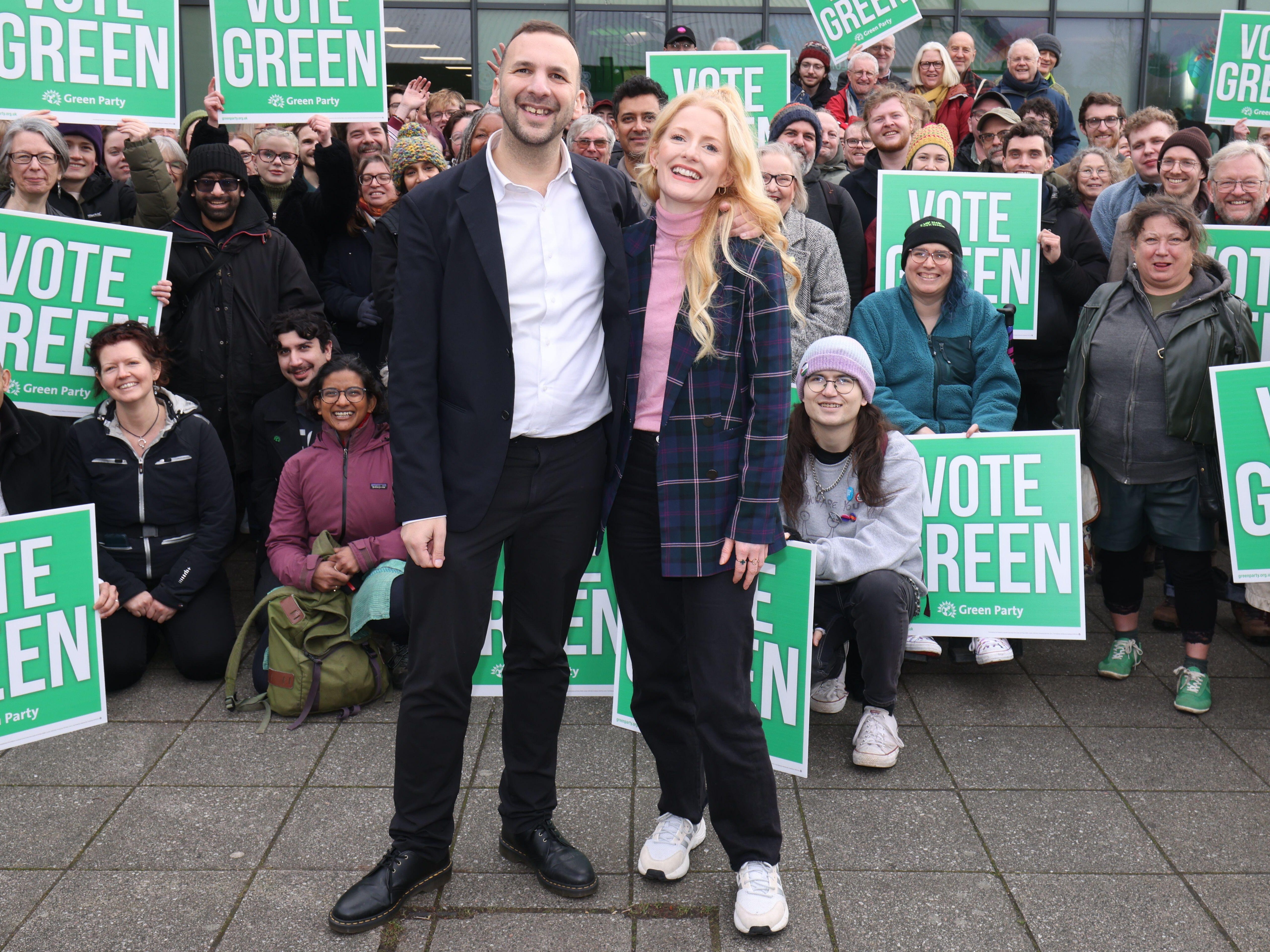
Last weekend, Paul Foulkes-Arellano, a 61 year old businessman from Macclesfield, travelled to the Gorton and Denton constituency to canvas for the Greens in the by-election there.
This wasn’t his first time standing on doorsteps asking for votes for the party. “We unseated Labour in Macclesfield Central by-election in Mid-November,” he says, before listing other places across England he’s campaigned. But knocking on doors in the Longsight area of Manchester was, he tells me, “a very different experience”.
“So many Asian families in particular felt like it was the beginning of a dialogue,” he says, “The ones who were voting Green were buzzing to meet us, two random canvassers, I’ve never handed out so many posters in just a few streets, people were genuinely excited to put up posters”.
Lots of people had questions: “We’ve never heard of the Green Party? What’s it all about?”. “Who is Hannah? Can you bring her with you next time?”.
Where he’s canvassed before, he says, votes were “very individual.” Here, “the whole family, or groups of students were on the doorstep, on the pavement, wanting to engage.”
Getting Good at Elections
Over the last decade, Greens have got good at election campaigns. They’ve perfected the logistics and learned how to hone messages. Without big donors or much support from the national media, their method has usually been long-form; build up a presence in an area, door by door; street by street, community by community; win one councillor, build trust, win more. Eventually, climb that ladder into Parliament.
This time, it has had to be different. This time, the party has had little more than a month to introduce itself to thousands and thousands of people, many of whom, as Paul describes, will barely have heard of it before. To do this, it has successfully mobilised hundreds of activists, like Paul, to travel to the area - and not just on the weekends. On Wednesday, 400 people arrived, and delivered leaflets to every one of the 40,000 houses in the constituency in just six hours, the campaign press officer tells me. It’s also got better at logistics: until recently, the Green party was still using pens and paper to keep canvassing records. Now, it has an app.
I’m not surprised by this efficiency.
Back in the autumn, I had dinner with the Greens’ head of elections, Chris Williams. The party was riding the Polanski effect. Its scores in national polls were rising and money was pouring in. My first question was simple: “are you ready for a by-election?”
Every other party that has broken into the mainstream of British politics in the last 100 years has done so though this high-adrenalin, punk route. Plaid Cymru got their first MP in the Carmarthen by-election in 1966. Winnie Ewing’s victory in Hamilton a year later was foundational for the modern SNP. UKIP established itself through the snap polls in Clacton and Rochester and Strood in 2014, before morphing into Reform. The Lib Dems built their national reputation on their skill in by-elections.
But, so far, the Greens have only ever won Westminster seats through the much more vanilla route, at general elections. Historically, the attitude in the party was that by-elections could suck in a lot of time and money, distracting from target areas for little benefit; that it didn’t have the resources to run a street battle with the big parties in a national contest in one seat.
The vast surge in members since Zack Polanski’s election as leader changed that, and Chris’s reply was confident: he was ravenous for a by-election in a winnable seat; and determined to get a fifth Green MP elected before the end of this parliament.
And what’s certainly clear is that the operational side of the campaign is going smoothly.
A Niggling Worry
After talking to a number of Greens who’ve canvassed in the seat, and looked at various leaflets for the different parties, I do, though, have a niggling worry about the Green campaign.
One leading organiser in the Manchester Greens described to me what he and other canvassers were saying to people. “We were asking them about what the main issues they were concerned about are, telling them about Hannah [Spencer, the Green candidate], and asking how they voted last time. If they were obviously anti-Reform we would say that it’s between us and Reform.
“We were giving them a card with a bar chart showing it being close between us and Reform.”
Every election is a referendum. The winner is the person who sets the question. And, at the moment, the Greens are focussing on one main message, which is summarised to me by another campaign insider as “it’s Greens vs Reform here, and it’s pretty clear to voters that Goodwin is a nasty racist who we’re confident the good people of Gorton and Denton are going to reject.”
In other words, the Greens are primarily running as the anti-Reform party. Which means they aren’t pitching themselves, primarily, as a way to shake up the system.
There are three potential problems with this.
Firstly, if the only question in voters’ minds is “who’s best placed to beat Reform?” it will be relatively hard for Greens to comprehensively win the argument with Labour. Both parties will shuffle mountains of materials through voters’ letter boxes making the case that it’s them, and people who do want to stop Reform will split across the two. While Greens certainly need to convince voters that they can win, much of that work is done in subtler ways than saying it: by delivering those mountains of leaflets, by being everywhere in the constituency, and by winning a wider argument.
Secondly, in the same way as establishment Democrats in the US ultimately helped Trump by talking about him all the time, Greens focussing on Reform risks making the election a story about Reform. And the most likely party to benefit from that is… Reform. If Greens are going to win their first by-election, it will have to be by telling a story about themselves – by properly introducing themselves to the thousands of people in Gorton and Denton who don’t know much about them.
And thirdly, because people absolutely hate our political system. Focus groups of former Labour voters in the seat show that this anger was one of the reasons they generally liked Andy Burnham. One described him as “chipping away at the London-centric old-boys’ network”. Another said they’d voted Labour in 2024 because the Conservatives were “an old boys club,” and that they had been disappointed that Labour weren’t any better. Blocking Burnham made such voters feel these things more intensely.
And these were focus groups from before the Mandelson revelations over the last week, which, research nationwide is already showing, have been closely followed by large numbers of voters.
At the moment, if a voter wants to upend the establishment, the party in Gorton and Denton whose main message is that they’re the way to do that, isn’t the Greens, but their main opponents. “Vote Reform, get Starmer out,” says one of their leaflets. Their name and messaging all communicate a carefully crafted “anti-establishment” vibe.
In reality, this is a racist party which represents the interests of its oligarch financiers over those of ordinary people. But it is pitching itself as a way to shove a stick in the spokes of Keir Starmer’s bicycle, just at the moment when most voters desperately want him to fall on his bum. Many people, including many who aren’t die-hard racists, will be willing to accept the dirt on the stick in order to do that. And the risk for Greens is that, by pitching themselves primarily as the anti-Reform party, they might end up looking to some like the establishment’s suspension spring, absorbing the shocks of voters’ fury and helping keep the show on the road.
The bookies predict, and every canvasser I spoke to reported, that this is a straight race between the Greens and Reform. This means that every vote Greens win from Reform is worth twice as much as a vote they win from Labour – because the Reform total falls by one, as well as the Green vote rising by one. While it might seem absurd to suggest Greens can win some swing votes from Farage’s party, polling and focus groups done by More in Common last Autumn showed that Reform has attracted a broad coalition of voters who are united by their hatred of our political system.
Greens: A Better Way to Shake Up Westminster
Greens don’t need to ape Keir Starmer and follow Reform into the ditch to win over some of this anti-system coalition. They simply need to show that they are, in fact, the better way to shake up Westminster.
Polanski’s party has a powerful story to tell about this. Unlike Reform, they do actually want radical democratic reform. They don’t get their funding from the super-wealthy class implicated in the Epstein files. Their leader hasn’t been palling around with Donald Trump. Their candidate is a plumber, who has talked about the need to send more working class people to Parliament. A Green victory is more likely to scare Labour MPs and force Starmer’s resignation than another Reform victory.
This by-election has often been compared to that for Caerphilly’s Senedd seat in October, where Plaid Cymru won another long-standing Labour constituency, seeing off Reform. But the crucial thing about Plaid Cymru – as with the SNP – is that disliking the Westminster system is central to their identity. While Greens are also a party of radical democracy, voters don’t know that about them unless they are told.
In every one of the by-elections I listed above, where small outsider parties won shock victories, they did it by channelling anger with the establishment at a time when voters had good reason to be angry. Greens in Gorton and Denton have to show that they can beat Reform so Labour voters aren’t scared off voting for them. But to beat Reform, they need to show they are the real way to change our hated political system.
And this doesn’t just matter for the Greens, or for one by-election. People across the country are very angry with politics. They already were, even before the recent revelations about the proximity of the faction at the top of the Labour Party to Jeffrey Epstein’s international pedophile ring.
People are even more angry now. If someone doesn’t start channelling that anger towards the light of real change, things are going to get darker.
Adam Ramsay’s forthcoming book, Abolish Westminster will be published by Faber & Faber in November 2026.

And their leader essentially wants us out of NATO. That makes the Greens unacceptable except possibly if you absolutely have to vote prevent a Reform win.