


Former Labour cabinet minister Liam Byrne has told the Byline Times Podcast his party has shifted too far to the right in its bid to see off the challenge of Nigel Farage’s Reform UK, while neglecting the views of progressive voters in the centre and on the left.
Byrne, who served in the Blair and Brown governments and is currently chair of the powerful Business and Trade Select Committee, said the language used by Prime Minister Sir Keir Starmer and his colleagues to demonise migrants had been a “mistake”.
“Tacking so hard right that you begin to sound like Mr Farage on things like immigration is a dead end,” he argues, pointing out that Labour “is only losing about 10% of its vote to Reform”, significantly less than it’s shedding to the Liberal Democrats at the centre of UK politics and, increasingly, to the Greens on the left.
“Labour has to fix that if it is to retain office,” he said. “We’ve got to do a better job at finding the overlapping consensus between us and the Greens. It’s quite easy for Labour and the Greens to get into these kind of quite unpleasant fights with each other, where we actually accentuate our differences, rather than zero in on the things that we’ve got in common. Labour has to find a way of kind of glueing the progressive left bloc back together.”
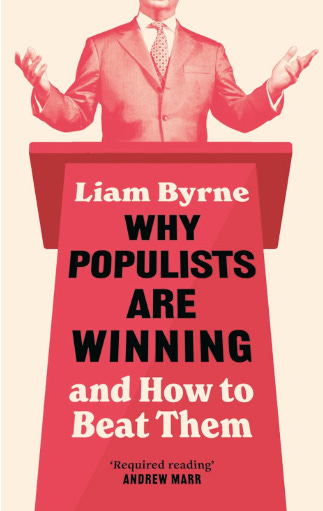
Byrne’s analysis is borne out of extensive research for his book Why The Populists Are Winning And How To Beat Them, which blames the rise of the populist right in liberal democracies on stalling living standards, partly as a result of globalisation.
“Initially, globalisation proved a great boon,” he reflects. “The combination of trade and technology lifted living standards, and wage growth was about 1.6 -1.7%. Wages were basically doubling every 44 years.” But on a trip to the United States for the 2008 Presidential election when the Obama-Biden administration came to power, Byrne realised the economy was failing working people.
“I was in Washington talking to Joe Biden’s team, which had just set up the Middle Class Task Force which was looking at the way in which productivity growth and GDP growth in America had become detached from wage growth. When I got home, I said to [then Chancellor] Alistair Darling, ‘look, I think we might have this problem in Britain.’ And we did a big study, and we realised that this was indeed happening to the UK. So from about 2004-2005, folk in Britain on median incomes were seeing their livelihoods stagnate, and the Labour Government hadn’t spotted it.”
These problems were exacerbated by the banking crisis of 2008-2010, which was partly solved by quantitative easing, whereby central banks effectively printed money and reduced interest rates to stimulate demand – a practice which favoured those who already owned substantial assets.
As Byrne, a former Chief Secretary to the Treasury describes it, quantitative easing and low interest rates handed a massive windfall to the seriously rich. “So since 2010 the top 1% have multiplied their wealth by 31 times more than everybody else, and you’ve got this inequality of progress. Some have done really, really well – most people, though, have not and can’t see their prospects changing. That induces a kind of a zero sum politics, where the instinct to share generously is replaced by a mad scramble to defend what might be left and that is the breeding ground of the populist right.”
Alongside this combustible mix, the UK has seen the emergence what Byrne describes as a “media-political complex” funded by a tiny number of billionaires – some based overseas, like Reform donor Christopher Harborne – who have collectively pumped more than £170million into promoting right-wing narratives via news websites and think tanks. The flagship of this operation is TV channel GB News, backed to the tune of more than £100 million by hedge fund manager Sir Paul Marshall
Byrne observes that “a lot of that money goes into GB News, then goes out into the bank accounts of Reform politicians. Nigel Farage has made about £770,000 at GB News in the five years we looked at. The content they create is then leveraged online through advertising share revenues from X and Instagram and Facebook. And then you’ve got the direct money that is coming into Reform as donations and into the bank accounts of Reform politicians – plus the money going into think tanks and conferencing networks. So this was a huge amount of money. Overwhelmingly, it comes from just four men, two of whom are actually offshore. Our politics really has been hijacked by people who don’t necessarily have the UK’s national interest at heart.”
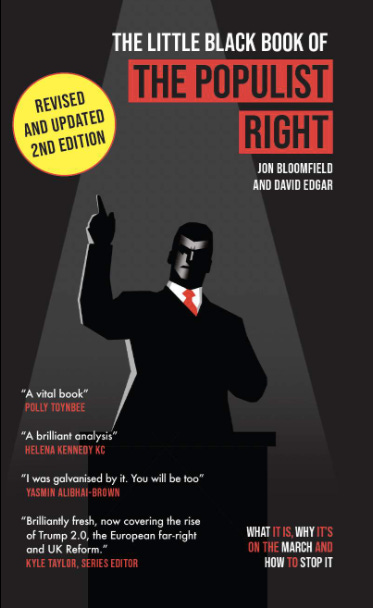
David Edgar, whose The Little Black Book Of The Populist Right (with Jon Bloomfield) has just been republished in an updated edition, also points to the shapeshifting nature of populism. Those on the hard right, he said, originally sold themselves as “socially conservative on immigration in particular, but also on family issues and on civil liberties and crime in a way that looks very conventionally conservative but [also] quasi-left wing on economic questions. So in 2016 Trump offered the biggest infrastructure project since the New Deal, Boris Johnson offered ‘Levelling Up’, Orbán put up the minimum wage and abolished student fees, and indeed on the day of the Brexit referendum result, Farage said that it was a victory against big business and the big banks.”
As immigration has become a more salient issue, however, Edgar says they “have reneged on these more socially inclusive policies and national populism is reneging on its economic agenda. The two big economic things that Trump has done in his two terms are massive tax cuts for the rich in his two big budget bills [and] Farage gave a speech last year in November in the Banking Hall, symbolically, saying, the financial sector is the most important section in the economy. We have to deregulate.”
There’s evidence that Reform’s proposed Great Repeal Bill to axe workers’ rights is unpopular, even among their own supporters, leaving migration as their most powerful calling card.
The ‘othering’ of minorities is an all-too familiar trait among far right parties and Byrne explains: “If you are deeply pessimistic about your future, if you’re feeling under pressure financially, if you feel that politics is broken [and] you don’t feel like you’ve got agency about what’s going on, it’s quite easy for you to get very angry about two things. One is the state not appearing to be in control – and when you see small boats coming across, and you can see Government struggling to stop them, it feels like government doesn’t work, like Government is breaking down.
“Secondly, you become acutely conscious about what you perceive to be people cutting in the line ahead of you, and these feelings become really intensified in a zero sum political world. And populists are past masters at preying on those kind of sentiments. So when you look at the kind of language that they use, they always freight their national renewal story in a story about ethno-nationalist decline.”
What then, is the best way to counter the surge in right wing sentiment, which currently sees Reform at the top of the polls? Byrne argues that Labour “has got to unite the left bloc, the kind of the progressives who largely voted to remain in the European Union. That’s actually one of the things that they have in common.”
They should also “be aggressive about tackling climate change,” he says. And while, “you’ve got to get immigration reform right – there’s no getting away from that – you can’t race to the right and hope to win the next election if you’re a progressive mainstream party.”
Listen Adrian Goldberg’s full interview with Liam Byrne and David Edgar on the Byline Times Podcast here.