

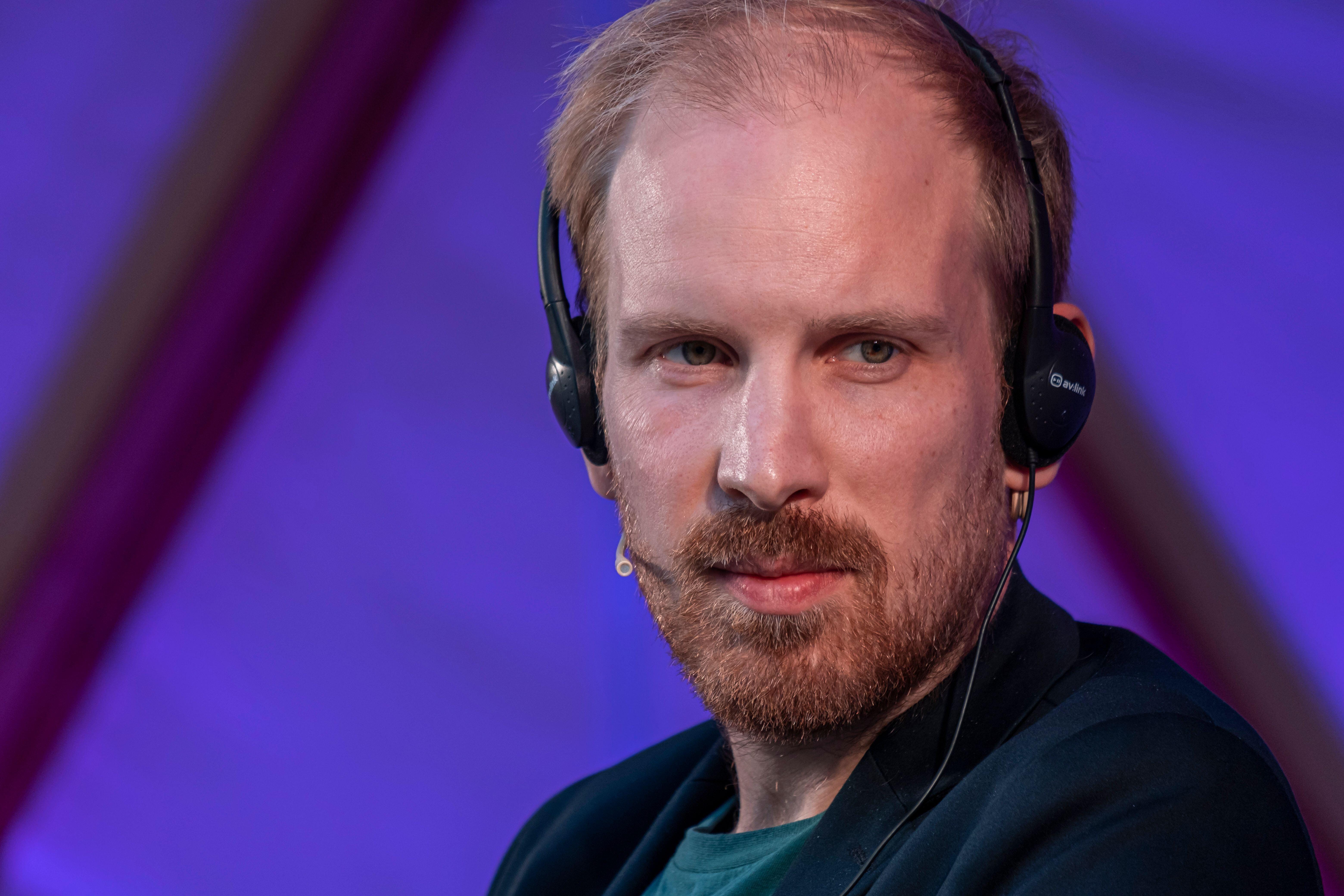
Rutger Bregman is a Dutch historian and journalist, who came to prominence as a writer for De Correspondent, the Dutch news platform which launched in 2013, after a record-breaking crowdfunding campaign that raised over €1 million in eight days. He is the author of five books, the most recent being Utopia for Realists (2017) and Humankind: A Hopeful History. Both were both Sunday Times and New York Times bestsellers and have been translated from Dutch into forty languages.
His 2017 TED talk ‘Poverty Isn’t a Lack of Character; It’s a Lack of Cash’ argued for the introduction of universal basic income and has been watched over 4 million times. In 2019, he goaded Fox News anchor Tucker Carlson into an expletive-laden rant by accusing him of scapegoating immigrants instead of talking about tax avoidance. Bregman’s nimble arguments and his ability to range over history, economics and philosophy led the Guardian to dub him ‘The Dutch wunderkind of new ideas’.
Where to Start
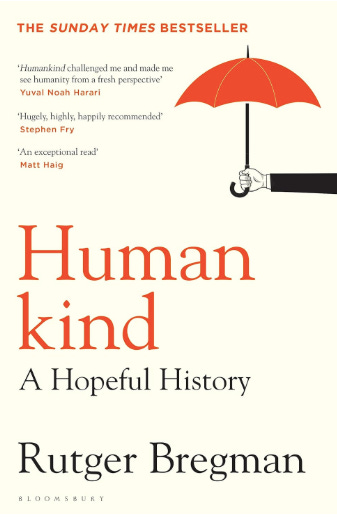
Humankind: A Hopeful History is a hugely ambitious 480-page attempt to reverse the received wisdom about human nature. He confronts the “persistent myth that by their very nature humans are selfish, aggressive and quick to panic.” The book examines the sources of this myth in history, economics, psychology, biology, anthropology, and archaeology and mounts a series of robust counter arguments that reveal most humans to be “deep down, pretty decent.”
In the first half of the book, Bregman lays out his revisionist view of our evolutionary history. Humans, he writes, “by nature, as children, on an uninhabited island, when war breaks out, when crisis hits – have a powerful preference for our good side” and then carefully goes about dismantling the argu
ments that seem to undermine it: “How do you explain Auschwitz? How do you explain the raids and the pogroms, the genocide and concentration camps?” It’s a question of perspective – trust, he argues, is every bit as contagious as hatred.
The second half of the book is full of real-life examples of how trusting in the better angels of our nature can transform education, healthcare, local government and our justice system. This approach he calls “a new realism” – and “like all the best things in life, the more you give, the more you have. That’s true of trust and friendship, and it’s true of peace.”
The Big Idea
In order to explore his “radical idea” about our essential decency in historical perspective Bregman revisits the work of Thomas Hobbes, who believed that human beings needed protecting from their own base instincts by a strong leader and Jean Jacques Rousseau, who believed that it was civilisation that had corrupted humankind, alienating us from one another and from our inner natural goodness. “The opposing views of these two heavyweights are at the root of society’s deepest divides. I know of no other debate with stakes as high, or ramifications as far-reaching. Harsher punishments versus better social services, reform school versus art school, top-down management versus empowered teams, old-fashioned breadwinners versus baby-toting dads – take just about any debate you can think of and it goes back, in some way, to the opposition between Hobbes and Rousseau.”
Bregman is clearly in Rousseau’s camp. He sets himself up against what the Dutch primatologist Frans de Waal has called “veneer theory” – the idea that civilisation is a thin carapace, likely to crack if put under any pressure. “In fact,” argues Bregman, “the opposite is true. It’s when crisis hits – when the bombs fall or the floodwaters rise – that we humans become our best selves.”
Before he can demonstrate the truth of this insight, Bregman has to take on thousands of years of received wisdom about original sin and our propensity for selfishness and violence, and the book is at its best when it stakes its claim in the debatable land between historical fact and philosophical insight: “What makes us so eager to believe in our own corruption? Why does veneer theory keep returning in so many permutations? I suspect it has a lot to do with convenience. In a weird way, to believe in our own sinful nature is comforting. It provides a kind of absolution. Because if most people are bad, then engagement and resistance aren’t worth the effort.”
The success of Humankind depends on how persuasive you find Bregman’s myth-busting. Beginning with the remarkable sang-froid and co-operative spirit of the London Blitz, through the official lies and scaremongering of the early reports of Hurricane Katrina (“What sounded like gunfire had actually been a popping relief valve on a gas tank. In the Superdome, six people had died: four of natural causes, one from an overdose and one by suicide. The police chief was forced to concede that he couldn’t point to a single officially reported rape or murder”) to the real life version of Lord of the Flies (in 1977 a group of Tongan schoolboys survived for fifteen months on a barren Pacific atoll through kindness and co-operation) and a new solution to the mystery of Easter Island (the de-population was caused by Western diseases and enslavement not deforestation), Bregman patiently dismantles a series of narratives that apparently show us at our worst. In their place, he offers the remarkable story of the Russian biologist Dimitri Belyaev’s selective breeding experiment, which over several generations transformed wild foxes into tame pets. In the same way, humans are really domesticated apes. “For tens of thousands of years, the nicest humans had the most kids… The evolution of our species, in short, was predicated on ‘survival of the friendliest’.” Bregman calls this theory Homo puppy.
Some of the most compelling parts of the book are the takedowns of the methodology of famous psychology experiments including Stanley Milgram’s ‘shock machine’ and Philip Zimbardo’s Stanford Prison Experiment and his persuasive dismissals of the pseudo-scientific managerial theories of Frederick Taylor and the US political scientist James Q Wilson’s deeply cynical insights into the criminal justice system have real political bite. Nor is he afraid to accept that our predisposition to kindness can cause problems. “The tragedy of war is that it’s the best facets of human nature – loyalty, camaraderie, solidarity – that inspire Homo puppy to take up arms.”
Bregman is persuasive on the difference between empathy and compassion. Empathy he argues makes us less forgiving, because the more we identify with victims, the more we generalise about our enemies: “The sad truth is that empathy and xenophobia go hand in hand. They’re two sides of the same coin.” However, compassion “is simultaneously more controlled, remote and constructive. It’s not about sharing another person’s distress, but it does help you to recognise it and then act. Not only that, compassion injects us with energy, which is exactly what’s needed to help.”
Humankind is full of such insights, many of them falling into what Bregman calls the ‘non-complementary’ category, i.e. doing or thinking the opposite of what is expected (Nelson Mandela scores highly here: “he chose to see good in people who ninety-nine people out of a hundred would have judged to have been beyond redemption”). Ultimately, the book can be read as a sustained attempt to wrest the narrative back from those currently in power. (“If you’re powerful you’re more likely to think most people are lazy and unreliable.”) Ideas, he argues, are never merely ideas. They quickly become self-fulfilling prophecies: “When modern economists assumed that people are innately selfish, they advocated policies that fostered self-serving behaviour. When politicians convinced themselves that politics is a cynical game, that’s exactly what it became.”
Why Rutger Bregman is a Zeitgeister
At the heart of Bregman’s book there lurks a simple insight: “believing in something can make it come true.” You don’t have to agree with all his evolutionary arguments and revisionist psychology to feel the power of that statement. Humankind is its own act of faith and that gives it an importance that sets it apart from most books in the ‘big idea’ genre. Plus, Bregman has a refreshing modesty: “I needed a lot of help from critical readers to keep me on track.” His concluding “Ten Rules to Live By” reveal a sly humour (“Don’t punch Nazis”; “Avoid the News”). And if his anthropological examples can run a little simplistic at times and his presentation of historical evidence is often not quite as compelling as he’d like to be, he puts his hand up and admits it. He knows the real value of the book lies elsewhere: in its open-hearted call to action:
“So be realistic. Be courageous. Be true to your nature and offer your trust. Do good in broad daylight, and don’t be ashamed of your generosity. You may be dismissed as gullible and naive at first. But remember, what’s naive today may be common sense tomorrow.”
Humankind: A Hopeful History is published by Bloomsbury. Rutger Bregman’s BBC Radio 4 Reith Lectures series ‘Moral Revolution’ continue with Episode 2 on 2 December.
I trust Rutger will get an invite to the next Byline Festival. I reckon he’d love the ample examples of ‘moral ambition’ , and imagine that he’d ramp up the galvanising energy that turns talking shops into springboards for action. I love how he faces down what Steve Bannon floods the world with by challenging us to flood each zone with clarity, curiosity, compassion, collaboration, courage and canniness.