


Dan Clayton: Your book comes out at a point in US history where anti-fascism is probably more necessary than ever but also at its most vulnerable. How do you make sense of that?
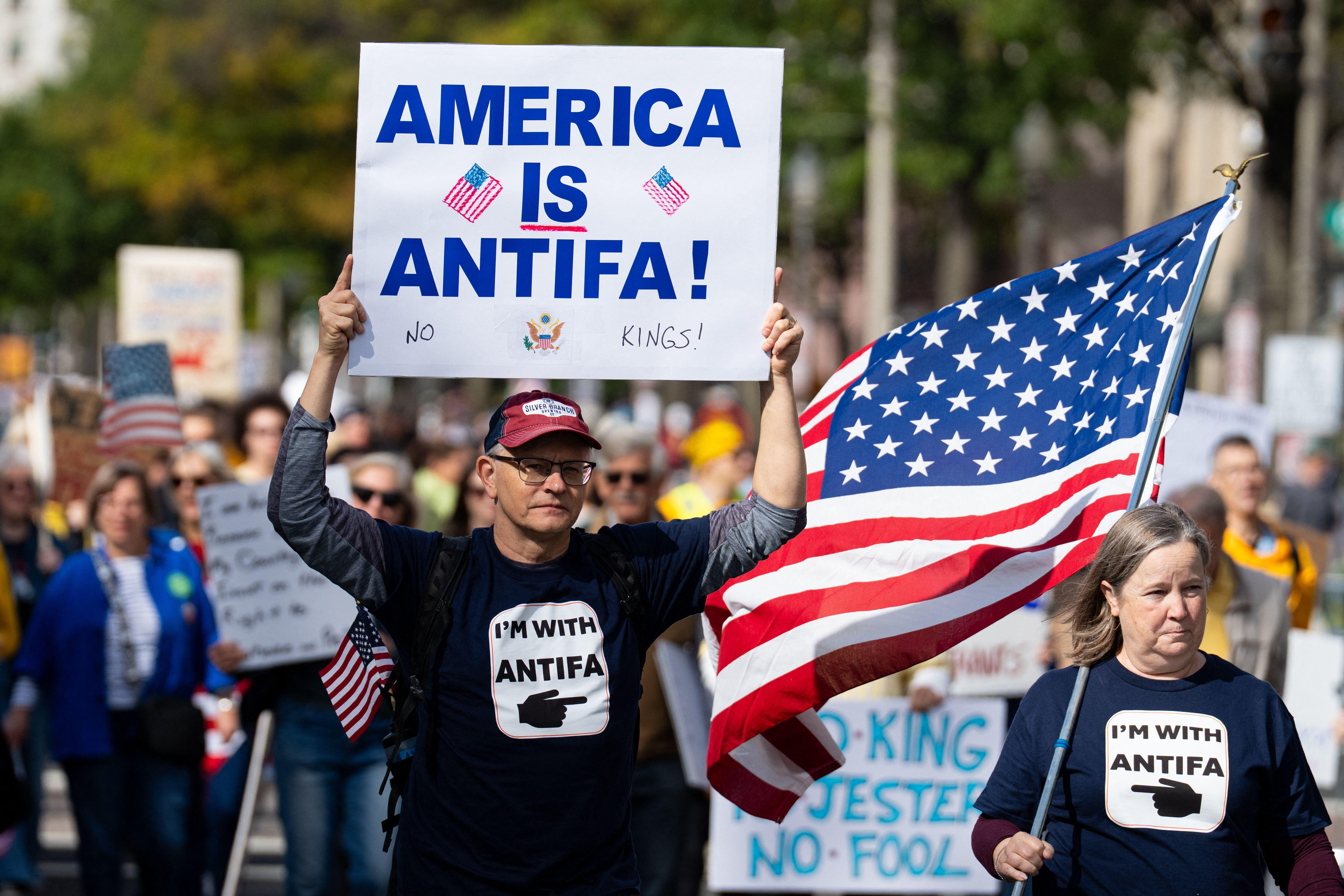
Christopher Mathias: It’s a scary moment, I think. In September the Trump administration claimed to designate antifa a domestic terrorist organisation which is on one hand farcical because there is no statute to designate any group a ‘domestic terrorist group’, but on the other hand very dangerous because what it does is send a signal to Trump-supporting District Attorneys, police officers and vigilantes and fascist groups that it’s open season on the left.
When you look at what happened in Minneapolis with the murders of Alex Pretti and Renee Good, what did the Trump administration call them immediately after their murders which we all saw on video? It was ‘domestic terrorists’. And what they were doing there is saying that if we call you a domestic terrorist, we can do whatever we want to you. So if they’re calling antifa domestic terrorists, and what I describe in the book is that MAGA has a really expansive definition of who constitutes antifa – they are not as maybe diligent as I might be in identifying who constitutes antifa – they will call whomever they want antifa.
Dan Clayton: So we’ve heard of the Trump ‘antifa bogeyman’, as he presents it – a shadowy, black-clad, George Soros-funded army of militant anarchists ready to riot at the drop of a hat but how closely does his nightmare match the reality of the anti-fascists you met when you were researching the book?
Christopher Mathias: It couldn’t be further from the truth, and that was a big part of the reason I wanted to write the book. There are still so many misapprehensions and misunderstandings about what Antifa is.
Basically the far-right was really emboldened by Trump’s election and was doing all these rallies in the streets, and everywhere they went, they were confronted and there were suddenly all these viral videos of Nazis getting punched, which led to a flurry of explainers of what antifa was.
By the end of 2017 in America, Webster’s Dictionary, adds ‘antifa’ to its dictionary. And then Oxford Dictionary shortlist ‘antifa’ for Word of the Year. So that cements this idea in the public imagination of antifa as solely Nazi-punchers.
Obviously, what my book is about is the bulk of the work they actually do: often intelligence gathering, research, espionage, and identifying, unmasking, doxing thousands of members of this new, fascist movement in America.
Dan Clayton: So how do you describe antifa?
Christopher Mathias: I describe it as a decentralised, underground network of largely anarchists, socialists and communists, dedicated to destroying the far-right by any means necessary.
They’re basically part of this radical tradition, which in the US we can largely trace back to groups like Anti-Racist Action (ARA) and Skinheads Against Racial Prejudice (SHARP), which were essentially punks trying to kick Nazis out of the punk scene. Those groups in the eighties and nineties developed a set of principles which still operate as the foundation for the modern iteration of antifa. And although they are anarchists, socialists, communists and may disagree ideologically on some things when it comes to confronting the far right, they all agree on a basic set of tenets or beliefs: firstly, ‘We go where they go’ – you have to follow fascists and the far-right, wherever they go and confront them. You can’t let them have the streets. They have to be confronted, sometimes violently.
The second tenet is the idea of ‘No platform for fascists’. So basically, you are going to rip down and cover their propaganda, you are going to try to get their permits revoked when they want to hold a rally. You are going to try to get them to be deplatformed from social media for violating terms of service, or maybe get their websites taken down.
And then the third tenet is this idea of, ‘We protect us or we keep us safe’, which is basically saying that you can’t rely on the institutions that are allegedly supposed to protect you – law enforcement and the Government, the State – because those institutions are inherently or systemically white supremacist or when push comes to shove, those institutions will collaborate with fascists.
Dan Clayton: So tell us a bit about the rise of the far-right in the States.
Christopher Mathias: The rise of the far-right in America in a big way was in response to us electing a Black president and a demographic panic that whites were going to be a minority in the US eventually. And then of course you have the dawn of the internet and spiralling inequality in the US. I think a lot of these factors contribute to the point where in the mid-2010s suddenly there’s this explosion in secretive white supremacist and other far-right groups organising online, eventually under the banner of the ‘alt right’, which is a way of euphemising fascism and Nazism. The way I often describe it is as if they were trying to resurrect the Ku Klux Klan’s invisible empire for the digital age.
So by the 2016 election, when Trump emerges as a candidate and starts his campaign with blaming Mexicans and Muslims for all of our problems, and proposing a Muslim ban and calling Mexicans rapists and murderers, talking about building a wall, obviously there’s excitement in these far-right corners and they in a lot of ways become a propaganda arm of the Trump campaign.
Dan Clayton: And you see the Unite the Right rally in Charlottesville in 2017 as an inflection point in the story of both antifa and the far-right in the US?
Christopher Mathias: I think the Unite the Right rally in Charlottesville was a coming out party for the alt-right. It was when it moved offline and said that we have the numbers and the power to take the streets and the name ‘Unite the Right’ was to unite all of these various factions and fascist groups. After the Charlottesville Unite the Right rally – the largest white supremacist gathering in a generation – a Nazi drives his car into a crowd of counter-protestors and kills Heather Heyer.
Dan Clayton: In the book you say how antifa had already gathered information and done undercover work on Charlottesville.
Christopher Mathias: Yeah, a single anti-fascist spy went undercover into the Unite the Right Charlottesville planning server, where for months he gathered reams of data of their messages and the memes they were sharing, collected all this evidence of their murderous intent for that day, and just how extreme they were. Anti-fascists tried to show this evidence to city officials in Charlottesville to get them to cancel the rally. They didn’t listen and then people died.
But afterwards, a lawsuit was filed against the organisers of Unite the Right, which was based almost entirely on all of this material that the anti-fascists collected, and that lawsuit ends up bankrupting, disbanding, sending certain fascists into hiding – it really deconstructs the coalition that was in Charlottesville.
Dan Clayton: And after this?
Christopher Mathias: Afterwards, the right knows that what happened in Charlottesville is a really bad look: essentially that the GOP, the Republican Party, Trump, MAGA, has honest-to-God Nazis in their coalition. So this pseudonymous pro-Trump troll named ‘Microchip’ starts a viral petition to the White House to designate antifa a domestic terror group.
Microchip gives this remarkable interview to Politico where he spells out why he’s doing this, which is to “set up antifa as a punching bag”, and basically to distract and deflect from the right’s very real violence. And to create this false equivalence between the right and the left to say, yeah, sure, the right can be violent, but look, the left is just as violent too, which of course is an absurd equivalence.
Over the course of the next few months, all of these MAGA influencers follow suit and basically after every mass shooting in America, of which there were many in this time period, when, you know, the facts aren’t in yet, these influencers rush into this information vacuum and baselessly blame antifa. And then over the course of the next few years, you have incidents where they blame antifa for wildfires and natural disasters and train derailments.
During the 2020 uprisings for George Floyd – arguably the largest mass demonstrations in United States history – MAGA and Trump blame the uprisings and some of the property destruction on antifa, which is absurd. Those were organic, grassroots, largely black-led uprisings. Antifa is a very small political formation that wouldn’t have the power to propel millions of people into the streets. And then during that summer you have all these rumours again being put forward by MAGA influencers and by white supremacist groups that there are roving bands of antifa roaming the countryside, threatening to set fire to white-owned businesses.
It imagines antifa as this kind of highly regimented underground group with a hierarchy and headquarters and billionaire benefactors. It is not only an attempt to paint the George Floyd uprisings as somehow artificial or the work of provocateurs, but it creates a pretext for far-right vigilantes to start confronting the uprisings across the country. And you have incidents where far-right militia groups are carrying around guns and occupying towns, because of this perceived antifa threat.
Dan Clayton: So what are some other examples of the kind of antifa work you cover in the book?
Christopher Mathias: One of the more remarkable stories is about the guy, ‘Vincent’ – the main character in my book – who goes undercover into Patriot Front, method acts as a Nazi for about five or six months, goes on their hikes, goes to their meetings, he earns their trust to such an extent that he is named the official photographer and videographer, which is amazing. He eventually collects 440 gigabytes worth of their messages, contributing to about 80 of their numbers being doxed or unmasked, some of their marches are sabotaged, their cars are, you know, ‘redecorated’ and I don’t want to give too much away, but he collects a lot of their material and propaganda at the end of the infiltration, has a bonfire and posts a video of the bonfire online for Patriot Front to see.
Another group infiltrated was Identity Europa, which was a suit and tie fascist group – a lot of college kids who considered themselves more educated. They were trying to infiltrate the GOP (Republican Party). They were running for lower level, Republican party positions: a lot of them held very respectable jobs and positions of power, and they organised behind pseudonyms online in a private server. Then one day in the spring of 2019, all of those messages end up online, in a public database for anti-fascist researchers to use and to mine those messages for clues to reveal these Nazis’ real offline identities. Eventually anti-fascists unmasked and identified 100 members, and we’re talking police officers and teachers, politicians and an executive board member of the NRA (National Rifle Association), a lot of soldiers and people in the military. And this leads directly to Identity Europa disbanding. There are so many other stories like this. but I think part of the reason I wanted to write the book is that people don’t quite understand just how successful antifa was in so many ways.
Dan Clayton: Doxing seems to be a preferred tactic of antifa in the USA. What can you tell us about that?
Christopher Mathias: In the anti-fascist context and the anti-fascist parlance, ‘doxing’ refers to the digital equivalent of ripping the white hood off a Klansman. It refers to identifying, unmasking or exposing previously unidentified members of organised fascist groups or independent actors, people that are white supremacist actors who hide behind usernames or avatars.
And the reason anti-fascists do so much of this work of doxing, disclosing or unmasking is twofold: one is that it’s important for communities to know who among their neighbours has these beliefs because they pose a threat, they could commit violence. Two, because it creates a social cost for being part of organised fascism. It leverages existing societal taboos against, explicit racism and bigotry and white supremacy and fascism; it leverages that taboo to create the social cost. It says if you are part of these fascist groups, we will figure it out and we will name and shame you and you might get fired, your girlfriend might dump you, your family might be angry at you, you might have to skip town. And that is very destabilising for fascist groups who often thrive on organising in the dark.
Dan Clayton: You quote an antifa activist in your book, who says ‘Hate has consequences’ but what happens when the taboo weakens, and the social cost diminishes? You’ve got a US administration that supports the far-right in many cases.
Christopher Mathias: That’s the animating question of my book, and in that way I think my book becomes essentially a document of rising fascism in the US; and anti-fascists, I think in many ways saw before anyone else just how potent, or dangerous, this insurgent fascist movement was becoming in America because we saw in real time their doxes starting to lose their effectiveness when this taboo against explicit white supremacy or fascism was becoming diminished because it was going mainstream.
So we are in a completely mask-off fascist moment and I think it’s a really interesting dynamic that I try to describe in the book: in previous eras in America when you wear a mask in organised fascism, you do so in hopes of creating a world in which you won’t need a mask at all. And so in that way, as much as antifa had a victory over the alt-right, maybe the alt-right in some ways had a victory, in so much as they helped propel their views into the mainstream. There are obviously other elements at work there, but it is interesting now that the people wearing masks aren’t secretive white supremacist groups, but armed agents of the state – ICE (Immigration & Customs Enforcement) and CBP (Customs & Border Protection) – are the people actively trying to round up immigrants, human beings, because they don’t have the right pieces of paper.
And so it is a very scary development. That said, I think if you talk to anti-fascists, they are still doing this work because it is still important to identify people in organised fascism and to fight to maintain the taboo against explicit white supremacy and fascism and sometimes it is still effective. I think it’s also telling that a lot of anti-fascist work has moved towards identifying these masked ICE agents and creating a social cost for being a part of ICE.
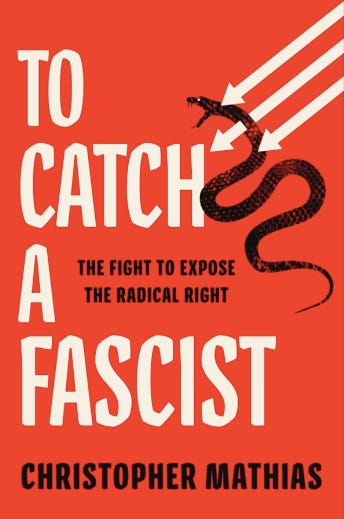
To Catch a Fascist: The Fight to Expose the Radical Right by Christopher Mathias is published by Simon & Schuster