

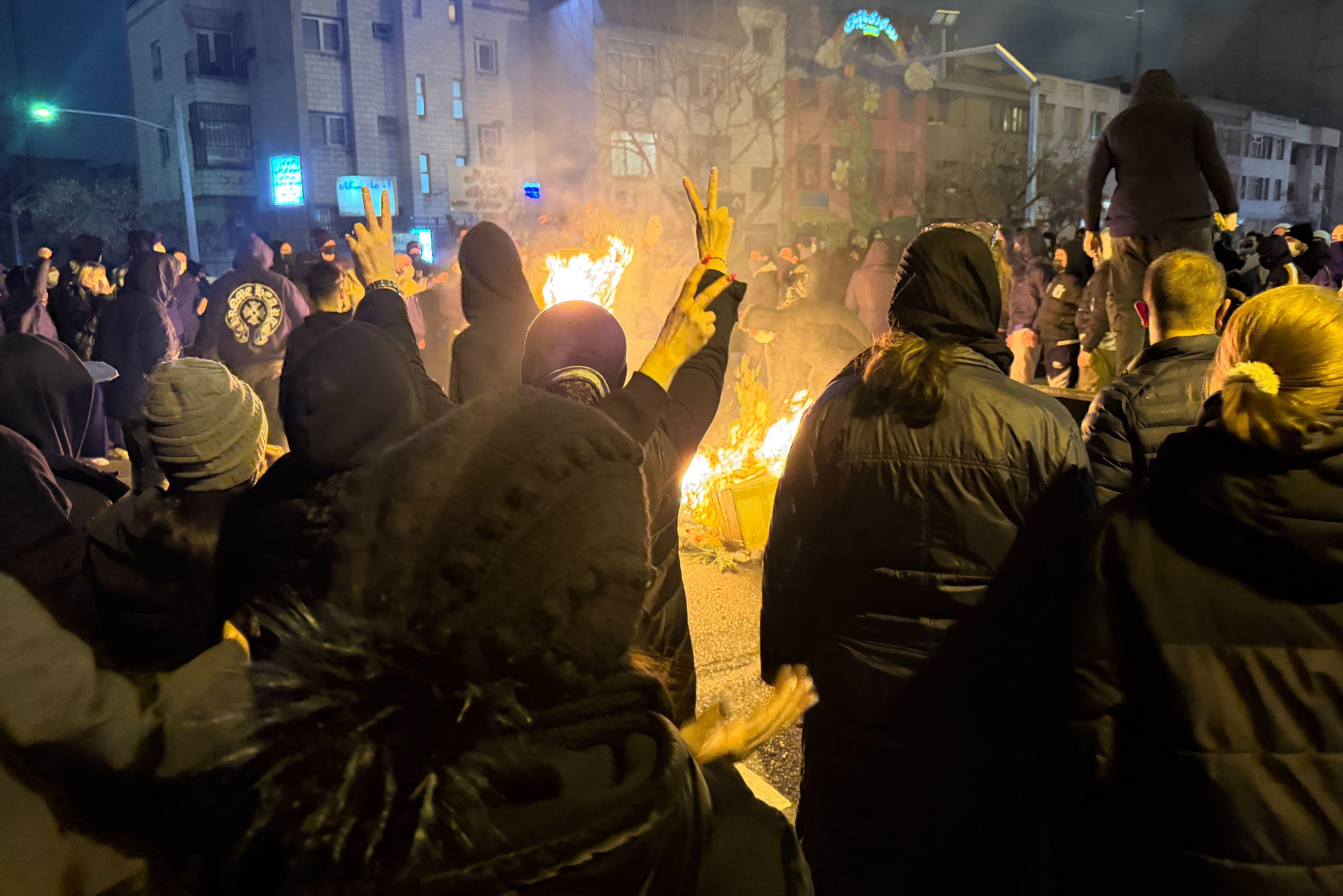
As the death toll mounts in Iran following weeks of unrest, an expert on international relations has warned that Donald Trump’s threat of military intervention is “putting a target on the backs of protestors”.
Scott Lucas, Professor of US and International Politics at the Clinton Institute, University College Dublin, has previously taught in Tehran and is sympathetic to the aims of ordinary Iranians seeking to overthrow the Government.
But he said the threat of regime change, imposed from overseas, only strengthens the hand of the Supreme Ruler, Ayatollah Ali Al Khamenei.
Professor Lucas told the Byline Times podcast: “When Donald Trump talks about using US military action in Iran, particularly in a country which is next to Iraq and knows what happened [there] in 2003, you give the regime breathing space to throw all the blame onto the Americans.”
Iraq, of course, descended into a bloodbath, following the US-led invasion and the downfall of Saddam Hussein. More than 4,000 allied troops were killed along with hundreds of thousands of Iraqis.
Trump said last week that the US military was “locked and loaded” and prepared to attack the Islamic Republic if it crossed the “red line” of killing its own citizens but, so far, his threat has been ignored by the authorities in Tehran.
More than 600 people are reported to have died in a brutal crackdown on demonstrations which have erupted across the country since late December – although it’s impossible to assess the true figure because of an internet blackout.
“I do think there are certain steps the Americans can take, possibly alongside the Europeans,” Professor Lucas said. “For example, trying to find a way to open up communications in Iran, both within the country and also between Iran and the outside world.”
This could involve restoring support to the US-funded Persian language broadcasting network Radio Farda, for example, which was seriously curtailed by spending cuts imposed by the incoming Trump administration.
But Lucas cautioned: “You have to consider very, very carefully and be very, very calibrated in what you do – rather than what Trump is doing, which is to say, ‘I can go in there and I can make this all right.’”
Concerns about President Trump’s aggressive language were endorsed by Daniela Sepehri, an activist with Iranian heritage who lives in Germany.
“Every time there are protests, the regime says that these protesters are paid by foreign countries, mostly Israel and the USA,” Sepehri said.
The situation has been further inflamed by Israel’s secret service Mossad, which has claimed in social media posts to be working alongside protestors in Iran. This allows the authorities to frame non-violent calls for democracy as ‘espionage’ – a capital offence.
Sephari said the frequency of politically motivated executions in Iran has risen steeply since the war in Gaza began in 2022, when the Tehran-funded terror group Hamas attacked Israel.
“We have seen that last year, there were more than 2000 executions under a President [Masoud Pezeshkian] that Western media always frames as reformist.
“So the reformist has more executions than the so called hardliner [Ebrahim Raisi] before that. There is no difference between reformists and hardliners in Iran anymore.”
In the latest conflict, she said, “we are seeing forced confessions out of imprisoned protesters, where they have to say on state television that they are paid for by Mossad.”
Iran’s current turmoil was prompted by concerns over the cost of living but it’s just the latest in a long line of rebellions dating back to 2009, when the then President Ahmadinejad was re-elected amid allegations of electoral fraud.
That prompted the ‘Green Movement’ in support of his opponent Mir Hossein Moussavi, who was detained shortly after the poll and remains under house arrest today.
Iran’s theocratic leadership viciously put down the nascent pro-democracy movement, killing dozens of participants and arresting hundreds more.
2,000 people were subsequently killed in 2019 during what’s become known as ‘Bloody November’; and there was a further bout of violent repression following public outrage at the death in custody of Mahsa Amini, in 2022. The 22-year old had been detained by ‘morality police’ for allegedly not wearing a hijab correctly in public.
Sepehri argues that the persistence of these uprisings – in the face of potentially deadly consequences – shows that the Iranian people are not acting at the behest of any foreign power.
The protestors, she says, “are people that do not want this regime anymore. They are protesting for themselves. They’re protesting for freedom in this country, and we should support that.”
Listen to the complete interviews here: