

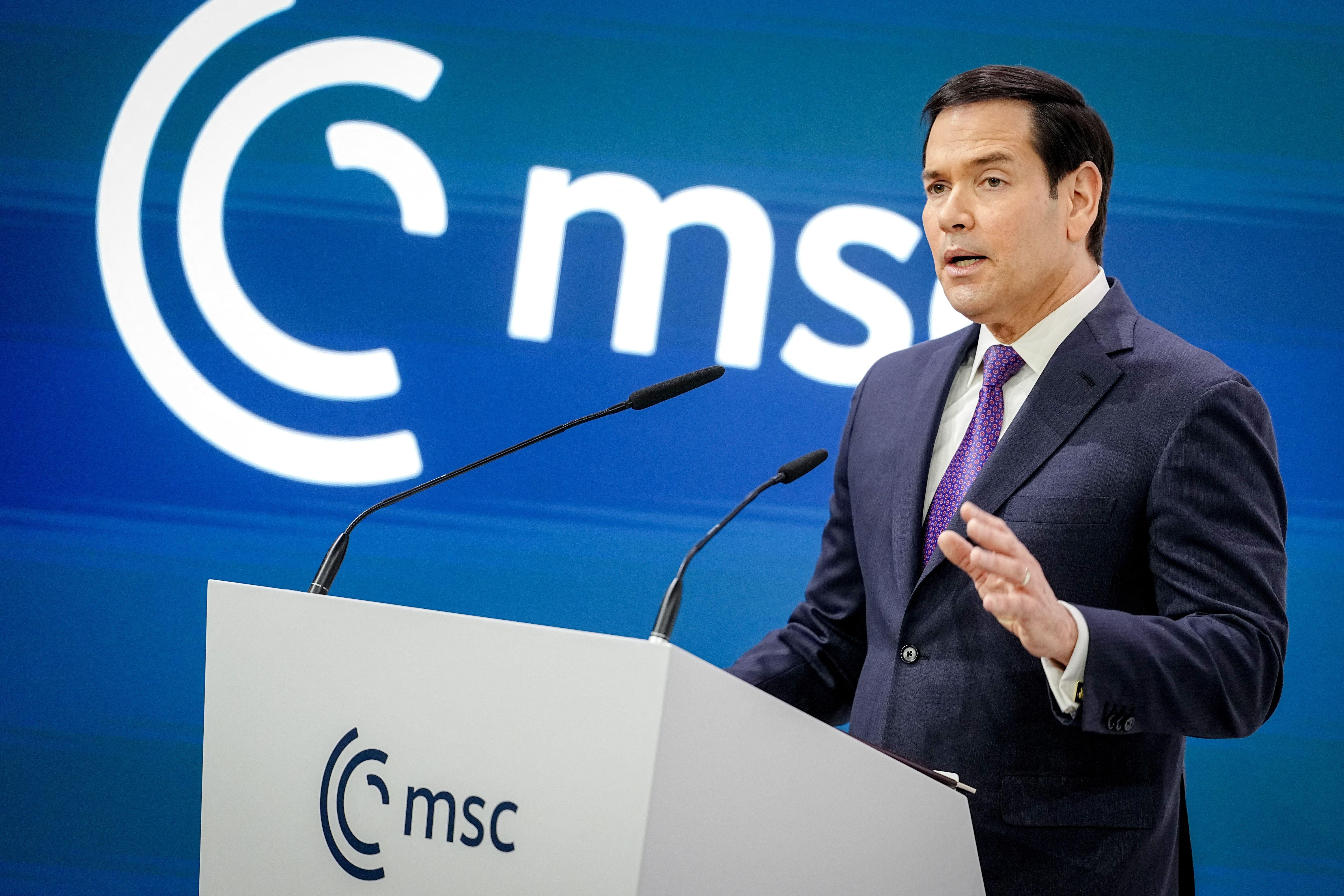
On Valentine’s Day in Munich, Marco Rubio told Europe what it should want. He wrapped the message in warmth. He called Europeans “friends.” He said the US and Europe “belong together.” He promised to “revitalise an old friendship and renew the greatest civilisation in human history.”
Then he told them what that civilisation requires.
Migration, Rubio declared, “threatens the cohesion of our societies, the continuity of our culture and the future of our people.” The post-war liberal order amounted to “a delusion.” Europe had “outsourced our sovereignty to international institutions.” America wants allies “proud of their culture, their heritage, and together with us willing and able to defend it.”
And, in a line that landed like a tail slap dressed as a handshake: “We in America have no interest in being polite and orderly caretakers of the West’s managed decline.”
A year ago, JD Vance stood on the same stage and delivered the same message with a snarl. He attacked European leaders on free speech and immigration, then met with Alternative for Germany’s Alice Weidel. The room recoiled. European commentators called it an aberration.
This year, Rubio confirmed it as doctrine. The snarl has become a smile, and Valentine’s Day became a massacre. The 2025 National Security Strategy, published in December, has already committed the United States, in writing, to “cultivate resistance to Europe’s current trajectory within European nations.”
I know what that cultivation looks like from the inside. I’ve sat in the rooms where it gets planned.
Several years ago, I went undercover into a meeting of the Council for National Policy (CNP), the most powerful political organisation in America that gave birth to the policies behind Project 2025. Founded in 1981 to unite oil money, extractive industries, and evangelical activists, the CNP runs a private networking body for the American hard right. It guards its membership list. It closes its meetings. It bars journalists. I got in anyway, undercover, while making the documentary People You May Know.
The Competence of the CNP
The meeting filled a large hall at the Ritz-Carlton on Canal Street in New Orleans. Suits and proto-MAGA faces packed every row. A layer of too-heavy security hung at the walls, men who turned out later to belong to the Secret Service. Mike Pence would speak that afternoon.
The agenda covered Dominionism to dark money for elections.
The extremism didn’t surprise me. I expected that. The competence did. No fringe operators ranting about conspiracies filled those seats. Strategists filled them, executing a long-term programme to reorganise American political life around Christian nationalism. Their end game, according to the research we published and which has never faced legal challenge: control enough state legislatures to rewrite the US Constitution.
And they kept succeeding through a grasp of something the liberal democratic establishment refuses to learn.
People don’t move toward arguments. People move toward what their lives lack.
The CNP operatives understood desire as a strategic principle. Political mobilisation doesn’t happen when you change someone’s mind. It happens when you offer someone what they need: belonging, purpose, recognition, the feeling that someone has seen their suffering. Wrap that offering in ideology, and the ideology sticks. People don’t cling to it because the arguments hold up. They need the container it comes in.
Not Policy, Feeling
Listen to Rubio’s Munich language through this lens. He didn’t argue a policy position. He offered a feeling. Pride in culture. Heritage defended. Sovereignty reclaimed. A civilisation renewed rather than managed into decline. Every phrase targeted an absence, something European populations experience as missing from the liberal democratic offer. The facts of migration or trade or sovereignty barely matter. What matters is that Rubio spoke directly to the felt gap between what pluralism promises and what it delivers.
Every successful authoritarian movement in the modern era runs on this principle. Viktor Orbán doesn’t just message Hungarians about national identity. He builds. Family subsidies. National curriculum reform. State-funded cultural institutions. A coherent story of Hungarian life delivered through material benefits. His supporters believe Fidesz provides what the liberal alternative does not. Whether that belief survives contact with Hungary’s inflation, brain drain, and collapsing public services matters less than the fact that the feeling of provision holds. The satisfaction stays sticky long after the substance evaporates.
Nigel Farage didn’t win Brexit by out-arguing Remain. He offered something Remain never could: the pleasure of transgression. The satisfaction of saying what polite society forbade. The thrill of believing you belong to a community that sees through official lies, even when that community runs on its own fictions. These feel like real satisfactions. The community feels real because it holds together. The enjoyment runs deep.
Psychoanalyst Jacques Lacan had a term for this kind of satisfaction: jouissance. Something deeper than pleasure. The rush of feeding on an emotional position regardless of its truth. The compulsive gambler knows what they’re doing is bad for them, but they don’t really want to win. They want to keep playing. They don’t want to go home to their real lives.
That captures what the far right offers. An endless, exhilarating game of opposition that saves its players from confronting the emptiness behind the curtain.
And in Munich this Valentine’s, the United States Secretary of State played the game on Europe’s stage, to Europe’s face, wearing the skin of friendship. Vance attacked. Rubio seduced. That slithering seduction should worry Europe far more than the attack, because seduction reorganises desire while attack only provokes resistance. Every diplomat in that room understood the tone had changed. Would that they grasped that the softer tone makes the operation more dangerous, not less.
Targeting the Emotional Lives of Ordinary People
The 2025 National Security Strategy spells out the architecture. It targets the European Union as a “sovereignty-sapping” institution. It endorses what it calls “patriotic European parties,” code for anti-immigration nationalist movements. It promises to reward countries that restrict immigration and adopt “their own traditions” over the universalist claims of pluralistic democracy. It pledges to strengthen European nations as singular identities over the European Union as transnational, universalist project.
Desire construction as declared foreign policy. Political struggle plays out in the organisation of what satisfactions reach populations. Which communities offer belonging. Which transgressions get permitted. Which emotions receive validation. Rubio validated all of them in Munich. He told European populations, over the heads of their own governments, that discomfort with migration, frustration with supranational institutions, hunger for cultural identity, all of it carries American backing. All of it deserves pride rather than shame.
The US National Security Strategy doesn’t target nation states. It targets the emotional lives of ordinary people.
Vance delivered the threat. Rubio delivered the seduction. Same architecture. Different venom.
Making the Same Mistake
European democracy’s defenders keep making the same mistake. They respond to all of this with counter-narrative. They debunk. They fact-check. They build media literacy programmes. They craft strategic messaging. All of this assumes that people have fallen for a trick, and that correct information will break the spell.
But no one is tricked. They’re looking for an offer. And pluralism is failing to make one.
I have argued, in research published by NATO’s Strategic Communications Centre of Excellence, that counter-narrative strategy fails on structural grounds. Every rebuttal confirms that the original claim deserved rebutting. Every fact-check amplifies the lie it corrects. You cannot defeat a narrative by opposing it within its own terms.
The people inside the institutions know this. They commission evaluations. The evaluations confirm the failure. They fund the same programmes year after year. Lacan called this disavowal: I know full well that this doesn’t work, but I will proceed as if it does. The knowledge exists. The action contradicts it. The gap between the two is where institutional paralysis resides.
The far right, however, carries a structural weakness of its own.
Parasitic Desire
Every one of these movements draws its definition from what it opposes. Orbán’s “illiberal democracy” amounts to a negation. Farage without the EU became a man without a subject. Bannon’s “deconstruction of the administrative state” actually requires the state as an enemy. Rubio’s Munich speech defined Western civilisational renewal against migration, against multilateralism, against what he called “a delusion.” Remove the enemy and the satisfaction collapses. The belonging evaporates. No positive content holds any of it together.
Parasitic desire. It feeds on a host. It cannot build anything that lasts without something to destroy.
The question for European democracy: how to make the game unnecessary. How to construct something so worth wanting that opposition turns boring.
A historical precedent for this exists, and the West has ignored it.
Resistance
In 1983, the political theorist Cedric Robinson published Black Marxism, a study of how enslaved Africans resisted the most comprehensive system of information dominance in modern history. The plantation controlled everything: who counted as human, who could speak, what counted as knowledge, what constituted reality. Total narrative control. And it failed.
Escaped enslaved people constructed autonomous societies, maroon communities and quilombos, settlements in the forests and mountains beyond the plantation’s reach. They built networks of mutual support and escape that stretched across continents. Robinson’s insight cut deep: this resistance did not operate by opposing the plantation’s narrative. Its success was in constructing something else.
As Robinson told us, the Black radical tradition developed as an accumulation, over generations, of collective intelligence independent of European radical frameworks.
People risked death to reach those communities, just as they risk death now crossing the Mediterranean to reach Europe. Something real waited in the quilombo. Something worth wanting. No one argued for it. It existed, and its existence generated desire.
The parallel should stop every European strategist mid-sentence: Europe already generates the same pull. People already risk the same death.
And Europe has no strategic framework for understanding why, let alone for building on it.
Framing Desire as Danger
Strategic communications has never absorbed Robinson’s lesson. The most effective resistance to information dominance in modern history worked by exiting the dominant frame and building an alternative that generated its own gravitational pull.
Western StratCom doctrine has no concept for this. It assumes the information contest takes place within a shared frame. Robinson demonstrated that the most powerful move abandons the frame altogether.
The provocation? Europe has already become the object of desire.
Europe’s political response? Panic. Walls. Frontex patrols. Deportation agreements. Europe treats the proof of its own desirability as a security threat.
Rubio spoke about migration threatening “the cohesion of our societies, the continuity of our culture and the future of our people.” He framed desire as danger. European leaders have adopted the same framing. They have let the far right define the meaning of the most powerful evidence of European success available to them.
Europe generates desire and then recoils when desire arrives. Why do you want me? Stop wanting me. But also: why doesn’t America respect me? Why can’t I articulate what I stand for?
The far right steps into this vacuum. “We’ll tell you what Europe means. Not them.” Another negation. The liberal centre responds: “Europe rejects the far right.” Another negation. Nobody says what Europe means on its own terms. And that absence, that refusal to occupy its own identity, creates the strategic vacuum that every adversary exploits.
Rubio’s Munich seductive speech aimed to widen that gap. His warmth made it more dangerous, not less. Seduction reorganises desire. Vance’s attack only provoked resistance.
Europe needs to be Europe. Without apology. Without reference to what it opposes. Without being not-America. Europe needs to be the thing that people already, demonstrably, risk everything to reach. And then build on that rather than run from it.
I’m not promoting open borders. I’m recognising that the desire Europe generates functions as an asset. It means asking “what have we built that they want?” instead of “how do we keep them out?”
It means constructing European civic, cultural, and political life with the same strategic intentionality that the American right applies to its base. Except democratically. Except in the open. Except in service of something that doesn’t require an enemy to sustain itself.
Make Authoritarianism Irrelevant
Recently in Riga, I presented this argument to an auditorium of defence and strategic communications professionals. You’re getting the full package, but in Riga, I cut everything from the presentation except the structural theory, a couple of proposed pathways forward, and two short videos.
The first showed footage of the ICE protest in Los Angeles featuring the band Dead City. Punk Rock. Loud. Bodies in the street. Raging against the machine.
The second showed a sequence of memorial plates an artist had made for children who died in US immigration custody. Name after name after name. In silence.
I didn’t explain the videos. I didn’t contextualise them. I didn’t deploy them as evidence for a policy position. I showed them back-to-back and let the cut do the work.
The room went quiet. Some people cried.
Ninety seconds of film accomplished what a decade of counter-narrative white papers have failed to accomplish. The images carried no argument. They made present something that had lived in absence. The dead children arrived as a fact, landing before cognition could intervene.
Cultural production can do what strategic messaging cannot. It operates at the speed of feeling. Film, image, public art, collective ritual: these represent the fastest and most powerful tools available for constructing the kind of shared reality that makes authoritarian counter-offers irrelevant. For democracies that have forgotten how to generate desire, cultural production serves as the primary instrument. And the most neglected.
The West is losing because it has forgotten how to make itself worth wanting. The far right remembers, in its parasitic and destructive way. The CNP remembers, in its cynical and exploitative way. And in Munich, Marco Rubio delivered the programme to Europe’s face, with the smile of a friend, and called it renewal.
The task for European democracy: stop defining itself against its enemies and start building something that deserves the desire it already generates. Stop arguing. Stop rebutting. Stop performing values and start delivering. Build something real. Something worth the crossing.
Some people already think so. They keep dying on the way.
Dr Charles Kriel serves as Senior AI Fellow at Sympodium Institute of StratComs, and created Screenburn Strat, software for democratic information operations. He served as Special Advisor to the UK Parliament Committee that brought down Cambridge Analytica. His research focuses on AI, psychoanalysis and influence operations. He co-directed People You May Know and Dis/Informed.

Yep, at last an article with answers instead of questions.
Can we have an edited version without all the negative stuff, though?
I'm sure you're right about "what works", but how do we go about doing it?
Sorry, but I don’t think the answer is here. It a good analysis of the problem. Basically, Europe (and the US) have “fought” on the far right’s turf and have said these are “legitimate concerns”.
What’s missing is the devastation wrought by 50 years of neoliberalism - wealth has cascaded upwards, a small group have grabbed most of the pie, government has been captured by the rich, by corporate interests, tech billionaires, media barons and criminals masquerading as politicians and the vast majority of its policies have favoured this small group with the result that there are obscene disparities in wealth, massive inequality, entrenched poverty, dead-end, insecure, low paying jobs, while public services and infrastructure have deteriorated or been sold off and become an involuntary tax on the public.
This has had a profound psychological-social-emotional effect on much of the population. Many of the familiar touchstones that people could rely on from public libraries, education as a route to employment, a health service that delivered for everyone, a social security system that offered a humane safety net for the least advantaged, honesty and decency in the governing classes and much more - have disappeared or been corporatised for someone else to make a profit from misfortune.
But perhaps the most insidious aspect of neoliberalism has been the deification of Finance and the characterisation of government finances as being no different to running a household. So we have had 50 years of cuts for the majority and 50 years of welfare for the wealthy. And all the time it’s government that creates the money, not Finance and not taxpayers.
Against that background of 50 years of austerity (of varying levels of intensity) and stagnant wages and workers’ rights being eroded little wonder the charlatans who tell us it’s all the fault of various scapegoats, such as immigrants and that they and only they can fix it, find a ready audience prepared to suspend disbelief and none to keen to look at the shadowy figures behind them.
Governments have to start governing in the best interests of all citizens, and particularly for those who are least advantaged and start regulating and breaking up the beasts that are too big for democracy to work for everyone. And for that to happen we need better politicians, more devolution and to give ordinary citizens a bigger say in the kind of polity they want.
I’m not hopeful.