


“There has to be accountability,” muses Daniel Rachel, reflecting on the long and hitherto neglected association of rock stars with Nazi Germany.
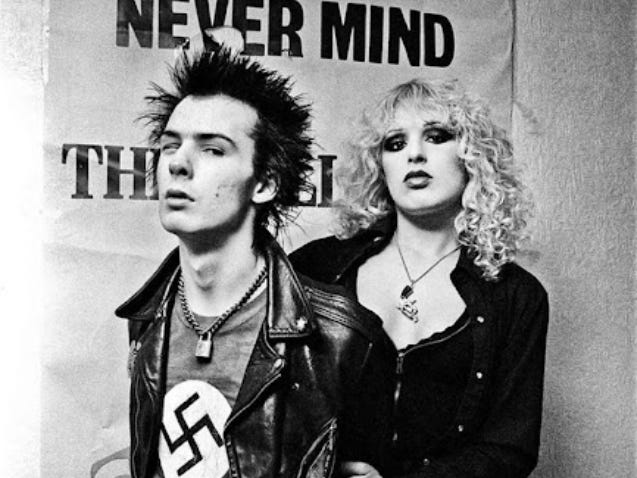
He’s talking about artists like Kanye West, who released a single last year called ‘Heil Hitler’ which is (astonishingly, you might think) available to stream on Spotify. Or David Bowie, who owned the desk belonging to Nazi propaganda minister Joseph Goebbels. Or punk icon Sid Vicious, who sported a T-shirt with a swastika bearing the legend ‘I Hate Jews’. Or Joy Division, the hugely influential Manchester indie band, who took their name from areas in concentration camps where women prisoners were forced into sexual slavery.
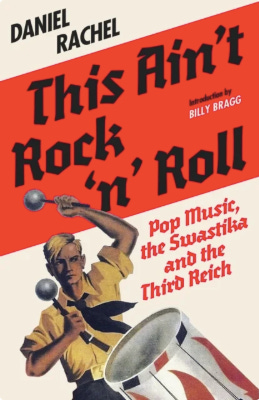
Rachel has chronicled these and many other examples in his recent book This Ain’t Rock ‘n’ Roll – Pop Music, The Swastika and The Third Reich which was named in several year-end ‘best of’ lists in 2025.
He’s aware that keen fans will know about their favourite artists’ use of Nazi iconography, but is puzzled why they often seem to be glossed over as trivial ‘mistakes’.
Bowie’s lapses for example, are often excused on the grounds of his substantial drug abuse, but Rachel points out that the singer’s interest in Nazism endured “for more than a decade, longer than any man could be taking cocaine for on a daily basis.
“This is something that goes back to him talking the late 1960s about Britain needing a leader like Hitler, to saying in the mid 70s that Hitler was the first rock and roll superstar. He had a deep interest in Nazism that dominates his thinking in the 70s. It’s across his lyricism. He was planning to write a film about Goebbels. And did you know he owned Joseph Goebbels desk? Wow. Can you imagine what was signed at that desk?
“In the 90s, Bowie explained away a lot of his fascination, saying it was to do with the mystical side of it, the search for the Holy Grail. That’s one side of his interest. Another side is his (Nazi memorabilia) collection and his interest in Goebbels, which was very deep. He never really satisfactorily talked about that.”
Rachel makes it clear that he’s not accusing Bowie, or the others who appear in his book, of being Nazi sympathisers. “I try not to excuse, or indeed accuse, anybody. What I say to the reader is, ‘here is a history. This is what has been said. It’s all in plain sight. It’s all in the public domain. Here it is, all collated, with lots of artists, there is a pattern of behaviour. You reach your own conclusion.’”
He’s even been forced to confront the fact that some of his own favourites have been tainted by their Nazi associations, and admits that, “as a music fan, I’m culpable of buying records by artists that have dabbled in these areas. I liked the Sex Pistols and bought a single with Sid Vicious on the cover wearing a swastika T-shirt.”
Vicious, who has become a punk icon since his death in 1979, has an especially problematic past. He wrote the original version of a Pistols song called ‘Belsen Was A Gas’ which, even in the kindest interpretation, could be said to amount to hamfisted satire and, as Rachel recalls, “he was in the first lineup of Siouxsie and the Banshees, when they appeared at the 100 Club rock festival. He came on stage with a ripped T-shirt and he’d handwritten in the corner, ‘I hate Jews.’ And there were images of Jews being shot on his T-shirt.”
Rachel also points out that, “where his sentiments lay was contradictory. His girlfriend was Nancy Spungen, who was Jewish and was buried in a Jewish cemetery, and yet there’s film footage of her sitting alongside Sid Vicious and he’s wearing the ubiquitous Nazi T-shirt.”
A further irony is provided by the fact that the swastika was introduced to the punk movement by the Sex Pistols manager Malcolm Mclaren, who was himself Jewish.
Nor are these issues confined to rock’s back pages. Only last month, rapper Kanye West – now known as Ye – took out a full-page ad in the Wall Street Journal to apologise for a long history of anti-semitism in his lyrics and social media posts, blaming his mental health struggles.
Rachel’s response is scathing: “He’s meant to be bipolar, and that’s the excuse he gives – but Winston Churchill was bipolar. He didn’t go around singing ‘Heil Hitler.’ He [West] apologised before, but here’s the man who took out an advert during the Super Bowl, encouraging viewers to go to his website. When you clicked on the website, one item was available – a white T-shirt. And at the centre of the white T-shirt was a black swastika.”
Perhaps Rachel’s most disturbing revelation is the sheer persistence of imagery from the Third Reich throughout the history of rock music, whether it was Lennon and McCartney goose-stepping and ‘sieg heiling’ at the premiere of A Hard Day’s Night in Liverpool in 1964; Brian Jones of the Rolling Stones donning full SS regalia later in the same decade; or Lady Gaga wearing what appeared to be a Nazi-style uniform at a ball for Hillary Clinton in 2016.
Fans are often in denial about these incidents and Rachel acknowledges that, “we want to think the best of our heroes and our rock stars, so we provide the necessary reasons and excuses on behalf of them.”
But he cautions, “there has to be accountability – accountability of fans, artists, the media, the music industry, because in more recent years, since the death of George Floyd or the #MeToo movement, there has been a reconciling of what is and isn’t acceptable within rock and roll.
“If we put the swastika to one side and replace it firstly with an image of, for example, the lynching of a black person in the South, that would not be acceptable in rock and roll. If we replace the swastika with an image of a woman being raped or sexually abused, we would not accept it.
“I’m not saying rock and roll has cleansed itself of all racism – and certainly not of sexism or misogynistic tropes, but it is confronting them. We haven’t done that with Nazism and the swastika.
“Though that symbol of the swastika is thousands of years old, in 1919 as the Hakenkreuz it became the symbol of the Nazi Party. Adolf Hitler said it was explicitly an anti semitic symbol. That’s what it means. Rock n roll has to accept that and decide how it will face up to its past and move on – but it can’t deny that that is what it is.”
Listen to Adrian Goldberg’s full interview with Daniel Rachel on the Byline Podcast here.