

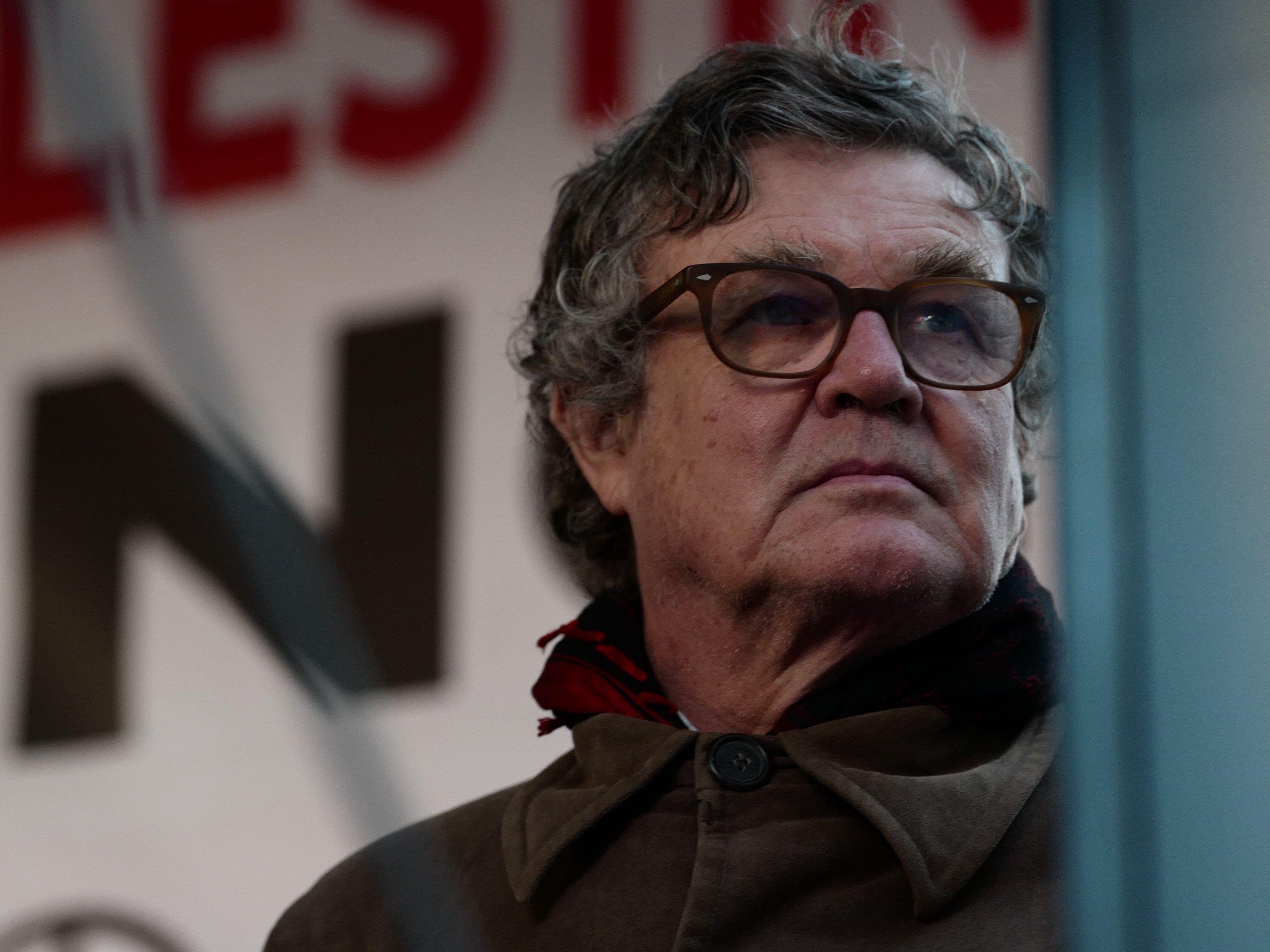

“The USA has long been the most dangerous nation on Earth. Look at Vietnam, its disruptions in Latin America. It hates democracy abroad.”
Veteran journalist, Byline Times columnist and Middle East expert Peter Oborne is in combative mood as we settle down over Zoom to discuss the US and Israeli war on Iran for the Byline Times Podcast.
Oborne is no apologist for the Tehran regime, but he is keen to challenge mainstream reporting of the conflict, which casts the Islamic Republic as the villain in a binary contest between good and evil.
Iran, he argues, “hasn’t got any choice but to regard the Americans as the enemy. America, remember, dismantled Iranian democracy after World War Two. It then established a barbarous regime led by the Shah of Iran, supplied by the United States and employing illegal methods — torture chambers, etc. Enough isn’t said about the damage inflicted on Iran by America — its deliberate destabilisation — in the interests of oil for the West. That’s a background which you mustn’t forget.”
Oborne is referencing the coup d’etat of 1953, inspired by the CIA and the UK’s MI6 which deposed the elected government of Mohammad Mosaddegh, following his decision to nationalise the country’s oil industry. (This episode, incidentally, is vividly told in the recently re-released Coup 53, an award-winning documentary directed by Taghi Amirani). The Shah’s bloody misrule paved the way for the revolution of 1979 which, however it is viewed now, was greeted with popular acclaim at the time.
Oborne, author of The Fate Of Abraham; Why The West Is Wrong About Islam, is deeply sceptical of claims that Iran was within sight of creating a nuclear arsenal at the point at which the Americans and their Israeli allies attacked on 28 February this year, even though this was one of the justifications used by Donald Trump. During his first presidency, Trump himself tore up the Joint Comprehensive Plan Of Action, which limited Tehran’s nuclear ambitions in return for reducing sanctions. Another round of discussions was underway when the Americans decided to strike.
Oborne says, “if you talk to the Omanis, who were negotiating before the illegal assault at the end of February, Iran was being totally reasonable. It was sitting at the negotiating table. There was a deal on the table — and then Trump bombs…”
He points out that the country’s former Supreme Leader Ayatollah Khamenei “issued a fatwah against nuclear weapons and made it clear that Iran was never going to go down that route. His reward was to wake up one morning, go into his office and be bombed to death along with his family. This is grotesque. This is barbarism.
“We killed the man who stopped nuclear weapons being built, and we kept on lying about him. If you read the statements of [Israeli Prime Minister] Netanyahu going back about 30 years now, Iran is always ‘on the verge of having nuclear weapons.’ That’s straightforward lies. The International Atomic Energy Authority was quite clear that Iran adhered to the to the Non Proliferation Treaty. The countries which didn’t, of course, are the United States and Israel. Israel has got loads of nuclear weapons — they just systematically ignored the Non Proliferation Treaty. I’m just simply asking for a fair discussion here.”
One consequence of Khamenei’s killing, Oborne argues, is that, “his successors are likely to reach the conclusion we’re going to have to have nuclear weapons in order to protect us.”
The irony of the current situation is that having seen off wave after wave of American and Israel airstrikes, the Iranian Government appears to have been strengthened by Trump’s intervention — not least because the impasse around the Strait of Hormuz has given it a strategic advantage that can now be leveraged in peace negotiations. The US has signalled that talks are underway, with Trump now referencing only Tehran’s nuclear ambitions, rather than regime change, which had previously been a war aim.
“I think that you’ve got to distinguish between the United States and Israel here, Oborne says. “I think they probably have two separate strategies. I think Israel wants to dismantle Iran. It wants to be the regional hegemon and it wants to turn Iran into another failed state like Iraq and Lebanon. The consequences of that for us in the West would be disastrous. It’s a huge country — 90 million people. Tens of millions of refugees heading towards Turkey and beyond to the West is not something we should encourage.”
Of the Iranian Government he observes: “I’m not saying that they’re perfect people — they’re not. But it is us, or rather, the United States and Israel, who have broken every rule, broken every promise. I would love to see Britain condemning the way that Israel and United States have conducted themselves, because there was no threat from Iran [and] there was no attempt at a getting United Nations Security Council authorisation for war. America and Israel just went ahead and did it, attacking schools, hospitals — with no condemnation from the British Government.”
There is, however, a considerable charge sheet against the Iran’s theocratic leaders; not least that it exports terrorism beyond its borders through groups such as Hamas in Gaza, Hezbollah in Lebanon and the Houthis in Yemen. At least half a dozen Western countries have claimed that Iranian exiles have been assassinated abroad.
Again, Oborne is ready with a fierce rebuttal: “How many assassinations do the Israelis do? How many assassinations have the United States sponsored? They assassinated Ayatollah Khamenei. They assassinated [security chief] Ali Laranjani…”
When pressed about Iran’s behaviour, he clarifies: “To assassinate is wrong, I condemn it,” but Oborne argues that it is inconsistent “to condemn Iran for doing what, unfortunately, we support.”
Another criticism of Iran seized upon by Western critics is its ruthless suppression of dissent. Human Rights Watch has reported that more than 2,000 people were executed last year, the highest number since the latest 1980s. Protestors who took the streets in December and January were also brutally killed, with estimates of the death toll varying between 6,000 and 36,000.
“Of course, they committed atrocities, and they should be condemned for it,” Oborne acknowledges. But he also points to Iran’s historic, 3,000 tear-old civilisation and its functioning, if deeply flawed, parliamentary system.
“What I’m really trying to do here is challenge the idea, which you frequently read in the mainstream British and American media, that on the one hand you have a very sophisticated civilisation in the West, and the other hand, you have a set of sorts of bigots and barbarians in Iran. I’m just simply asking for a fair discussion here.”
Listen to Peter Oborne in conversation with Adrian Goldberg on the Byline Times podcast.