

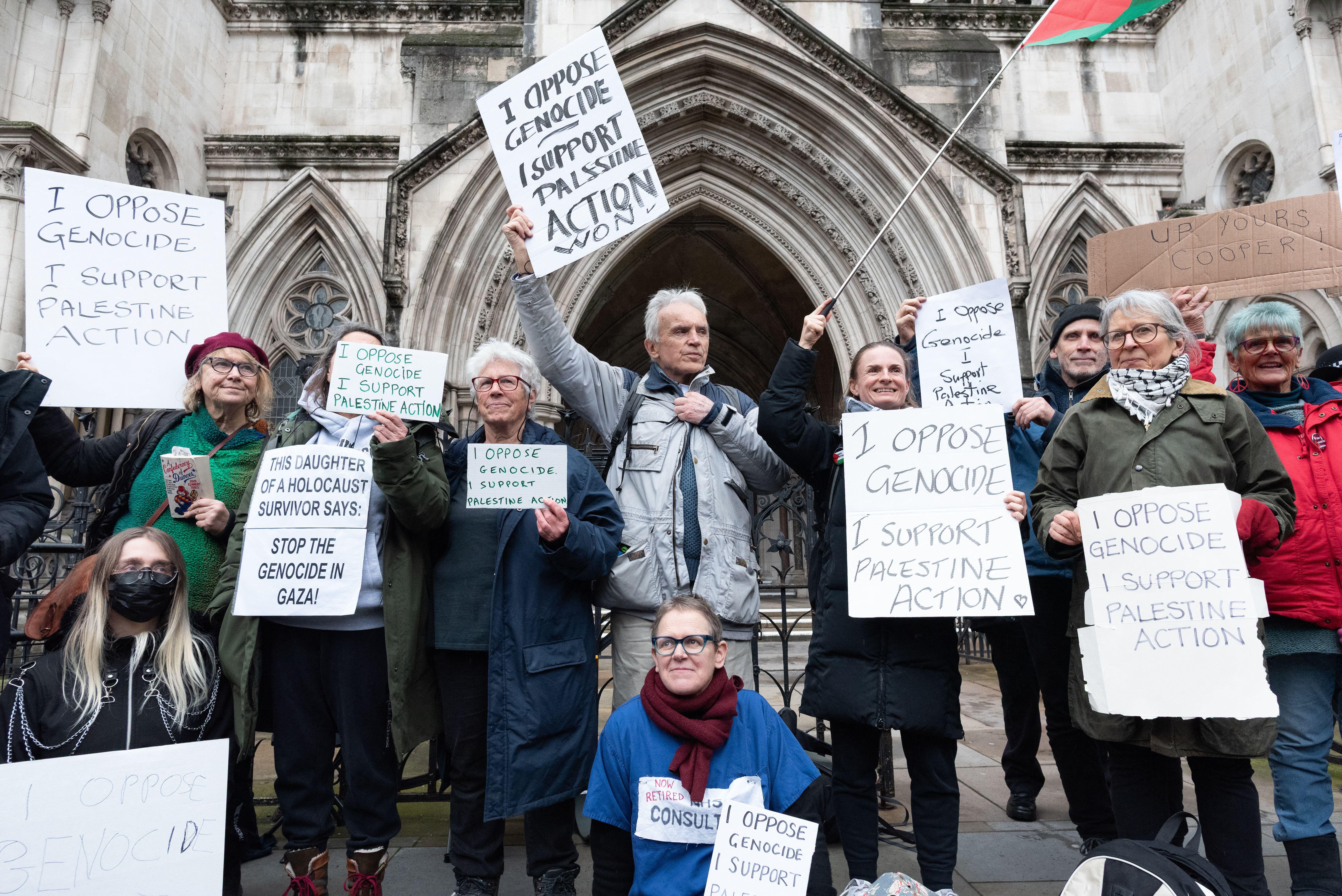
“In 2026 the most common terrorist is a pensioner writing on a placard, ‘I oppose genocide. I support Palestine Action.’ Something has gone badly, badly wrong,” observes lawyer Raj Chada, speaking to the Byline Podcast, in the aftermath of last week’s High Court ruling that the Government’s proscription of Palestine Action as a terrorist organisation is ‘unlawful.’
Chada and his colleagues at civil rights law firm Hodge, Jones & Allen represent hundreds of those arrested for peacefully signalling their support for the group, which advocated for direct action against arms companies and other organisations supporting Israel during the Gaza conflict. Their targets in the UK included RAF Brize Norton, where the engines of refuelling planes were filled with paint; and a factory in Bristol operated by Israeli defence firm Elbit, which was rammed by a prison van and where sledgehammers and crowbars were said to have been used. (Three people have been acquitted for their role in this incident, while verdicts were not reached for three others.)
Palestine Action was formally proscribed in July 2025, putting them on a par with the likes of Islamic State and Al Qa’eda, but Chada said their activities wouldn’t have traditionally been considered as terrorism: “We think of attacks involving bombs, involving killing people, involving serious violence or trying to injure people. What we don’t think about is sledgehammers to property. And I think that the risk that the Government runs by trying to draw terrorism too wide is that they lose the confidence of the general public as to what really is terrorism.”
The most successful exponents of similar direct action activities in the UK were the Suffragettes, whose bombing and arson campaign between 1912 and 1914 eventually secured votes for women. A statue of their leader, Emmeline Pankhurst, now stands in Victoria Tower Gardens, just outside the House of Parliament.
Chada sees Palestine Action as a continuation of this long British tradition: “They’re willing to commit acts of criminal damage in direct action protests, and that has often happened in history. In fact, just after 2003 a group of activists broke into an RAF base to try and prevent US aeroplanes going to bomb Iraq during the second Iraq War. That case went all the way to the House of Lords, and they were represented by one Keir Starmer. How is it that 20-odd years later, the Prime Minister who was happy to defend them then, is now saying that that’s a terrorist action?”
Among the thousands of people arrested for showing solidarity with Palestine Action in a series of sit-ins at Parliament Square last year was Steve Masters, an RAF veteran and long time environmental campaigner. By holding up a banner saying that he supported the group and opposed genocide, he risked 6 months in jail. In fact Masters, one of many older people attracted to the cause, has been arrested twice for the same alleged offence.
He said: "To lower the threshold for terrorism to such a low degree that property damage, in and of itself, becomes terrorism, is a gross over-reach. If they’re proscribing an organisation under the Terrorism Act for damaging property and disrupting commerce and business, as they did, they could proscribe Greenpeace and other environmental protests in the future. So it’s not just about Palestine Action.”
For Masters, speaking out against Israel’s mass bombing of Gaza in the aftermath of the October 7 atrocity, was a matter of conscience. He said, “I’ve been involved in a vigil for peace in Newbury marketplace every Thursday for over two years, trying to bring together members of all communities and stand against the horrors that we’ve witnessed - the actual acts of genocide that have been going on, live streamed. I don’t think there’s been any conflict that’s been so graphic and so obvious, and our government’s been complicit in that. I think this proscription was a political act as much as anything.”
Israel, for it’s part, denies genocide or any breach of international law and has been loyally backed by the Starmer government – although recent revelations in Byline Times suggest that behind the scenes, this position may not have been universally shared by ministers.
It remains to be seen whether Steve Masters and others like him, who have been arrested or charged for peacefully supporting Palestine Action, will be prosecuted. They remain in a state of limbo, pending the outcome of an appeal by Home Secretary Shabana Mahmood against the High Court decision. In the meantime, it is still illegal to become a member of Palestine Action and to promote or support its activities.
Masters said: “If I could offer any advice to anybody who’s potentially thinking about standing up for a cause they are passionate about, you have to be prepared. Giving up your liberty is not something to be done lightly, because of the [longer term] consequences, but also the immediate effect of being held in a police cell for a number of hours. It’s isolating. It can be quite intimidating.
“Thankfully, I’m quite at peace. I don’t worry about career prospects. I don’t have much to lose materially, and I’m in that privileged position where I can do my bit to stand up for something that I believe in, and be inspired by not only my fellow protesters, but also the other people that have gone before, the suffragettes and civil rights campaigners.
“It’s not to be done lightly. Nobody wants to go to prison for any length of time, but somebody once said, ‘bad things happen when good people sit by and do nothing.’ I don’t want to put myself on a pedestal, but I’d like to think I’m on the right side of history.”
Listen here to the full episode of the Byline Podcast with Raj Chada and Steve Masters.