

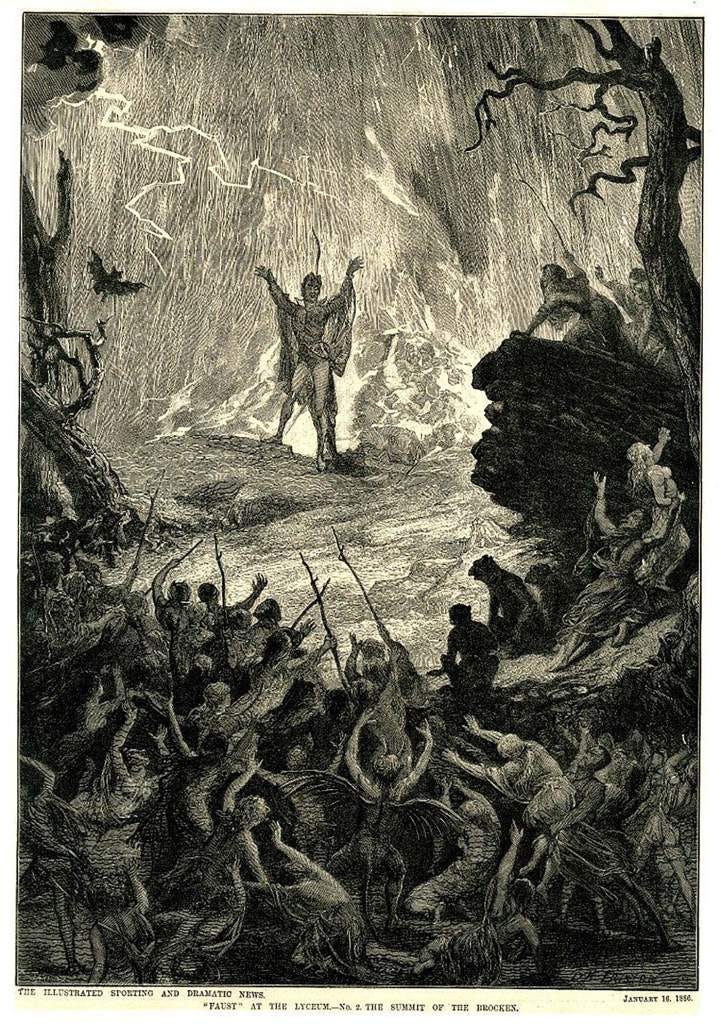

The Epstein Files have released something undeniably diabolical into the air.
The reprise of Peter Mandelson’s nickname, the Prince of Darkness, and Jeffrey Epstein’s own eerie denial that he was ‘the devil himself’ reveals there is something demonic going on.
But it is not the devil we are dealing with, but his intermediary.
Despite the whiff of brimstone and conspiracy this isn’t a Satanic narrative. It’s a Faustian one.
The story of Faust, the successful yet dissatisfied man who exchanges his soul for secret knowledge, power, and worldly pleasure, emerged as a folk legend in 16th Century Germany. Whatever evidence there may be of a historical progenitor to its eponymous protagonist, Faust is recognisable as the archetypal Renaissance magician dabbling in the dangerous arts of alchemy, astrology, and necromancy.
First dramatised by Christopher Marlowe in his groundbreaking play The Tragical History of Doctor Faustus c1592, and reworked by Goethe into his magnum opus Faust c1808, the story continues to inspire countless literary, artistic, musical, and cinematic works.
Its central conceit is of reckless and amoral ambition; of calling upon unconscionable means to satisfy dubious desires.
Faust risks all by summoning a hellish spirit. But it’s not the devil himself he conjures, it’s Mephistopheles.
Mephistopheles is an emissary for forces greater than his own and a protean figure.
Gathering kompromat is very much like harvesting souls, and Mephistopheles’ supernatural tradecraft is similar to that of espionage and disinformation
In Marlowe, the crude demon of the medieval morality play has already evolved into a sophisticated tempter; witty and cultivated. In Goethe, he’s a suave and persuasive creature of the Enlightenment.
In a contemporary world of transactional politics, he becomes the broker, the mediator, the consummate player in the art of the deal, promising the cruel excesses of capitalism for his corrupt clients.
Epstein was a modern Mephistopheles, deploying a seductive charm to draw influential men into a hellish orbit while ruthlessly exploiting the powerless. And his modus operandi extended from iniquitous business to even darker worlds of intelligence and statecraft.
For gathering kompromat is very much like harvesting souls, and Mephistopheles’ supernatural tradecraft is similar to that of espionage and disinformation.
In Goethe’s work there’s even an ambiguity as to who he might really be working for; a sense that he could be an asset to some vast celestial intelligence agency.
“Well, what are you then?” Faust demands on their first meeting. The reply is intriguing in its duplicity: “Part of the power that would, wish forever evil yet do forever good.”
The suspicion that Epstein was a kind of double agent worked its own cover, running the interference that being in the pay of a higher purpose could somehow excuse base and degenerate activity.
Beneath the grandiose premise of the Faustian myth are very personal stories of sexual abuse and misogyny.
Mephistopheles enthusiastically pimps vulnerable women for a decadent coterie, his most famous victim being Helen of Troy. Presented as the epitome of female beauty and classical aestheticism, Helen’s depiction is also an ugly and primal narrative of abduction.
In Marlowe, it is observed that “Sir Paris crossed the seas with her and brought the spoils to rich Dardania”. Denigrated as a mere possession in the currency of entitled men, Helen’s legend is that of trafficked women down the centuries. As Mephistopheles created a lavish playground for his clientele, access to an emperor’s court where the rich and famous might be summoned, Epstein, too, promised an invitation to a very select party, where power and influence could be traded.
Here, our tempted protagonist takes his place at the top table, and his own modern archetype is disturbingly familiar.

The Tech Bro is the New Faust.
A latter-day Renaissance magician, dabbling in new forms of alchemy, astrology, and numerology in an attempt to unlock secret knowledge, gain fantastical powers, and even transcend mere mortality.
Elon Musk, Bill Gates, and Jeff Bezos all appear in the Epstein Files, as does Peter Thiel (pictured), arguably the most Faustian of this self-styled cognitive elite, whose venture capital fund Valar Ventures received $40 million from Epstein in 2016.
Thiel, the German-born co-founder of PayPal and data mining firm Palantir – and a would-be philosopher king – advocates the realm of the ‘sovereign individual’ with powerful economic fiefdoms operating outside of political boundaries, moving between jurisdictions at will.
Rejecting liberal ideals and egalitarianism, Thiel’s fiercely right-wing libertarianism envisages a rigorously engineered future, based on traditional values and hierarchies and driven by visionary individuals. A new breed of people with unimaginable wealth and influence, beyond the reach of any earthly power, on a trajectory to a higher state of being.
In asserting it as a solution to all our problems, Thiel has invoked his ancient countryman. “I badly miss the misguided optimism of a Faust,” he declared in the 2015 article ‘Against Edenism’. “At least he was trying to do something about everything that was wrong with the world.”
But the ‘heroic agency’ of Thiel’s apocalyptic philanthropy is shot through with delusional self-interest and fear.
Although he imagines being in possession of great power, it is ultimately power that possesses him. An obsession with life-extension technologies and transhumanism betrays him. He might not fear hell, but he is clearly scared of his own mortality.
Yet it is Mephistopheles himself who admits to that very mundane terror, when he explains his parole from the Underworld. “This is hell,” he says of his earthly state, “nor am I out of it.” And this is the essential humanism of the fable: that we might want a better place for everyone.
With selfish pride Faust gives up his own soul which, in a secular world, might simply mean a sense of moral integrity. Of course, many named in the Epstein Files had already divested themselves of this tiresome burden.
But if we consider a more benign version of our hapless hero we find a true fall from grace.
Faust was also a scholar, a seeker of truth who aspired to high ideals. Noam Chomsky (pictured below) is probably the most famous academic of our age and one of the defining figures of the American left.
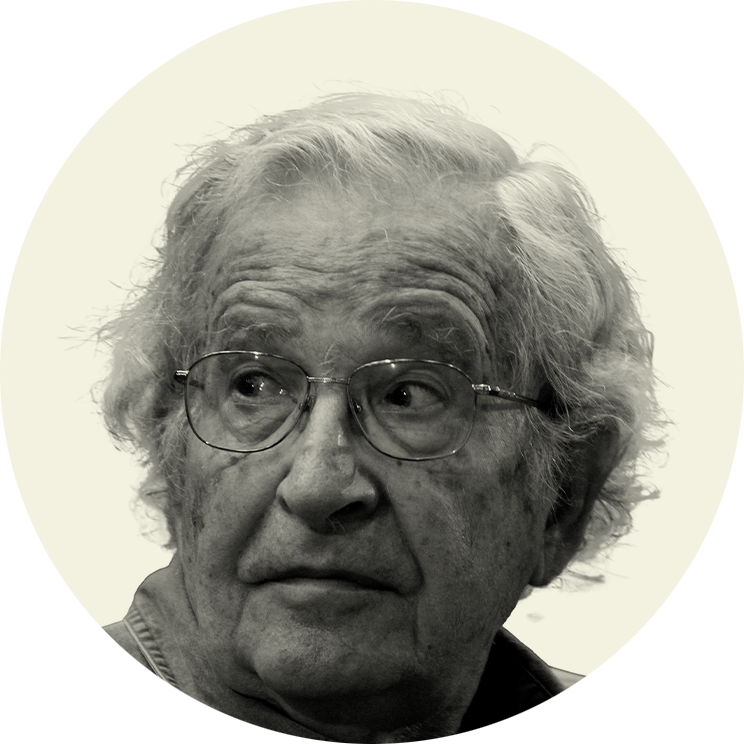
For the past six decades, he has been an outspoken critic of imperialism, colonialism, contemporary capitalism, and corporate influence on political institutions. An unflinching advocate of human rights, equality and freedom of thought, he appeared to represent all that was best in the public intellectual seemingly free of taint or compromise.
But how the mighty have fallen.
A long-standing relationship between Chomsky and Epstein emerged from the files in the form of very friendly email exchanges that make for depressing reading.
There is Epstein’s advice in a rather sordid financial dispute between Chomsky and the children from his first marriage. A breezy reply from an invitation from the sex offender in which Chomsky confesses that he’s “really fantasising about the Caribbean island”. And various payments of more than $250,000 through Epstein’s account (which Chomsky insists were from another source).
Most egregious of all is a document dated February 2019 in which Chomsky lent moral support while Epstein was facing sex-trafficking allegations. “The best way to proceed is to ignore it,” Chomsky advised his friend, 11 years after Epstein pleaded guilty to soliciting sex with an underage girl. “That’s particularly true now with the hysteria that has developed about abuse of women.”
It is the professor of linguistics’ use of the word “hysteria” that is particularly damning: a semantic seal to his pact with the devil’s disciple.
The language of misogyny marks Chomsky out as a willing apologist for Epstein’s crimes. Near the end of his long life, it leaves an indelible mark against his reputation, his legacy, and yes, his soul.
And that is the true tragedy of Faust, and a cautionary tale. Not only the old warning that all power corrupts – but also that even the most brilliant minds are not immune to its temptation.
Jake Arnott is a dramatist and author. His latest novel is Blood Rival
This article appears in edition #84 of the Byline Times monthly magazine