

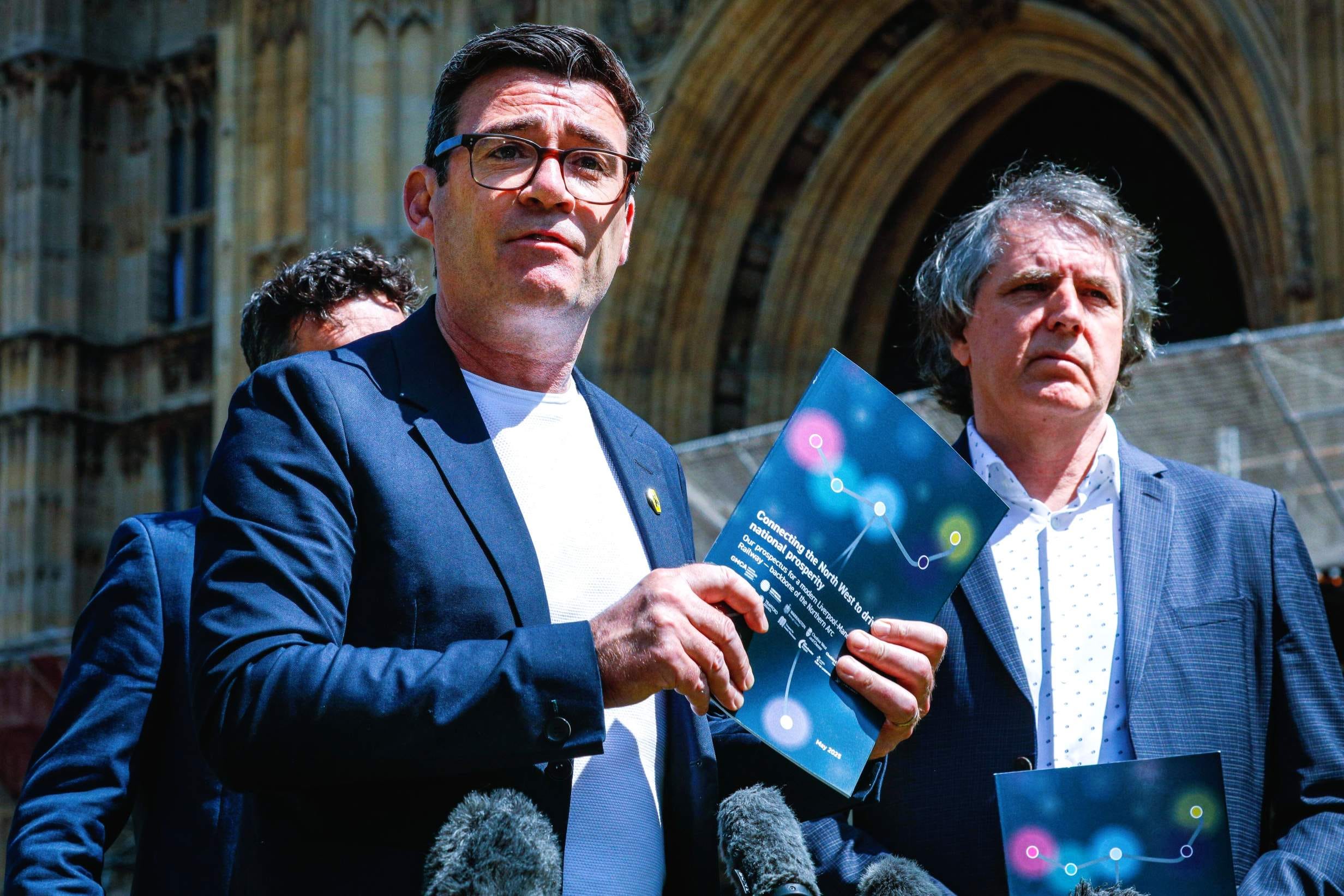
Head North by two Scousers, Andy Burnham and Steve Rotheram, is the most original, interesting and important book by serving Labour politicians that I’ve read.
It was published in 2024 to a pitiful number of mainly patronising reviews in the London media – all of which missed the larger point of its call for a new constitution that enshrines a Basic Law, includes PR, and empowers Members of Parliament. A failure that perhaps confirms the authors’ assertion that London has lost the plot and does not grasp how intolerable our system of government has become for the country as a whole.
Of the two, Burnham is well-known as a high-flying Labour politician, who entered Parliament in 2001, and rose swiftly to become a senior Cabinet member under Gordon Brown. When he tried to become Labour leader in 2015, he lost out to Jeremy Corbyn. A year later, he left Westminster altogether to become the first Mayor of Greater Manchester.
Rotheram is less well-known nationally, but his rise from being a bricklayer to becoming a Labour MP and then Mayor of Liverpool is also impressive.
The book opens with the two of them shaking hands in 2016 and pledging their joint determination to leave the House of Commons and seek election to the twin cities of England’s north-west – where the novelty of elected mayors was about to become a reality for the first time.
The first half of the book is a dialogue between the two of them as they share the experience of their personal journeys close to the heart of power. Again and again, they are shocked to the point of being traumatised by the cold indifference of the centre to the legitimate needs of their communities.
From Hillsborough to COVID, they draw two personal conclusions from 20 years.
First, in a crisis “you have to speak to the soul of the place you are in”.
Second, that the UK has “an unaccountable state that tries to divide and rule and foist decisions taken by a small cabal on millions”. It prioritises private vested interests over the public interest while “Whitehall does not regard all people and places as equal”.
The way they share their account of experiencing the built-in failures of the British state is comparable to Rory Stewart’s Politics on The Edge.
Stewart’s is a more sustained blow-by-blow account of his journey, in his case through the ruins of the Conservative tradition. It culminates in his attempt to become Prime Minister and his humiliation. Whereas Burnham’s takes off after his Westminster ambitions are crushed.
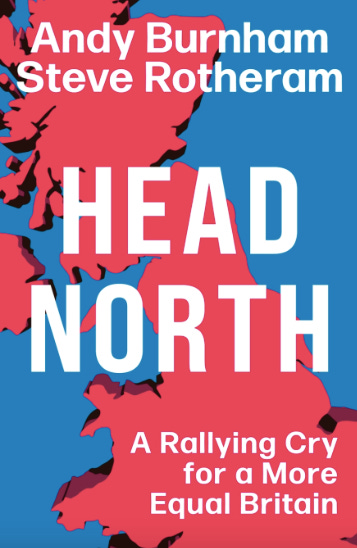
The second half of Head North sets out the way in which Burnham and Rotheram believe the country has to change.
They conclude by demanding a written constitution. They spell out the need for a proportional voting system; empowering Members of Parliament by the removal of the whipping system; a senate of the nations and regions to replace the House of Lords; full devolution; two equal paths in education; a Grenfell law for those in public housing; a Hillsborough law to impose a duty of candour on all public servants; and ecological sustainability.
Missing from their list of constitutional demands is the need for a justice system that works for regular people – something, however, that emerges vividly in their account.
Many others have proclaimed the need for systematic constitutional reform in the United Kingdom, going back to Charter 88 and beyond. Burnham’s and Rotheram’s call is unique in that it emerges from, and is rooted in, their tangible experience.
For example, they both write in a compelling way about the 1989 Hillsborough disaster, which Rotheram witnessed, and the two decades of frustration suffered, not just by the families of the victims but by everyone in their native city.
“For Andy and me, everything leads to and from Hillsborough,” Rotherham writes. “It was an event that shaped us both as people and as politicians. The disaster was not just an appalling tragedy. It was entirely man-made and one which the powers-that-be, the establishment, fought tooth and nail to cover up.”
The last point is crucial to their joint reflections. They embed their experience of the fight for justice over Hillsborough so that it reveals systemic state indifference, listing similar scandals such as Aberfan, Bloody Sunday, Shrewsbury, Orgreave, the Post Office, Windrush, and Grenfell.
Or, for example, their argument for proportional representation is grounded in their own experience of it in their mayoral elections, how coalitions and the need to cooperate leads to better outcomes, and how voters prefer this to tribal polarisation.
The tangibility of their joint call for urgent, sweeping constitutional change is especially compelling because they are still active politicians on the front line of government. What is needed in order to achieve what they want, however, is necessarily beyond their experience.
For, as we can see all too well in contemporary Washington, without a robust democratic constitutional culture, written rules will not protect us from those who abuse the powers of public office.
A full-throated, transparent, public process with empowered participation and citizens’ assemblies is going to be needed to achieve a constitutional framework that delivers the kind of change that Burnham and Rotheram desire.
For it is not hard to put onto paper the basic principles of a democratic constitution that enshrines the rights of citizens, protects them from an overbearing state, and entrenches support for regional equality. What is much harder is to ensure such principles are internalised by politicians and administrators. And it is harder still to initiate a process that inspires the public’s participation, so that they embrace the resulting constitution as their own.
In other words, codifying a constitution is the easy part. Ensuring that it commands loyalty across political differences and becomes a living, flexible expression of a country, and genuinely holds power to account, is a much tougher challenge.
Because all constitutions, whether codified or not, are lived. And the way in which they are lived determines their reality.
What matters for the nations of the UK today, therefore, is that no new constitutional settlement is produced ‘out of the hat’ of the existing system – for that will merely reproduce the public’s current and entirely justified cynicism and disbelief in how we are governed.
On 5 September last year, the Daily Mail launched its campaign for an electoral alliance between the Conservatives and Reform UK with a full page editorial headlined: “A new politics is beginning. Everything we knew and accepted as normal is dissolving and crumbling.”
Their new politics is to double-down on Brexit and ‘sovereignty’ and completely dismantle the constitutional reforms Labour legislated under Blair which have supposedly shattered our democracy. Freed of all such restraints and regulations, our ‘Mother of Parliaments’ will apparently re-emerge to once again claim its leading role.
Believe that and, one way or another, you will be admiring and imitating, if not worshiping, President Donald J Trump.
To get from here to there, you have to embrace disaster nationalism. It is now a right-wing trope that currently ‘Britain is broken’. Yet the claim is false. Britain, as a country that comprises four nations and nearly 70 millions of us, has deep reservoirs of public intelligence, patience, and tolerance, and is far from broken. Its governing system, however, is indeed structurally malfunctioning and beyond rescue.
From Dominic Cummings on the maverick right to Wes Streeting on the Mandelson left, the solutions offered to resolve this breakdown involve doubling-down on the powers of the British state — with calls for a massive step-change in competence.
All such approaches are doomed to fail. Because the heart of the problem is the British state itself, which cannot be utilised to bring about its own solution. What is needed is a fundamental break from the old regime.
This can only come about from outside. Yet to command popular assent it will also need credibility and expertise. Burnham and Rotherham have both. Perhaps the novelty of creating new mayors in the north will provide the external source for the root-and-branch transformation of Westminster politics that is now imperative.
Written by
Anthony Barnett is a writer and campaigner. He was a founder of openDemocracy. He writes an exclusive column, Notes On Now, for the monthly print edition of Byline Times
