


BYLINE TIMES IMPACT: Find out about the changes you made happen
Birmingham, spring 2025. Nigel Farage fronts a Reform rally.
I spend the early evening in the pubs and bars, looking, listening, and sniffing.
Every woman around me has over-powering perfume, thick make-up, high heels, and dyed blond hair. Not quite natural Aryans. The older men are loud and beery, balancing pints on their bellies, loving the sound of their own voices; pub bores watching footie and criticising the management.
Everyone’s on a jolly, off to the cabaret with their old chums.
But my animal self is on the alert when the younger men slice through the crowds – on their phones, not chatting but reconnoitring; sharp-suited thugs with razors in their eyes, the ‘Tomorrow Belongs To Me’ men.
Inside the arena, the bars are full and the stage is set, dressed as a “typical” British high street, with a betting shop and bus shelter, pot-holes, and “too many” Turkish barbers shops, says the Vaudevillian Farage who enters with dry ice, and a live band, wheeled in on a JCB, to the infatuated cheers of a drunk audience.
What will end as pogrom begins as panto.
Speakers mention net zero to elicit boos and the rising numbers of Reform councillors to get cheers.
European Court of Human Rights: Boo. Anyone from Reform: Hurray. Reform’s chief strategy is “keep it simple”.
A posse of supporters of Rupert Lowe and Restore Britain raise a heckle. The spiked young men surround them in an instant and bundle them out.
Europe: Boo. Britain: Hurray. Woke liberals: Boo. ‘Broken Britain’: low growls of recognition. And then – tar la! – Nige’ll fix it. Hurray. Gaza MPs: Boo. The bloodlust of Netanyahu’s genocide is irrelevant to this crowd. It is suddenly serious. Race is in the air. English farmers: Hurray.
I’d be surprised if the people I speak to would attack anyone for being gay, trans, or foreign. But people change when they are in crowds
Then the touch-paper: farmers’ inheritance tax increases. Boos and fury to foot stamping.
It is a moment of thunder. Blood and soil unite right here. Inheritance is in the blood. Soil is in the fatherland. The crowd’s blood is pumping.
Me, my blood runs cold.
When trans and gay people are drummed up into the collective mind to be booed with especial loathing, I feel sickened by the visceral hate.
When 25,000 “illegal immigrants” are invoked in the verbal arena, these pantomime lions could tear them limb from limb.
When I talk to people individually, though, I find both men and women quite nice, really. I’d be surprised if the people I speak to would attack anyone for being gay, trans, or foreign.
But people change when they are in crowds.
“In the crowd the individual feels that he is transcending the limits of his own person,” writes Elias Capetian in Crowds and Power. “His freedom is the crossing of these boundaries.”
I sit near a middle-aged woman from Glasgow who, when she was young, had spent a year in Turkey and tells me how much she loved the country and the people – noting the kind hospitality of a street vendor when she and her mother were over-heating in sweltering temperatures. He had given them slices of watermelon for free.
The irony hurts: she had been tenderly welcomed when she was a migrant, yet within moments as a crowd-member, she is screaming hatred for migrants in ‘her’ country; Farage leading the “outrage” that immigrants have their human rights protected by the ECHR. She adores him.
If you could see him through her eyes, he wouldn’t look fascist at all.
No one could accuse Farage of coherence.
He supports Israel and is also known for the antisemitic bullying of Jewish boys at his school, mimicking the sound of gas chambers. Boo. Hisses.
Demagogues don’t need ideas if they are selling hate.
“Hate beats pure cocaine any day,” Kurt Vonnegut wrote. “Hitler resurrected a beaten, bankrupt, half-starved nation with hatred and nothing more. Imagine that.”
Farage turns up the temperature, giving his fans hate figures.
Shared hatred is a greater unifier than shared adoration (unless it’s Nigel). Sadiq Khan: Boo. David Lammy: Boo Boo. Nigel Farage: Hurray. Hurray. Hurray.
Dispassionate reason cannot compete against distilled passion. The left lacks all conviction while the right is full of passionate intensity.
Farage, ventriloquist, understands the worst in his followers and, by voicing their thoughts, gives them permission to go further: more, he tells them that they are victims, their voices having been silenced for too long.
They’d walk through fire for him: they’d light those fires too.
Farage is a performer, pacing his speeches, moving from the pessimism of economic hardship and austerity, to the pivotal political present and on to optimism – as redemption comes through Reform and the beer-and-fags man will be the saviour of his people against the ‘aliens’.
We humans are suckers for a tripartite phrase; a three-word slogan; a triple whammy, and Farage has oratorical force, with his three-step crescendos and his three-act dramas.
His Birmingham rally begins as the daftest kind of variety show, as entertaining as the cabaret atmosphere in Brecht’s 1941 play The Resistible Rise of Arturo Ui.
Arturo Ui – a cruel gangster given lessons in rhetoric by an actor – represents Hitler and Ui speaks of “a world replete with Jews and bicyclists” with the same disgust Farage evinces for immigrants and environmentalists.
Ui remarks: “Who the hell cares what professors think, or intellectuals?” Universities, says Farage, are “poisoning student minds”.
The play is most of all an attack on the complacency of those who could have resisted Hitler but didn’t. Its contemporary meaning tolls out unforgettably in its last line delivered in aghast fury in the recent RSC production by the actor Mark Gatiss: “The bitch that bore him is in heat again.”
Meanwhile, back in Birmingham, Farage is on heat and wants Britain on fire.
Seated next to me is a young builder, perhaps in his late twenties, physically powerful and looking for somewhere to put his strength.
Pre-Brexit, he’d lived in Spain which he liked, though he hated how animals were treated and got into fist fights to protect them. He spoke of his fury at the rape and sexual abuse of children. I nodded with his anger. Then, he said, “it is all done by illegal immigrants”.
“Well, I don’t think that’s really true, is it,” I start saying – but to him, it’s an open-and-shut case. He eyes me suspiciously for a moment and asks witheringly if I’m a Labour supporter.
“I’m not political,” I say mildly, and add that I’m curious about Reform and why it gets such support. “What is it,” I ask directly, “that pulls you to Reform?”
“You really want to know?” he says.
“I do. I really, really do.”
He leans towards me, suddenly, and I can almost feel a rise in the temperature immediately between us.
“It’s the passion,” he says, his voice almost choked.
In an instant, he pulls away from me. As if he’s over-spoken. As if he’s embarrassed.
He’s on his feet, gesturing to a pal of his: “Arright, mate? My round I think” – and he’s off to the bar. He doesn’t speak to me again.
Passion. Inchoate, glorious, passion.
The word detonates deep in my mind, and I think instantly of the passion of Trump supporters, the passion of war, of religion, of love.
Passion is amoral as fire, neither good nor bad, but dependent on its use: the passion of Hitler or the passion of Christ.
The root of ‘passion’ is the Latin word meaning suffering, and some of Christ’s followers have both suffered and inflicted suffering, in the Crusades and the Reformation, Rome to Belfast.
Passion is temperature and intensity and it is utterly compelling.
There’s passion even in this panto. Boo and cheer. Love and hate. Them and us.
Which side do you support? What team?
Passion is temperature and intensity and it is utterly compelling
Lee Anderson comes on stage and the crowd begins the footie chant “here we go, here we go, here we go-oh”.
Football is a great place for public passion. It answers a lot of needs: a sense of belonging, something to cheer and something to boo, a flag to unite behind, a colour to wear, a side to choose.
Dear England. The televised homage to dear Gareth Southgate shows how public passion can be well-channelled so honour, pride, and loyalty flush out hatred, racism, and thuggery. So people can lose themselves in a trance of hope and in football’s reasonably innocent nationalism where the ‘other’ is only a temporary opponent for 90 minutes of fierce and passionate rivalry.
Warmongers like to sell war as sport.
Sebastian Haffner, one of the most intuitive and incisive interpreters of Hitler’s rise to power, considered that, in the First World War, an entire generation of German schoolchildren experienced war between nations as “a great, thrilling, enthralling game”. It provided, he wrote in Defying Hitler in 1939, “far more excitement and emotional satisfaction than anything peace could offer”.
The nation could feel public passion and grew addicted to it: love and hate, joy and sorrow. But with the end of the First World War, people lost that passionate engagement.
The 1920s were times of austerity, with housing problems, and a huge rise in the cost of living – and these were accompanied by such a poverty of public passion that people were left feeling bored, disappointed, and robbed.
Hitler embodied that generational need for public passion not least because he had no private passions and politics was a substitute for any inner life. “His life lacked,” writes Haffner, “everything that normally lends weight, warmth, and dignity to a human life: education, occupation, love, and friendship.”
Farage, of course, knows his fan base needs public passion and he models his rallies on Donald Trump’s mass circuses.
The American writer Joe Bageant depicted the white working-class who were to become Trump supporters as suffering a poverty of money, of health, of time, and of education. On top of these, they suffered what I’d call a poverty of glory, of public passion.
They sought it where they could: hunting on Saturdays, and church on Sundays, hence Bageant’s 2012 book title: Deer Hunting with Jesus. It’s blood on Saturday and blood on Sunday.
Bageant notes that among fundamentalist Christians (extreme Protestants who loathe Catholicism), “pleading upon the blood of Jesus” and sermons on “blood redemption” and the “doctrine of the blood” have become more common, celebrating Christ’s blood being shed. Behind the religious language, the blood is shed in Gaza.
Bageant notes that for those fundamentalists, “the Messiah can return to Earth only after an apocalypse in Israel called Armageddon … The first requirement was the establishment of the state of Israel. Done. The next is Israel’s occupation of the Middle East”.
More war. More passion. More blood.
I wanted something to read on the train to Birmingham.
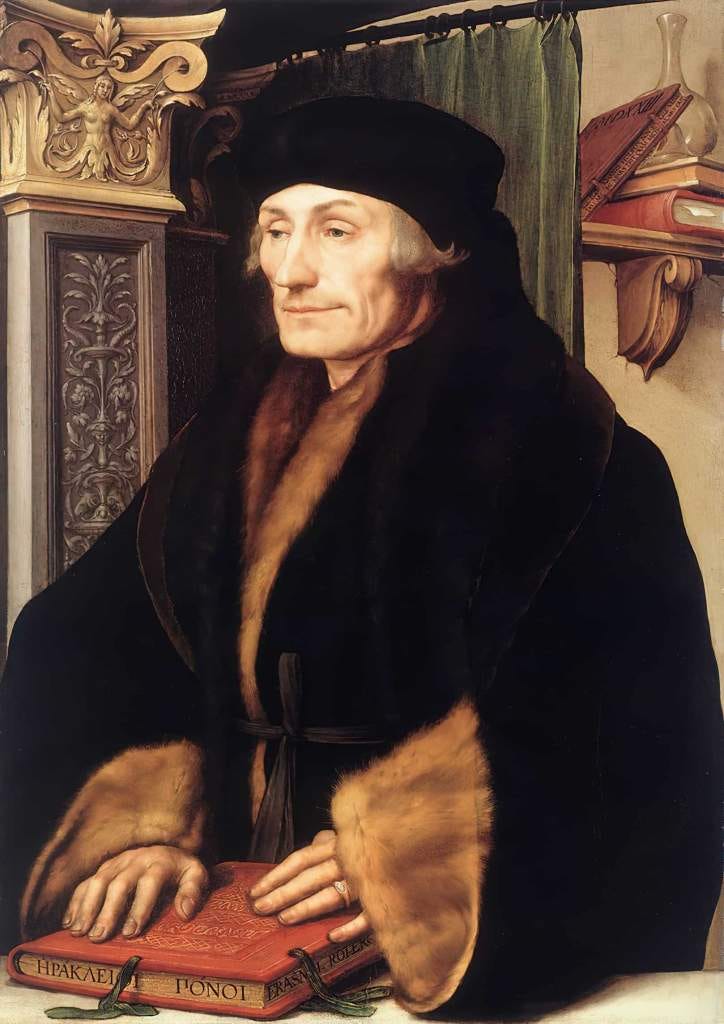
I chose Stefan Zweig’s The Triumph and Tragedy of Erasmus of Rotterdam because Erasmus, “the first conscious European”, is the opposite of Farage.
The triumph of Erasmus is his nature: eloquent and gentle, he was a “world-friendly soul” and the “friend of peace”, settling nowhere but at home everywhere, and refusing to consider any nation as superior to any other.
Erasmus and his fellow humanists were, says Zweig, “aristocrats of the spirit”, believers in education and “nobility of mind”.
The tragedy was that Erasmus, cool, reasonable, and intellectual, shared his world-hour with Luther who embodied passion, virility, and heat. Zweig opposes “this blood man” Luther to “the spirit man Erasmus”.
Luther “exudes violence atmospherically” and he holds people “in a kind of servile bondage by his imperious, masculine nature”. He “thinks unconsciously out of the masses and represents their will in a potency heightened to the highest degree of passion”.
Luther stormed onto the world stage for the Reform party, against the Catholic Church of 500 years ago. It was a time of bloodshed, as Luther led the way in smashing the culture, the mores, and the manners of an ancient civilisation. (Erasmus agreed that the Catholic Church needed reform, but wanted slow, thoughtful evolutions, not reckless revolutions.) Erasmus couldn’t compete with Luther’s blood-drunk vehemence and toxic masculinity.
Erasmus stood for conciliation; Luther for the fanaticism that “can most easily kindle its sacrilegious flame in hatred”.
It was culture versus elemental forces; cosmopolitanism versus nationalism; and above all reason versus passion.
Luther, seeking violence, division, and the destruction of the intellect, loathed all that Erasmus represented: dear Erasmus who stood for friendship, for Europe, intellectualism, and grace.
There are parallels today, as Farage steps forward, a modern-day Luther with his Reform Party. Farage and his Brexit louts went to Strasbourg in 2019, and uncouth and graceless, turned their backs when the European cultural anthem ‘Ode to Joy’ (with Schiller’s words and Beethoven’s music) was performed. Like Luther, Farage knows that his first goal is to subjugate the sweet spirit of Erasmus and Farage’s Brexit meant Britain lost those beautiful, intellectual European treasures: the Erasmus scholarships.
There are more unexpected parallels.
Luther and the Reformation were aided by the tech bros of the time: Guttenberg’s new printing press. Luther’s success depended on his ability to publish his ideas in short, punchy texts that gained enormous traction. He was more than an influencer: his whole ethos drove the disorder and violence of the ‘reform’ movement.
Farage and Trump alike deliver their punchy social media posts, while Musk the moronic puppeteer, mobilises bloodshed at a distance.

Belfast, spring 2026.
St George, that Palestinian saint usurped by the English, is drenched in blood for the Reformers in their present day Reformation. Farage seizes his moment.
After the horrific attack by one man who happens to be a person of colour, against one man who happens to be white, Farage calls for “pure, cold rage”.
A hatred for “illegal” immigrants has, within a year, morphed into a hatred for immigrants and, in turn, a straightforward racism against anyone who isn’t white.
Masked, armed, and bloodthirsty men – terrorists, in other words – rampage through the streets of Belfast, setting bins on fire, kicking doors down, breaking windows, setting cars alight, and shouting “foreigners out”.
A pogrom. Here we go. Here we go. Here we bloody go.
Jay Griffiths is an award-winning author whose books include Wild and How Animals Heal Us

What a tour de force of journalistic brio! I could not imagine being able to sit amongst the Faragists and be able to emerge alive after quizzing them about their motivations! And the contrasting analysis of the ethos of Erasmus versus Luther was stunning. A world-class piece of journalism!