


While pundits and politicians ponder the ultimate objectives of the war on Iran which Donald Trump, in league with Israeli Prime Minister Benjamin Netanyahu, launched on 28 February, it is worth putting this tumultuous moment in context against the rationale of the American President’s career so far – which has always been a deep and dynamic relationship with the irrational.
We can try to surmise how the MAGA leader’s objection to “forever wars” fits in with the massive bombardment of a country that is as mountainous and impregnable as Afghanistan, and with double the population of Iraq. We can puzzle over the continuously improvised war aims. Is it regime change and setting the Iranian population free? Defending Israel? Or hunting down any possible precursors to nuclear WMDs?
But this search for cue and motive would miss the point about Trump – he is a master of chaos. That’s where he finds meaning and strength. His supporters also thrive in the wake of his psychological and cultural whirlwind.
“I love the smell of deportations in the morning,” Trump wrote to great applause on social media last year. “Chicago is about to find out why it’s called the Department of War,” he added, along with three helicopter emojis.
Channelling the character of Air Cavalry Lieutenant Colonel Bill Kilgore from Francis Ford Coppola’s 1979 epic Apocalypse Now (itself a re-imagining of Joseph Conrad’s 1899 novella Heart of Darkness), the meme is a telling addition to Trump’s arsenal of iconography now that he has cast himself as a wartime leader.
Just like Trump, Kilgore – played by the iconic American actor Robert Duvall, who died on 15 February at his Virginia horse farm at the age of 95 – mashes up the old and new in a pastiche of American exceptionalism: combining the classic black Stetson of crossed sabres with 60s shades and unbuttoned fatigues.
Duvall actually toned down his dialogue in the original script after consulting Vietnam veterans. He told the Tribeca film festival in 2019: “Coming from a military family, I wanted to treat the military with respect … without caricature.”
For Trump, who avoided military service in Vietnam, who called decorated war heroes like Senator John McCain losers, Kilgore epitomises the kind of WASP operatic imperial hubris he’d love to tap.
In one of the film’s famous scenes, Kilgore’s helicopter brigade swoops on a Vietnamese village on the Nùng river, pumping out Richard Wagner’s ‘Ride of the Valkyries’ from loudspeakers because it “scares the hell” out of the insurgents.
One moment, Kilgore is scattering ‘death cards’ on slain Viet Cong bodies as a psyops warning. Next, he is rebuking US soldiers for torturing a dying enemy fighter by denying him water. Then, suddenly, he drops everything when he hears that a famous Californian, Lance Johnson, is travelling with his brigade.
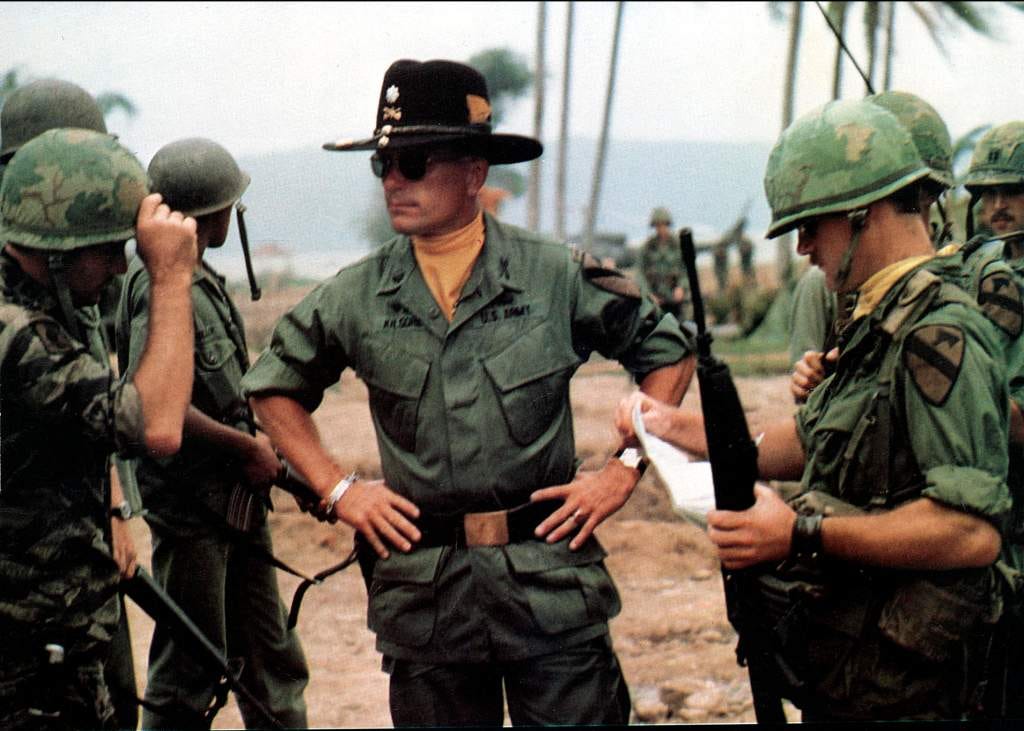
That’s when the film’s most memorable moment happens. Lance’s surfing expedition is interrupted by snipers from a nearby treeline. Irritated, Kilgore calls in an airstrike. Moments later, after the whole forest has been incinerated in a sudden blaze, he sits on his haunches and ruminates: “You smell that? Napalm … Nothing else in the world smells like that. I love the smell of napalm in the morning … It smelled like … victory”.
Impulsive, visceral, and easily distracted, the US President surfs the world’s zeitgeist in the same way as his devoted followers doomscroll social media.

In his first inauguration speech in 2017, he revelled in wanting to put a stop to “American carnage”. But disaster is not an obstacle; it’s an addiction. Like Duvall’s Kilgore – who closes the beach sequence with the wistful sadness of “some day this war’s gonna end” – Trump would be lost without the chaos of conflict.
The Vietnam War did end, but the smell of napalm did not augur victory.
Despite Operation Rolling Thunder, which dropped hundreds of thousands of tonnes of bombs on transportation networks, oil facilities, and air defences in Vietnam, Laos, and Cambodia, military escalation in Vietnam ended in humiliating and traumatising defeat for the United States.
Opinion polls on the US/Israeli war on Iran should be a dire warning for today’s conflict. Fifty years on, Donald Trump’s current war of choice remains more unpopular with American voters at its beginning than the Vietnam War was at its disastrous conclusion.
For all these reasons, Trump could well declare victory and withdraw. But that would assume reason has a role here.
Facing the discontent of his MAGA base over the Epstein Files, and possible obliteration in the midterm Congressional elections this autumn, Trump may well decide that the spectacle of power matters more than the pursuit of any rational goal.
Unforgettable Fires
Through his meteoric career (and, remember, meteorites eventually burn out on impact), Trump has viscerally triggered the unconscious ‘politics of feeling’ and animated a whole constituency that feels disconnected from the procedural and process-driven functions of democracy.
Anger and violence are powerful factors in this emotive sphere, and technology is constantly changing the aesthetics of war and its terrible beauty.
Coppola understood the ‘unforgettable fires’ and hypnotic seduction of destruction right from the opening sequence of Apocalypse Now.
Lying in his Saigon hotel, in a (genuinely) drunken haze, the army captain Benjamin L Willard, played by Martin Sheen, confuses the rotor blades of the ceiling fan with assault helicopters. Over slow-motion shots of a burning jungle canopy, Jim Morrison from the Doors intones, “this is the end, my only friend, the end”.
He is a master of chaos. That’s where he finds meaning and strength. His supporters also thrive in the wake of his psychological and cultural whirlwind
Vietnam not only provided a visionary palette for what Gaston Bachelard called, in The Psychoanalysis of Fire, the primordial reverie of looking into flickering flames, but it changed the whole communication of conflict.
Vietnam was the first colour-televised war. From 1965, Movietone footage piped napalm infernos – vivid, almost painterly – into suburban American living rooms, transforming industrial slaughter into a nightly spectacle. The medium didn’t merely report the war; it wrapped atrocity in the grammar of cinema before cinema had even processed what it was seeing.
Then came the inversion.
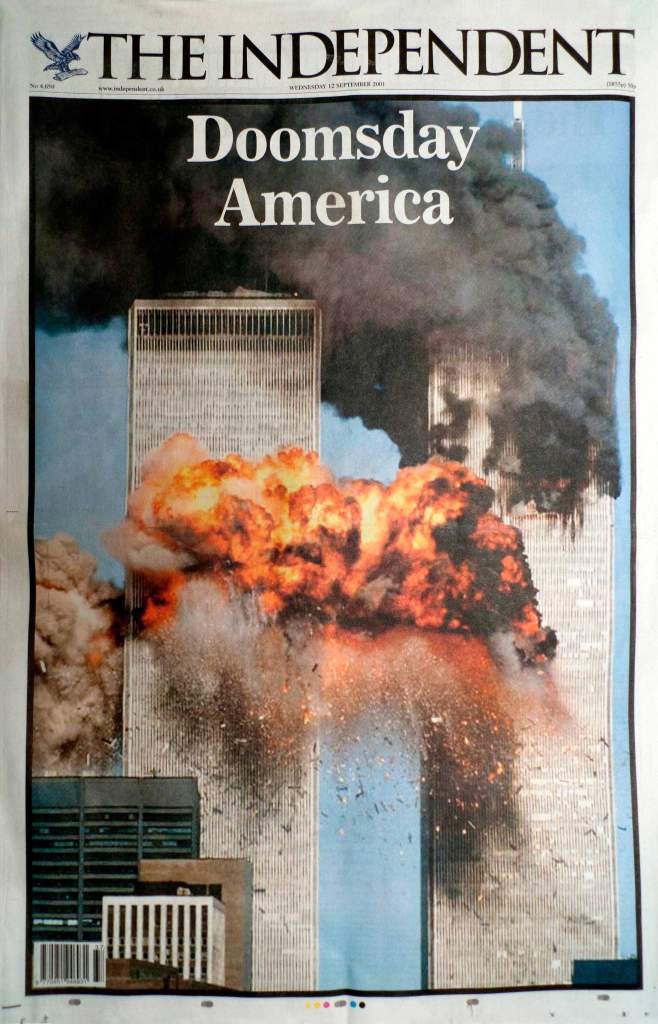
On 11 September 2001, instead of American fire consuming distant jungles, foreign conflagration consumed New York’s landmark World Trade Centre. The whole world watched in real time as two towers dissolved into a rolling cloud of pulverised concrete, asbestos, and human remains.
The image was, in its terrible way, as cinematic as anything Coppola had staged – which is precisely why it demanded a cinematic response.
In March 2003, President George W Bush’s Defence Secretary, Donald Rumsfeld, announced his sequel – his version of The Empire Strikes Back – with the ‘shock and awe’ opening bombardment of Baghdad.
That was a prime-time son et lumière show of cruise missiles and tracer fire, choreographed for the satellite news cycle. The Pentagon had learned from Vietnam not to suppress the images but to curate them – to make destruction beautiful, controlled, and above all ours, because we’re in the director’s seat.
But it wasn’t the end, beautiful friend. After the fireballs, the dust.
The towers’ collapse aerosolised decades of construction material into a toxic cloud that settled across Lower Manhattan and into the lungs of thousands. The 9/11 dust is still killing people – slowly, bureaucratically, through mesothelioma and rare cancers and interstitial lung disease – in a death toll that has long since surpassed the count from the day itself.
It’s too early to calculate the aftermath of the US/Israeli attacks on Iran. By the time Byline Times was going to print, within a week of full-scale war being unleashed, US Tomahawk cruise missiles had already killed 175, mainly young schoolgirls, at Shajarah Tayyebeh elementary school in Minab.
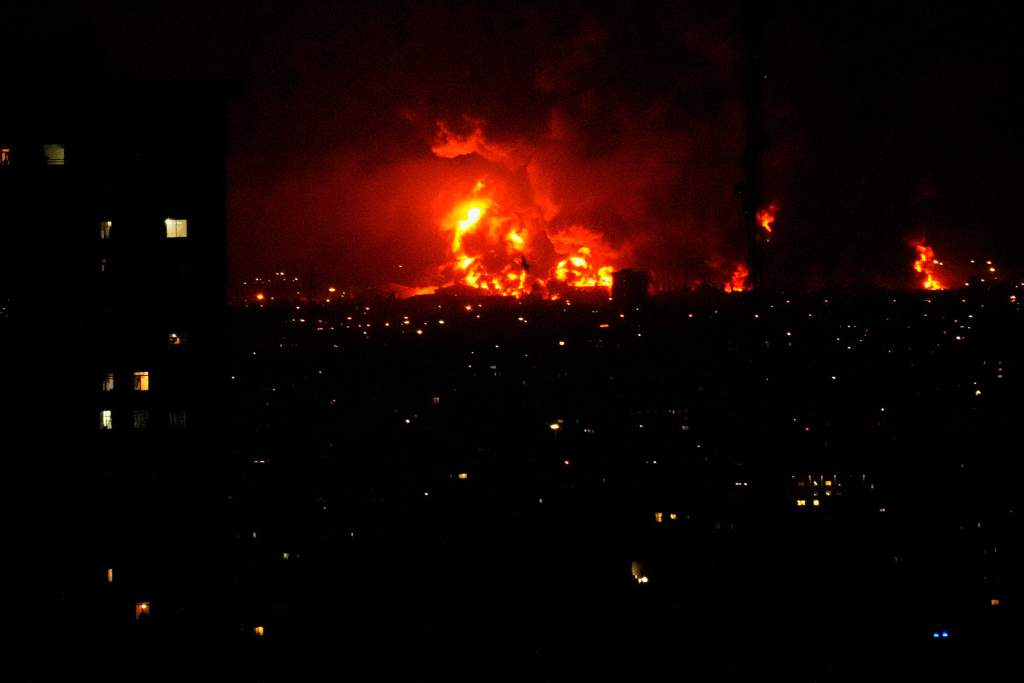
Within a week, Israeli jets had bombarded multiple oil depots and petroleum facilities around the Iranian capital, Tehran, with some residents describing the darkness at noon as thick black smoke blanketing the city, “rivers of fire” as oil spilled into the sewers, with officials warning of a toxic “black rain” looming which will affect the public health of the city’s 10 million residents for years to come.
Apocalyptic scenes, indeed. But this war won’t end with a bang but a whimper for long-term survivors.
As Professor Sir Lawrence Freedman, Emeritus Professor of War Studies at King’s College London, observed in the Financial Times: “The intended part of the war is going to plan. Israel and the US quickly achieved command of the skies so that they could attack targets with impunity … But the unintended consequences will largely be in the political, social, and economic spheres – and they will be felt for some time.”
The Fire Next Time
Whatever the practical consequences of Trump’s new war, some very powerful forces in his MAGA coalition will be looking forward to more destruction.
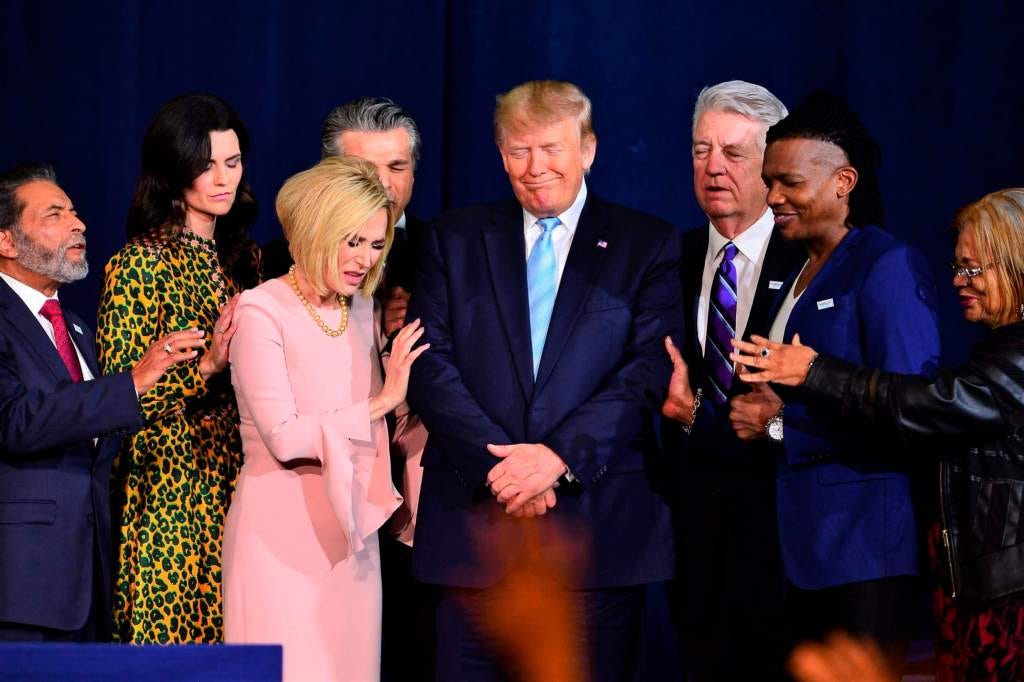
Within days of the missile and air attacks on Iran, the Military Religious Freedom Foundation – the watchdog organisation that documents the creeping theocratisation of the US Armed Forces – reported that, as the assault was launched, combat-unit commanders told non-commissioned officers that the Iran war was part of God’s divine plan, and that President Trump was “anointed by Jesus to light the signal fire in Iran to cause Armageddon and mark his return to Earth”.
Just so you know, Armageddon is a real place – the Greek rendering of the Hebrew Har Megiddo – a dusty hill in northern Israel where, as archaeologists have revealed, real conflicts from the Egyptians to Napoleon have been fought for more than 4,000 years.
These paranoid apocalyptic delusions among right-wing American evangelicals are a vocal force in Trump’s base.
Paranoid apocalyptic delusions among right-wing American evangelicals are a vocal force in Trump’s base
War Secretary Pete Hegseth often plays into these tropes of Christian Zionism and courts its core preachers. Republican Senator Kevin Cramer echoed the ideology by claiming the war on Iran as a “biblical responsibility”.
Like Nigel Farage and other Trump cheerleaders who talk of ‘Judeo-Christian’ civilisation, it is worth remembering that the evangelical final ‘rapture’ concludes with the Judeo element erased (again). Only the Jews who convert to Christianity are saved.
As the National Council of Churches noted in 2007, Israel is loved and bankrolled by American evangelicals, not as a democracy, but as a stage set for a drama in which Jews are expendable and “mere pawns in an eschatological scheme”.
Steve Bannon – Farage’s mentor, and Trump’s former White House chief strategist – has his own version of this eschatology. He believes in a cyclical historical crisis and that we’re now entering a ‘fourth turning’ of racial war and violent rupture before a great renewal.
His Russian contemporary and soulmate (they met in Rome in 2018 and talked for eight hours), philosopher Aleksandr Dugin, believes in something very similar – a ‘fourth politics’ beyond fascism, democracy, and socialism, which will be led by Russian orthodoxy as a ‘katechon’ or shield against the false messiah of liberalism.
Bannon and Dugin’s only major disagreement is over the final role of Judaism and Islam in the end times. The Russian believes Iran is a key ally against the Anti-Christ, while the co-founder of Cambridge Analytica characterises Iran as an enemy – a disagreement that also mars Trump’s otherwise close alignment with Vladimir Putin on most things.
But any potential fissure here, at least in Trumpworld, has been bridged by the arrival of the Silicon Valley PayPal mafia, its billions, and its strange ‘Dark Enlightenment’ set of beliefs, which sees the economic and social ruptures caused by big tech as just the start of a revolution against liberal democracy.
Primus inter pares among the tech bros is Peter Thiel, a key investor in Facebook, co-founder of the data surveillance giant Palantir, and a major supporter and commercial beneficiary of the war against Iran.
Thiel has recently been touring the world giving lectures on the coming of the Anti-Christ. From reports, he is unsure whether the false messiah is Greta Thunberg or AI regulation, but – inspired by a misinterpretation of Stanford teacher Rene Girard, who also influenced Dugin and Bannon – he seems to be convinced that there must be some mass slaughter, some ritual sacrifice of ‘scapegoats’, for a corrupt society to renew itself.
For his fellow broligarch, SpaceX founder and Tesla CEO Elon Musk, that sense of purity through bloodshed is even more explicit. The X owner is frequently tweeting that civil war is “inevitable” in the UK and the rest of Europe because of its multiculturalism.
It’s an open question whether the broligarchs and their far-right acolytes actually believe in a ‘final battle’, a racialised version of Armageddon when ethnicity and culture will separate us into ‘sheep’ and ‘goats’, but the very invocation of the conflict – the mental polarisation that happens when humanity is categorised into ‘us’ and ‘them’ – has long suited the divide-and-rule playbook of right-wing populism.
In this way, doomsday is effective even if it never comes. The literary critic Frank Kermode, in his canonical study of apocalypses, The Sense of an Ending, argued that Judgement Day is not imminent but immanent: perpetually looming, never quite landing, because its function is not prophetic but psychological.
Kermode also made a trenchant point about the difference between disaster movies and millennial myths. Fictions are a ‘let’s pretend’ suspension of disbelief, so their ends demand only a conditional kind of assent – unlike the absolute assent demanded by religions and ideologies.
So here’s the rub. Whatever the memes, many of Trump’s followers, and apparently some of his military commanders, actually believe we are heading to the end times. And for the new leadership of Iran, the conflict is a matter of life and death, and a genuine doomsday for its ideological regime.
When the dust finally settles, what cost will we have to pay for this spectacle of fire?
Peter Jukes is Co-Founder and Executive Editor of Byline Times
This article appears in edition #84 of the Byline Times monthly magazine
I think they’re too cynical to actually believe in Armageddon. With the exception of the evangelists and the Zionists. Trump being Jesus for instance is just….farcical even by their standards. I think they’re excited by the possibilities of using it as means of control. Sowing conspiracy theories has been such a useful strategy.
Good analysis, and very worrying. But as Alan Rusbridger wrote this morning in the Indy and as many of us have been saying for several years. “He’s nuts”. And also suffering from dementia, which, as happened with my mother for a time can accentuate a person’s worst characteristics and diminish inhibitions.
Another issue is that MAGA is a cult and Trump, the cult leader is the all-knowing all seeing font of all wisdom, is never wrong and must always be obeyed. And once you are a member of a cult it is almost impossible to escape back to normality.