



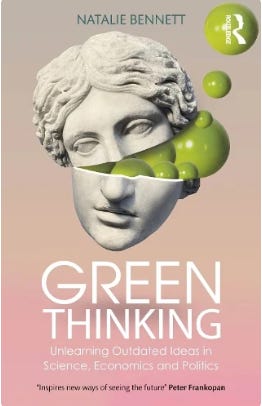
From her position on the comfy red benches in the House of Lords, former Green Party leader Natalie Bennett is planning nothing short of a revolution. As she reveals in her new book Green Thinking, Bennett (aka Baroness Bennett of Manor Castle) doesn’t have armed struggle in mind; more a complete transformation in how we see the world — a change she hopes will infuse our politics.
In an interview with the Byline Times Podcast, she says it’s time to dispense with many of the foundational thinkers of western cultural and economic tradition, whose perspectives promote conflict rather than co-operation. “There’s so many things that we were taught at our mother’s or grandmother’s knee, that we were taught at primary school and secondary school; things we now know to be untrue, but they still are really pervasive in society. I hear them in the House of Lords all the time.”
As an example, Bennett cites 19th Century naturalist Charles Darwin, whose understanding of the ‘survival of the fittest’ has been used since Victorian times to bolster the idea that ruthless economic competition is the natural order of things. Bennett points out that the more modern research of evolutionary biologist Lynn Margulis offers a powerful alternative view — one in which all life on earth is interdependent.
Bennett explains that, “In the 1960s and 70s, Margulis came to understand that mitochondria — powerhouses in the cell that keep your body going — and chloroplasts - which collect the sun’s energy and put them into sugars - were originally independent organisms.”
Their mutually dependent evolution, “built the whole foundation of life on Earth. The technical term for this is symbiosis, but what it really means is cooperation. So if we start to think about what’s the whole foundation of life on Earth — our life, other living things — it’s cooperation.”
This sounds like a simple, perhaps even uncontroversial premise, but its runs directly counter to the profit-oriented, extractive essence of capitalism. Bennett’s deep research builds out from here into a narrative which challenges the view that previous civilisations were somehow inferior to our work and money-oriented milieu.
“There’s this stereotype of ‘primitive man’, but actually in what we call hunter-gatherer societies, the best evidence we have suggests they worked four or five hours a day, and had the rest of the day to care for the children, to sit around the fire and have a yarn, to have a really pleasant life. When we started what we call farming, human health and well-being actually went down.”
Bennett draws on archaeological evidence to suggest that indigenous populations in both North America and Australia carefully cultivated and managed their land in ways that counters the offensive, and now outdated, stereotypes of what were portrayed, for generations, as ‘backward’ societies. In Australia, for example, Aboriginal people grew a staple crop called murnong, “and then the white settlers brought in sheep and cattle that just ate the whole thing out and destroyed it. One of the really big things we’ve got to tackle is the idea that people in the past were stupid or dumb or primitive. We’ve been around on this planet for about 300,000 years. People from that time were just as smart, just as innovative as we are, and there are things we can learn from those indigenous communities.”
As well as questioning the West’s contemptuous treatment of other cultures, Bennett also recoils at our treatment of other species, and tells a story to illustrate the intelligence of dolphins. “A researcher who was working with dolphin mothers and babies found that when it was time for the kids to stop playing and go off and have lunch, the dolphins would signal to her, as the chief of the researchers, that it was time for her to stop and get her people to stop playing with their babies.”
She marvels at the “level of sophistication involved in understanding human hierarchy” among the dolphins and observes that “we’re starting to acknowledge animal feelings. One of the things that that challenges hugely [is] both factory farming — what we are doing to pigs, to chickens, etc — and it also challenges what we do to animals in laboratories. We’ve discovered recently [that] rats and mice sing to each other just like we can. All of those horribly mistreated rats and mice in laboratories are singing to each other in the same kind of way. And if you really know that and think about that, then you really have to start to think about the world differently.”
Bennett’s book can be seen as an informed broadside against many established cultural preconceptions, but it’s also a clarion call for radical change in our politics. How likely is her latest successor as Green Party leader, the ‘eco-populist’ Zack Polanksi, to achieve that?
“Zack’s doing a great job. What he’s communicating has always been the Green Party political philosophy — that economic and environmental justice are indivisible. That’s our absolute foundational thinking. And the way I express green philosophy, which very much reflects what Zack says, is there’s enough resources on this planet for everyone to have a decent life, for us to look after climate and nature, if we share those resources out fairly.
“We’re also at a point where society is really ready to listen, and people are looking for an alternative to Reform. People want hope, they want inspiration, and politics is increasingly turning into Green versus Reform. That’s where we’re at, and Zack’s doing a great job of lifting us up to be able to rival Reform.”
Watch or listen to Adrian Goldberg’s interview with Natalie Bennett here.
Green Thinking: Unlearning Outdated Ideas in Science, Economics and Politics by Natalie Bennett is out now published by Routledge.