

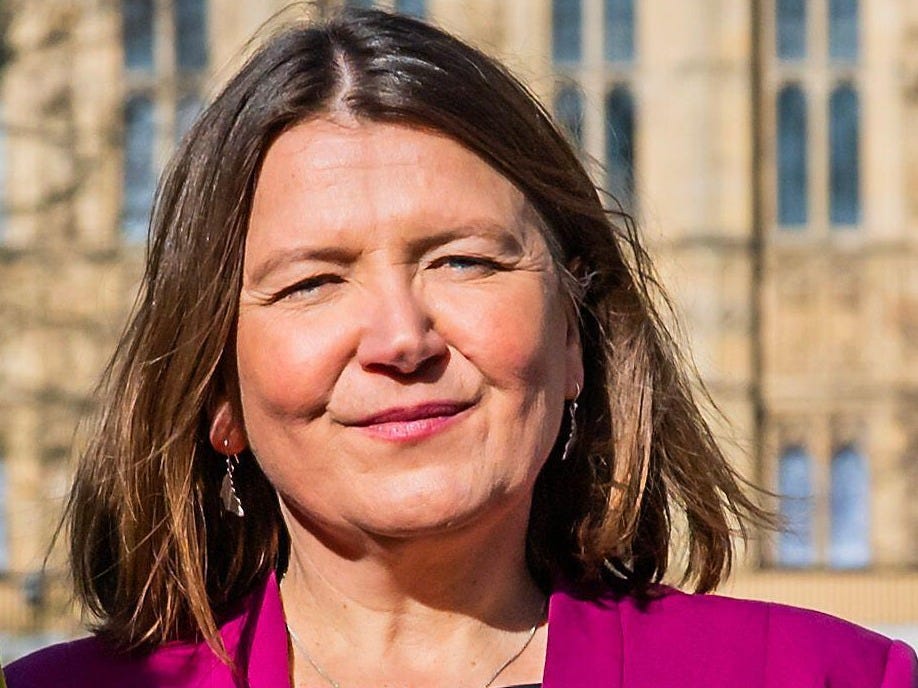
When Foreign Secretary Yvette Cooper announced details of the 40% cut to the UK’s overseas aid budget last week, she explained the savings would be redirected to defence – but Green MP Ellie Chowns has told the Byline Times Podcast that diverting spending away from some of the poorest people on earth is “short sighted and incredibly damaging”.
Chowns, an international development specialist who has worked in Uganda, argues that ministers need to look beyond stocking up on military hardware and take a more holistic view of national security.
“We’re not thinking really strategically and long term about the security threats that are faced by the UK indeed the world as a whole,” she said. “Putting more money into guns and bombs or even boots on the ground is not necessarily the sort of investment that will make us more secure.
“I think we need to think about this ‘security’ framing. Too often these discussions are had under the umbrella of defence, which tends towards thinking about military investment, but if we speak even to senior leaders in the military, they recognise that we face security challenges that are not getting enough attention.”
She cites last year’s cyber attack which paralysed Jaguar Land Rover and cost the Birmingham-based car maker almost £2 million in lost production as an example of the asymmetric warfare the UK now faces.
Noting a recent report by the UN’s weather agency, which concluded that the planet’s climate is “more out of balance than at any time in observed history”, she added “we’re facing a hugely damaging security challenge in relation to the climate crisis barreling down the road.”
Chowns believes the Government should be focussed on these challenges, rather than being dragged into the Middle East conflict, “on the coat-tails of Trump and Netanyahu.”
She points out that the biggest killer of UK citizens in recent years wasn’t a foreign state, but the Covid 19 pandemic – and notes with concern a 15% reduction in the UK’s contribution to the Global Fund to fight AIDS, malaria and TB. While ministers have designated a greater role for private investment in international development, Chowns would prefer a different emphasis, based on “a fundamental human recognition of our common humanity.
“Aid is sometimes a bit stuck in a frame of mind dating back a long time to when the UK still had colonies. I think we need to be thinking about international aid as solidarity, as something that is done in partnership.”
There’s a widespread perception among mainstream commentators that overseas assistance is unpopular with voters – and it certainly riles columnists in right wing newspapers. Chowns acknowledges that, “if you do a national survey [asking] ‘do you think the UK spends too much on aid’, people may say ‘yes’ – but it’s probably because they’re making assumptions about aid being a much larger proportion of Government expenditure than it is.
“It is now less than 1% of Government expenditure and if you look at the way the British public chip in when we have big public events like Comic Relief, for example, people are very, very generous. People really understand that if they’re putting their money to something that is going to transform somebody’s life, enable girls to go to school, enable people to have access to clean water – that’s the sort of thing that the British public really do understand and absolutely want to invest in, recognising that this is a long term investment in building a fairer world, which ultimately is going to be good for everybody.”
Before Labour won the 2024 election, it made an manifesto pledge to restore spending on overseas aid to 0.7% of Gross National Income, a figure established by David Cameron’s Government in 2013 in spite of austerity, but subsequently reduced by Boris Johnson to 0.5% and now cut again by Keir Starmer’s Government to just 0.3%.
“It’s honestly unbelievable that a Labour Government is slashing aid so significantly,” Chowns observes. “It’s completely counter to everything that Labour supposedly has stood for, for many, many years, and also completely counter to the sorts of things that Keir Starmer himself was saying not so long ago.”
Chown’s views have have been widely echoed in the aid community and even by several backbench Labour MPs, including Sarah Champion, chair of Parliament’s International Development Committee, who described the cuts as “brutal”. Gideon Rabinowitz, Director of Policy and Advocacy at the development NGO Bond told the Byline Times Podcast that some impoverished African countries would be hit particularly hard. He explained that in Malawi, there are “still hundreds of thousands, if not millions of young people who still don’t have access to schooling,” and that following the UK cuts, “the estimate is that a quarter of a million young people will lose access to family planning services, and 20,000 children risk dropping out of school.”
Rabinowitz welcomes the UK’s decision to ring fence spending in Ukraine, Palestine, Lebanon and Sudan for the next year, but warns, “it excludes some countries where humanitarian needs are very, very significant as a result of conflict, as a result of drought, or because of climate change. Somalia is a country that’s not on that protected list; South Sudan, where there’s been a devastating civil war, is not on that list; Myanmar, where there are very significant needs. These are countries where there are going to be disproportionate cuts to programmes, because they are not being ring fenced for protection.”
Listen to the full interview with Ellie Chown and Gideon Rabinowitz talking to Adrian Goldberg on the Byline Times podcast here. Also available via Apple podcasts.