
A Guest Post from Rachel Shabi’s Stack
In recent months, antisemitic violence in Britain has surged. There have been stabbings on the streets, arson attacks, and assaults on synagogues, which have instilled horror and fear among this country’s small, close-knit Jewish community. The political response to these attacks has involved right-wing leaders rushing to blame the left and the Prime Minister suggesting a ban on pro-Palestine marches. All this has poisoned the debate—and it is clear that progressives are struggling to navigate this conversation amid the noise.
There should be no doubt that it is antisemitic to direct anger about Israel’s actions towards Jews in Britain. It is also true that the scale of the current antisemitism crisis is related to the scale of what is happening in the Middle East. Even those sympathetic to Israel argue that its devastating conduct in Gaza and the wider region is making Jewish people unsafe, as the columnist Rob Eshman put it in The Forward, which reports on American Jewish life. Or as New York Times columnist Thomas Friedman has written, the enormity of Israel’s war on Gaza is forcing Jews to reckon with the reality of being “Jewish in a world where the Jewish state is a pariah state”. He warned that the moral stain of Israel’s violence in Gaza could generate backlash against Israelis and Jews everywhere.
Again, the unconscionable severity of Israel’s Gaza assault, described as genocide by a growing list of experts, does not justify heinous attacks on Jews. It does, however, help to explain the context in which antisemitism is rising, and this cannot be left unspoken. We are in need of a common language that can bridge these two truths without suggesting that Jewish people are in any way to blame for the antisemitism they face. Failing to find this language will make a muddled debate only worse. And it will feed a climate of competition between minorities where antisemitism festers, Islamophobia – also at alarming highs – abounds and people grow mistrustful and siloed.
What makes this discussion especially fraught is that, just as antisemitism is rising, so too have politicised accusations of antisemitism, which are invoked to stifle criticism of Israel’s atrocities in Gaza and elsewhere. Such claims have in recent years been wielded against many speaking out over the Gaza war, from the popular children’s entertainer Ms Rachel to pop singers to the UN. Israel’s former foreign minister, Israel Katz, for one, described the latter as “an antisemitic and anti-Israeli body”. Such claims have chilled speech and had an impact in lost jobs, cancelled platforms, trashed reputations and even threats of deportation.
This climate has unfortunately helped to fuel a dangerous suspicion towards claims of antisemitism. We are seeing, amid progressives, noxious instances of prejudice against Jews, such as a Green party local election candidate suggesting that ramming a synagogue “isn’t antisemitism It’s revenge”, or that arson attacks on Jewish ambulances are false flag operations. And we are seeing dismissals of genuine incidents of antisemitism, rooted in knee-jerk assumptions that such claims must be an attempt to silence criticism of Israel. While raising the alarm over such instances of antisemitism is essential, we cannot simultaneously ignore the corrosive effect of the politicisation of antisemitism.
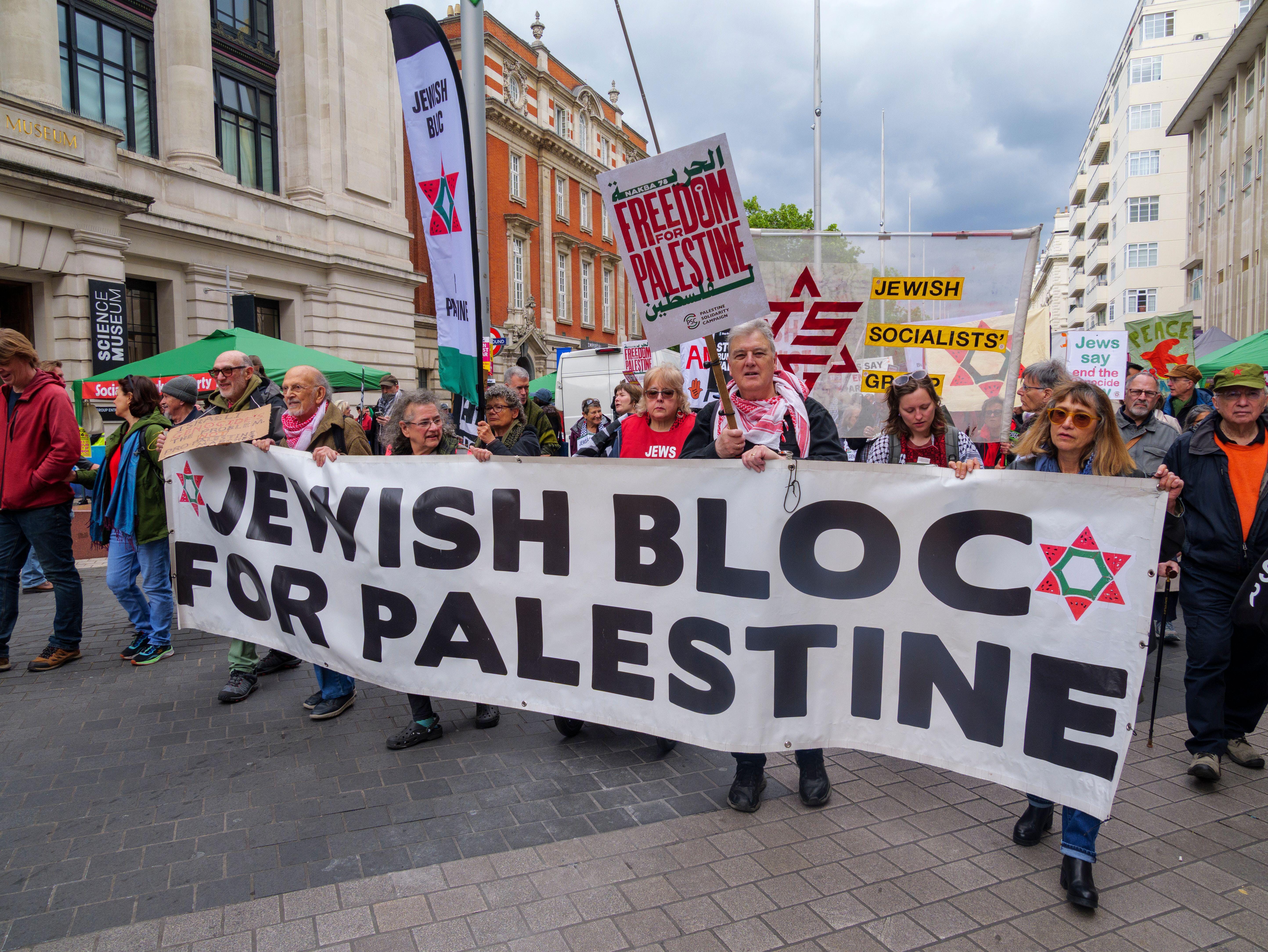
The rush to ban Gaza marches should be viewed in this context. Labelling protests in solidarity with Palestinians as hot-beds of antisemitism tars millions of people who are quite simply appalled by Israel’s violence in Gaza and want it to stop. It impugns the motivations of the many on the basis of the reprehensible placards of a tiny few. It sends a signal that people cannot both support Palestinians and extend solidarity to British Jews, as though we must make a choice. It would also put a Jewish face on authoritarian measures pushed by the government.
We must reject every part of this equation. It is entirely possible – in fact vital– to hold compassion for a fearful Jewish minority facing violent antisemitism, while rejecting the way such fears can be manipulated for political ends.
Predominantly a conspiracy about power, antisemitism arises in moments of crisis. Jewish people are ascribed outsized influence as a way of deflecting onto this community the responsibility for social and political ills around the word. It should not surprise us, then, that a conspiracy about outsize Jewish power surfaces across the political spectrum in critiques of a Jewish-majority nation. Antisemitism, to the detriment of us all, is common and dangerously close to the surface of society. And we are in a prolonged crisis. People struggle to comprehend why Western governments support Israel, despite the country’s repeated war crimes and injustices toward Palestinians. Absent a clear, accessible geopolitical analysis that understands these alliances as grounded in strategic interest and material gain, conspiracies about Jewish control of governments or media have flourished.
Yet there is something else at play here, too. When Western governments that funded, facilitated and covered for Israel’s catastrophic war in Gaza also use antisemitism as a pretext for censorship or to limit the right to protest, this combination of policies and political rhetoric sends a terrible message over whose lives are viewed as valuable. The destruction of Gaza connects to the hostile, if not outright hateful, way that Palestinian, Muslim and Arab lives are routinely treated. Western political tolerance for gruesome violence against Palestinians in Gaza has been a clear indication that people who look or pray a certain way are not viewed as equal, or equally worthy of life.
This same dynamic plays out domestically. Antisemitism is rightly a Government priority amid a spate of attacks: proportional to population, Jewish people are experiencing the highest rate of hate crimes in the UK. Yet Islamophobia is also at record highs, in terms of overall incidents, and is not treated in a commensurate manner at a political level. No Government serious about antiracism should create such disparity. At the same time, antisemitism from the right does not attract nearly the same amount of media attention. No society serious about tackling racism should display such hypocrisy.
Acknowledging of all these factors is key, not just to resisting injustice across the Middle East, but to consolidating an antiracist coalition. This struggle has to cohere across all communities living in fear of racism and bigotries. Solidarity must be forged in the understanding that all racism, whether that be anti-Black racism, antisemitism, or Islamophobia, is the creation of the unjust systems that govern us, and that we yearn to change.
Rachel Shabi’s book, Off White: The Truth About Antisemitism is published by OneWorld