


BYLINE TIMES IMPACT: Find out about the changes you made happen
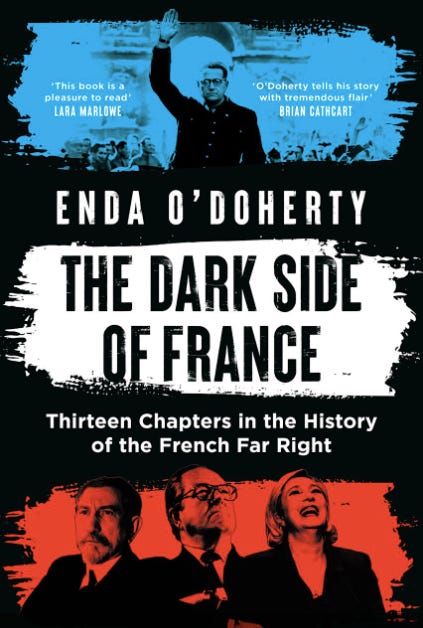
France is hardly unique among developed European nations in accommodating the far-right within mainstream political thinking, but the persistence of racism and xenophobia is a strikingly persistent feature of its public life, dating back to the Dreyfus Affair in the late 19th Century. Irish journalist Enda O’ Doherty traces this troubled history in his new book, The Dark Side Of France, which arrives at a timely moment, given the recent legal appeal which cleared Marine Le Pen to stand in next year’s Presidential elections, despite being found guilty of misusing EU funds.
In an interview with the Byline Times Podcast, O’Doherty identifies a shape-shifting quality to the French far-right, saying “I wouldn’t argue that it has been the same since the 1890s. There are many strands to it. For a long time, its chief hope was to restore the monarchy, which had been toppled by the French Revolution.”
Yet through its various iterations – whether the anti-semitism which led to the wrongful conviction of former army captain Alfred Dreyfus for treason in 1894, through to the racism which resisted Algerian independence in the 1950s and 60s, and in more recent times the anti-Muslim sentiment of Le Pen’s National Rally movement – O’Doherty does detect a consistent thread. “The thing which I think unites the far right from at least the 1890s onwards is this slogan, ‘La France aux Français’ – France for the French – and that is very much what [Le Pen’s] Rassemblement Nationale stands for now.”
This definition of ‘Frenchness’, he says, is based on being white and Christian, with a Roman cultural heritage: “Anyone who didn’t fit with that – the Jews in the 19th century and throughout the 20th century until 1940; and since the 1970s and 80s, the immigrant community from North Africa who are chiefly Muslim in religion – these are both seen as extraneous elements who don’t really belong.” This othering extended to Italians who came to settle in the South East of the country, Poles who worked the coal mines of the North East, and the Spanish who fled the civil war of the 30s.
O’Doherty argues that while modern French may look integrated - with substantial numbers of non-white citizens in evidence on the streets of Paris and other major cities - “many of them, in fact, don’t feel that they’re accepted as fully French. They even use the term ‘the French’ to refer to other people.” This, he says, is particularly true amongst Muslims, whose traditional modes of dress including the hijab (head covering) and abaya (long flowing robes) have been restricted in schools.
“When the far right talks about it, every Muslim is an extreme Muslim, a radical Muslim,” O’Doherty comments. “That is very far from being the case. There are Muslims who go to the mosque every week. There are Muslims who don’t go to the mosque every week. There are Muslims who go to the mosque where the imam is a perfectly reasonable person. There are some Muslims who go to the mosque where the imam is a radical. There are some young Muslims who are more interested in football and rap music than in anything to do with the traditional tenets of their religion. There is great variety. People can’t all be tarred with the same brush.”
For decades after 1945, referencing the Vichy regime’s collaboration with the Nazis during World War 2 was taboo, helping restrict the spread of far-right sentiment, but the movement gained fresh energy under Jean-Marie Le Pen, who downplayed The Holocaust and made derogatory statements about Muslims. He was expelled in 2015 from the National Front, the party he founded, by his daughter Marine, whose rebranded RN is in a strong position ahead of next year’s scheduled presidential election.
O’Doherty says that if she wins, “I think it won’t be good for minorities in France because she and her party make absolutely no secret that they are interested in ideas like repatriation, or confining welfare benefits to people who are ‘vrai Français’ [true French] as they define it. So it won’t be good at all, and it could possibly cause civil unrest, as there could well be pushback to measures that the far right might seek to introduce.”
He acknowledges that a republic founded on the principles of ‘Liberté, Égalité Fraternité’ has also staunchly resisted these trends in the past, citing as his one of his heroes the three-time Prime Minister Léon Blum, a socialist whose Popular Front Government denounced the appeasement of Nazi Germany and granted workers new rights to paid annual leave. “In 1936 there was a landslide for an alliance of the parties of the left and centre, which led to the Popular Front government,” O’Doherty recalls. Then there was wartime resistance leader Charles de Gaulle, later France’s President, who, “in a rather calculating, crafty way, outmanoeuvred the far right in the late 50s and early 60s. So, for a long period, [the far right] was there, and it was unpleasant, but it didn’t represent the soul of France – which I think has very, very many positive aspects to it, too. And I hope that they [the forces of resistance] will continue to prevail.”
You can watch Adrian Goldberg’s interview with Enda O’Doherty on the Byline Times Podcast here.
Might look at Poland next - a dark side before WW2 and during and don't forget Britain's refusal to home more Jewish refugees. But apart from antisemitism stories from France which we all need to be reminded of, and the Vichy regime colluded with the Nazis, many of the dead- Jewish children, do please for heavens sake resist the vicious propaganda coming from Israel over the genocide in Gaza. I loathe Israel for its lies and what it has done to others and their hatred of Palestinians which is doing to others what was done to them and lying about it in plain sight. And while talking about France, don't forget the sacrifices of the Resistance and Oradore Sur Glane, the village that in a Nazi revenge action, saw the slaughter of all the inhabitants- men women and children.
Sounds like the book will be very interesting! How did “Charles De Da Gaulle” creep in? It’s a lower case “d” for the particle, btw.