

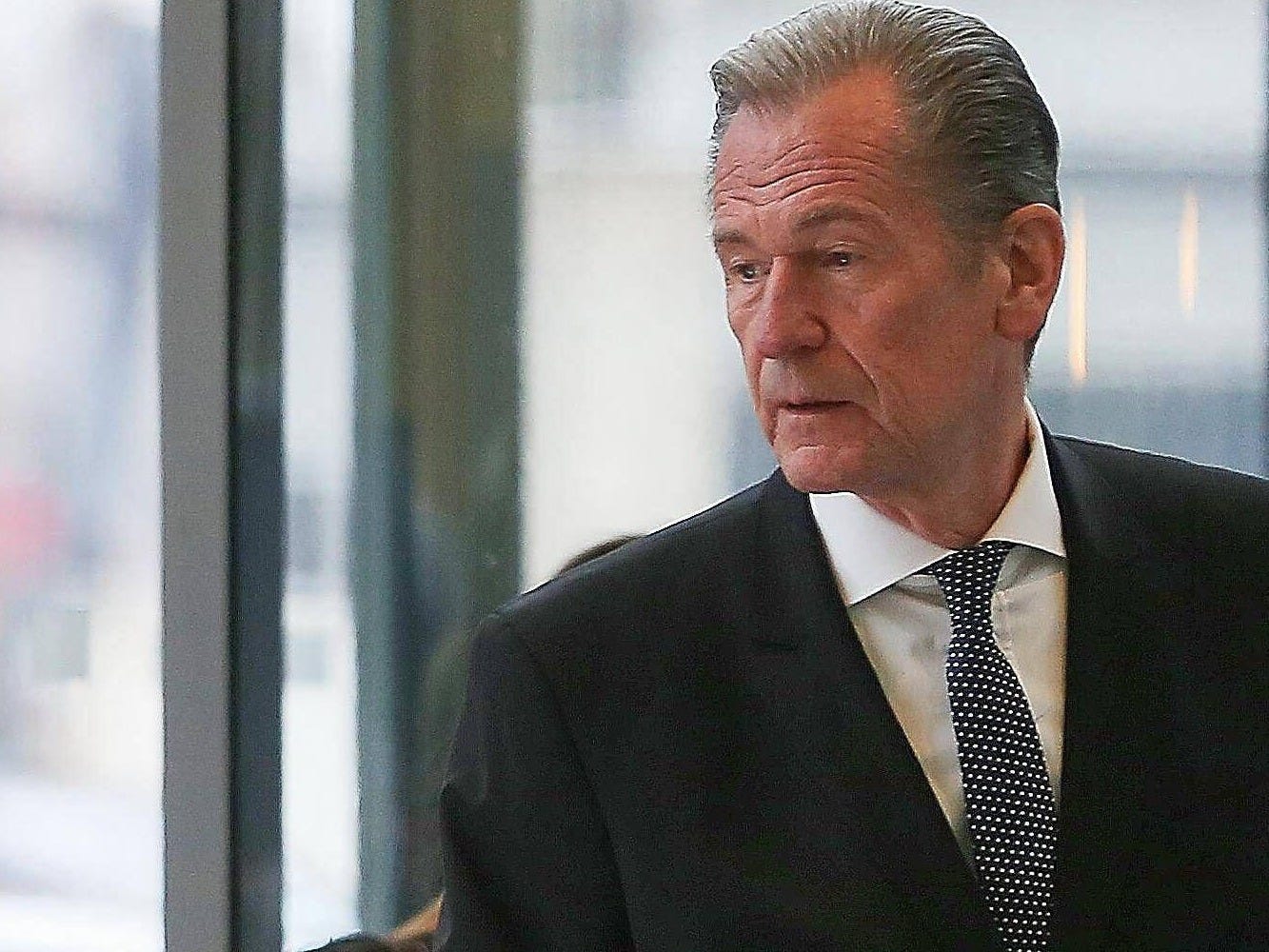
So, the EU-hating Telegraph titles have been acquired not simply by a German company – Axel Springer SE – but by one that was strongly opposed to Brexit. The company already owns Die Welt, Bild, Business Insider, Politico and the best-selling Polish red-top Fakt, which is closely modelled on Bild. However, the ironies are nothing like as acute as some initially supposed, and it appears to be perfectly clear that the new owner does not intend to change the paper’s political and ideological orientation.
As Springer’s part-owner and CEO Mathias Döpfner stated when the takeover deal was announced, the German company was founded in 1946, “inspired by the tradition of Fleet Street”. Vouchsafing that he regarded the Telegraph as an “institution of quality British journalism”, he continued:
“We want to grow The Telegraph, while preserving its distinctive character and legacy, to help it become the most read and intellectually inspiring centre-right media outlet in the English-speaking world. The Telegraph stands for freedom, personal responsibility, democratic values and a belief in open societies and market economies. These convictions closely align with our Axel Springer essential values.”
These values, to which employees have to sign up, are laid out in the company’s constitution and include advocating “the alliance between the United States of America and Europe”, supporting “the right of existence of the State of Israel” and opposing “all forms of antisemitism”. Indeed, the company has flown the Israeli flag over its HQ since 7 October 2023.
The fact that Döpfner has offered such a high price for the Telegraph Media Group (TMG) titles – £575m, when by common consent a more realistic price would be £350m – raises the question of why he wants them so badly, particularly as many would no longer regard them as representing either “quality British journalism” or “centre-right opinion”. Of course, as the history of the national press in Britain demonstrates all too clearly, newspaper proprietors are perfectly prepared to take an economic hit on their titles as long as they can use these as a megaphone for their views and to boost their other economic interests, and Döpfner’s admiration for “the tradition of Fleet Street” would appear to put him in the same camp.
Döpfner’s stress on the future growth of the Telegraph titles in the “English-speaking world” suggests very strongly that he wants to increase its transatlantic reach, and this is confirmed by his promise that “Axel Springer will turbocharge the expansion of TMG into the United States market, leveraging the significant expertise of its media brands Politico and Business Insider”. Part of the plan, presumably, is to appeal to those American readers for whom the main news networks and papers such as the New York Times are too liberal.
However, with CBS and the Washington Post increasingly kowtowing to Trump, Döpfner may discover that market segment is now better catered for on the home front. Furthermore, particularly for older Telegraph readers of the Sir Herbert Gussett tendency, there may be a limit to how many more articles they want to read by American commentators and politicians (along with their British hangers-on) slagging off the UK as a hellhole of crime, decline and Islamic terrorism.
One also wonders what such readers – not to mention Telegraph journalists – will make of Döpfner’s claim that “TMG will be able to access Axel Springer’s successful track record in developing journalism in a digital and AI world, as well as commercial expertise in areas including digital advertising, subscriptions and events”. In this respect, it’s worth remembering that in 2023 the conglomerate decided against bidding for the Daily and Sunday Telegraph because its focus was on a “digital first, digital only” acquisition strategy. As Döpfner stated at the time:
“We want to be faster, more agile and less bureaucratic. We are digital and transatlantic. But we need to strengthen the role of technology as a critical success factor. We need to understand and harness the power of artificial intelligence faster and better than our competitors.
We need to become even more market, customer, and revenue-focused than before. These priorities must be our focus if we want to be the leading transatlantic media company for digital journalism and related business models.”
But what can we expect of the political stance of the Telegraph titles under Döpfner? Jane Martinson has noted that “his reputation has prompted fears among some that he will seek to promote the wilder excesses of the newspaper’s most recent journalism – an anti-migrant stance that would work in the market he most wants to conquer, the US”.
To put it bluntly, will he want to accommodate the ravings of the likes of Alison Pearson and Allister Heath?
Reputation
Before we go on to consider his personal reputation, there’s also the matter of the reputation of his company.
Döpfner, as noted earlier, has expressed admiration for the “tradition of Fleet Street”, and this of course includes a great deal of hostility to the left. Such hostility was also glaringly evident in the flagship Springer title, Bild-Zeitung, in the 1960s and 1970s. The sheer intensity of what can only be called the company’s hatred of the left was frighteningly captured in Heinrich Böll’s 1972 novel The Lost Honour of Katharina Blum, which concerns the victimisation of a supposed ‘subversive’ by the fictional Die Zeitung, which is very clearly modelled on Bild-Zeitung. This was made into a film by Volker Schlöndorff and Margarethe von Trotta and is also referenced in the title of the ITV drama The Lost Honour of Christopher Jefferies, which is another story (this time a true one) about press persecution of an entirely innocent person.
And in 1977 the investigative journalist Günter Wallraff (as ‘Hans Esser’) worked undercover as an editor for Bild in Hanover, describing his unpleasant experiences in Der Aufmacher and Zeugen der Anklage. They also feature in his edited collection The Undesirable Journalist and served as the basis for the 1990 film The Man Inside. What Walraff found at Bild on the part of his colleagues was a contempt for humanity, a lack of respect for people’s privacy and widespread unethical behaviour. Mic Wright quotes him as admitting that “I believe it’s the most difficult role I’ve ever played. Compared to that, backbreaking, dirty work in a factory on an assembly line is almost a relief. Because with this filth you’re exposed to here, you have no distance, no defence mechanisms”.
All a long time ago, Springer’s defenders will no doubt immediately retort. But the company’s more recent history, and in particular the political and ideological leanings of its CEO, suggest more than a few disturbing continuities with the past. That these were actually aired in December 2024 by, er, the Telegraph, which Springer had long had in its sights, strongly suggests that there were those in the TMG who did not always think of it as the ideal owner. Alan Rusbridger has helpfully identified the main articles (which can be found here, here and here) and also drawn attention to a revealing Guardian piece as well.
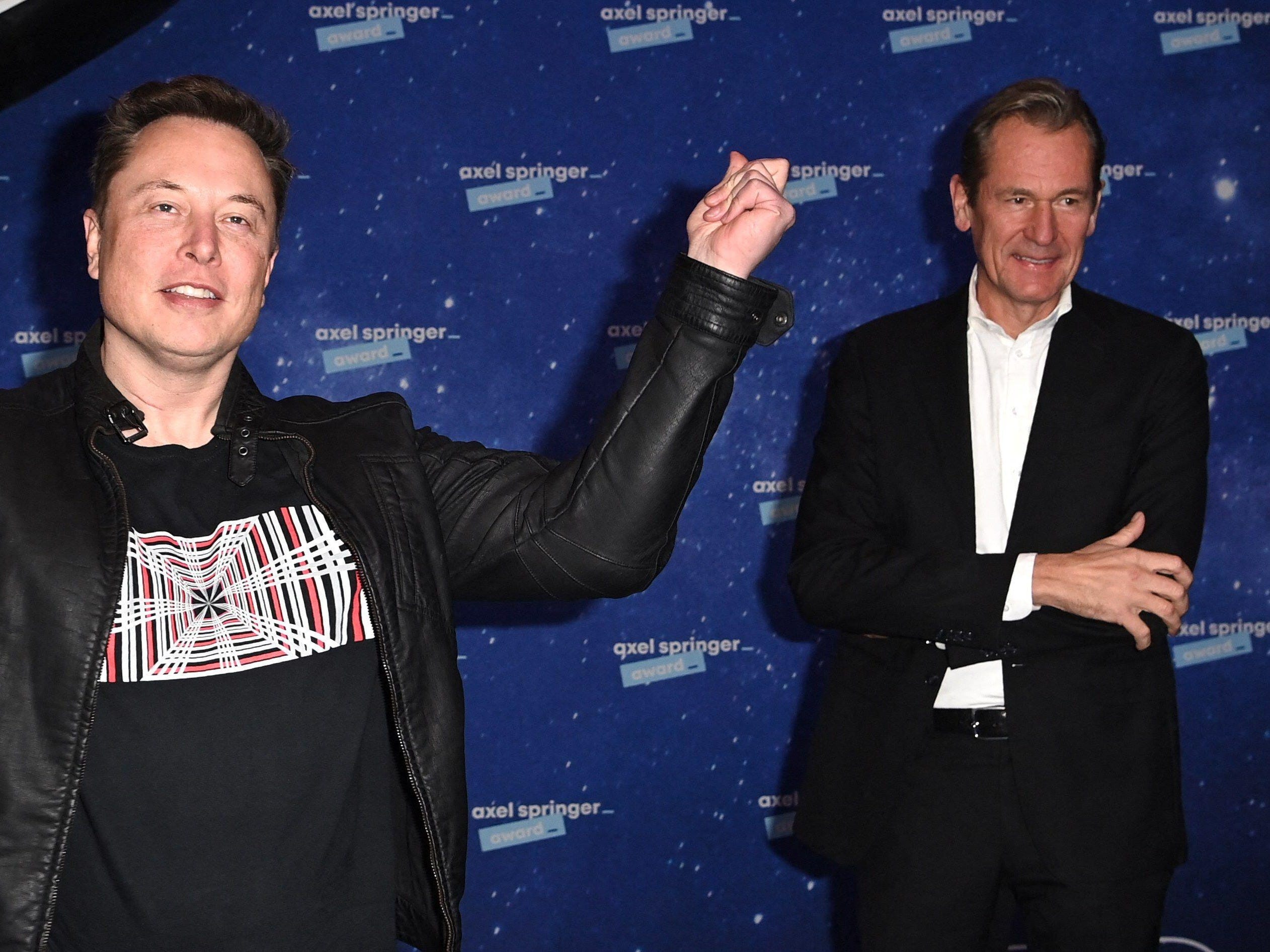
Taken together, these reveal that just before Christmas 2024, Döpfner encouraged Musk to tweet in support of Alternative für Deutschland (AfD), a party officially classified as ‘right-wing extremist’ by Germany’s domestic intelligence agency. Musk duly tweeted: “Only the AfD can save Germany”. This, the Telegraph reported, was part of a stratagem by Döpfner to get his own paper, Die Welt, to publish an article by Musk supporting the AfD, and this followed in Welt am Sonntag.
In the article, Musk stated that Germany’s traditional parties were responsible for economic stagnation, social unrest and the erosion of national identity, not least by opening the country’s borders to large numbers of migrants. By contrast, the AfD, which Musk denied was far right or extremist, was “committed to a controlled immigration policy that prioritises integration and the preservation of German culture and security” and to “ensuring that Germany does not lose its identity in the pursuit of globalisation. A nation must preserve its core values and cultural heritage in order to remain strong and united”. Musk also claimed that “the AfD can save Germany from becoming a shadow of its former self” by spurring economic prosperity, cultural integrity and technological innovation. (Significantly, Tesla has built its first European gigafactory in Brandenburg, which is strongly AfD territory).
The paper’s editorial board fiercely opposed the publication of the article, which appeared with a highly critical response by the paper’s editor-in-chief Jan Philipp Burgard. And the head of the opinion section, Eva Marie Kogel, resigned.
It’s important to understand that up to this point there had been a tacit consensus among German media outlets that they would not give the AfD a sympathetic platform, which parallels the firewall (Brandmauer) amongst Germany’s political parties against working with the far right. This too is weakening, however.
A comment piece in the Telegraph by the German-British historian Katja Hoyer drew a comparison between Musk’s promotion of the AfD in a mainstream newspaper and the uncritical fashion in which the National Socialist party had been treated during the last years of the Weimar Republic in the newspapers belonging to the media magnate Alfred Hugenberg, the Rupert Murdoch of his day, who served briefly as the minister for both agriculture and the economy in Hitler’s first government. Döpfner, however, was, and remains, unrepentant, telling the Sunday Times in June 2025 that Musk is “clearly a genius” and that the article was a “global scoop … we should be proud about it and not apologise”.
Normalising the AfD
In April 2024, the Springer-owned WELT TV staged a live debate between the leading candidates of the Thuringian AfD and the Christlich Demokratische Union Deutschlands (CDU), Björn Höcke and Mario Voigt respectively. Giving the former airtime was particularly controversial as he had been found guilty by a court in the eastern city of Halle of using the Nazi slogan “Alles für Deutschland!” at an AfD rally in May 2021. Significantly, before the debate, the company felt it necessary to raise the issue of breaching the media Brandmauer, arguing that:
“The approach that prevailed in most German media for years, largely avoiding mentioning the AfD to deny them a platform, can be considered failed in light of their rising poll numbers. Especially since AfD politicians address a large audience via social media – unfiltered, uncommented, and unchallenged.”
Thus, the company decided, in its own words, to “treat them as a democratically elected party as journalistic practice requires: scrutinize their statements critically, factually, and contextually. Show the viewers as accurately as possible what the two lead candidates of the CDU and AfD stand for”.
Or, as some might see it, normalise the AfD.
Later that year, in October and thus ahead of the 2025 election cycle, WELT TV also broadcast an encounter between the AfD leader Alice Weidel and Sahra Wagenknecht of the left-wing Bündnis Sahra Wagenknecht (BSW). This debate was widely reported not only on WELT TV but also in Die Welt itself and other media. In January 2025, Weidel was further invited to attend the highly prestigious WELT Economic Summit, which is held in the Axel Springer building.
A further window onto Döpfner’s own political and ideological views was opened by a cache of his leaked messages, chats and emails which found their way into Die Zeit in April 2023 (and which, inevitably, he claimed had either been taken out of context or did not represent his true views). These revelations led journalists at Die Welt to form a Redaktionsausschuss (editorial committee) intended to safeguard editorial independence. In one message, he succinctly summed up his foreign policy views as: “Free west, fuck the intolerant Muslims and all the other riff-raff”.
Elsewhere he described East Germans as “either communists or fascists. They don’t do in-between. Disgusting” and referred to them derogatorily as “Ossis”. The leaked material also revealed that in October 2019 he had considered writing an article arguing for the reversal of German unification and turning the former East Germany into an “agrarian and production zone with uniform wage payments”. Another message shows him urging Elon Musk to buy Twitter and to let Axel Springer manage it “as a true platform for free speech” and “a real contribution to democracy”.
After the German parliament passed a substantial aid package in 2020 in order to shield the economy from COVID-19-related shocks Döpfner lamented: “That is the end of the market economy … and the beginning of 33”, presumably a reference to the year that Hitler turned Germany into a dictatorship. Mic Wright has further observed that headlines in the Springer press at the time included attacks on the German Government’s “corona fetish” and claims that the nation was suffering from a “policy pandemic”.
On a different culture war issue, Döpfner claimed: “I am all for climate change”, seemingly arguing that human civilisation was always “more successful” when the climate was warmer and concluding that “we shouldn’t fight climate change but adjust to it.”
One of the most serious things to emerge from the cache is the suggestion that Döpfner pressurised the then editor of Bild, Julian Reichelt, to express support for the pro-business Freie Demokratische Partei (FDP) in the run-up to the September 2021 federal elections. At this point the FDP, which Döpfner backed, was a junior partner in Olaf Scholz’s so-called ‘traffic light’ coalition along with the Sozialdemokratische Partei Deutschlands (SPD) and Bündis 90/Die Grünen, and he made it clear to his editor that he wanted the FDP to take such a strong line in the coalition that it would cause it to collapse.
Cheerleading for Trump
When, in January 2020, the Iranian general Qassem Suleimani was killed in an American drone strike Döpfner retorted: “My suggestion. Nobel peace prize for Trump. And take it away from ibama [sic]” (Obama was given the prize in 2009). Also with regard to Trump, in September 2022 The Washington Post revealed that weeks before the 2020 US Presidential Election, Döpfner had sent a message to his closest executives, asking: “Do all want to get together for an hour in the morning on November 3 and pray that Donald Trump will again become President of the United States of America?”.
According to the Post, his email was motivated by his ongoing anger at the Justice Department threatening to bring an antitrust action against Google, focusing on its dominance in online search and advertising, which it claimed was anti-competitive and damaged consumers’ interests. But he also went on to argue that Trump had made the right moves regarding what in his view were some of the most important issues of the last half century, including defending democratic states against Russia and China, pushing NATO allies to increase their contributions to the organisation, tax reform and Middle East peace efforts. “No American administration in the last 50 years has done more”, he concluded. When asked by the paper about the email, he first responded forcefully that it didn’t exist and that the story was “intrinsically false”. However, when faced with the actual text, he admitted that it was possible that he may have sent it, but only “as an ironic, provocative statement in the circle of people that hate Donald Trump”.
Since Trump returned to power, Döpfner’s remarks about him have not always been entirely positive, possibly in response to Trump’s own incessantly shifting positions on matters dear to Döpfner’s heart. Furthermore, the President has also accused Politico of being a “left-wing ‘rag’” and accepting $8m from the US Agency for International Development in exchange for coverage favouring the Democratic Party.
However, Döpfner has expressed considerable admiration for J D Vance, not least after his highly controversial speech at the 2025 Munich Security Conference in which he stunned those present by accusing European leaders of suppressing free speech, failing to halt illegal migration and being scared of voters’ true beliefs – taking particular aim here at the Brandmauer around the AfD. In his view, the real threat to Europe stemmed not from Russia or China but from its own internal retreat from some of its “most fundamental values”, leading him repeatedly to question whether the US and Europe any longer had a shared agenda.
In a long interview with Gideon Rachman for the Financial Times, Döpfner stated that there were many things in the speech “where I think he has a point” and called the negative responses to it “unstrategic” and “even dangerous”. In his view, “just to react to everything in a kind of bitter way and then calling for a kind of European isolationism” was highly inappropriate when what is urgently needed is a “transatlantic security alliance” and a “transatlantic trade relationship”. Of course, many of those present may have thought that Vance was in fact seriously jeopardising both, but in Döpfner’s view he was “intentionally misunderstood”.
The Thiel Connection
No story about right-wing politics these days would, it seems, be complete without a link to Peter Thiel. In this case, it is provided via Döpfner’s son, Moritz, who previously served as chief of staff at Thiel Capital. Recently he launched a new venture capital fund, Doepfner Capital Fund 1, with $50m start-up funding from Thiel. According to the German Manager Magazin, Döpfner Jr is already being dubbed the “German J D Vance” in the investment community because Vance himself initially worked for Thiel’s fund, Mithril Capital, and later received seed capital from the multi-billionaire to establish his own fund, Narya.
Furthermore, Thiel is also reported to have visited Mar-a-Lago before Vance’s first meeting with Trump in order to try to ensure that everything would go smoothly. Just to add to the mix, Alexander Karp, CEO of Palantir, which Thiel founded, also served for several years on the Axel Springer supervisory board. And finally, Marshall Wace (Sir Paul Marshall’s investment fund) is a major investor in Palantir, giving Marshall a close connection with the Telegraph, which at one time he looked to be interested in buying.
The Telegraph has been relatively quiet about its probable new owner – although the earlier articles quoted above are still available on the website – but from everything that Döpfner has said about it, and everything that we know about his views and modus operandi, it would seem unlikely that it is set to change its political and ideological stance in any substantial way. Given the paper’s dramatic transformation in recent years from what Robert Shrimsley in the Financial Times described as “a bastion of serious if somewhat crusty journalism” into a paper that “now too often descends into shrill populist paranoia and heated anti-immigrant rhetoric”, one might hope for the emergence of something that more closely resembles a serious centre-right newspaper.
However, the relentless downward trajectory of the entirety of the right-wing national press in Britain in recent years makes the hope of any exception to this process an extremely forlorn one.
Julian Petley is Honorary and Emeritus Professor of Journalism in the Department of Social and Political Science at Brunel University, London.