


Sir Keir Starmer says Labour has learnt lessons from the 2003 Iraq War, but perhaps he should look farther back into party history.
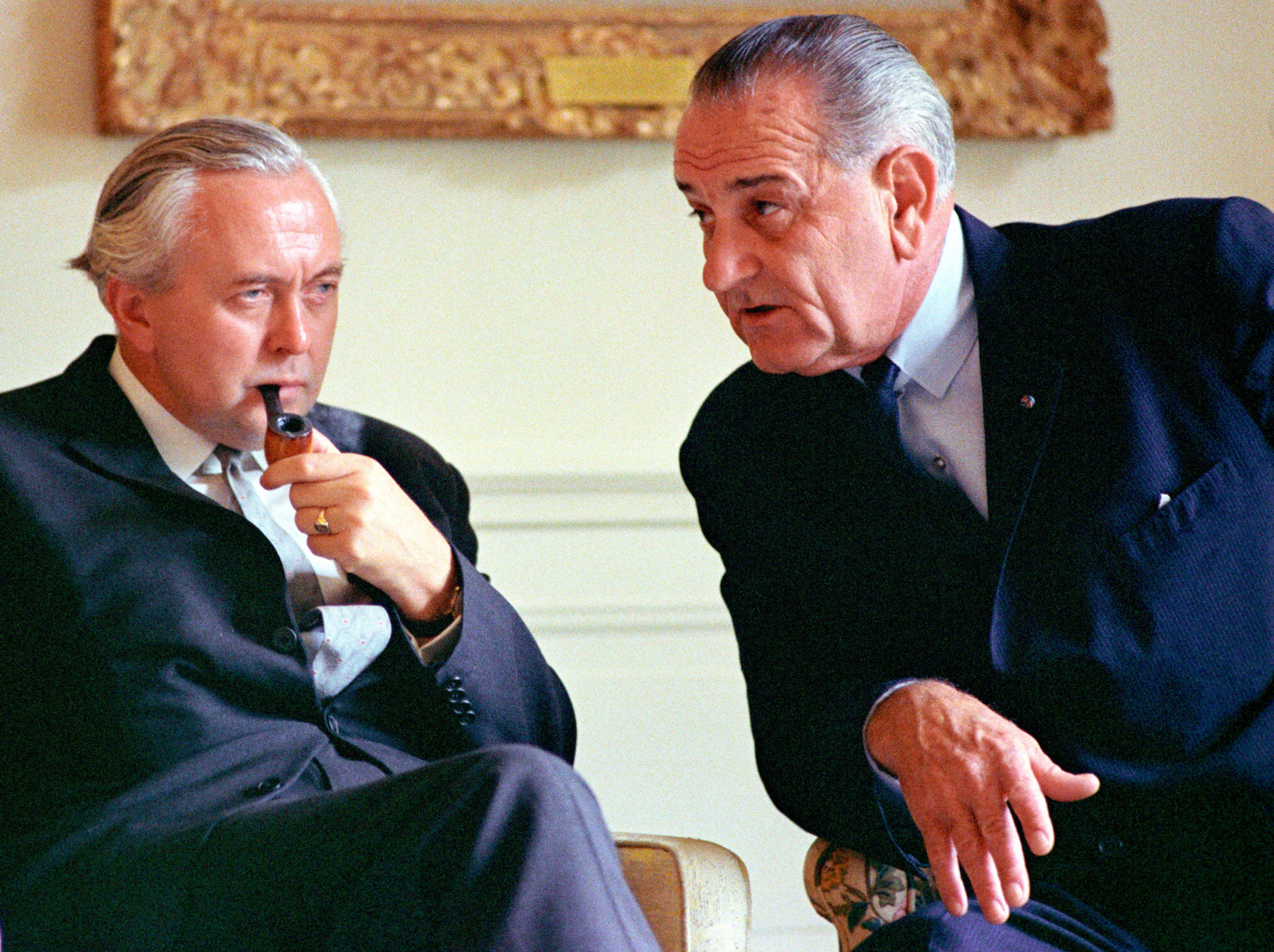
In the 1960s, the Labour Prime Minister, Harold Wilson, faced intense pressure from US President Lyndon B Johnson to send British troops to Vietnam to support the vast American force already fighting there. He refused.
Instead, Wilson pursued what historians often describe as a “middle way.” Britain offered public support to the United States while refusing to send “even a platoon of bagpipes” to Vietnam. The war was deeply unpopular, both with the British public and within Wilson’s own party.
Johnson was not personally pleased. He referred to Wilson as “the little creep on my doorstep.”
Yet despite Britain’s limited support for the war, the “sacred” and “fraternal” transatlantic relationship first described by Winston Churchill in 1946 survived. It would later reach new heights under Margaret Thatcher and Ronald Reagan, and again under Tony Blair and George W. Bush.
Wilson’s approach, backing the United States while keeping British troops out of the war, is a useful reminder that the “special relationship” does not necessarily require complete obedience.
More than half a century later, Starmer faces a similar challenge: maintaining the special relationship with the United States while managing political pressure at home.
When Donald Trump asked to use British bases for strikes on Iranian missile facilities. Starmer hesitated. He raised concerns about the legality of the strikes and rejected what he called “regime change from the skies.”
Only after Iran launched retaliatory attacks across the region did Britain allow the United States to use Diego Garcia and RAF Fairford for defensive operations. Subsequently, Starmer also announced the deployment of four RAF fighter jets to Qatar to strengthen Britain’s defensive posture in the region.
Trump remains unimpressed. He said Starmer was “no Winston Churchill” and complained that the relationship between Britain and the United States was “obviously not what it was.”
On 7 March, the President said the UK was considering sending aircraft carriers to the Middle East but dismissed the prospect, writing on social media “we don’t need people that join wars after we’ve already won!” while labelling Britain “our once great ally”.
Starmer therefore finds himself in a difficult position. Pressure is building within his own party, while the economic outlook remains fragile, with rising tensions around the Strait of Hormuz threatening energy supplies.
Wilson faced similar constraints.
When he became Prime Minister in 1964, Britain was running a deficit of £800 million. Sending British troops to Vietnam would have been financially risky.
And with a majority of just four seats, Wilson could not risk a rebellion from his own party, many of whom were deeply sceptical of American policy in Vietnam.
On a trip to Washington in July 1966, Wilson argued that Britain was “more useful” to America “as an ally rather than a satellite.” Johnson continued pressing for “a British flag in Vietnam” but the pair had come to an uneasy compromise.
By 1968, the United States had 549,500 troops stationed in Vietnam, and Washington wanted visible support from its allies. Some provided it. Australia and New Zealand had sent ground forces in 1965.
Wilson nevertheless maintained the alliance while keeping British troops out of the conflict. Washington, in turn, helped stabilise Britain’s fragile economy. In 1964 the United States agreed to financial support worth nearly $3 billion.
Yet Wilson’s policy on Vietnam was not without contradiction.
Covertly, Britain offered more than rhetorical support. London shared regional intelligence, allowed weapons to move through back channels and provided jungle-warfare training for US special forces. Wilson also approved the sale of weapons to the United States through Hong Kong, including shipments of 500-pound napalm bombs, largely out of public view.
It was a carefully managed balancing act, shrewd political manoeuvring designed to support Washington while avoiding a domestic backlash.
Wilson only publicly distanced himself from Washington during the bombing of Hanoi and Haiphong in 1966-67, voicing concern about the humanitarian impact as outrage grew in Britain, including within the Labour Party.
Like Vietnam, military action against Iran is not popular in the UK. A YouGov poll on 2 March found that 27% strongly oppose US military action against Iran, while 11% strongly support it.
Public opinion is similarly wary about Britain’s involvement. When asked whether the UK should allow US forces to use British airbases to launch strikes on Iranian missile facilities, 29% strongly opposed the decision, compared with 13% who strongly supported it.
There are, of course, important differences. Starmer has a large majority in the Commons. Crucially, Vietnam was fought in the context of the Cold War and ideological rivalry with the Soviet Union, whereas the confrontation with Iran centres on preventing the development of nuclear weapons and regime change. There are also no ‘boots on the ground’ in Iran.
Still, today more than 300,000 British nationals live in the Middle East, and Iranian strikes have hit around ten countries across the region.
The former Labour leader Neil Kinnock, who led the Welsh division of the Labour Student movement against Vietnam, shared his impressions with me about a trip he made to the United States in 1975, just as the US withdrawal from Vietnam was collapsing.
“In Kansas and the West Virginia coalfields I kept hearing the same thing,” he said. Democrats, Republicans, veterans and trade unionists all told him Wilson had been “wise… sensible… cunning… farsighted” to “keep the hell out.”
Kinnock later repeated these views to Wilson, whose response was simple:
“It was difficult, but I had no real choice, thank God.”
Given how disastrously the war in Vietnam turned out, Harold Wilson’s decision not to send British troops there was vindicated. Vietnam and the current confrontation with Iran are very different, and there are limits to making comparisons. But there are still lessons in Wilson’s cautious approach that may help Keir Starmer balance national, political and party interests.
Agreed. Politicians often make the case that we have "assets" or "interests" in far away warzone hot spots. Well, maybe we shouldn't, at least none that are so essential or so fragile that they require a military response.
Then they also say we have British nationals living/working/holidaying there who need protection or evacuation. Well, economic migrants chose to go there, the Middle East, knowing that there were tensions between some States that could turn nasty. Same for those holidaying.
During Franco's reign millions of Britons holidayed in Spain knowing that it was a Fascist government. Many of us didn't.