

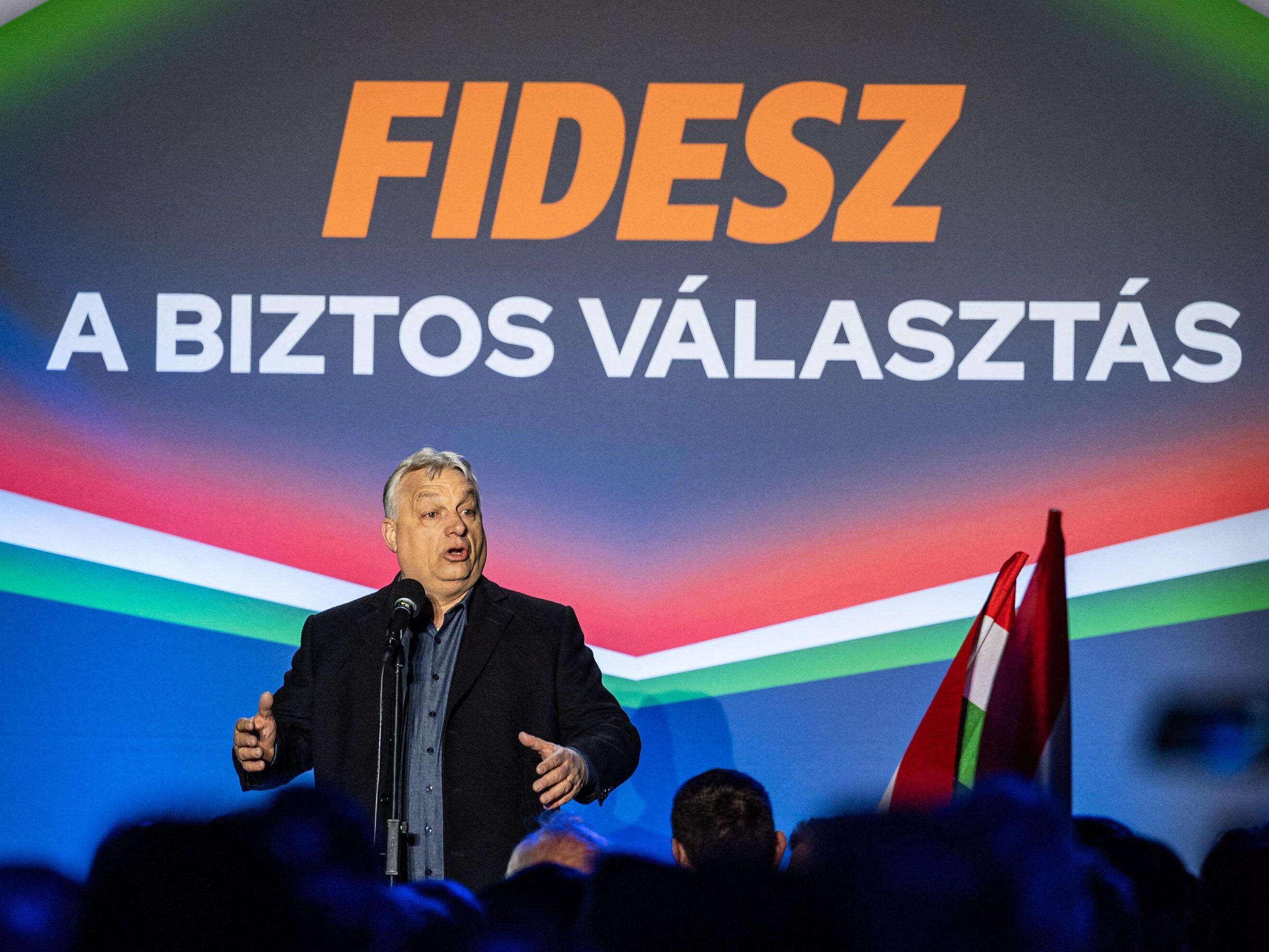

Viktor Orbán’s speech in the Western Hungarian city of Győr on Friday 27 March might go down in history. At one of his daily campaign rallies, his speech was interrupted by counter-protesters. These protesters are growing in number on each occasion, and this time, they clearly managed to unsettle Orbán.
“You are pushing the agenda of the Ukrainians and do not stand by Hungary! You want a Ukraine-friendly government and want to take Hungarians’ money to Ukraine!” he yelled at them, while angrily pointing his finger. Orbán is usually a calm and cynical orator, this time, however, his voice cracked, and he radiated an uncontrolled anger.
Orbán’s stress is understandable. He’s been trailing in the polls – some of which suggest that the opposition are close to getting a constitutional majority. The elections in Hungary, to be held on 12 April, might mark the end of his 16-year tenure.
Rising Opposition
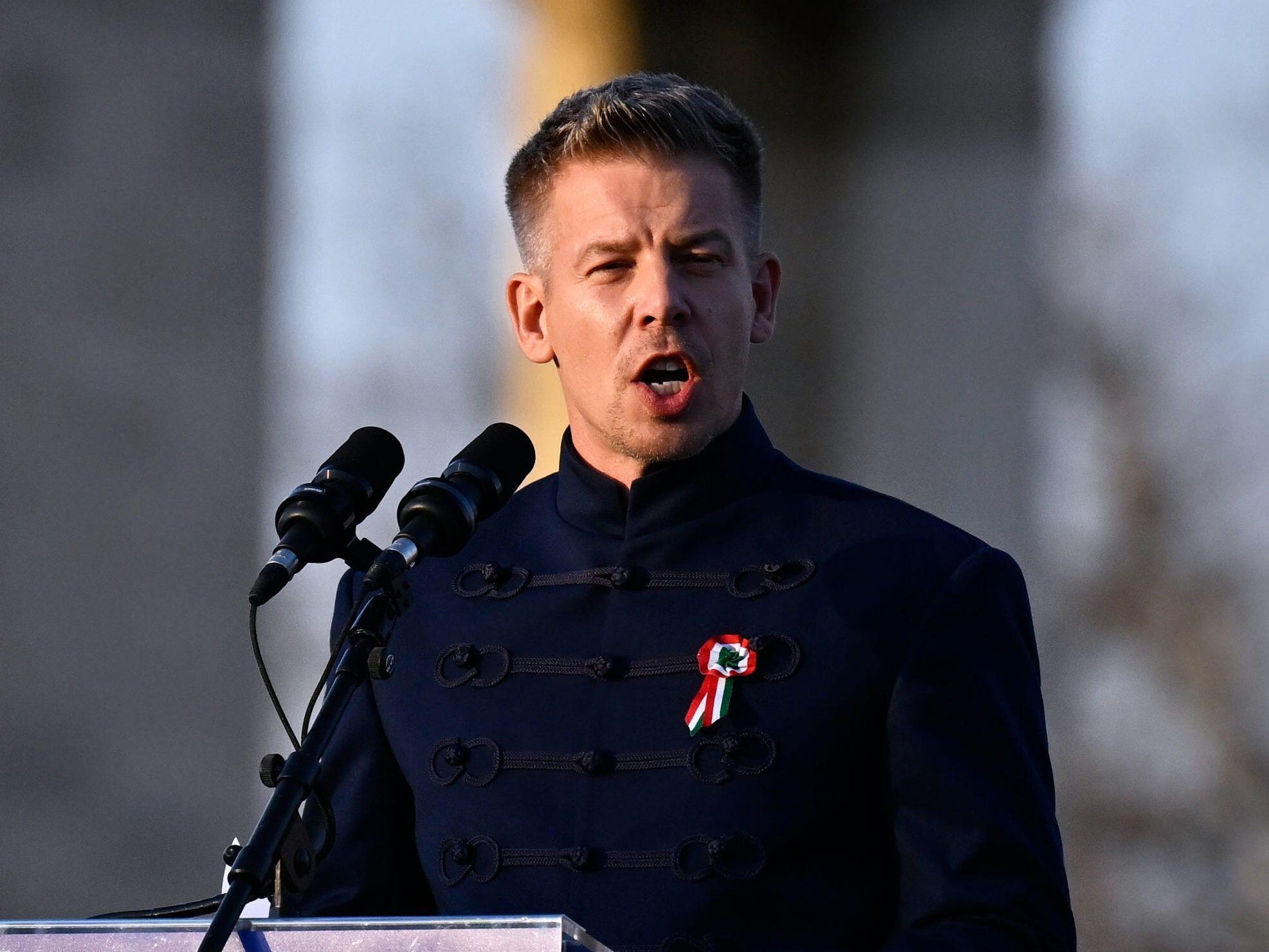
His opponent is Péter Magyar, formerly a member of Orbán’s Fidesz party, who broke ranks in 2024 as a result of a clemency scandal, when it emerged that the then-Hungarian President Katalin Novák pardoned the deputy principal of an orphanage who tried to cover up the systemic sexual abuse of children. The same year, Magyar’s party, Tisza (Respect and Freedom Party), obliterated Hungary’s existing opposition parties, gained 30% of the votes at the European Elections, and overtook Fidesz in the polls by October. Their lead has only increased in independent polls ever since.
Unlike his progressive-leaning predecessors, the centre-right Magyar has not been focusing on the erosion of democracy and rule of law issues in his messaging, but rather on the systemic decline of Hungarian state institutions, like education, healthcare, and the railways. He has been touring the country at pace, attracting crowds even in smaller communities.
The domestic focus of his messaging contrasts sharply with that of Orbán. The Government’s communication centres around claims that the Ukrainians are actively sabotaging Hungary and wanting to drag the country into war. In the Fidesz party narrative, this catastrophic scenario, with Hungarian youth dying on the battlefields, can only be prevented if Orbán remains Prime Minister.
But it is not only Orbán who is focused on world politics. World politics also seem to be focused on him. The Hungarian election is a crucial one for Europe due to Orbán’s frequent vetoes at EU Council meetings and his relationship with both Vladimir Putin and Donald Trump, whose interests he has often been accused of serving. His brand of illiberalism has also found plenty of admirers on both sides of the Atlantic, including among the German AfD, within the US Republican Party, France’s National Rally, or even Reform UK.
One of the main pledges of Péter Magyar, by contrast, is that he will bring Hungary closer to the European mainstream.
Global Orbán Fans
Orbán has had enthusiastic support from various figures from the illiberal right. At the beginning of the year, Italian Prime Minister Giorgia Meloni and Israeli Prime Minister Benjamin Netanyahu both endorsed him via public video messages. On a visit to Hungary in February, US Secretary of State Marco Rubio said that the US government is committed to Orbán’s success.
In March, Budapest held its annual CPAC conference, with former Polish Prime Minister Mateusz Morawiecki, AfD’s Alice Wiedel, and Argentinian President Javier Milei all making an appearance. US President Donald Trump also sent a video message in which he made clear that Orbán has his “total endorsement.”
A few days later, Patriots for Europe, Fidesz’s EU parliamentary group, also held a conference in Budapest, where Italy’s Matteo Salvini, France’s Marine Le Pen, and the Netherlands’ Geert Wilders all praised Orbán. According to press reports, Budapest’s welcome mat will be rolled out again for arrival of US Vice President J D Vance a few days before the election.
Endorsements are not the only help the Fidesz campaign is gaining from abroad, however. In early March, citing European national security sources, the Hungarian investigative journalist Szabolcs Panyi revealed that agents linked to GRU, Russia’s military intelligence, with expertise in social media manipulation, arrived in Hungary to help the Fidesz campaign.
Russian Interference
In March, after Zelensky joked that he would give Orbán’s address to his military personnel – comments which were condemned by the European Commission and Polish Prime Minister Donald Tusk – the campaign saw pro-government media outlets quoting an edited video, which initially emerged on the Russian internet, of a retired Ukrainian general seemingly threatening Orbán and his family with the Ukrainian “crime organisation” KARMA.
The Hungarian news outlet 444 later investigated the claims and found that the original video does not threaten Orbán’s family but mentions them in a different context, the word KARMA was used not for an organisation, but as a word for karma the spiritual concept, and the person speaking has no relevant political power in Ukraine, but is a YouTuber who sometimes ventures into conspiracy theory territory. As a reaction to the video, Orbán posted videos of himself anxiously calling his family members inquiring about their well-being. The episode showed clear signs of Russian disinformation tactics at work.
Even more serious allegations emerged in mid-March in The Washington Post in an article by the British journalist and Russia-expert Catherine Belton. Citing an unnamed European intelligence service, she wrote that the Russian team was suggesting staging an assassination attempt against Viktor Orbán to boost his chances of reelection. The article also contained claims that Hungarian foreign minister Péter Szijjártó made regular phone calls during breaks at EU meetings to Russian foreign minister Sergei Lavrov, providing him “live reports on what’s been discussed.” Szijjártó’s response is inconsistent about the allegations: sometimes he states that it is natural that he calls foreign leaders regarding issues that affect them, but sometimes he calls them “fake news.”
Secret Service Spy Games
Thus, the Hungarian election seems to have become a field of intense operation by secret services: Russian agents plan something, which Western intelligence services leak. But last week, the Hungarian Secret Services also emerged as a key player in the campaign. After the Washington Post report, an audio recording was posted on a flagship pro-Fidesz media outlet, Mandiner, of Szabolcs Panyi – the Hungarian journalist who initially broke the news of GRU agents coming to Hungary – talking to a source about a conversation between Szijjártó and Lavrov. The conversation concerned Szijjártó asking a favour from Lavrov to grant a state visit to then Slovak PM Peter Pellegrini to boost his re-election chances.
The Hungarian Government accused Panyi of taking part in the wiretapping of Péter Szijjártó and colluding with a foreign intelligence service and announced it would charge him with espionage. Panyi denies that he had anything to do with the wiretapping of Szijjártó and revealed he was talking to the source for a book he is writing on Russian influence in Hungary.
The recording of Panyi’s conversation already suggested the involvement of domestic intelligence services, but they became the main characters in the campaign a day later. The investigative portal Direkt36 published an explosive article which suggests that the Constitutional Protection Office – Hungary’s counter-intelligence agency overseen by Antal Rogán, the minister who is also responsible for the government’s propaganda apparatus – tried to sabotage the Tisza party’s IT systems.
The article claimed that detectives at the cybercrime department of the police received an anonymous tip-off that two individuals were preparing to make pornographic images of children. Throughout the process, the detectives found that the Constitutional Protection Office kept interfering in the investigation, and that it had even warned them in advance that a tip-off was imminent. This is unusual as child pornography does not come under the agency’s jurisdiction.
During the investigation, the detectives found no trace of child pornography, and the investigated individuals – who the article names only under pseudonyms as ‘Buddha’ and ‘Gundalf’ – revealed to the detectives that they have both worked for the Tisza party. Moreover, while looking through the files on their computers, the detectives found messages from a mysterious “Henry” who tried to convince Gundalf to sabotage Tisza’s IT systems, promising money and prostitutes in exchange, with proposed meetings in dubious secret locations.
The messages also reveal that Henry was aware of the movements of Gundalf and Buddha in real time and knew about leaks concerning Tisza’s system days in advance of their occurrence. Henry also suggested that another group from within his organisation were involved with the leaks of secret audio recordings of Péter Magyar in 2024.
When the detectives started to suspect that secret services might be involved with trying to sabotage Tisza’s IT systems and gather information illicitly, they proposed investigating the matter further. However, under pressure from the Constitutional Protection Office, their superiors stopped them from doing so, and even tried to make them investigate Buddha and Gundalf on other charges.
The day after the article came out, Direkt36 published a 90-minute-long video recorded in February in which the detective who leaked the information, now identified as Bence Szabó, told the story in greater detail. The video was released because, as it later emerged, the police had searched Szabó’s house, and he is now being charged with misconduct in public office.
Szabó’s interview with Direkt36 now has more than 2 million views (Hungary’s population is less than 10 million). Szabó has since become a viral sensation, with an online fundraiser for him raising 12,500 euros in a matter of days. Péter Magyar now regularly mentions and commends his actions during his rallies.
The Government and its affiliated media are now claiming that the secret services were trying to uncover an espionage attempt by the Ukrainian authorities, alleging that Gundalf was spying for Ukraine.
Their accusation is based on the release of video footage of Gundalf’s two interrogation sessions and the fact that he attended an IT training camp in Estonia, which he, at the time, assumed was part of NATO’s (which Hungary is part of) Cyber Defence Centre. In the second interrogation, Gundalf expressed doubts about the authenticity of the course, saying that he tried to verify the code he had received on his certificate but was unable to do so. Later, NATO’s Cyber Defence Centre also denied that the individual took part in any of its courses.
In the video, Gundalf admits that he was approached by a cyber organisation while he was visiting Kyiv, however, crucially, he asserts that he declined their offer. Yet, Government-aligned media and Fidesz politicians consistently write that he admitted spying for Ukraine.
Additionally, this version of events still raises the question that if, as the Government repeatedly says in their campaign, Ukraine is actively working to put Tisza in power in Hungary, why did the agents try to convince Gundalf to sabotage Tisza’s IT systems? And why were Gandalf and Buddha investigated for wanting to make child pornography if there was no evidence of it whatsoever?
Yet another twist emerged on the evening of Monday 30 March, when Gundalf, now identified as Dániel Hrabóczki, gave a video interview to 444. He stated that he deliberately misled the Constitutional Protection Office, as he had been pre-warned by an individual who claimed to be from the agency that they were planning to frame him during the interrogation. Hrabóczki claimed that in order to outsmart the authorities, he fabricated a story about NATO training and Kyiv cyber organisations that would fit the Government’s propaganda narrative.
He did so, he says, because he suspected that the Constitutional Protection Office would release it to the public and use it against Tisza, thus proving the collusion between the secret services and the Government. The latest twists of the spy saga therefore not only show attempts by Hungarian authorities to sabotage the country’s main opposition party, but also indicate that Hungary’s secret services may have been outplayed by a 19-year-old.
Hungary now heads into the final two weeks of its most consequential election campaign in 16 years. In recent weeks, neither party was able to dominate the news agenda, which is instead full of claims of domestic and international espionage. Whatever the outcome on 12 April, the revelations in the campaign show how important the election is for both Hungary and Europe.
Worryingly, in the long term, so many claims of undue interference may further erode Hungarians’ faith in democracy and in their ability to influence their own society.