


BYLINE TIMES IMPACT: Find out about the changes you made happen
‘The fog of war’ is a term used to describe the confusion of the battlefield, the difficulty in finding accurate information in a chaotic environment. With Russia’s current war effort is seems that the confusion is not an accidental byproduct of the chaos, but a deliberate and systemic pattern of dishonesty designed to avoid or absolve blame, to deflect criticism, to defy reality, to please the tsar, and as the strain of his war is clearly now taking its toll on the Russian leader he appears to be coping by means of self-delusion.
Shocking Losses
To start, things are not going well on the battlefield for the Russian army. In fact, things are going catastrophically badly for them. It has long been known – and is evidenced by the more than 1.4 million Russian casualties they have sacrificed since their invasion – that the Russians place no value in the lives of their own soldiers. But June has returned shocking numbers. So their lies have to intensify as a countermeasure.
In June of 2026 Russia lost, dead and seriously wounded, 39,490 troops. In the same month they managed to capture 30.4 km2 of terrain. A cost of close to 1,300 casualties per km2. This time last year, June of 2025, the land/lives trade-off was 68 casualties per km2. The ratio has increased 19-fold.
Cascade of Lies
Cue the cascade of lies to pretend things really aren’t that bad. Where the lies originate is impossible to know. It’s most likely that the commanders are forcing their troops to feign control of sectors through literal ‘false flag’ operations in a bid to paint a bright picture for Army chief Valery Gerasimov to then pass on to Putin in their now daily briefings.
Here’s how that works.
As previously reported, the contact lines are no longer thousands of men facing each other across a no-man’s land. With the skies now full of drones, some conducting reconnaissance and the rest carrying deadly payloads, swathes of land offer photo opportunities. While no troop movement at scale can advance to actually seize control of the next town or village, a small infiltration group of one or two men can try to go undetected as much as a few kilometres beyond the actual line of control. Once there, covered by one of their own drones, they can unfurl their tricolor and the drone obligingly takes a photograph of that event. That photo gets kicked up the chain of command.
At this point they all no doubt know that they are lying. They know they haven’t made any significant advances. They haven’t occupied any more land at all, but they can make it look like they have. And then, like the layers of bribery and corruption rife throughout the Russian military, everyone is entitled to a piece of the action. The troops will take the photos across various locations. The next level of command puts them together to present an impression of ‘advances on all fronts’ in their respective sectors, and the top brass gives Putin a map showing that the entirety of the frontline has shifted.
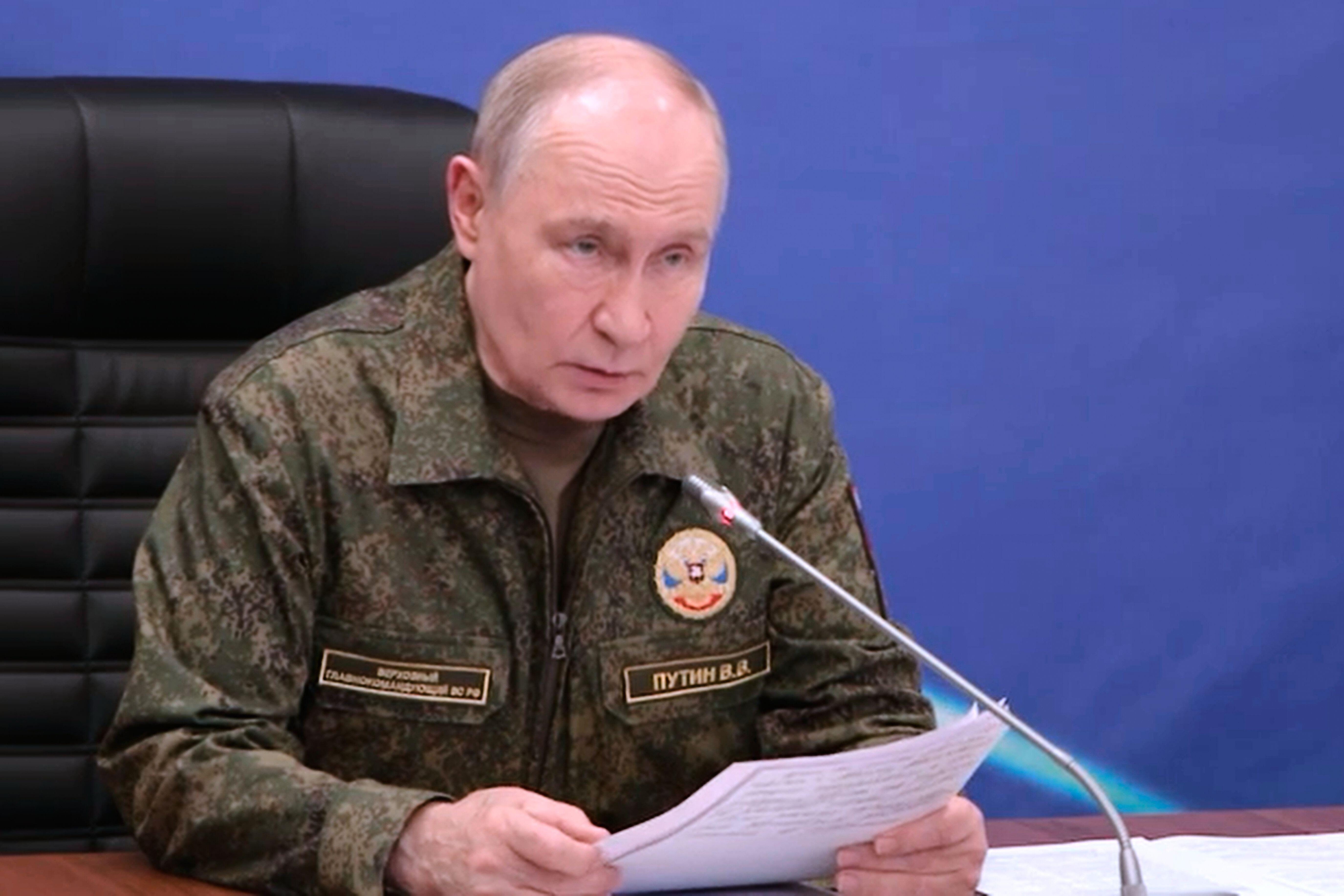
To complete the circle of deceit, Putin then gives a televised and scripted address reporting fantastical nonsense to a nation needing reassurance that the war is being won and that, therefore, normal service at the nation’s filling stations will inevitably soon be resumed. This is where we see Putin’s own delusions now becoming a factor too.
In one such recent address, the Russian President told viewers that a grouping of about 5,000 Ukrainian troops were encircled up against the banks of the Stary Oksol river Close to a place called Rubtsi. There is no Stary Oksol river in that region. And, for the record, Rubtsi, a place with a population of 350, is not encircled. No ordinary Russian citizen will have heard about a place called Rubtsi, and they’re unlikely to Yandex it. (Yandex is the Russian equivalent of Google, controlled and censored by the Government.) But if they did, they might wonder why their President is apparently preoccupied with the potential capture of a hamlet.
The problem, for Russia and for Putin, is that lies will sooner or later fall apart. What is certain is that like Russia’s war effort, all of this is unsustainable. We can cover old ground and recite the lies that are the foundations of Russia’s war since either 2014 or 2022, but that’s not as relevant as the situation at hand.
Economic Pressures
As well as the enormous losses for diminishing returns mentioned at the outset of this article, the losses in Russia itself are bringing the country to breaking point. The CEO of Sberbank, one of Russia’s largest lenders, German Gref – a Putin confidante for 35 years – in an interview on state TV in recent days called for “an end to military hostilities as soon as possible” as the “economy simply cannot survive” further pressures.
While it has long been assumed of Russia that the only path to change is a palace coup after the elites break ranks with Putin, because a pliant population will not rise up, we have to ask how long that population will remain pliant? Of course, any attempt at a popular uprising will be met with a brutal response, but when the current fuel shortages extend into their second month, or third, will that be enough?
The fuel crisis doesn’t just affect the regular Boris and Tatyana and their commute to work. What about when the farmers cannot get diesel for their tractors? Harvest season in Russia is from July to September. Ukraine is not about to stop with their strategy of demolishing the Russian oil extraction, storage, and refinement facilities because they are the lifeblood of the Russian economy and Ukraine needs to cut off Russia’s war-making ability at source. If there’s no harvest, there will be no bread. A historical revolt point for some societies at least.
Electoral Flashpoint?
Then there’s the matter of the State Duma elections to be held in the middle of September. Will they become a flashpoint? Or, at least, will the predictable rigging of elections to renew the United Russia supermajority at a time when the war is increasingly unpopular and costly and being brought home to Russians be a flashpoint?
If the Russian population are capable of putting the pieces of this jigsaw together, the next thing they may decide to object to is the wave of mobilisation expected to follow hot on the heels of the elections. It is widely believed that Putin is ready to throw the dice one more time in the hopes that another 500,000 bodies will be able to bring him to the point where he will be able to declare a victory of sorts and say the war is won and can end.
At the rate of 1,300 casualties per km2 of seized Ukrainian land seen in June of 2026, those 500,000 new bodies would possibly gain another 385 km2 of the Donbas before they are dead too. That is some way short of the 6,600 km2 of Donetsk Oblast that remains under Ukraine’s control.

If we must close down the fossil fuel industry, Putin deserves to be first.
The oil and gas paid for his imperial fantasy, the attacks on democracies.
It's a brutal business on all sides, isn't it?