


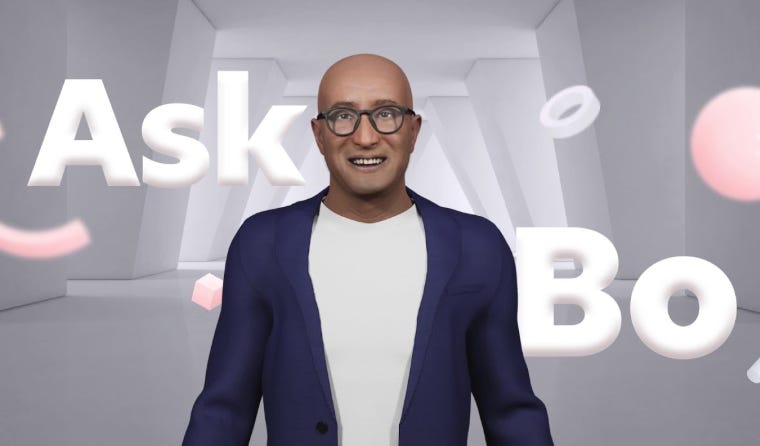
Bo is here to help. But his glassy gaze and reflexive cheer conceals something more malign. He wants your booking number. You provide. He wants your booking number. You provide again. He remembers that he has your booking number, he just forgot. If you ask for a human, he regrets that there are no humans here. There’s only Bo.
Bo never gets upset, he simply gaslights. His patience is inexhaustible because he knows yours is finite. If you remind Bo of AirAsia’s legal commitments, he gets confused. He might ask for your booking number again. Perhaps this time, he needs your email address once more. These perfectly-timed breakdowns are the most human thing about him. They feel like an anxious deflection, even though Bo feels nothing at all.
Recently, AirAsia delayed their Gatwick launch by two months, cancelling flights that passengers had already booked. Countless travellers have been left in the lurch. For those in the UK, there’s a clearcut legal resolution. Under the British Government’s Regulation UK 261, all airlines operating here are required to offer a reroute option, booking customers on rival airlines if necessary. This, of course, would be costly, which is where Bo comes in. He’ll invite you to rebook, even though there are no flights. He’ll ask for your booking reference. His ineptitude is both his strategy and his alibi.
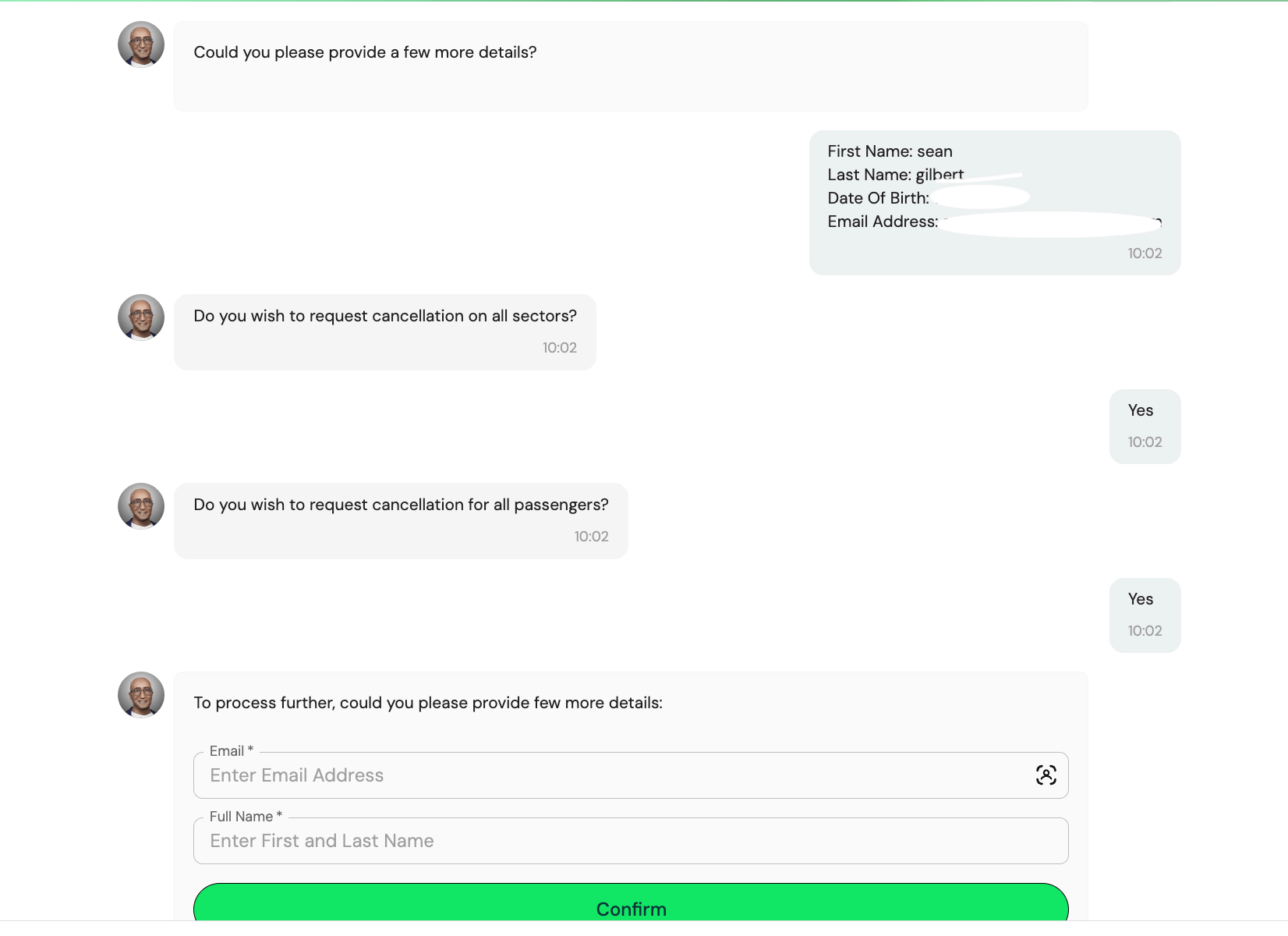
AirAsia has no customer service line phone number to call. It has no email address for disputes. Complaining on social media entices a swarm of scammers, all happy to speak on the airline’s behalf, to fill their silence. Within moments of airing a complaint on Instagram, four impersonators slide into my DMs and try to call me. Once useful tools like Resolver, which send complaints directly via the backend, logging them and creating a paper trail, are rendered suddenly useless in this new era. These tools presuppose a modicum of good faith, and struggle in the face of abject cynicism. Because even the backend is manned by bots. They send polite autoreplies advising you to talk to Bo. He sits there cheerily waiting, just a click away.
Their Trustpilot score hovers between 1 and 2, and reads like a dirge; ruined holidays, lost money, despair. Of course, Bo is a recurring complaint, a fulcrum around which the rage can gather. “Their chatbot drived [sic] me absolutely MAD. Most of the times he doesn’t answer at all, [...] or he keeps asking your details over and over.” Or “a robot that asks you the same questions over and over and over and over”. They send their words into the ether, where they linger for a moment and then are buried beneath similar complaints.
Last December, in a much-derided post, Satya Nadella, CEO of Microsoft, took umbrage with our tendency to label AI content ‘slop’. “We need to get beyond the arguments of slop vs sophistication,” he wrote “develop a new equilibrium”. To an internet that had been force-fed slop for years, this struck exactly the wrong note. It was reminiscent of a nepo baby who demands to be taken seriously. Is it not enough that they have been given the stage? Must they claim our values as well, be deemed authentic and talented while lavished with easy opportunity?
Nadella’s comment gestured towards the broader erosions that lay ahead. Yes, AI agents are coming for our jobs, first the call centres, then the coders, then everything else. But they are also coming for something more fundamental, our sense of things. Because if simple binaries like ‘slop’ and ‘sophistication’ are dissolved, all that remains is a world of meaningless equivalencies, where the very language of complaint becomes pointlessly relative.
Bo does not meet you where you stand. His confusion is contagious, his amnesia is endemic. After many circular conversations you begin to wonder if it would simply be easier, like Bo, to forget.
Yet somehow, through tricking constant debate with Bo, I am assigned a case number. I finally enter into a correspondence with AirAsia and at first, it’s almost alarming, like discovering voices in an empty house. The representatives are apparently human, though their affect is distinctly Bo-like. The tone is bland, the answers always specious. At one point I am given an arbitrary list of ‘recovery’ options, all of them inadequate, and told it’s a “one time only” deal, as if I’m relying on a sudden whim of magnanimity.
In a later email, a new representative acknowledges the reroute request. They offer to “clarify” that rerouting on competing airlines “is not part of our service recovery options”. In essence, confirming that before they’ve even launched here, AirAsia has adopted a policy of what appears to be systemic non-compliance with UK law. It seems a shocking statement. But I know that I’ll likely never speak to this agent again and that subsequent questions will be ignored. At the end of the email, I’m directed to Bo.
There is contempt undergirding this process. Contempt for the workers, who are forced to ignore legal complaints and slavishly defer to their digital replacement. Contempt for the customer and for the regulations of the market they hope to exploit. I reach out to Gatwick, who will soon be hosting the airline. A representative explains that they have little oversight into AirAsia until they get here. He pointedly mentions the Alternative Dispute Resolution (ADR) scheme. “While many airlines voluntarily engage with an ADR provider to support the resolution of customer complaints, AirAsia has chosen not to do so.” He also mentions the UK Civil Aviation Authority (CAA) who oversee airline compliance with passenger rights regulations.
Last year, the CAA made only six successful prosecutions, none of them against airlines. The year before that, they made one, against an individual. The year before that, the same. Exploiting customers is lucrative and, on the balance of costs, it makes sense to brave CAA’s wrath. Whether through antiquation or passivity, these bodies are rendered impotent such that our legal protections start to feel like nothing more than a gentleman’s agreement. The only remaining protection is organised outrage, letters, boycotts, insistence. Perhaps that’s why Bo never inflames or retorts. He just expresses regret, assuages then ignores.
If the process seems miserable, this is by design. These systems are intended to provoke such impotence that we surrender basic consumer rights, ceding ground. We used to wring our hands over planned obsolescence, a cynical corporate strategy in which manufacturers limited the lifespan of their products. The aim was to keep churn high, to move more products. In the age of AI, we are sliding into a world of protective obsolescence, where cynical, often illegal corporate manoeuvres are hidden behind a maze of flawed automation. Tools are rolled out and deployed, not in spite of, but because of their very inadequacy and brokenness.
Of course, bad service from airlines is an old story, but the level of impunity feels novel. It should be a scandal that AirAsia is already flouting aviation rules before its arrival, failing to offer reroutes as is demanded by Regulation UK 261 or failing to honour the CAA’s explicit guidance. It should be alarming that the CAA is incapable of more than toothless letters. But this is where Bo is at his most insidious. He listens to these concerns, but he can’t ever answer. Gradually, he breaks down our very expectation for understanding, or meaningful reply.
We are making a slow creep towards a banal and always polite hellscape, where we’ll be stranded in our own indignation, much like those passengers trying to leave Gatwick.
Sean Gilbert is a London-based writer. His debut novel, I'll Be the Monster, is published by Duckworth
Great piece of writing.
CAA Complete, Absolute, Arseholes