


BYLINE TIMES IMPACT: Find out about the changes you made happen
When James Orr was appointed as a senior advisor to Nigel Farage, much was made of his supposed ability to add intellectual heft and ethical weight to Reform UK.
Announcing his appointment as the party’s new policy chief, Reform’s Zia Yusuf described him as a “brilliant academic,” a “theologian”, and a “thinker”. In newspaper profiles, he was “Farage’s brain” and his “philosopher king”.
According to these depictions, Orr’s involvement in Reform was rooted not just in politics, but in an almost ordained principle, dating back to his own religious conversion some years before.
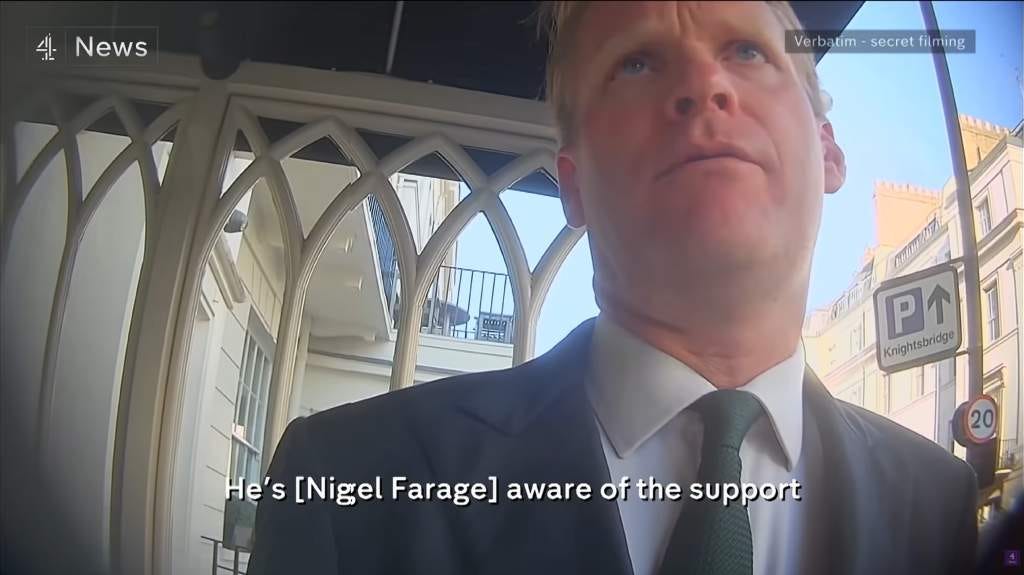
The reality, as exposed by the recent Verbatim undercover report broadcast by Channel 4 News – ‘Reform Caught on Camera – The Foreign Money Scandal’, looks far grubbier.
Although Orr, Associate Professor of Philosophy of Religion at the Faculty of Divinity at Cambridge University, was publicly touted as the man who would devise the high-minded intellectual framework for a Reform government, his actual role appears to have been far less high-minded.
“So basically, the job will be fundraising,” Orr told an undercover reporter, posing as a potential Reform donor, during a meeting at an exclusive private members’ club. “I’m raising a lot of money for the party.”
In many ways, Orr was perfectly placed for this task.
An internationally known right-wing academic, with close ties to the White House and Silicon Valley, he was the ideal man to gather international support and funding for Reform.
That support was much needed. As Orr admitted to the undercover reporter: “We just don’t have British resident donors, British entities that would support us. That’s the grim reality.”
£2m – Outside earnings in Nigel Farage’s first two years as MP for Clacton
£72m– Reform UK donations in one weekend from two crypto-billionaires
The apparent solution, as Farage’s other senior advisor, Dan Jukes, admitted on camera, was to funnel foreign cash through UK donors – something he suggested the party had done multiple times before.
If true, this would amount to a serious criminal offence, yet both Jukes and Orr appeared unconcerned about the risks.
“The reality is we could easily get away with it,” Orr told the reporter, adding that the Electoral Commission – the official watchdog charged with preventing such abuse – was “completely useless” and “just so dumb and ineffective”.
Orr and Jukes stepped down after the broadcast, characterised as mere “contractors” by Farage, but the episode is now being investigated by the Metropolitan Police.
The scandal stands in stark contrast to the image their leader has long been keen to portray.
‘Golden Age’
“I cannot be bought by anybody,” Nigel Farage insisted to The Sun earlier this year. He has often portrayed himself as being a breed apart from what he called the “greedy” politicians in other major political parties.
Boasting of his past life as a high-earning commodities trader, Farage has often claimed that his switch to politics was a principled one which came at significant financial cost to himself.
“There’s no money in politics,” he once said in comments unearthed by Byline Times, before adding the revealing caveat, “if you’re straight”.
In reality, Farage was never quite the high-flying businessman nor the impoverished but principled politician he likes to pretend to be.
Although he did find some level of success as a commodities broker in the 1980s and 1990s, one of Farage’s companies became insolvent, with the business still in the process of paying back £33,000 of unpaid taxes to the Exchequer as late as 2014.
As one former associate told the Financial Times in 2015: “This suggestion that he was a very wealthy man in the City is probably a bit of a misnomer. I don’t think he was anywhere near as successful as some people are portraying. He probably does better out of being an MEP.”
‘Farage was never quite the high-flying businessman nor the impoverished but principled politician that he likes to pretend to be’
Farage was certainly far from being a pauper during his time in Brussels.
In 2009, he was recorded talking of the huge amounts he had claimed in office expenses since first becoming a Member of the European Parliament a decade earlier.
“It is a vast sum,” Farage said. “I don’t know what the total amount is but … it must be pushing £2 million.”
He wasn’t the only one of his colleagues to benefit financially from his time in Europe.
Last year, Farage’s long-term friend and former Reform Leader in Wales, Nathan Gill, was sentenced to 10-and-a-half years in prison at the Old Bailey after pleading guilty to taking tens of thousands of pounds in pro-Russian bribes as an MEP.
However, such sums were but small fry compared with the much larger figures Farage has netted – quite legally – since entering the Houses of Parliament.
Analysis earlier this year revealed that he had taken some £2 million in outside earnings in his first two years as MP for Clacton.
Among his many money-making schemes was a job as a “brand ambassador” for a gold bullion firm, earning him hundreds of thousands of pounds for a handful of hours’ work. The relationship appears to have been a mutually beneficial one.
As Byline Times first revealed, a promotional video released by Direct Bullion warned of the potential disruption and crisis caused by a Reform government, which it predicted would push people towards stockpiling their funds in gold instead.
“It’s becoming increasingly difficult to imagine Britain getting through the next few years without a rise in political violence,” the video warned. “And in that environment, ordinary people are being forced to put themselves back on their own personal gold standard because relying on sterling alone is no longer enough.”
It’s not just gold that Farage has been selling, but himself too.
Reform UK Investigations by Byline Times
The first to reveal that the gold firm employing Nigel Farage, Direct Bullion, told savers a Reform government could spark unrest on the scale of the 1990 poll tax riots. The firm has an interest in talking up instability as gold sales normally perform well during times of national instability.
Farage promoted crypto-billionaire Christopher Harborne’s firm Tether on air at the same time Reform took £9 million of donations from him. Farage backed the firm on LBC’s Nick Ferrari Show, while lobbying the Bank of England to embrace the currency.
Reform paid £645,000 to a ‘ghost’ pollster with no public footprint, no identifiable owner, and missing invoices that should have been shared with the Electoral Commission.
At least £440,000 more went from Reform to firms linked to party activists, donors, and a former chairman.
Reform’s South Tyneside Council Leader Paul Mackings owns a firm which gave £111,000 to Reform just weeks before his selection as a candidate.
Four senior Kent Councillors, including the Deputy Leader and Cabinet members, amended their registers of interests after this publication discovered a raft of undeclared firms. They have so far faced no sanctions.
Cashing in on Trumpism
For years, Nigel Farage was a leading figure on the video-sharing website Cameo, where he sold personalised recorded messages to members of the public.
After earning hundreds of thousands of pounds from users, he was ultimately forced to quit the site, after a series of stories about him being paid to make embarrassing statements for money, including one apparent endorsement of the IRA.
Despite this, Farage has continued in his role as a self-described digital influencer, earning many thousands of pounds in payments for his often inflammatory posts on Elon Musk’s X.
This desire to net huge amounts of personal cash – well above that received by any other serving UK politician – was reportedly heavily influenced by Farage’s time in the United States.
Unlike in the UK, where rules on donations and party spending somewhat limit the amount of cash that can flow through Westminster, US politics has long been a highly lucrative industry.
For no one is this more the case than Farage’s personal hero Donald Trump, who reportedly netted at least $2.2 billion during the first year of his second presidency.
For Farage, who models much of his own political strategy on MAGA, the outrage over the mere millions he secretly took as Reform Leader appears to be incredibly infuriating.
After the Guardian revealed earlier this year he had secretly accepted a £5 million ‘gift’ from the Thailand-based crypto-billionaire Christopher Harborne, an exasperated Farage told BBC News that “it’s literally none of your business”, insisting that his personal windfall was a “purely private matter”.
There may be good reasons for this desire for privacy.
Although he has repeatedly denied any connection between Reform’s proposed massive tax cuts for crypto firms and this secret donation from a crypto-billionaire, the apparent correlation between the huge sums given to Farage and Reform by Harborne and other crypto donors, and Reform policies that would massively benefit those individuals, is difficult to ignore.
“It was an unconditional gift,” Farage, who often touts Reform’s ‘anti-establishment’ credentials, told LBC about Harborne’s donation. “I can spend it on Ferraris if I want.”
After the revelations, Harborne gave another £36 million – matching the same sum from another crypto-billionaire, Ben Delo, in one weekend.
“My conclusion from Reform’s recent troubles is that they should spend less time trying to raise funds to compete on equal terms and more time preparing for government,” Delo observed.
At a meeting held at an exclusive private members’ club in Mayfair, the undercover reporter posing as a donor attempted to arrange a meeting with the Reform Leader himself.
For Orr, there appeared to be only one way to open that door. “If you do a five or six figure sum [donation] we could do lunch with Nigel,” he told the man.
After suggesting this would be possible, Orr and Reform later arranged a face-to-face meeting with Farage and the actor posing as the man’s hugely wealthy American father.
As Jukes also told the reporter, such meetings could prove hugely beneficial to their business: “You know, you’re having a pint with someone who is effectively going to be his chief of staff at No 10. If that isn’t a business interest then I don’t know what is.”
At the subsequent lunch, Farage was recorded over a meal of oysters and champagne, thanking the American actor, whose promised £500,000 donation would have been a major breach of UK electoral law had it taken place.
Farage dismissed his comments as “loose pub talk” after the footage was broadcast. But the truth is this scandal poses major problems for his party.
James Orr’s departure from Reform, in particular, is highly significant.
As Byline Times has revealed in these pages, the Cambridge academic has been using his position at one of the world’s leading universities as a crucial recruiting ground for Reform. His dramatic exit has stripped away the intellectual and social veneer of respectability his appointment was presumably designed to provide.
In his place is a picture of a political project with the pursuit of cold hard cash at its heart. ‘Money talks’ goes the expression, popular during Farage’s time in the City, ‘and bullshit walks’.
With multiple parliamentary and criminal investigations now well underway into the finances of Reform and its senior figures, the truth of that statement could soon become evident. ●
This article appears in the new edition #90 of Byline Times monthly magazine, available now in print and digital.