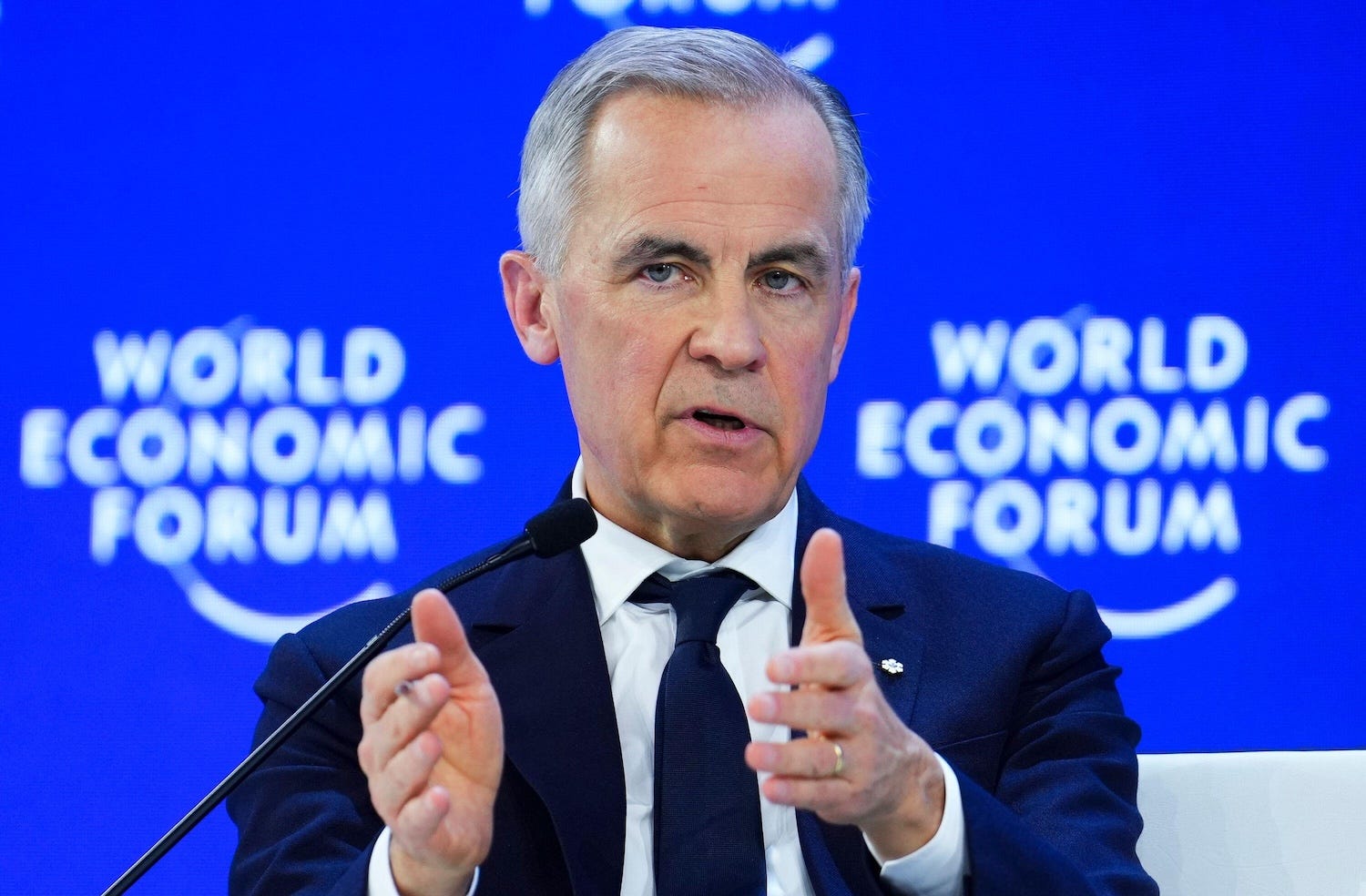
Mark Carney’s speech in Davos on the end of the world order is rightly being hailed as one of the most powerful interventions by any political leader in the year since Donald Trump returned to the White House. My social media feed and WhatsApp groups have been filled with veterans of past Davos gatherings telling me it was the most important speech they had ever heard delivered in the Swiss mountain town – or indeed expect to hear this year.
The Canadian Prime Minister’s argument tempered brutal realism— “we are in the midst of a rupture, not a transition” —with optimism. He set out a way that middle powers such as Canada, Britain and other advanced economies can maintain some sovereignty and control over their own destinies in a new era of superpower rivalries. His speech was an eloquent call for middling powers to work together to face down the great powers whose trashing of global rules and weaponisation of dependencies had turned integration into a source of subordination.
Carney was better placed than anyone in the world to have delivered such a speech. As one of the high priests of the global financial system over the last two decades – having previously served as Governor of the Bank of Canada and then the Bank of England – he will have no illusions about the costs of the collapse of the old rules-based order. What’s more, as Prime Minister of a country whose own territory it is the stated policy of the US president to annex- and which would be encircled by America if Trump succeeds in his ambition of seizing Greenland – he surely feels both the gravity and urgency of the moment keenly.
But above all, Carney understands what is at stake with greater clarity than other world leaders because he has been thinking about these issues for longer. As Governor of the Bank of England, he watched as Britain committed what he privately considered to be a monumental act of stupidity with Brexit. He appeared to allude to the lessons he took from that experience in his speech, noting that “the cost of strategic autonomy and sovereignty can also be shared. Collective investments in resilience are cheaper than everyone building their own fortress. Shared standards reduce fragmentation. Complementarities are positive sums.”
What is depressing is that it is almost impossible to imagine Keir Starmer or any other British political leader delivering such a speech, even assuming they understood the arguments. Starmer himself, no doubt, is keenly aware of the dangers of this moment and the risk to Britain’s national interest posed by a rogue United States. But he is incapable of articulating them, paralysed by his own timidity and buoyed by overconfidence in his capabilities as a “Trump whisperer” who can convince the capricious US President to change course.
Besides, in his decade at the front rank of UK politics, Starmer has never delivered a single notable speech. Indeed, the only memorable phrase ever to pass his lips—a claim that Britain was becoming an “island of strangers”—had such obvious racist connotations that he was later obliged to disown it. As for the rest of the British political class, one detects little sign that either of the two parties currently leading in the polls – Reform and the Conservatives – have any understanding of the consequences of this moment of rupture for Britain, of the costs that Carney rightly warns countries will have to incur to boost their resilience, and of the trade-offs that will be required as the price of preserving some autonomy.
This is partly a reflection of what has happened to British politics in the years since the Brexit referendum in 2016. Both major parties have been hollowed out of experience and talent following the turmoil of the Boris Johnson and Jeremy Corbyn years. What’s more, Britain’s new status outside the European Union has denied the political class opportunities to work alongside their European counterparts in search of common solutions to common problems. The sad truth is that in Britain’s political system, it is simply impossible to imagine someone of Carney’s calibre entering Parliament, let alone rising to become Prime Minister.
Of course, the UK is not helped by an increasingly parochial and trivial mainstream media that seems incapable of rising to this geopolitical moment. On a day that Europe was facing its gravest international crisis since the Second World War, and with the transatlantic alliance hanging in the balance, The Times—which used to be a serious newspaper—did not carry a single comment piece discussing the alarming global disorder.
The nearest it got was a leader that, rather than condemning Trump, praised the US President for turning on Starmer over the transfer of sovereignty of the Chagos Islands to Mauritius, a policy that the US President had previously backed. This intervention had been patently designed to pressure the Prime Minister over his support for Greenland and Denmark, a trap that Conservative leader Kemi Badenoch, predictably but still to her immense discredit, walked straight into at Prime Minister’s Questions on Wednesday.
Nonetheless, Carney’s rallying cry can and will be heard far beyond his Davos audience. Since taking office in April last year, he has emerged as the de facto leader of the free world, setting out, as the title of his speech suggested, a “principled and pragmatic path” for others to follow. The hope must be that our own leaders have the sense to take his advice, unlike a previous generation of British leaders who failed to heed his warnings in 2016.