

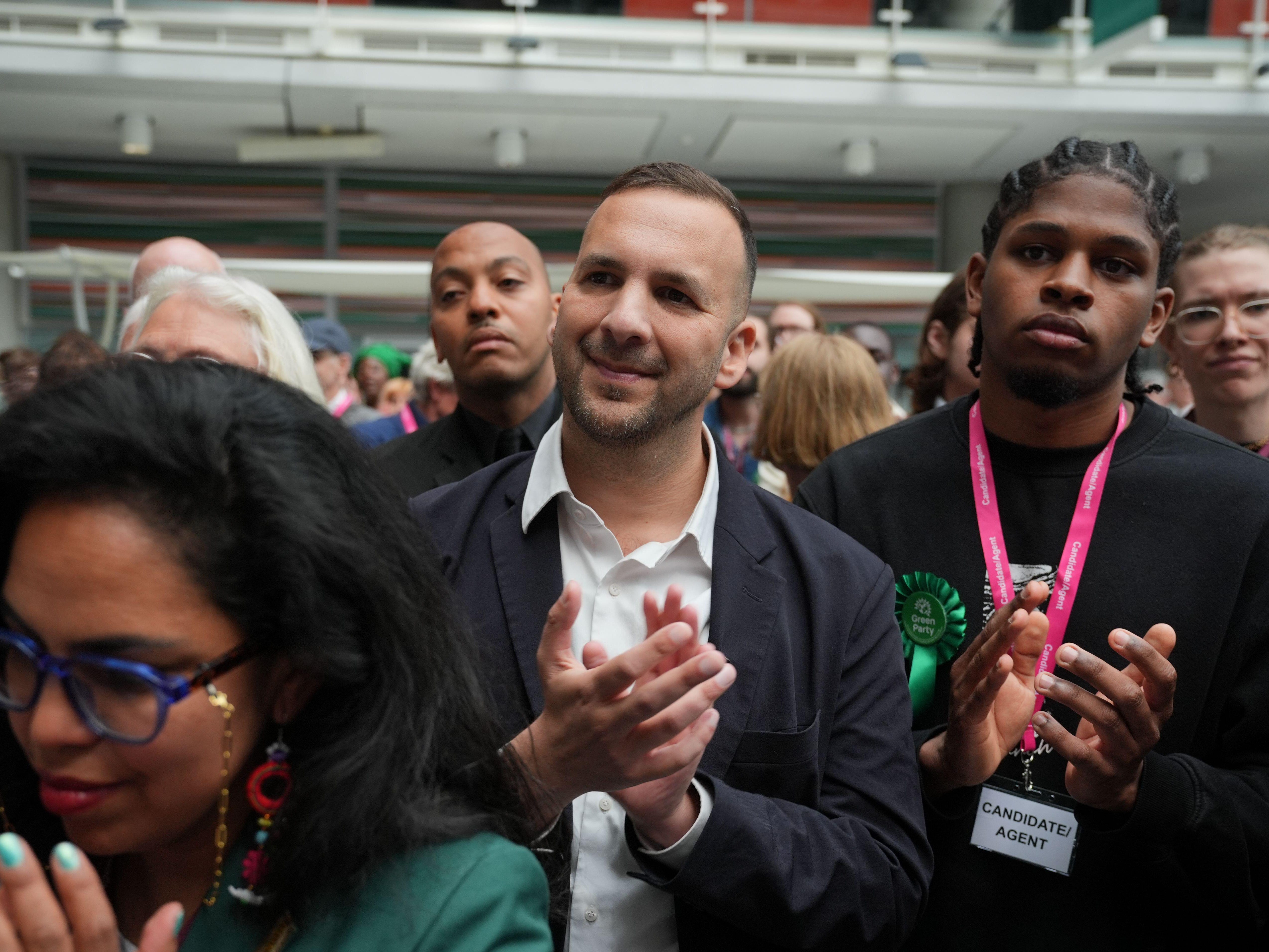

Make no mistake: this is a very strong and truly exciting set of results for the Green Party. That vital and historic fact must not be lost, amidst the splurge of attention for the appalling rise of Reform UK at these elections. Just how strong these results are can be seen in the national projected vote share. By this measure, as opposed to by seats won (by which measure the Greens came in in fifth place), the Greens came in second place nationally. An extraordinary, unprecedented achievement.
Could the results have been even better? They could. These were local elections; the Green Party second place equates to 18% of the vote overall, a 5% increase from the last comparable elections (Reform’s increase was 24%). A 5% boost is very impressive, but not stratospheric. Greens would expect to do better in these elections than in a general election. A few weeks ago, there was talk from the Green camp of possibly even doubling its Councillor numbers at these elections or close to that. In the end, it didn’t come close to that.
Why?
Clearly, a large part of the answer is to be found in the ferocious attacks on the Greens from the media and the Government, recently. Some will say that those attacks constitute an establishment/elite-conspiracy in plain sight, and that they show how broken our system is. There is truth aplenty in that, and I myself have fought back very strongly against such attacks, accordingly.
But just bemoaning the system and playing the victim won’t do. What has happened is partly due to choices made by the Green Party over the last year.
The Potential Ceiling
The Greens face a potential ceiling to their support, if they are perceived as polarising or even as ‘rabblerousers’ rather than offering bold leadership that unites Britain around a response to its real challenges – inequality, the cost-of-living and insecurity, including from environmental breakdown. This concern about a ceiling is now a real and present risk: The election campaign that just concluded showed clearly that the Greens are definitely at risk of being perceived as unsafe controversialists.
Zack Polanski has done remarkable work in raising the profile and poll ratings of the Greens; congratulations to him and his team. But Zack’s own net-popularity has recently nose-dived.
So much has clearly gone right in this campaign, for the Greens. Nevertheless: What has gone wrong is partly self-inflicted. Some of us warned last year that the Green Party faced the risk of ‘entryism’: that is, of people with no attachment to the fundamental values and aims of the Party entering into it in an organised fashion. We were attacked and even mocked at the time. That mockery has suddenly gone very quiet, as it becomes clear that there is a cohort whose dogmatically ultra-Left views, leaching at times into anti-Semitism, have been allowed to be Party members and indeed, in some cases, candidates.
The Green Party has sought to be robust in suspending candidates who have crossed this line. That’s good, essential. And so, to be absolutely clear: charges that the Green Party is ‘anti-Semitic’ are laughably absurd, confected, and I reject them utterly.
Those charges are a desperate attempt to repeat the disgusting anti-Corbyn playbook in order to seek to prevent the rise of a new political force. And they are a disgraceful attempt to leave the rogue Israeli state free to continue its genocidal ethnic cleansing.
But Zack Polanski made a very consequential error of judgement in appearing to attack the police officers who closed down the horrifying knifings that occurred recently in Golders Green. And the more important point is that that error did not come from nowhere; it is a broadly-predictable consequence of a culture of attention-grabbing angry Left ‘populism’.
Culture eats strategy for breakfast: a culture that encourages the kind of decisions made in the election run-up and campaign will inevitably sabotage the best-laid plans. A culture that lionises polarisation and conflict in the search for attention inevitably ends up feeding errors in judgement.
On the doorstep for the Green Party in recent days, I and many others felt directly the negative impact of that incident; and it is expressed in these election results being less good than they could have been. It is expressed, in other words, in the sad fact that some potential Green Councillors have at the last hurdle fallen short.The Greens are suddenly seeing the (foreseeable) downside of being seen as polarising ‘populists’.
What is actually called for is a modified version of populism, one that depolarises. For, increasingly, what is popular is not attention-grabbing culture-warriorism; huge swathes of voters are dismayed by disdain and rancour; they want unifying leadership.
Think Mandela, King, Roosevelt, Attlee; none of these figures sought to polarise. They sought to inspire.
My view is that Zack Polanski is at his best when he does the same, and indeed when he appeals to patriotism in the process – as in this video – which, for good reason, he has had as his pinned tweet for months now.
And the content of that inspiration? It needs to do much more than retreading what Labour used to do when it was an authentic left-wing Party. For, if Burnham (or Rayner) succeeds Starmer, after these truly dire results for Labour, then Greens will need more than just solid left-wing credentials to mark out their distinctiveness. Polanski has been very fortunate so far to have been up against a clueless, Mandelson-gated, non-Left ‘Labour’ Government and an infighting Corbynite Party utterly failing to threaten the Greens.
Sustaining the Green Insurgency
To sustain the Green insurgency, the Green Party are going to have to learn to be truly loud and proud about being Green (as in leaves and trees green), again. And to call out Labour for being the opposite: Rayner has been as catastrophically anti-nature as Starmer, while Burnham, though reasonably positive on ‘net zero’, is similarly very weak on nature and weak on climate adaptation.
The Green Party ought to make hay from the two Government reports that have emerged in the past few months which show that our system’s cavalier attitude towards nature and climate is a severe national security risk and poses a threat of food price rises and food shortages in this country, in the unstable world we are moving into. So far, the new Green Party leadership has shown very little interest in these bombshell reports.
Labour has failed so badly because it has systematically taken Left-wing voters for granted. The Green Party must never make the same mistake: it must not take for granted the votes of the many millions – some of them not ‘left wing’ – who love nature/wildlife, or who understand that you cannot have an economy at all without supporting life and having a stable climate, or who get that the real way to reduce the cost of living includes a full raft of fairly deep green policies, or who want our common future – and our children’s future – protected through the building of resilience and of nature-based national security.
Burnham or Rayner will try to entice Green voters back. It is essential that clear green water is set out; water that their old-fashioned growthist boosterism cannot cross.
Greens need to appeal to a wider base. Even if you disagree with some of my specific claims or suggestions in this piece, please hold onto that basic thought. We need to find effective ways of appealing well beyond the progressive activist ‘base’. If we don’t, then we increase the probability of a Farage premiership.
We need to be able, with full intent, to contest not just metropolitan Labour strongholds but the new Reform strongholds too.
What, in Sum, is Needed?
We need a politics that seeks a broad popular front to stand against the very real risk of a hard, far-right Government succeeding to power in 2029. That means less talk of replacing Labour and more talk of offering something truly different from them – something truly eco-logical, adaptation-centric, reality-based – done in a manner that can nevertheless enable electoral co-operation with them.
We need to be able to win seats in both rural and suburban areas. This means not just trying to ‘replace’ Labour and not leaning in overly hard into identity politics.
We need a Green Party that can present itself accurately as an in-touch, practical, and patriotic Party ranged against the reckless grifters of Reform. Getting the Greens to be perceived as genuinely, properly, deeply patriotic, or as part of a potential patriotic coalition, is both essential and challenging. It can be undermined in an instant. It needs to be rigorously pursued as a goal, with a contrast constantly being firmly drawn with the foreign-backed, tyrant-loving leadership of Reform.
As I’ve set out for several years, the ultimate future of British politics is likely to be Green vs Reform. That prediction has been confirmed at this election, in which, as I noted at the start of this article, the Greens, remarkably, have come in second (in vote share), to Reform’s first, with the old parties lagging behind. But we will lose that epic struggle with Reform, unless we learn the tricky lessons of this election campaign.
If we end up after the next general election with sixty or seventy seats and a proto-Fascist Government, those seventy-odd seats, while impressive, will be comparatively little consolation.
So, it’s two cheers for the Greens. These election results, across Britain, while objectively very good for the Green Party, are actually a little less good than they looked like they were going to be, while by contrast Reform have truly prospered.
We cannot afford for that to happen again.
Rupert Read is Emeritus Professor of Philosophy at the University of East Anglia and Co-Director of the Climate Majority Project. He is a former Green councillor, whose books include Why Climate Breakdown Matters published by Bloomsbury.

"These were local elections; the Green Party second place equates to 18% of the vote overall, a 5% increase from the last comparable elections (Reform’s increase was 24%)"
A very interesting article. My I point out that Reform barely existed in comparable local elections 4 years ago (the Brexit Party renamed itself Reform in January 2021 but is basically the same outfit as UKIP then the Brexit party were so it's level of polling a) comes form a base of zero and b) is about the same level of support that it receives in "how do you intend to vote at the next GE" type of polls.
Quite why Reform garners that level of support though is beyond me.
I usually find this author a complete turn-off but on this occasion he's pretty much on the money.
Pushing the message that Ffarij's party is NOT patriotic,. does NOT support British sovereignty and generally wants to increase inequality is exactly the right message.
Mocking their attitude to climate change as completely unrealistic & driven by their (fossil-fuel-loving) uber rich donors also goes down well.
As Trump tumbles out of the reckoning, Ffarij's admiration for him will become less important.
Pointing out that immigration is falling to new lows is tempting - but then Ffarij pivots to demanding that existing "foreign" residents should be expelled. Although that's likely to be unpopular with the general public, it plays better than it should with committed RefUK supporters if they were really Christian, so isn't so helpful.