


Paul Mason insists his new book ‘Reds’ is more about guiding the future than simply revisiting the past, despite a subtitle that reads, ‘A Global History of Communism’. In an interview with the Byline Times Podcast, the respected former Newsnight economics editor says he’s become alarmed at the number of young people who are being lured by Marx and Lenin, without fully understanding all that has gone before.
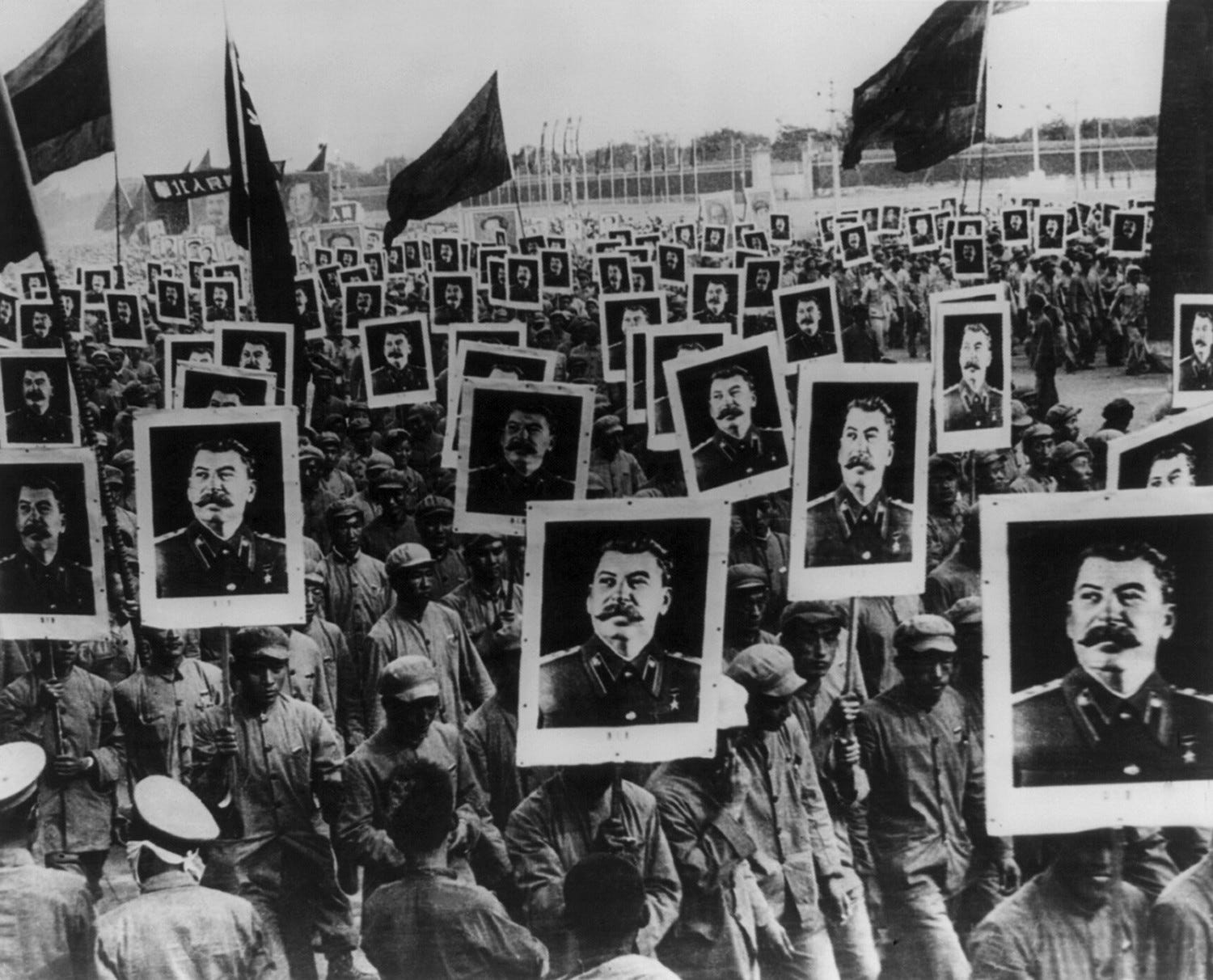
“We see it on the British left and the American left, as critical faculties are being drained away from a young generation, by what we’ve been seeing in academia - the cult of unreason, the cult of identity - people become unable to process simple ideas like ‘killing 16 to 44 million people in a famine is not a great advert for Marxism- Leninism’ - because this is what happened in China. And so we’re now seeing on TikTok, people from Gen Z teaching each other the basics of Marxism-Leninism and Mao Zedong thought as if all the catastrophes and mass murders never happened.”
It perhaps needs emphasising at this point that Mason is a socialist. He describes himself as having grown up belonging to “the far left of the Labour Party, influenced by Trotskyism”, whilst insisting that he “was never starry-eyed about either the Soviet Union or China.” Indeed, when he visited trade unionist friends in Russia following the collapse of the USSR in 1992, “we wanted to see that Soviet bureaucracy fall.”
At that moment in history it was tempting to think that communism was, if not quite dead, then certainly on the critical list. There were various isolated communist regimes - Cuba and North Korea for example - but after the fall of the Soviet Union, China was the last major flag-bearer for the ideology.
Even then, as Mason recalls, the party in Beijing seemed ready for change.
“In the 2000s, as a BBC correspondent, I was allowed quite extensive access to China. I used to meet very senior Chinese officials, and they’d say quietly, ‘Paul, listen, off camera, we’re not really communist. We’re more like Swedish social democrats. We want to do good for the workers. We want to develop our economy. It’s just we haven’t got a developed economy enough to have a welfare state. When we do, we’ll have one; and we’re experimenting with a few local elections. So the direction of travel is towards a kind of controlled democracy.”
There were even fanciful hopes that China’s admission to the World Trade Organisation in 2001 might accelerate an era of greater personal freedom in the PRC, but as Mason observes, “Xi Jinping has cancelled all that. Xi has restored orthodox Marxism as the ideology of the state. We have to therefore take seriously the possibility that if China does become the strongest economy in the world, it might still have this ideology, and it will teach 100 million party members and 1.6 billion Chinese citizens that this is communism, and will say that this is a vindication of Marx.”
Suffice to say, Mason - who has “a lot of time for Marx” - feels that China’s authoritarian structure, which rewards party loyalists, is a betrayal of “the sharing impulse” which he regards as “part of human nature” and drives many towards communism, especially at moments of societal breakdown. He notes that Marx (and Lenin) believed that in a society with private property, “class hierarchy and violence disappears - and that’s just wrong. And the fact of it being wrong it takes away an important premise of all the communisms I talk about.”
Asked to identify the origins of communism, he goes much further back than the overthrow of Tsar Nicholas in 1917, Marx’s Communist Manifesto of 1848 or even the French Revolution in 1789; all the way, in fact, to the dawn of man.
“The impulse to share and to collaborate and not hoard private property, I would argue, is genetic for us, and there are strong arguments among evolutionary biologists to say it is that which separated us from the primates we evolved from. Our modes of living had to be [communist] in order to suppress the dominant male, which is the characteristic of all baboon tribes or the gorilla family. We had to evolve sharing. Both the archaeological record and the anthropological record of the surviving tribes show that the classic hunter-gatherer band is communist. It shares; it practices altruism.”
For all that, Mason returns to his concerns for the next generation, which might fail to recognise that, in practice, “the actual evidence is that those egalitarian, altruistic societies also had coercion. They enforced egalitarianism through strict peer pressure and sometimes murder. If someone’s trying to seize property, or seize position in those societies, there is quite a strong pattern among the anthropological record of them being taken down by mockery, by humour, by ostracism, and ultimately by murder if they broke the rules. Now, why is that important? Because if you argue, as I do, that the communist sharing impulse is part of human nature, you also have to then say it doesn’t guarantee the absence of violence, oppression, and coercion.”
Mason says he has consciously turned away from revolutionary thinking as a result of that observation, and describes himself now as “a radical social democrat. I work within the Labour Party. I want to push it towards more socially just outcomes. I want it to acknowledge the legacy of British imperialism. I want it to deal with modern imperialism in Russia against Ukraine. The idea that redemption emerges by knocking things down is something I think is provably wrong, and it’s so risky because the fact is that every revolution in the 20th century brought to power unscrupulous people who were determined to carve out positions for themselves. It was true in Venezuela, true in Nicaragua. Cuba is a travesty, however much we want to defend it against the American blockade.
“I think that capitalism is in trouble [but] the classic Stalinist, Leninist, Maoist answer is not an answer. The only thing we’ve got in Europe is social democracy and its green allies and its reformed communist allies. So, for example, in Spain, you’ve got [second deputy Prime Minister] Yolanda Diaz, an ex-communist, but effectively a social democrat. Let’s cherish that tradition and build something out of it. Be proud of it because our tradition, too, was heroic in the Second World War and against fascism.”
Watch or listen now to Adrian Goldberg’s interview with Paul Mason on the Byline Times Podcast.