


BYLINE TIMES IMPACT: Find out about the changes you made happen
The death of two-year-old Awaab Ishak from mould in a squalid flat in Rochdale shocked the nation, but it came as no surprise to ITV News Investigations Editor Dan Hewitt, who had already been exposing slum properties for nearly two years by the time an inquest in 2022 declared that Awaab’s death from a respiratory illness had been caused by exposure to deadly spores.
As Hewitt told the Byline Times Podcast, “I’d spent almost every week walking into tower blocks and found conditions much, much worse than those Awaab died in. I found myself looking at the awful photos inside his flat, and thinking, ‘how have I not reported on the death of a child before this?”
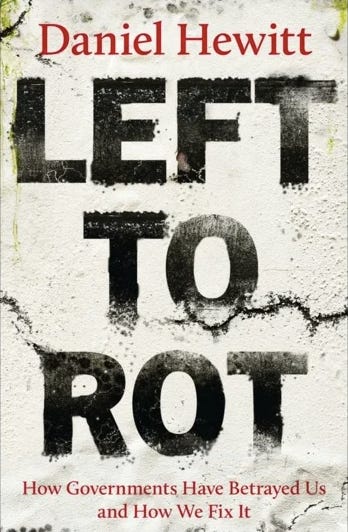
His reporting, chronicled in his new book, Left To Rot, began in Croydon when he was initially working on another story: “I stumbled upon this block of flats in South London, and the Awaab Ishak story had everything I’d found in that previous 18 months – the stigma, the lack of any kind of regulation to stop this happening, cuts to local government funding, lack of interest from central government, racism, class – it was all there…”
He joined forces with campaigners to highlight the need for Awaab’s Law, aimed at forcing social landlords to promptly remedy hazardous conditions. It entered the Statute Books in 2025, but Hewitt is under no illusions that years of neglect in the sector have been transformed overnight. Even now, he says, more than half a million children live in properties that don’t meet the official Decent Homes Standard. The blame, he believes, lies with Margaret Thatcher’s ‘Right To Buy’ policy in the 1980s, which allowed tenants to purchase their own council homes at knockdown prices, whilst denying local authorities the opportunity to re-invest the proceeds in new builds. Councils were forced to give way as landlords to more commercially-driven housing associations which, in some cases, are backed by private equity.
As for those in the intervening years who’ve lacked the means to buy their council house – even at a reduced cost – Hewitt says, “Thatcher didn’t really have much time for them, and successive governments haven’t had much time for them. For the last 40-45 years, successive governments have written into the sky, ‘ownership good, social housing bad’. If you can’t buy your own house, if you aren’t aiming for home ownership, the state hasn’t cared about you.”
He cites the scaling back of the Social Housing Regulator’s role during the ‘Bonfire Of The Quangos’ ignited by the Tory/Lib Dem coalition government in 2010. “It sounds pretty dry”, Hewitt admits, “but it meant the Social Housing Regulator was no longer given the power to inspect properties or speak to tenants – but it was allowed to speak to the housing associations, because banks were lending them money. They wanted to keep that regulation.”
Hewitt’s passion for his subject is partly driven by his own family experience He recalls as a child visiting his grandparents cheerful council house in Walsall – where his father had grown up – which gave the family an escape route from grim private rented accommodation. “Council housing did save that generation,” he observes. “It wasn’t a handout. It was a hand up. It wasn’t seen as a safety net. It was a springboard to a better life. I think I sit here as a privileged journalist doing this job, in part because the state stepped in after the war and helped working people like my grandparents to have a better life.”
One of his interviewees in the book is incoming Prime Minister Andy Burnham, who last month pledged to deliver the biggest council building programme since the war. Hewitt is cautiously optimistic: “I think he genuinely means it. I think a decade in local government [as Mayor of Greater Manchester] has allowed him to see the issues upfront in a way that lots of politicians don’t.
But, he admits, “We don’t know what he means by the numbers. There’s also this huge question of how he pays for it, [but] he has to do something. I don’t think this [Starmer] Government has gripped the crisis in the way that I think many hoped they would. I think there is still a hangover from Thatcher – that knee jerk instinct to talk about home ownership, which is important, of course. But it shows the success of Thatcher that ownership is just everything in the psyche of the way we view housing in this country. The stat that alarmed me most and surprised me most was that in 1980, just under a third of Britain lived in council housing. Today it’s 8% .
‘When I interviewed Steve Reed, the current Housing Secretary, he basically said people don’t want to live in council housing; they want to own their own home – but for millions of people, it’s not an option. There has to be something in between. And we can reel off the stats: 1.3 million people on waiting lists, record numbers of children living in temporary accommodation. Everyone can see the problem. It is time for solutions, and maybe we have a Prime Minister now who actually gets this and is willing to do something about it.”
Daniel Hewitt’s book, Left To Rot - How Governments Have Betrayed Us and How We Fix It’ is published by Policy Press, an imprint of Bristol University Press.
Burnham is right a should whatever it takes to remove blockages
Council houses were not just about affordable housing for the less well off. They allowed people with a bit more income to save and then to buy their own place. They also provided a degree of competition for the private rented sector, the sector that now owns so many of those ex council houses, renting them out at far higher rents.
Thatcher's Right to Buy policy has been a disaster for England (Scotland and Wales repealed it years ago I believe - unsure about NI) and Labour has betrayed the nation as a whole by not repealing it when they had the chance. It is an absolute right to live in clean, warm affordable council housing. Oh and Steve Reed has been a total failure in both his cabinet roles to date, first at Environment, Now in Local government and Housing - he's an unprincipled McSweeney fanboy.