
BYLINE TIMES IMPACT: Find out about the changes you made happen
Khaled’s life has always revolved around the olive farming in his field in Battir, a town near Bethlehem in the occupied West Bank. But in October, just as the harvest season was getting underway, he had to pay 100 shekels (£24) for a bottle of olive oil. “Every year I produce four tins, which are enough for my home, but this year there is nothing at all. I can’t reach the olive trees I need to harvest,” he explained in Hebrew.
The barriers keeping farmers like Khaled from their land are rooted across the Green Line, where the politics of settlement expansion have become central to Israeli governance.
Preliminary tallies from Israel’s parliamentary election left Prime Minister Benjamin Netanyahu’s right-wing bloc short of a majority at 53 Knesset seats. An opposition bloc led by Gadi Eisenkot captured 48, while Arab-led factions surged to 19, pointing toward another protracted stalemate.
Efforts to unseat Netanyahu quickly stalled: Eisenkot ruled out relying on Arab factions, even as Yousef Jabareen, head of the 12-seat Joint List, insisted on X that genuine change requires “Jewish-Arab partnership.”
Facing deadlock and record Arab turnout, Netanyahu’s Likud escalated, alleging the election was “stolen by Arab parties” through fraud and voter intimidation and demanding police and Shin Bet investigations.
The campaign broadsides mirrored a governing formula honed over years. Dependent on far-right partners to stay in office, Netanyahu has steadily empowered the ultranationalist settler movement by legalising rogue outposts or distributing assault rifles to West Bank civilian security squads.
On the ground, that political impunity has fuelled an unprecedented wave of violence. Since October 2023, more than 1,100 Palestinians across the West Bank have been killed, according to United Nations monitors.
During the harvest alone, the Israeli human rights group Yesh Din documented 486 incidents of violence by settlers and soldiers over an 18-day stretch, including 234 attacks directly targeting olive harvests, with Israeli troops present in 62 of them.
Facing Violence in the Groves
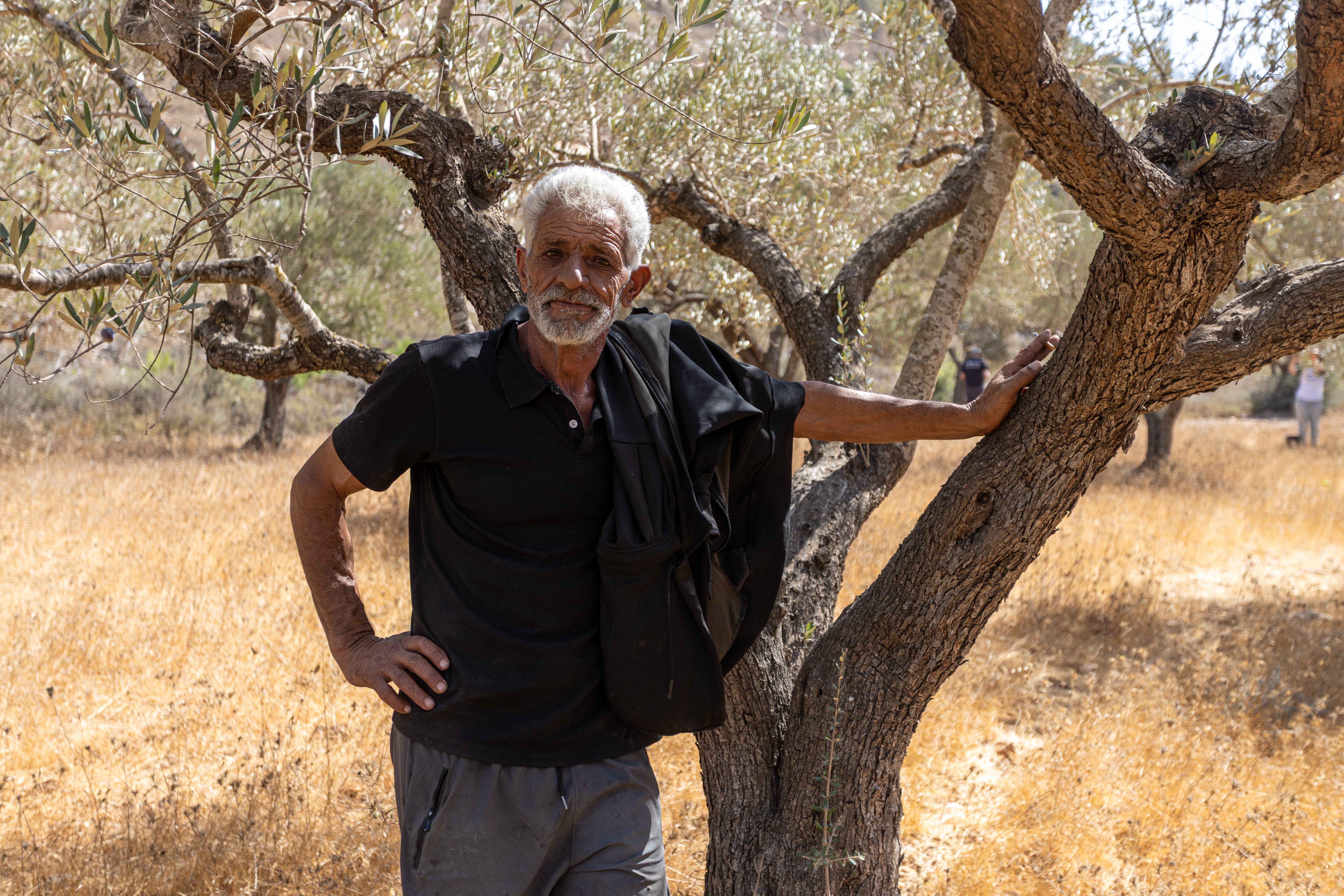
Khaled’s family lands lie alongside the old Jaffa–Jerusalem railway, a few hundred meters from the 1949 Green Line. Resting under the shade of an olive tree, he recounted the repeated settler attacks he has endured.
“They let us spend a whole day picking olives, working hard, me and my family. We gather them, pack them into sacks and then they come with total ease, beat us up, take our olives, and leave”, he said.
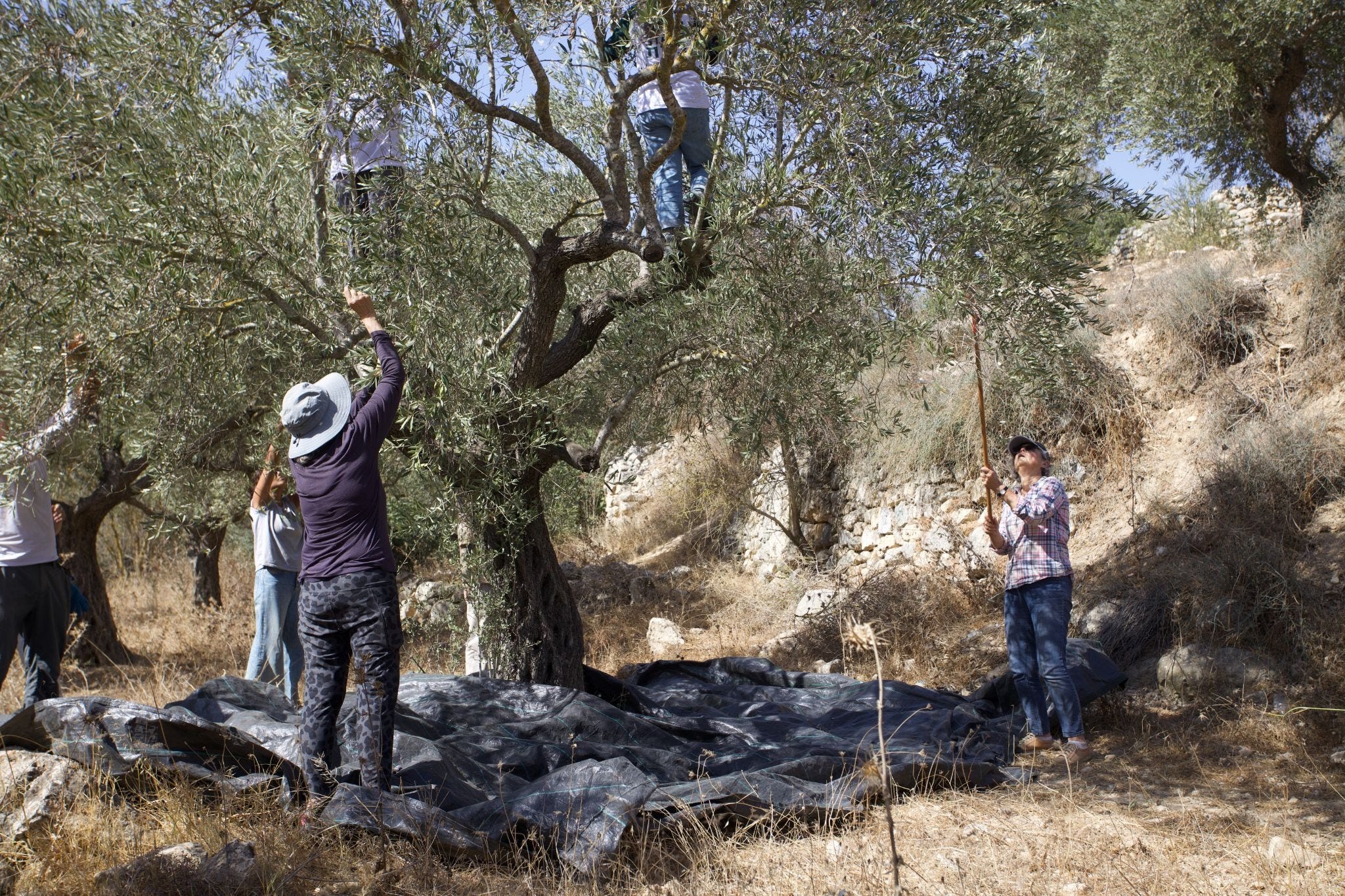
Against this backdrop of violence, the Israeli organisation Rabbis for Human Rights coordinates volunteers multiple times a week to accompany Palestinian farmers into the groves. They rise at dawn, gathering at designated meeting points in Jerusalem or Tel Aviv.
Wearing a bucket hat and an easy smile, Charline, a 23-year-old French-Israeli, mingled with fellow volunteers while waiting for a minibus whose destination organizers had kept secret until the very last minute.
Like many in the group that morning, this marked the first time she had taken her political convictions into the field to physically support Palestinians facing settler violence. An undercurrent of anxiety was palpable; recent weeks had brought a steady stream of footage showing volunteers pelted with stones, and journalists and politicians beaten by settlers.
“I feel deeply ashamed of what is happening, because this is my country, even if I haven’t lived here for very long, and I refuse to let this be done in my name. I just can’t accept it,” Charline said. “I also can’t accept living comfortably in Tel Aviv, where life goes on as normal, knowing what is unfolding just 20 kilometres away, whether in the occupied territories or in Gaza. Above all, I think it comes down to this: refusing to look away.”
On the bus, a young organiser ran through the safety protocols. If settlers begin throwing stones, he warned, never turn your back and run; keep your eyes on the projectiles to dodge them. If Israeli forces fire stun grenades, plug your ears and open your mouth wide, he instructed, miming the motion.
Rabbis for Human Rights, which was created in 1988 during the First Intifada to address occupation-related human rights abuses, unites Israeli rabbis across diverse Jewish denominations who advocate for universal human rights as a core, faith-driven mandate rooted in Jewish tradition.
“Settler terrorism is really rooted in religious extremism. It is a very worrying fanaticism that claims that God gave the entire land to the Jewish people and you can use whatever means to take this land. It’s kind of a holy war. It’s very, very dangerous,” explained Anton Goodman, CEO of the organisation.
Locked Gates and Closed Roads
Standing in the aisle, the coordinator finally disclosed where they were headed: Bethlehem, biblical birthplace of Jesus and, in Jewish lore, of King David. After an hour on the road, the West Bank’s rolling hills appeared through the bus windows.
Reaching the West Bank was the easy part. Getting to Khaled’s village proved harder. Turned away by a temporary Israeli army checkpoint, the Palestinian driver swung toward the village of Husan, only to find its yellow gate locked. Unfazed, the RHR coordinators called in another bus; volunteers slipped past the barrier on foot and climbed aboard. Such improvisation is routine in a territory where, by April, the U.N. counted 925 physical obstacles, including 307 checkpoints, restricting Palestinian transit.
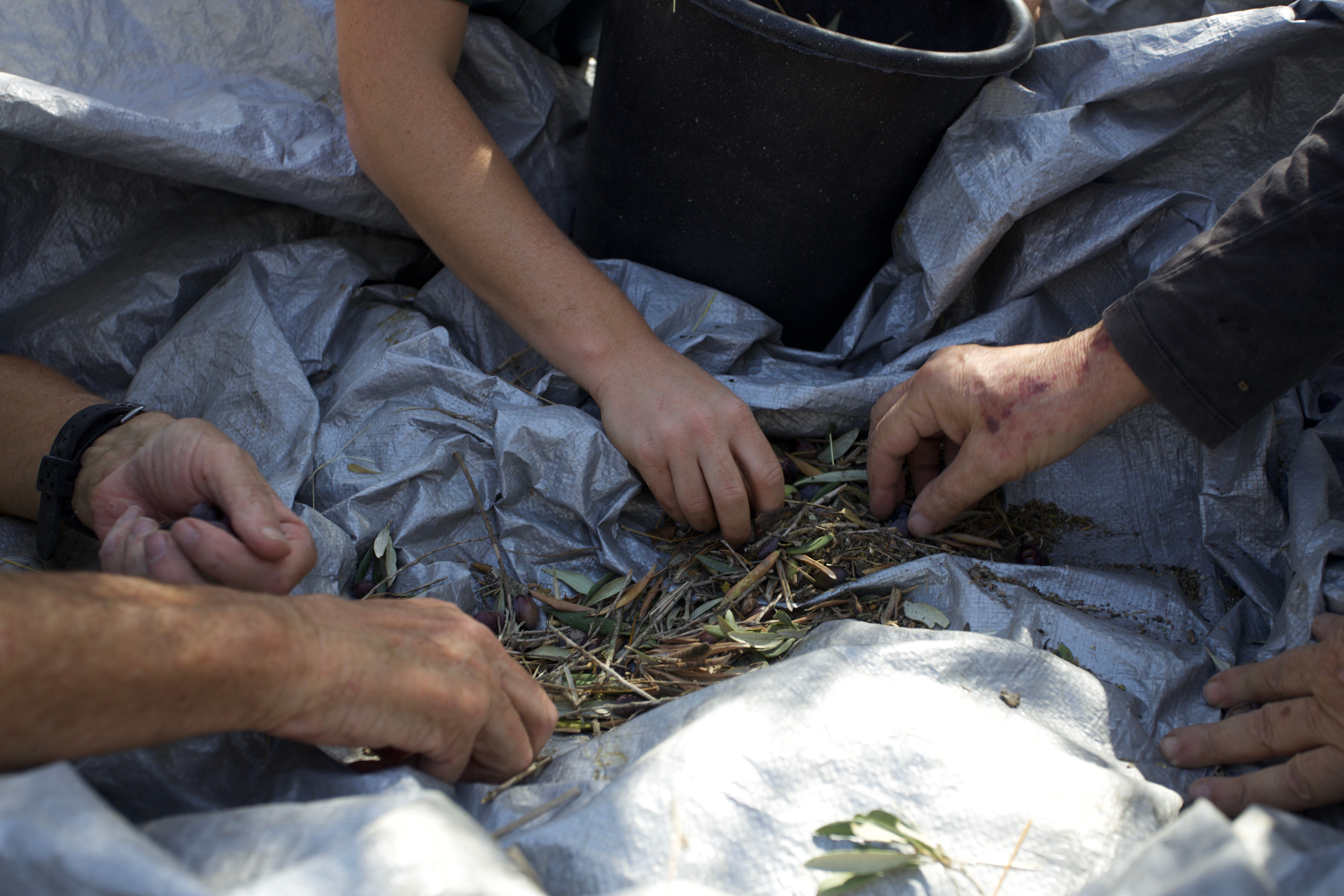
In Khaled’s grove, around fifty volunteers of all generations climbed trees and picked olives one by one. Noga weaved between them. A hasty departure from New York in late September for family reasons had left the 72-year-old Israeli-American ill-equipped for the terrain; in sandals, she periodically stumbled on the rocky hillside. Still, with the Israeli parliamentary elections merely five days away, boots or not, Noga was resolute: her place was here, beside the Palestinians.
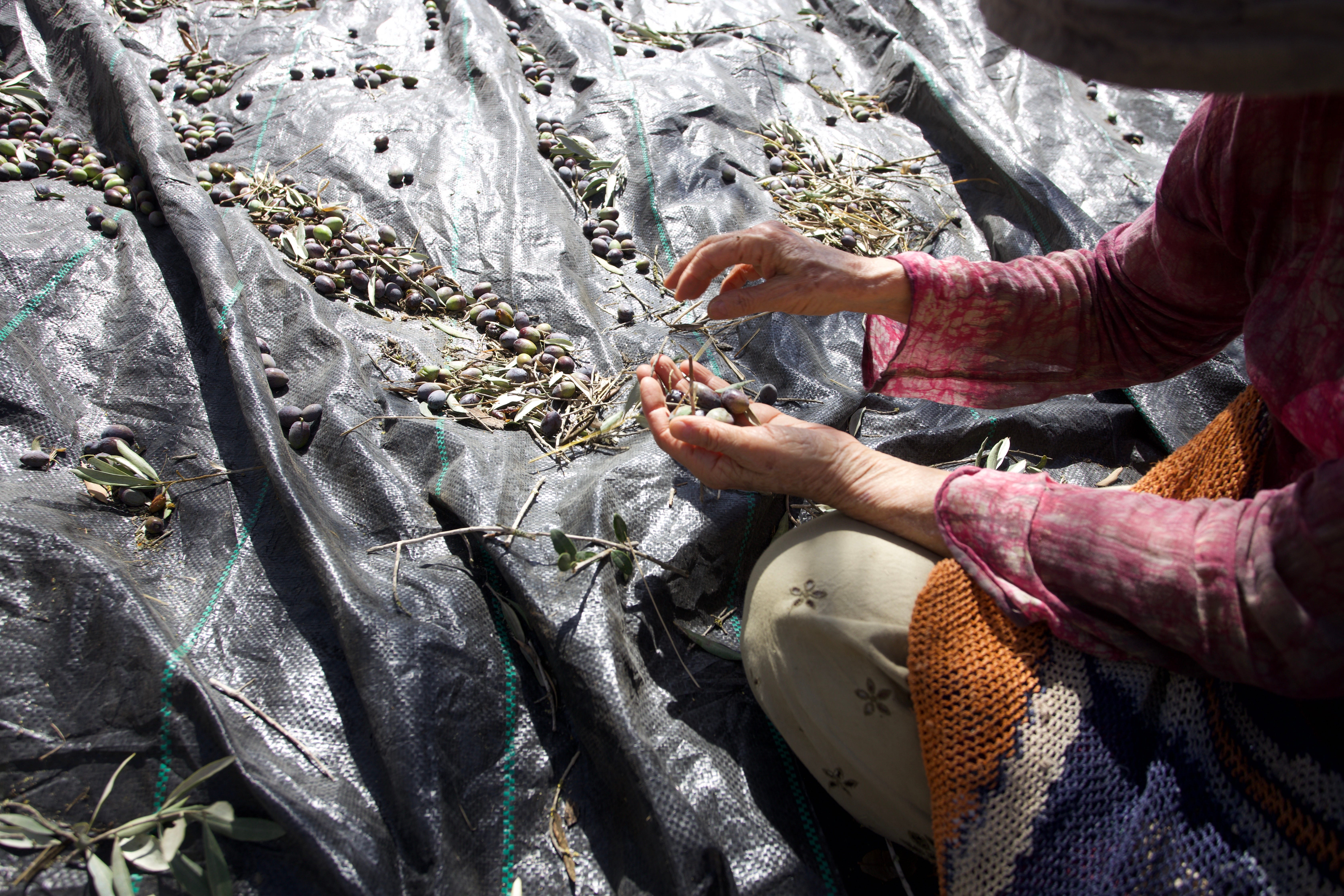
Sitting on a tarp, with olives in one hand while using the other to strip them, she said : “It is heartbreaking to see the extremists in power, filled with fear, and dominating the narrative and the events of the day. There’s no other future but to find a way to live together and discuss differences, and not kill each other”.
In recent weeks, Israel has tightened restrictions on the olive harvest, requiring Palestinians to obtain prior military clearance before accessing their groves. Khaled’s trees, like most of the West Bank’s farmland, lie in Area C, under direct Israeli military rule.The latest directives place roughly 8,800 hectares of agricultural land off-limits, a 30% surge compared to the previous year. Meanwhile, Israeli citizens have seen their access to surrounding lands expanded.
Detained for Helping Palestinians
Khaled and his family were in constant motion, shifting tarps, tipping buckets of olives into oversized sacks while tending to their guests. Coffee simmered over a makeshift fire. Turning down the sweets passed around by the farmers was out of the question - everyone needs their strength. Under a punishing sun, the volunteers worked without pause. The mood was bright; unlike the day before, both the soldiers and the settlers seemed to be occupied elsewhere.
On October 21st, the Israeli military detained about 80 American, Israeli, and British volunteers assisting Palestinian farmers with the olive harvest near Bethlehem. Among them was Rabbi Doug Alpert, who, upon his release, chose to return to the groves the very next day.
According to him, despite complying with an unannounced military closure order and attempting to leave, the volunteers were detained by Israeli soldiers, transferred to a station, and questioned for an hours-long detention.
“They fingerprinted and took mug shots of us. We were led to believe that there was a strong likelihood we were going to get deported”, said American Rabbi Doug Alpert. “I felt the injustice that I know Palestinians go through every day for years and years and years now. And we only experienced it for a day.” He had flown in specifically from Kansas City to stand with farmers facing settler violence.
Around 1 pm, organisers called across the groves for a midday break before departure, but the volunteers lingered among the trees. Charline worked alone, gathering stray olives scattered in the dirt. Nearby, Rabbi Doug Alpert folded a collection tarp alongside fellow Americans, while Noga remained seated under another trunk, methodically sorting fruit from leaves.
As the work wound down, Khaled thanked the volunteers, telling them how grateful he was for their presence. Yet the solidarity offered little relief from the constant friction he described living beside the nearby settlements.
He said : “They come to attack you without letting you say a word. If you’re strong, okay, you manage; if you’re not strong, you’re done for with the clubs that they carry”.
Soon, the group was on the road to Tel Aviv and Jerusalem; within days, several of the visitors would be flying back to their home countries, their votes cast.
Khaled remained behind. With white hair and deep lines etched by decades under the sun in his groves, he looked out across the land. “Before October 7th, there was a life,” he said. “Today, there is no life.”