

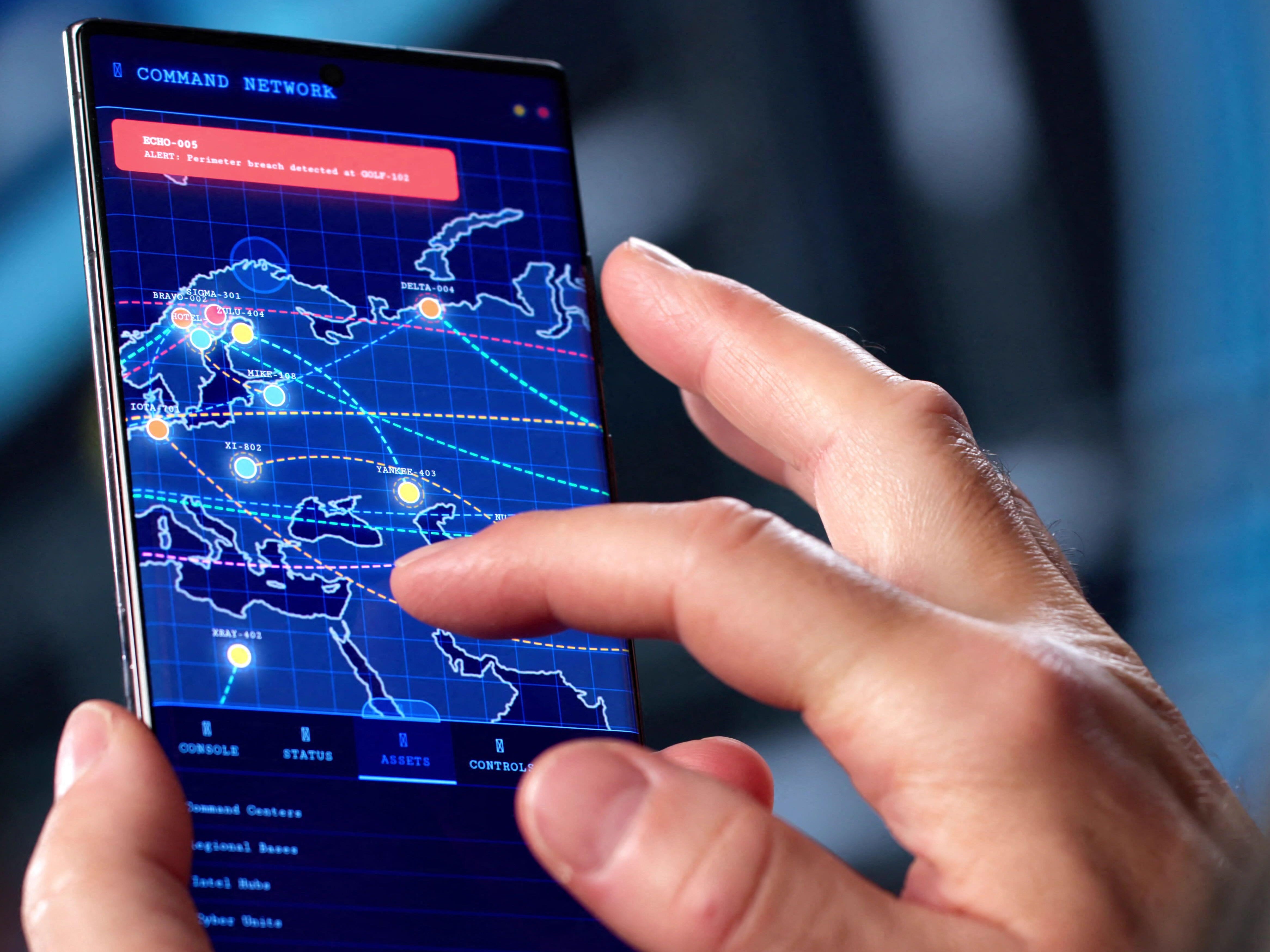

Over the past weeks we have seen just how hyperconnected the contemporary battlefield has become. Civilian technologies, media platforms, and data infrastructures are now deeply entangled with military operations. This is reshaping the conduct of war and revealing the limits of strategy making.
Recently, the White House defined victory against Iran as the moment when the President “determines Iran no longer poses a threat to the US”. Victory didn’t involve a formal surrender. It was to be decided by the President himself.
A day later, the UK Ministry of Defence released a news story that inadvertently helped the Russians geolocate a Ukrainian repair base funded by Britain. It wasn’t that the press team had their smartphone switched on and were broadcasting live. Rather the footage from the smartphone revealed the dimensions and layout of the building, allowing the site to be identified.
This last week, reports also emerged that the location of Iran’s senior leadership had been compromised because their bodyguards continued to carry their cellphones while on duty. Even while they were off the grid, Iran’s leaders could still be located.
In each of these cases, the medium had become part of the story. The bodyguards’ phones functioned as surveillance devices, generating location data that could be combined with other intelligence sources to reveal patterns of life. Similarly, the British press release created operational intelligence not because the team were connected in real time, but because they failed to consider what information the footage revealed once it was shared online.
In both cases, civilian technology was crucial for making military activity possible. And this is true of how the armed forces leverage Artificial Intelligence into their campaign planning. Anthropic’s LLM, Claude, has to be trained on data that comes from us as we go about our ordinary lives. Without the data we create using our devices, these LLMs would not work.
Yet despite Anthropic’s efforts to limit the military use of its technology, reports suggest Claude has been employed to support American targeting processes. Capable of detecting patterns in diffuse datasets at a greater speed, scale and clarity than human analysts, these systems are increasingly attractive tools for commanders seeking operational advantage.
This was the lesson American leaders took from operations in Venezuela. The media spectacle surrounding those operations appears to have reinforced the belief that similar results might be reproduced in operations against Iran.
Anthropic has insisted that humans must remain in the decision-making loop. Put simply, AI cannot replace military judgement. This has infuriated the Pentagon which continues to want greater freedom to experiment with AI to maintain military advantage. For technology companies, the concern is about responsibility and control. For military organisations, the pressure is operational. Systems that promise to help reach decisions at speed and scale offer a solution to the complexity of modern warfare where decision-making is increasingly compressed by social media cycles.
This disagreement points to a deeper tension. Accelerating the targeting process risks displacing the humans out of the decision-making loop. This reflects a wider struggle over how much strategic authority should be ceded to machines.
What becomes difficult to assess—particularly given the limited quality of publicly available information—is how this dynamic is playing out in the Middle East. Although the political objectives of the campaign have been articulated in different ways and with varying emphasis, their realisation is increasingly framed through the rhetoric of operational success and the narratives circulating in the media environment.
In a churning media environment, knowing what strategic success story will stick in the minds of crucial audiences is contingent on factors that cannot easily be predicted. Legacy media struggles for clicks and viewers even as social media produces dysphoria and uncertainty. Winning the narrative in this context means making a splash, going viral and speaking directly to the audience. This is reshaping how our leaders talk about war. And in Trump’s case is producing narratives in search of a strategy.
The claim that the goal is “unconditional surrender” illustrates the problem. Such language shifts attention away from clearly defined political conditions and toward a declaratory end point that can be announced whenever the administration chooses. In this sense, the war ends when leaders say it ends. The implication is profound for strategic decision-making: the combination of technological targeting systems and media-driven narratives risks displacing the slower, more difficult work of strategy itself.
Caught between Trump’s rhetorical flourishes and the populist right-wing baiting him into military action, this presents Keir Starmer with a serious challenge. AI has seduced American decision-makers into thinking military outcomes will be easy to come by. Media ecosystems imply rhetorical closure is more important than having a clear political end goal. In both cases, strategic thinking is displaced by media spectacle and the everyday failure of operational security by ministers, bodyguards and populations as a whole.
Dr Matthew Ford is Associate Professor in War Studies at the Swedish Defence University in Stockholm. He is the author of War in the Age of the Smartphone: Conflict, Connectivity and the Crises at Our Fingertips.