


BYLINE TIMES IMPACT: Find out about the changes you made happen
Reform UK leader Nigel Farage is currently escalating his bid to scrap the Equality Act – which prohibits discrimination against anyone – by blaming ethnic minorities for the poor educational performance of white working class boys.
However, a Byline Times investigation reveals how he systematically cherry-picks and misrepresents the official data in order to make his case.
Farage used a series of white nationalist tropes in his 7,000-word essay on Substack on 15 June titled ‘Britain is a two tier state – against white people’, in which he called for the repeal of the 2010 Equality Act, describing it as the means by which “anti-Whiteness is institutionalised into every aspect of public life.”
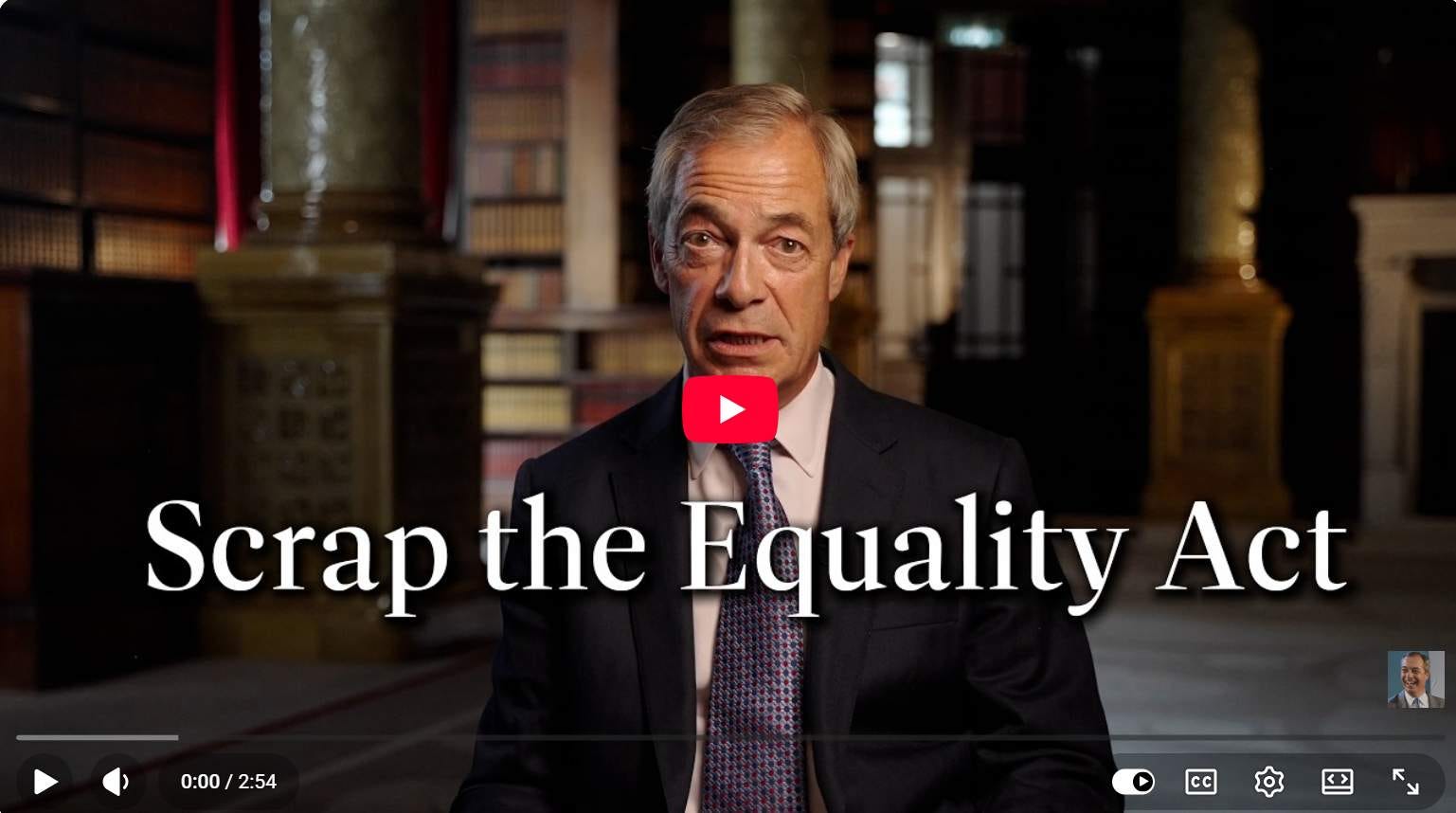
In a video published this week, he stated that white working-class boys were “currently the lowest-performing group in the country’s education system thanks to the Equality Act”, and pledged that Reform UK would “scrap it and return Britain to a meritocracy.” However, the official data Farage cites contradicts both his education claim and the causal argument on which his case for repeal rests.
Farage begins his argument with a truth, which is that white working-class boys are failing in Britain’s schools. However, the same official data that confirms this, also establishes that their underachievement stems from poverty and a decade of austerity cuts, rather than their race. Farage’s explanation – that ethnic minorities are favoured at white boys’ expense by schools, teachers and equality law – is contradicted by every relevant official source he invokes.
Department for Education (DfE) attainment figures, Education Policy Institute (EPI) and Institute for Fiscal Studies (IFS) research, and government poverty data reviewed by Byline Times demonstrate a consistent picture: working-class children of every ethnicity, girls as well as boys, are held back by poverty, concentrated in deprived communities and entrenched by a decade of funding cuts that landed hardest on the schools that serve them.
And while the severe under-performance of white working class boys cannot be contested, each of Farage’s core claims are contradicted by the official sources he invokes – that white working-class boys are the worst-performing group in British education, that equality law drives preferential treatment for minorities, and that schools condition white children to accept a subordinate status.
Three-quarters of the more than £30 million Reform UK has raised since 2019 came from three multimillionaires whose commercial interests align with a platform of tax cuts for high earners, deregulation and reduced welfare.
Farage’s racial account of school failure performs a precise political function: it directs working-class anger towards minorities and away from a programme whose primary beneficiaries are Reform’s donors.
The case Farage has built for repealing the Equality Act rests on two linked claims. The first is that white working-class boys are the worst-performing group in the British school system. The second is that they are “constantly being told” they hold racial privilege, through classroom teaching and equality rules, despite finishing at the bottom of the attainment tables.
The two claims work as a unit. They construct a group that is at once failed by the system and blamed by it – a portrait of racial victimhood that runs through Reform UK’s messaging. The data behind the portrait shows something else.
‘The Worst-Performing Group’
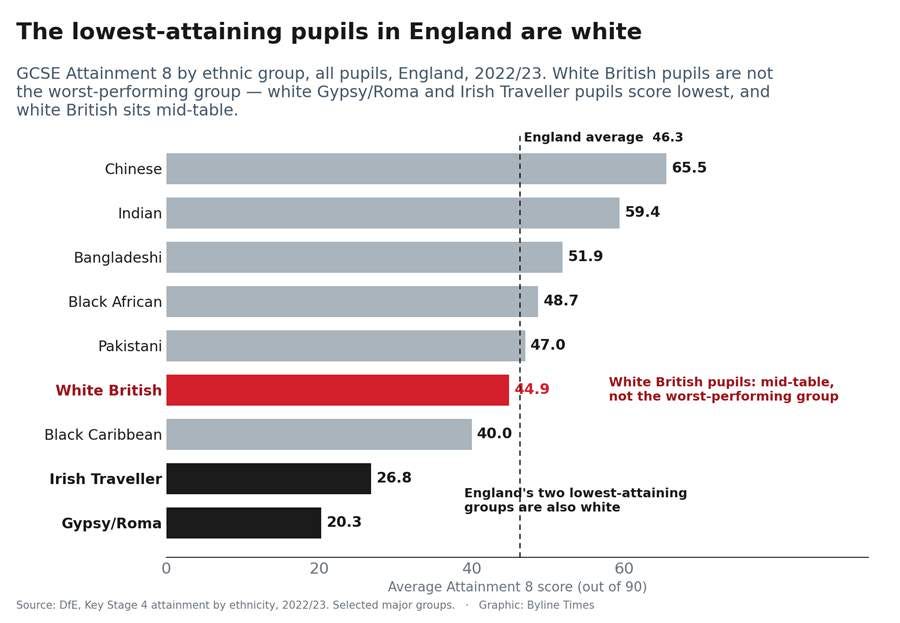
Farage’s claim that white working-class boys are the worst-performing group in British education is completely wrong on the official figures.
Take all pupils first. White British pupils scored an average of 44.9 on Attainment 8 – the DfE measure of performance across eight GCSE subjects, marked out of 90 – in 2022/23, against a national average of 46.3. That places them below the average, but above black Caribbean pupils (40.0), pupils of mixed white and black Caribbean heritage (39.1) and the groups at the very bottom.
The lowest-scoring pupils in England are white Gypsy and Roma children, at 20.3, followed by Traveller of Irish Heritage pupils at 26.8. The groups at the foot of the table are white. Farage does not mention them, nor suggest that they might subject to discrimination.
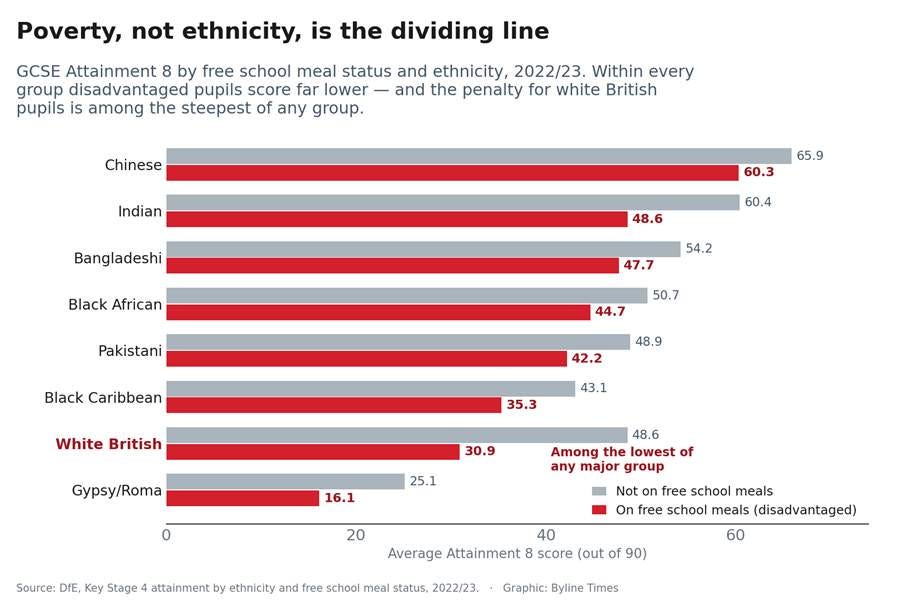
Look only at pupils from low-income families – those eligible for free school meals – and the figures seem to confirm Farage’s case. White British children score 30.9, below disadvantaged Chinese pupils at 60.3, Indian at 48.6, Bangladeshi at 47.7, black African at 44.7, Pakistani at 42.2 and black Caribbean at 35.3. Among children in poverty, white British pupils sit near the bottom of every group – above only white Gypsy, Roma and Irish Traveller children, who score lowest of all.
But only one thing separates this comparison from the previous one: whether better-off white British children are counted. Among all pupils, white British children score 44.9, above black Caribbean children at 40.0. Among poor pupils only, white British score 30.9, below black Caribbean at 35.3. The order reverses because the white British pupils who score well are the ones whose families are better off. Take them out and poor white children sit near the bottom, just as poor children do in every other group. Poverty is what distinguishes the two measures.
The margin that lifts white British pupils above black Caribbean pupils overall comes from the white British majority above the poverty line; remove them, and white British disadvantaged pupils sit near the bottom of every major group. Farage’s cherry-picking conceals the poverty driver and that common working class deprivation afflicting both white and black groups.
The kernel of fact that Farage builds on is real: poor white British boys do badly. He suppresses the fact that white British pupils overall sit above black Caribbean pupils, and that the children scoring lowest of all are Gypsy and Roma.
Poverty and Attainment
Poverty depresses attainment across every group. Nationally, pupils on free school meals scored an average of 34.8 on Attainment 8 in 2022/23, against 49.6 for the rest – a gap of almost 15 points – and within every ethnic group disadvantaged pupils scored below their better-off peers.
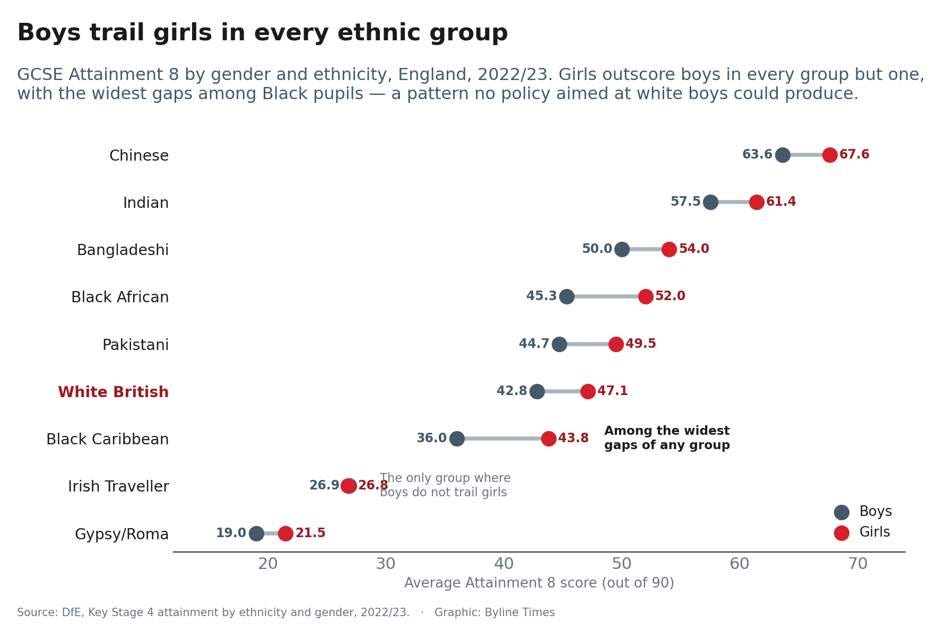
A second feature of the data bears on this: the gender gap. Girls scored higher than boys in every ethnic group but one in 2022/23.
Among white British pupils, girls scored 47.1 and boys 42.8. The widest gaps were among black pupils – black Caribbean girls outscored boys by 7.8 points, black African girls by 6.7 – and the only group in which boys did not trail girls was Traveller of Irish Heritage.
Boys lag girls in every community. Working-class girls fail alongside working-class boys. The gender gap – running through every ethnic group and widest among black children – is irreconcilable with institutional bias against white pupils as an explanation.
‘Constantly Told’ of Privilege
Farage presents himself as voicing a suppressed truth. The House of Commons Education Committee, chaired by the Conservative MP Robert Halfon, ran a full inquiry in 2021 and found that white working-class underachievement was real and persistent, calling on the Government to help these pupils fulfil their potential. It received extensive national media coverage.
Its explanation was not minority favouritism. The Committee attributed the underachievement to economic and cultural factors, intergenerational disadvantage and the effects of place, and recommended targeted local funding, early-years investment and family hubs. On the language of privilege, it agreed that the term “white privilege” could be divisive and that disadvantage should be discussed without pitting groups against each other.
The finding that poor white children are let down by class disadvantage is the mainstream parliamentary position, on the record from a Conservative-led committee since 2021. Farage’s claim to be saying what others forbid is false, and the substance of what he says is wrong.
Why Poorer Minority Pupils Can Pull Ahead
The fact that disadvantaged pupils from several minority groups now outperform disadvantaged white British pupils is real. A 2024 EPI study found that by the end of secondary school most ethnic groups achieved higher GCSE grades than white British pupils in 2023, with Chinese pupils around 27 months ahead.
Farage frames this as evidence of an anti-white institutional preference. There is no evidence for this. In reality, two structural factors explain the gap, and both operate on class and geography rather than ethnic preference.
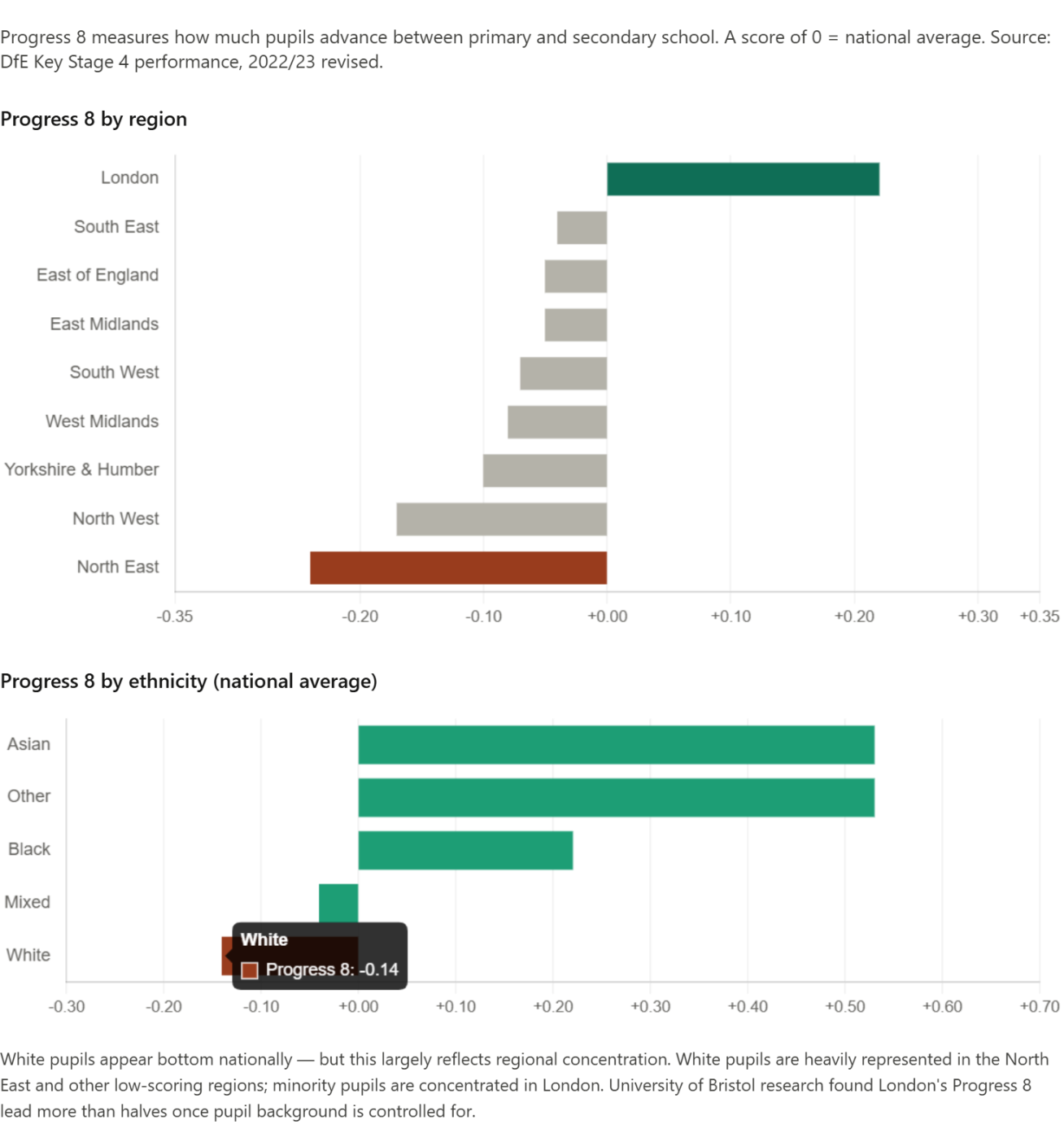
The first is geography. Minority pupils are concentrated in London, England’s highest-performing region. White working-class pupils are concentrated in deprived former-industrial and coastal areas with weaker schools and depleted local economies.
London recorded the highest scores on Progress 8 – which measures how much pupils advance between primary and secondary school – for Asian, white and mixed pupils, while white pupils in the North East had the lowest progress score of any group.
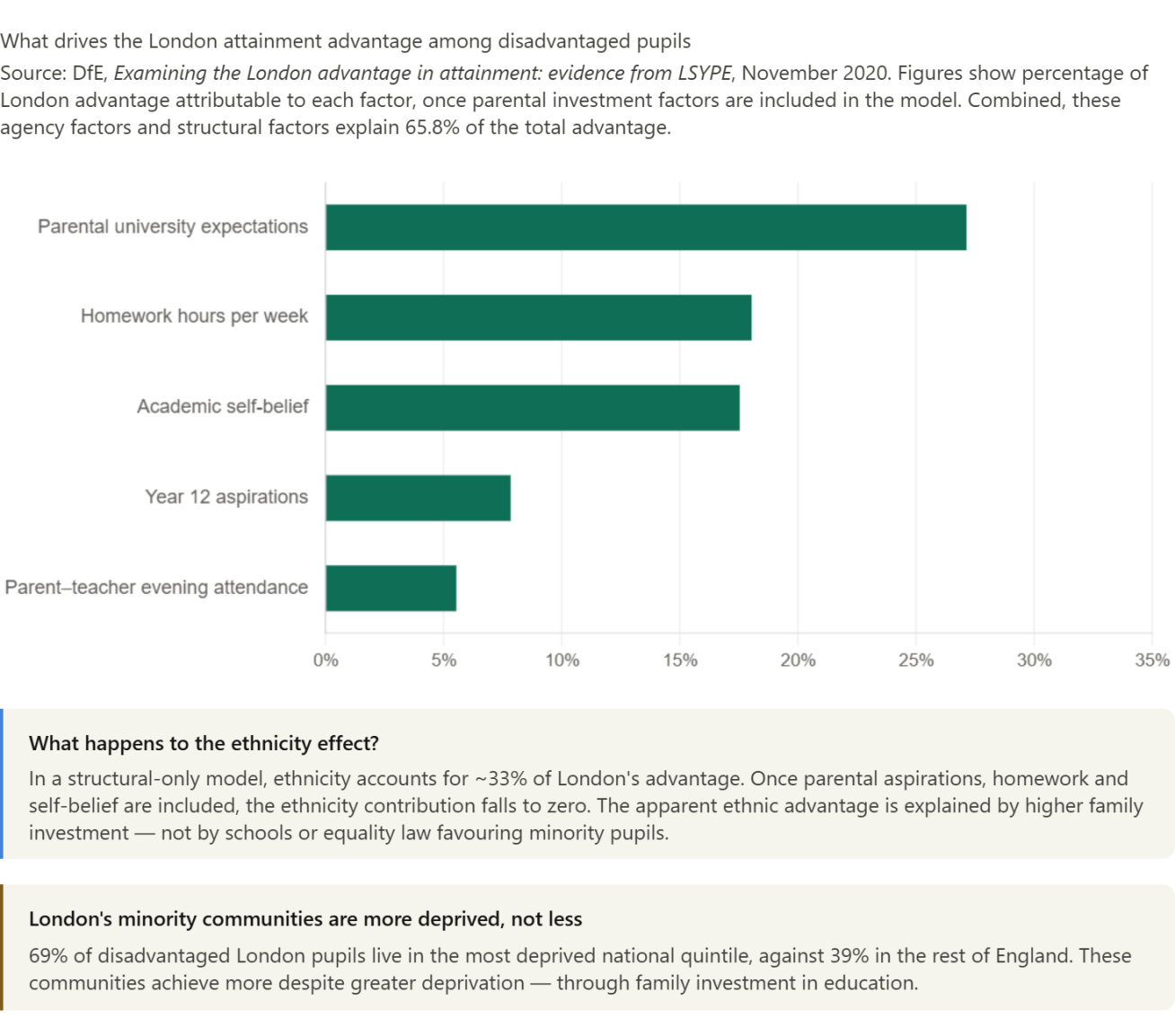
A 2020 DfE research report found that disadvantaged pupils in London scored the equivalent of eight GCSE grades higher than disadvantaged pupils in the rest of England. Ethnicity initially appeared to account for around a third of that gap — but when parental investment was factored in, the ethnic contribution fell to zero.
The real drivers were parental expectations of university entry (accounting for 27% of the London advantage), hours spent on homework (18%), academic self-belief (17.5%) and Year 12 aspirations (7.8%). Disadvantaged Bangladeshi, Black African and other minority pupils were more likely than disadvantaged white British pupils to do more homework, hold higher aspirations and have parents who attended parents’ evenings and expected university entry.
Critically, London’s disadvantaged minority communities are more deprived than their counterparts elsewhere: 69% of disadvantaged London pupils live in the most deprived national quintile, against 39% in the rest of England. These communities achieve more despite greater poverty, through family investment in education — not because schools or equality law favour them over white children.
Deprived white communities are held back by regional disadvantage and long-term immobility – problems that require targeted investment in infrastructure, schools and early-years services. They are not held back by policies which favour the existence of black and brown people.
Government Poverty Data by Ethnicity
Farage’s wider claim – that white people are the distinctively disadvantaged group in modern Britain – is contradicted by official poverty statistics, which he does not produce.
In the three years to 2024/25, child poverty rates were highest among Bangladeshi children, at 63%, and lowest among white children, at 22%, against a national rate of 31%. Some 52% of Pakistani children and 47% of black children live below the poverty line. Around 13% of Bangladeshi children and 11% of Pakistani children experience persistent and very deep poverty, more than three times the rate for white children, at 2%.
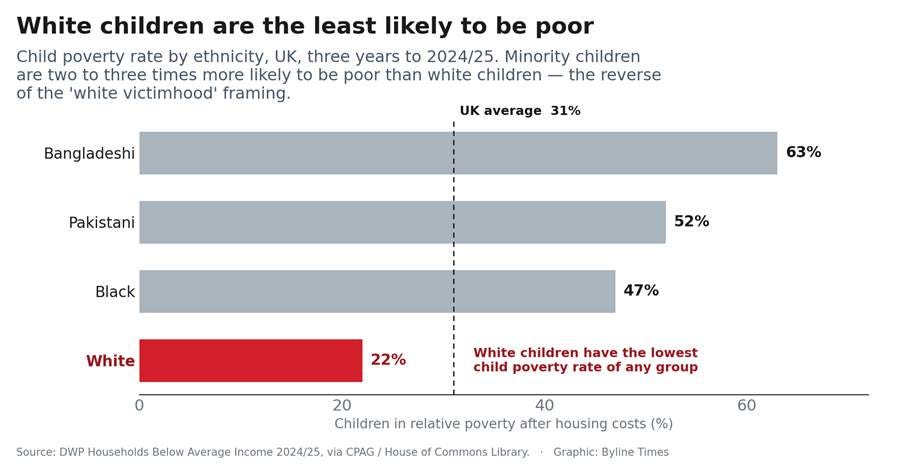
In absolute numbers, most poor children in England are white, because white British children are the largest group in the population. Farage cites the absolute numbers while setting aside the proportional data. Proportionally, minority children are two to three times more likely to be poor, and to stay poor across several years.
Some 67.3% of Traveller of Irish Heritage pupils and 51.2% of Gypsy and Roma pupils were eligible for free school meals in January 2025, against a national average of 25.7% and 7.5% for Indian and Chinese pupils. The white communities with the lowest attainment in the country are also the white communities with the deepest poverty. That connection – class shaping outcomes within white communities, as it does within every other – is what Farage’s racial framing is built to obscure.
Poverty Entrenched by Austerity
The forces behind white working-class boys’ underperformance are not what Farage claims them to be.
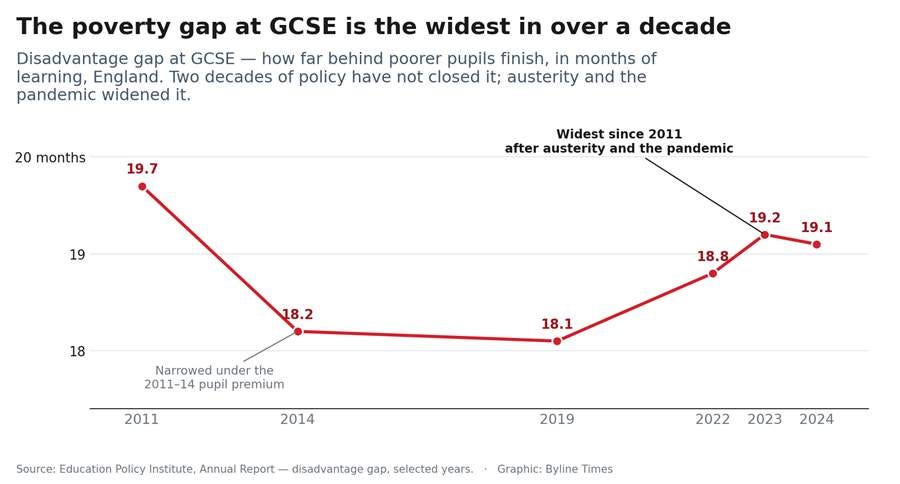
The disadvantage gap at GCSE – the distance between poorer pupils and the rest – narrowed between 2011 and 2014, held roughly steady until the pandemic, then widened to 19.2 months of learning in 2023, the widest since 2011, easing only to 19.1 months in 2024. For pupils in poverty across four or more years, the gap reaches 22 months.
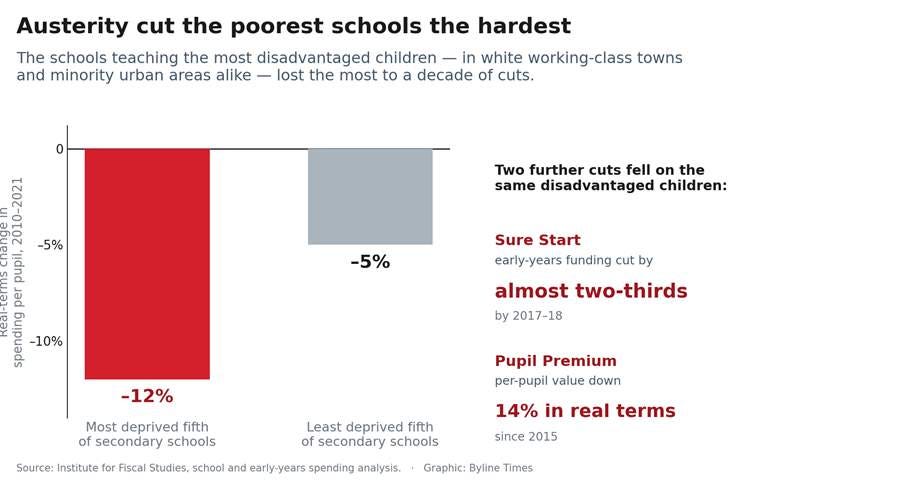
Sure Start – the early-years programme for the most deprived families – had its funding cut by almost two-thirds between its 2009-10 peak and 2017-18, removing services the IFS links to better outcomes for poor children. School funding then turned regressive.
The most deprived fifth of secondary schools lost 12% of their per-pupil spending in real terms between 2010 and 2021, against 5% for the least deprived fifth, cutting the extra funding directed at disadvantaged schools from 31% to about 21%, and reducing the real value of the Pupil Premium – additional money for disadvantaged pupils – by 14% after 2015.
The IFS has found the disadvantage gap in GCSE attainment essentially unchanged over two decades, and the EPI has concluded that schools alone are insufficient to address inequalities arising from austerity and a pandemic.
In 2024/25, 31% of children were in relative poverty after housing costs, rising to 45% in families with three or more children. These cuts and this poverty fell on the deprived towns where white working-class families live, and on the urban schools that teach minority children. The pupils Farage claims to champion are among those most harmed by the austerity favoured by the wealthiest supporters to his party.
Reform UK’s Donors
Reform UK’s racial account of school failure is advanced by a party whose funding and policy place it squarely in the service of concentrated wealth.
Reform UK’s 2024 manifesto proposed raising the higher-rate income tax threshold to £70,000 and abolishing inheritance tax on estates below £2 million; the IFS found the tax plans would disproportionately benefit high earners, and inheritance tax is currently paid by fewer than 5% of estates.
The party later proposed a “Britannia Card” offering non-domiciled residents – wealthy people who live in the UK but are taxed only on their UK income – a 10-year exemption from UK tax on overseas income, gains and inheritance for a one-off fee of £250,000. The IFS found the wider package did not add up, and warned that the savings required would almost certainly mean substantial cuts to the quantity or quality of public services, with reductions to working-age benefits among the options.
A platform of tax cuts for high earners and reduced support for working families requires an alternative pitch to working-class voters, conveniently supplied by the racial story about school failure. It tells families whose children are failed by poverty that the cause is migrants and minorities, and that the answer is a party funded by a handful for a network of powerful men who stand to pay lower taxes and face lighter regulation if it takes power.
The official data identifies what is failing white working-class boys: the same force failing poor black Caribbean boys, poor Bangladeshi girls and poor Gypsy and Roma children – a class structure left intact by two decades of policy, worsened by a decade of austerity that stripped early-years services, cut school funding in the poorest areas and drove child poverty towards levels last seen before the late 1990s. Farage’s racial story exploits that failure in a transparent bid to turn the working class against itself.
Nafeez Ahmed is Head of Investigations at Byline Times
