

I grew up with stories of war, of starvation and people forced onto cattle trains, of children playing in tanks that contained the bodies of dead soldiers. The children were my parents.
My father was born in Czechoslovakia, in a German community that was a frontline in World War II. He described how the community would be left with the burden of clearing out the dead bodies after battle, and he vividly recalled climbing into tanks with the remains of the horrors of war.
He told me as soon as the town was cleaned up, which usually took about a month, the war would return. It was his job to conceal his three sisters in hay stacks, away from Russian soldiers.
Nearly a century later, as I listen to Alisa Kovalenko speak about conflict-related sexual violence, I realize for the first time that sexual assaults that occur during war are a weapon of that war.
Kovalenko, a documentary filmmaker whose new film Traces contains interviews with Ukrainian survivors of rape and torture, tells me: “Conflict-related sexual violence is not about sex, it’s really a weapon of war, and Russia is using this weapon systematically in Ukraine.”
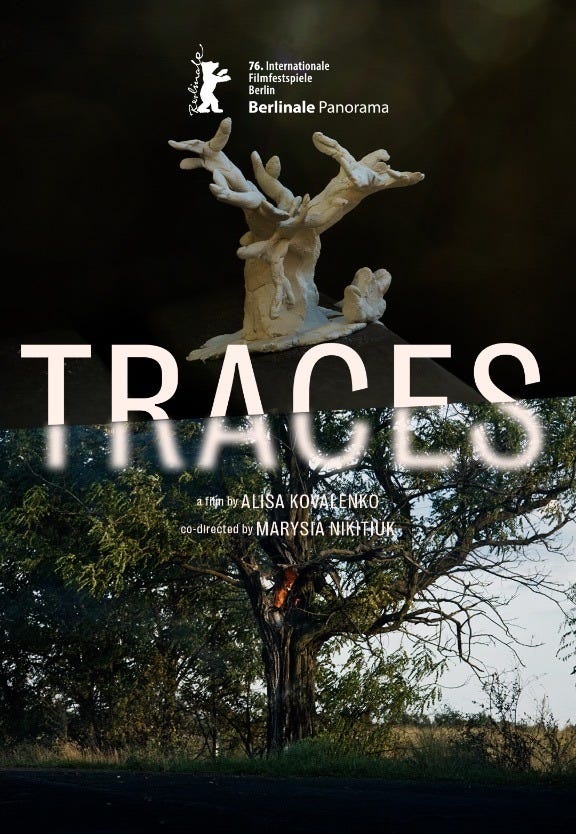
Traces exposes how sexual violence and torture are used as tools of war from the point of view of six women survivors — a former economist and beauty salon owner; a civil servant; entrepreneurs; a farmer; and a teacher.
Kovalenko says the film offers “a collective portrait of trauma that opens a space for hope.”
She is a veteran, a mother, and herself, a survivor.
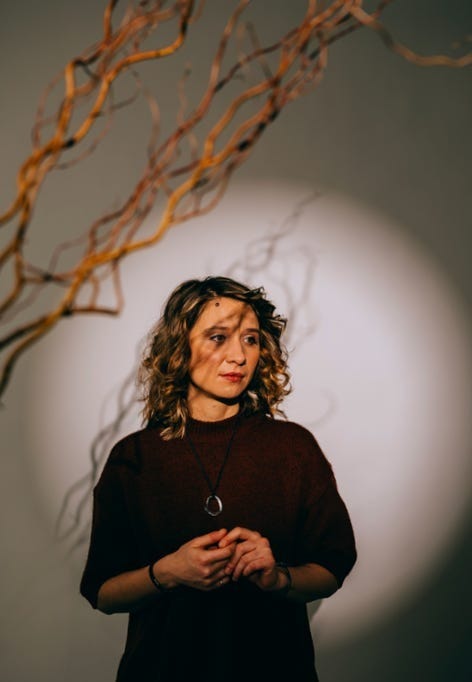
“It started with my own experience of captivity and sexual violence,” Kovalenko told Byline Times. “It was 2014 and I was still a student of film school — it was the Maidan Revolution first, we felt that it’s so important to document the events of Maidan, but at the same time, we were participants in the revolution — building barricades, making Molotov cocktails, and filming — so it was a big moment of change inside us as a civil society.”
After the annexation of Crimea and the beginning of Russian aggression in Donbas, Kovalenko, who was born in Zaporizhia in Northern Ukraine, decided to travel to Donbas to film the unrest.
“It was already quite dangerous, because there were lots of people arrested by pro-Russian combatants and Russian forces,” she said. “After two weeks of filming, I was captured at a pro-Russian checkpoint, and they brought me in for interrogation. A Russian, who said he was the head of the Counter-Intelligence Service there, interrogated me for many hours — threatening to torture me…if I do not tell them information, because I was also filming with one unit of a Ukrainian army in Donbas.”
She says she was raped by him and released after four days.
“He told me I should be thankful I was not executed.”
After her release, she didn’t talk about what happened to her, an attempt to not burden” her family or her partner with “this trauma.”
She soon learned that “you cannot just forget or put the memory in some place very deep inside yourself, or some shelf, it stays with you. For almost two years, I was silent about what happened, and then I went to an experimental documentary theater in Kyiv.”
She says it was at the theater that she was encouraged to explore her experience in captivity.
“It was an experimental documentary theater created called the Theater of Displaced People, and it was for reflecting on our reality of war,” Kovalenko said. “I decided to go there, and just to see what can happen. I started to share my experience of captivity without going into too much detail, and I also wanted to talk about other people who were in captivity and who’ve been tortured, and I wanted to find those people, and I wanted to tell their stories.”
She began to meet other survivors and was then invited to give a testimony to a 2018 Helsinki human rights organization, which was documenting war crimes. She found out she was the first woman from Ukraine to speak openly about such crimes.
Originally, survivors began meeting to help each other. The idea of a feature-length film came up.
“I was not sure if I could bear it, and if I could find enough bravery inside myself, because I realized that I have to dive into these old stories of trauma and captivity, and I realized that it can be kind of a retraumatization, full of triggers,” she said.
But as the women met and shared their stories, a movement grew, and the Ukrainian Government took notice. The women organized a conference, and the General Prosecutor’s Office attended, and 11 cases were opened.
How She Showed ‘Thanks’ to Her Tormentor
“After the full-scale invasion started, I went to fight. I became a soldier in a volunteer unit,” she said. “When I came back from the front line, together with Iryna Dovhan — a survivor-advocate, who founded Ukraine’s first survivor-led organisation SEMA Ukraine, with the support of the Dr. Denis Mukwege Foundation — we decided to make a documentary film. We had the opportunity to receive a small grant for documenting crimes against humanity, and we used this grant to start the film, because we saw this massive scale of violence, including conflict-related sexual violence, and we felt that now it’s really time to try to somehow to raise awareness more globally… I decided to sacrifice my feelings and my fears and get to work.
“We went to Kherson region, which was liberated, and started to document war crimes, and war crimes of sexual violence, because it was massive in Kherson region — it was 11 months of occupation.”
She soon learned how sexual violence was used deliberately to intimidate, destabilize, and assert control over occupied territories. She said the goal was “to break Ukrainians as a nation” – women and men, Ukrainian POWs, all targeted by Russian forces systematically. She identified how this torment leaves scars behind, visible and invisible traces, which became the working title for her film.
“When I arrived in the Kherson region, I saw these traces of occupation of war everywhere, you can see them in burning minefields,” she said. “I saw a burning tree, for me, it was the first time I saw a burning tree, and it was such a tragic picture. This tree was burning from the inside, and I had a feeling that the heart of this tree is on fire, and for me it was so strong, a metaphor about all of us inside, how we had this fire burning, and I could see so many traces – holes from bullets in the houses, but also so much invisible traces inside people – the invisible marks left on the human psyche.”
She set out on a mission to help survivors reclaim their voices.
“I felt that I couldn’t make a horror film,” Kovalenko explained. “And the more I listened to the stories and felt the strength of other survivors, I felt also this effect of healing myself.”
She recalls one very pivotal moment.
“I documented one woman who was speaking for the first time about her experience,” she said. “She was raped and beaten. She was 72 years old when it happened to her in the occupied Kherson region. Her house was bombed. She was living in a small building, in very bad conditions.”
The woman, Liudmyla Mefodivna Mymrykova, was a teacher of Ukrainian language and literature in a small village, where her school had been bombed. During the night, a Russian soldier knocked on her door.
“When she opened the door, he immediately hit her and broke all her teeth,” said Kovalenko. “They all fell on the floor, and he beat her, cut her stomach, broke her ribs, raped her, and left her a bullet from his Kalashnikov, so that she will remember what happened to her, and that she will never share this with anybody. Otherwise, he said he will come and kill her with this bullet. She was so terrified that he would come back and kill her, it took her two weeks to leave her home and escape to Ukrainian controlled territory.
“When we found her, she was in a very bad psychological state, and I was not even sure if her story will be in the film. But after one year, after we helped her with the rehabilitation process, and she arrived for the first time in Kyiv for a big conference on how to turn trauma into post-traumatic growth for survivors, she was smiling, and she was wearing a beautiful summer dress, and at that moment I realized that this smile was worth all my suffering.
“I was still in the process of editing this film, and yes, this film is about war crimes, but it’s more than that, it’s about human dignity, and it’s about how human dignity can triumph over this bottomless evil.”
She said that turning pain into power also helps change the narrative of the “mythology of victimhood”.
“There’s a sentence from the book Survival as Victory: Ukrainian Women in the Gulag by Oksana Kis, which was very important for me to hear. ‘We survived, it means we won’. Surviving is a form of victory.”
She said the film, which was co-directed by Marysia Nikitiuk, became “about solidarity between women who are supporting each other, standing together, breaking silence, breaking stigma, fighting for justice. So, from horrors we came to the light.”
There’s a moment in the film where a survivor makes a decision to not give in emotionally to the oppression of her tormentor by continuing to have a joyful life.
The film made its world premiere in at the Berlinale, Panorama Dokumente 2026, where it won the Audience Award – Best Documentary; additional accolades include Movies that Matter Grand Jury Documentary Competition Award (Oscar-qualified award); Top 20 Audience Favourites – Hot Docs Canadian International Documentary Festival; Millennium Docs Against Gravity: Smakjam Award for Best Production & Special Mention for Best Film in the Polish Competition.
Traces is currently in festival distribution, with national premieres taking place at international film festivals, as well as screenings organized within human rights and advocacy frameworks. It will be broadcast on ARTE in France and Germany in the fall.
Kovalenko says that the screenings have been “therapeutic for all of us, because we realize that we matter and our voices matter, and that we can really change something in this world.”
With the film becoming Oscar-qualified, Kovalenko says it gives her a unique opportunity to raise more awareness.
“It has no difference of gender, age, because there are also a lot of men who survived sexual violence. It is mainly, of course, sexualized torture by the Russians. We are now also working together with male survivors.”
On Friday, United 24 reported that the “United Nations has, for the first time, added Russian forces to its blacklist of parties suspected of committing sexual violence in armed conflicts, according to an annual report… investigators were able to verify 310 cases of conflict-related sexual violence in Russia and in occupied territories of Ukraine, involving both prisoners of war and civilians, with the vast majority of victims identified as men.”
Kovalenko wants people to know that conflict-related sexual violence is classified as a war crime, a genocidal crime, and a crime against humanity, and that there is no time limit for prosecuting perpetrators.
“The film is an act of resistance and an act of advocacy,” she said. “For us, it’s the recognition that Russia is systematically using conflict-related sexual violence as a weapon of war, and it’s super important that it will be recognized.”
View the official trailer for ‘Traces’ and help support the film’s impact campaign here.
Alisa Kovalenko is an award-winning Ukrainian documentary filmmaker, based in Kyiv. She studied documentary film directing at the Karpenko-Kary National University in Kyiv and at the Andrzej Wajda School in Warsaw. Her first two feature-length documentaries, Alisa in Warland (IDFA 2015) and Home Games (Sheffield Doc/Fest 2018) were both screened over 100 festivals, winning multiple awards. Alisa’s third film, We Will Not Fade Away, a teenage adventure documentary set in war-torn Donbas, premiered at the Berlinale 2023, won 20 international awards and was named Best Ukrainian Documentary 2023 by the Ukrainian Film Academy. After Russia invaded Ukraine in February 2022, Alisa joined a volunteer combat unit associated with the Armed Forces of Ukraine and fought on the frontline for months, before returning to filmmaking. From this existential experience she has drawn a personal documentary, My Dear Theo (CPH:DOX 2025). Among the awards the film has received are: Best Human Rights Documentary (Dokufest), Audience Award (Nuremberg International Human Rights Film Festival), and Best Documentary in the Central and Eastern Europe Competition Section (Astra Film Festival). Alisa Kovalenko is also a former captive and survivor of CRSV in captivity in 2014 in the Donbas region controlled by Russian and pro-Russian military forces. In 2019, she became a member of SEMA Ukraine, an NGO of women survivors of conflict-related sexual violence (CRSV) caused by the Russian invasion of Ukraine since 2014. Since then, she has been actively involved in human rights and advocacy activities related to CRSV in the Russian-Ukrainian war. Her personal experience and human rights activism led her to work on the documentary film Traces, which documents war crimes and amplifies the voices of survivors.
Emmy award-winning investigative reporter, Heidi Siegmund Cuda is an American correspondent for Byline Times and her Hot Type column runs bimonthly on Byline Times Substack. She is a #1 Amazon bestselling author, the co-host of RADICALIZED Truth Survives podcast, and her Bette Dangerous substack is read in 102 countries.
Liking this only to support its reach. It feels like all the monsters of the first half of the 20th century are back with force.