

BYLINE TIMES IMPACT: Find out about the changes you made happen
I spent the summer in England, wandering around the Cotswolds with my head in American Overthrow: Moscow’s Endgame In Its Long War with Washington, an upcoming book by UK author Keir Giles, which documents the totality of US destruction and how Russia benefits.
Few writers have been as consistent and willing to point to Russia as a key troublemaker in the West as Giles, who I befriended on Twitter in 2019, when I was sent his 2016 NATO Defense College Handbook on Russian Information Warfare.
Giles is a Russia watcher, the author of multiple books on information warfare, including Russia’s War On Everybody and Who Will Defend Europe?. He is an associate fellow of the Russia and Eurasia Programme at Chatham House, and worked with the BBC Monitoring Service and the UK Defence Academy.
Since our first Twitter encounter, I have gotten to know him personally, and I prefer the parts of his biography that are left out, but make him uniquely suited for this work. He has worked in Russia, co-founding the first company providing Western pilots with the opportunity to fly Soviet military aircraft. He then worked as a Russia correspondent for military and civilian aviation journals. His 2019 book, Moscow Rules: What Drives Russia to Confront the West, explains how viewing Russia’s actions through a Western lens will always fail.
With American Overthrow, Giles manages to mute all the background noise and meticulously document the actions of the first 18 months of Donald Trump’s second term, while noting a grim resemblance to what happened in Russia at the turn of the century.
Not only does he identify the ways in which the Trump regime is brutal and destructive, but he documents the ways in which Trump is actually copying Russia — attacking neighbours, committing war crimes, mangling truth, reality, and history, replacing public servants with loyalists, sending masked paramilitaries to terrorize the population, and methodically removing any challenges to his power — in exactly the same way as Putin did.
By documenting America’s transformation through what he calls “the prism of Kremlinology,” we can see the enormity of the destruction far more clearly.
Journalist and historian Anne Applebaum says of American Overthow: “Keir Giles draws direct parallels between the Trump oligarchy’s consolidation of power in the United States and Vladimir Putin’s rule in Russia. This is not a bizarre or far-fetched comparison, and it should make readers of all political persuasions think twice about American politics.”
Craig Unger, investigative reporter and author of House of Trump, House of Putin and American Kompromat calls it “the rare book that says exactly what has happened: Russia has effected regime change in the United States with the active support of millions of Americans—and most of them still don’t even know it.”
Giles calls what’s happening in the US an “authoritarian takeover speed run.”
“Trump’s crash programme of state capture was transforming not just America’s relationship with Europe, but the country itself,” he writes. “The war on facts and truth, masked paramilitaries operating with impunity, threats against neighbouring countries, consolidation of power in the hands of a tiny self-serving elite, and government for the profit of a narrow circle of oligarchs all mirror Vladimir Putin’s Russia of twenty-five years before. In Russia, the same processes described in this book took place gradually, so that only those watching closely were fully aware of what was changing… By contrast, the United States under Trump has moved so fast in the same direction that in some respects it has already matched or even overtaken Russia.”
In a recent interview with Giles in a Northamptonshire pub, he told me even he was surprised at how Trump and his loyalists were surpassing Moscow in overt corruption, theft, and speed of destruction.
“It’s not just mimicked Russia, it’s exceeded Russia. The North Korea-style praise sessions, where everybody in the cabinet goes around and makes ridiculous compliments to Trump, is something that Putin would never put up with because it’s over the top.
“The leader’s face on the front of the Department of Justice. You wouldn’t see that in Russia, but you would in North Korea. And the ways in which there is no attempt to conceal the illegal actions within the United States, as opposed to Russia, which pretends it’s a democracy, pretends to have legitimate leadership, pretends it isn’t a kleptocracy. In the United States, it’s all in the open.”
He told me: “It does appear that it is hard for many Americans to discern the totality of what is happening.”
And it is that totality he is trying to relay in American Overthrow, beginning with how swiftly Trump and Elon Musk dismantled or gutted one government institution after another.
He writes that in all the chaos, what defines the destructive actions is how they harm America, Americans, and “aid America’s adversaries, first among them Russia.”
From each destructive action, he draws lines to how US adversaries, primarily Russia and China, clearly benefit.
He cites French thinker Francois Heisbourg, who calls what is happening in America a “kind of assisted suicide,” hurried along by China and Russia.
Giles asks the reader to look at the totality and not the fragmentation, as he writes: “The evisceration of America’s defences against terrorism, extremism and disease are part of a whole rather than disconnected phenomena.”
Surprisingly Flimsy Guardrails
Installing a Russia-friendly leadership to power comes down to the fact that the US had “surprisingly flimsy guardrails” — subversion from within was easy when you had no protection and ample denial it was even happening.
Early in the book, Giles makes the important point that “America’s divisions were not invented by Russia, but Moscow has found them to be a vital weapon with which to attack its enemy.”
Paralysis is induced by making “victims unsure what if anything can be true,” with both Russia and Trump aligned in the mass destruction of truth.
While it may be difficult within the US to grasp the totality of Trump’s destruction in his first year in office, a poll from the EU that Giles cites shows that Europeans are increasingly aware.
“ A Politico poll in April 2026 found that three times more EU citizens see the US as a threat than as an ally, with Washington regarded as a greater threat than Beijing in Spain, Italy, Belgium and Germany.”
By April 2026, almost two-thirds of the countries around the world had no US ambassador, and appointments made since 2025 were to Trump loyalists, giving China an open field, he writes. Same for US media cuts globally and cuts to USAID, all opportunities for China and Russia to step in to vacated American soft power.
US governmental agencies are under sustained attack from Trump and his loyalists, who then turned their federal might on US cities, something very familiar from history and authoritarian regimes.
“Organised extrajudicial murder by the armed forces was previously a hallmark of Russia and other authoritarian aggressors, rather than of the United States,” writes Giles, who reminds us of the lethal strikes on small vessels in the Caribbean and eastern Pacific that began in September 2025, resulting in at least 180 extrajudicial killings to date.
That, of course, preceded Trump’s public threat that Iran’s “civilization will die tonight” if it did not comply with US demands.
The kill-threat, the boat killings, all blatant war crimes, made more clear by my recent visit to the International Criminal Court at The Hague, currently under attack by Trump and his loyalists.
When Giles reminds us of the Greenland campaign, the Russian methods are easily spotted.
Separatism! Annexation! Save Greenlanders from Danish Oppression!
I am momentarily uplifted when he notes that the Greenland lesson reveals “the appropriate response to Trump threats was to demonstrate resolve and face them down.”
There’s a lesson there for resistance.
Catching Snowflakes in a Blizzard
As Giles compares fact checking to “catching snowflakes in a blizzard,” because “the speed at which the lies come tumbling over each other leaves anybody trying to follow and disentangle them disoriented and unable to keep up,” I finally understand for the first time why autocrats lie so often and without shame.
It’s a demonstration of power.
Regarding the January 2026 murders in Minneapolis of Renee Nicole Good and Alex Pretti by federal agents, Giles writes:
“The murders thus marked a further milestone in the administration’s abandonment of truth and even plausibility, with the normalisation of federal officials not just concealing the truth, but lying even when everybody knows they are lying. Multiple news outlets published frame-by-frame video analyses showing the official accounts of the murders were false; and yet, the administration continued to assert the same false claims anyway.
“In a Russian context, this display of disregard for plausibility and not even bothering to pretend to tell the truth reflects that the speaker is already operating in a society where the truth no longer matters, and furthermore that they can use falsehood as an exercise of power and a display of dominance—the listeners know they are being lied to, but can do nothing about it.”
The US Constitution was not designed to cope with a challenge like Trump, the damage to America has been deep and will be hard to undo, Giles writes.
The facts he outlines on concerted election threats is sobering, and people should be prepared rather than surprised by staged attacks Trump might arrange to try to remain in power.
He does not end the book with any conjured optimism.
“As I have discovered with each of my previous books, artificially-inserted optimism is a shortcut to false predictions,” he writes.
But what he has done is offer a comprehensive document of Trump’s unbridled criminality. And if history is to offer any suggestions, one may be that each of his loyalists also risk an encounter with international law. Trump and his loyalists are trying to kill international law, but it is, in fact, still alive.
I also think of the “gravediggers” of Hitler’s inner circle and how they ended up.
And I often think of Europe and its late awakening.
“For some in Europe, both Russia and the US now represent what the West came together to overcome: imperialism and authoritarianism under-pinned by unbridled aggression,” writes Giles.
Maintaining a Fiction
During our interview, I tell him about a quote from Tom Stoppard’s play Rosenkrantz and Guildenstern Are Dead: “There must have been a moment - at the beginning - where we could have said no, but somehow we missed it.”
I ask him if he knows the moment when the West took its eye off the ball with Russia.
“1991,” he said. “The assumption that ‘this was now a different country, inhabited with different people, all of whom held different ideas, and a different understanding of what their country was and its relationship with the West, and, therefore, everything would have changed,’ this assumption persisted long after the evidence started to become undeniable that this was not the case.
“And if you think back to what a lot of people treat as a turning point in Russia’s relationship with the West, the Putin speech at the Munich Security Conference in 2007, where people were surprised, but only if they hadn’t been paying attention to anything that Putin had been saying or doing over the previous seven years he’d been in power. And this was already 16 years after the West had bought into the idea that Russia was now a friend, a partner, a different country, you could work with. So the amount of time that has gone by, during which anybody that was paying attention, was warning of what was going to happen, shouldn’t be underestimated. It is decades now of inaction, we’re now in a very, very much worse situation than if the problem had been recognized much earlier.”
Lastly, I asked Giles if there is any deus ex machina that could get liberal democracies out of their current jam and he said: “No, it’s going to take long, hard work, and be expensive, and difficult, and lives will have to change, and all of those are part of the reasons why no action has yet been taken.
“Sadly, Americans today, like Russians 20 years ago, are faced with a choice, whether to resist and to incur the inevitable personal costs for themselves and their families that would be involved in doing that, or to submit, surrender, comply, and see their country being changed into a very different and very much worse place. There is no easy option other than those two. What we see so far is the extraordinary passivity, not just of ordinary people who might not necessarily realize fully what is being done to their country, but also of the well informed, like Democrat politicians, who are apparently accepting this, allowing themselves to be steamrollered, and for their country to be taken away from them.
“That has to change if anything is to be stopped. Ordinary Americans, some of them, have bravely stood up, but the broad mass appears not to recognize what is happening, and if they do recognize it, then, just like in Russia, they seem not to be able to take the step to resist it.”
As he writes in American Overthrow:
“Anybody that wondered how they might conduct themselves during the rise of Nazism in Germany can experience that directly in the United States as the ruling elite conducts its authoritarian takeover in real time.”
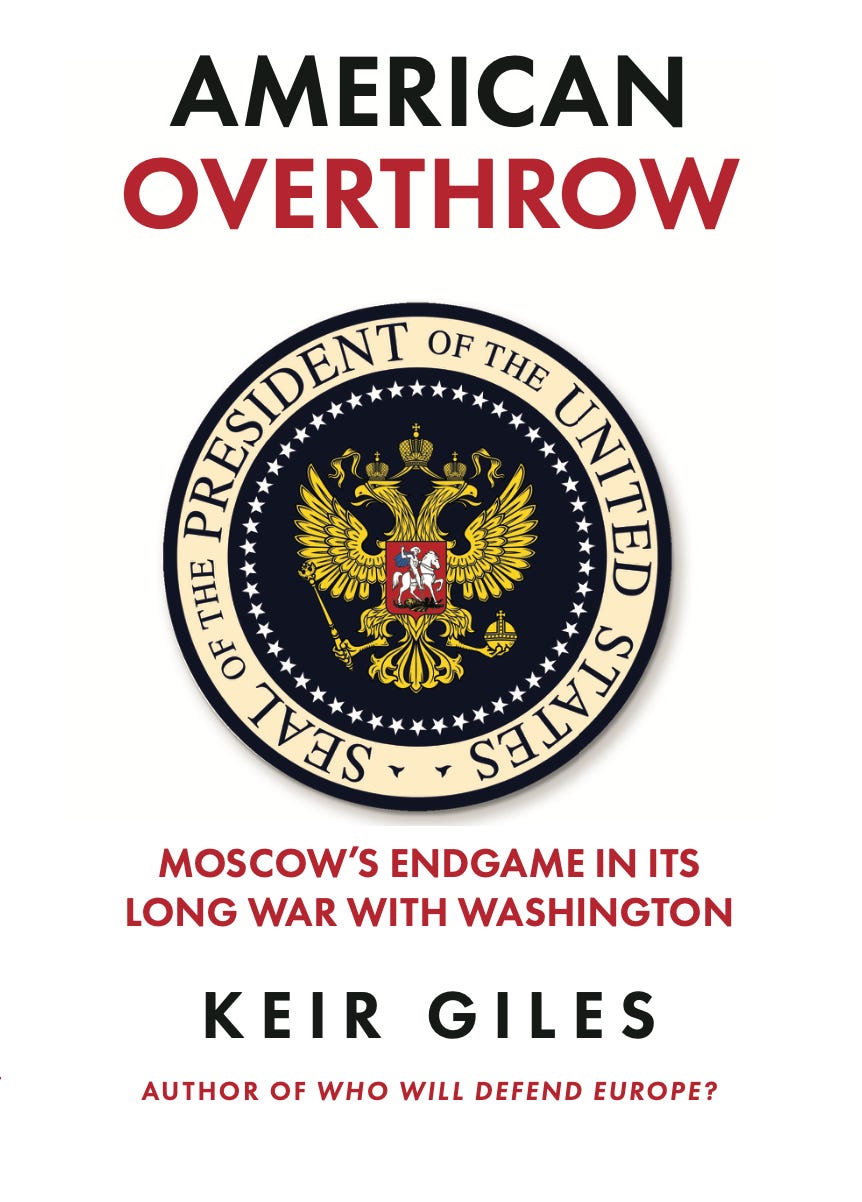
American Overthrow is published in the UK by Hurst Publishing on 3 September
And in the US on 15 November (Available for purchase 15 October)
Keir Giles has advised governments worldwide on the Russian threat. A former senior fellow with Chatham House’s Russia and Eurasia Programme, he regularly comments for the BBC and international media. His prescient books include Who Will Defend Europe?, a Financial Times Politics Book of the Year.
Emmy award-winning investigative reporter, Heidi Siegmund Cuda is an American correspondent for Byline Times and her Hot Type column runs bimonthly. She is a #1 Amazon bestselling author and her Bette Dangerous Substack is read in 102 countries.
The mass of US citizens are ‘passive’.
And that’s how the world sees it. The overwhelming majority of US citizens are Trump supportive or apathetic.