

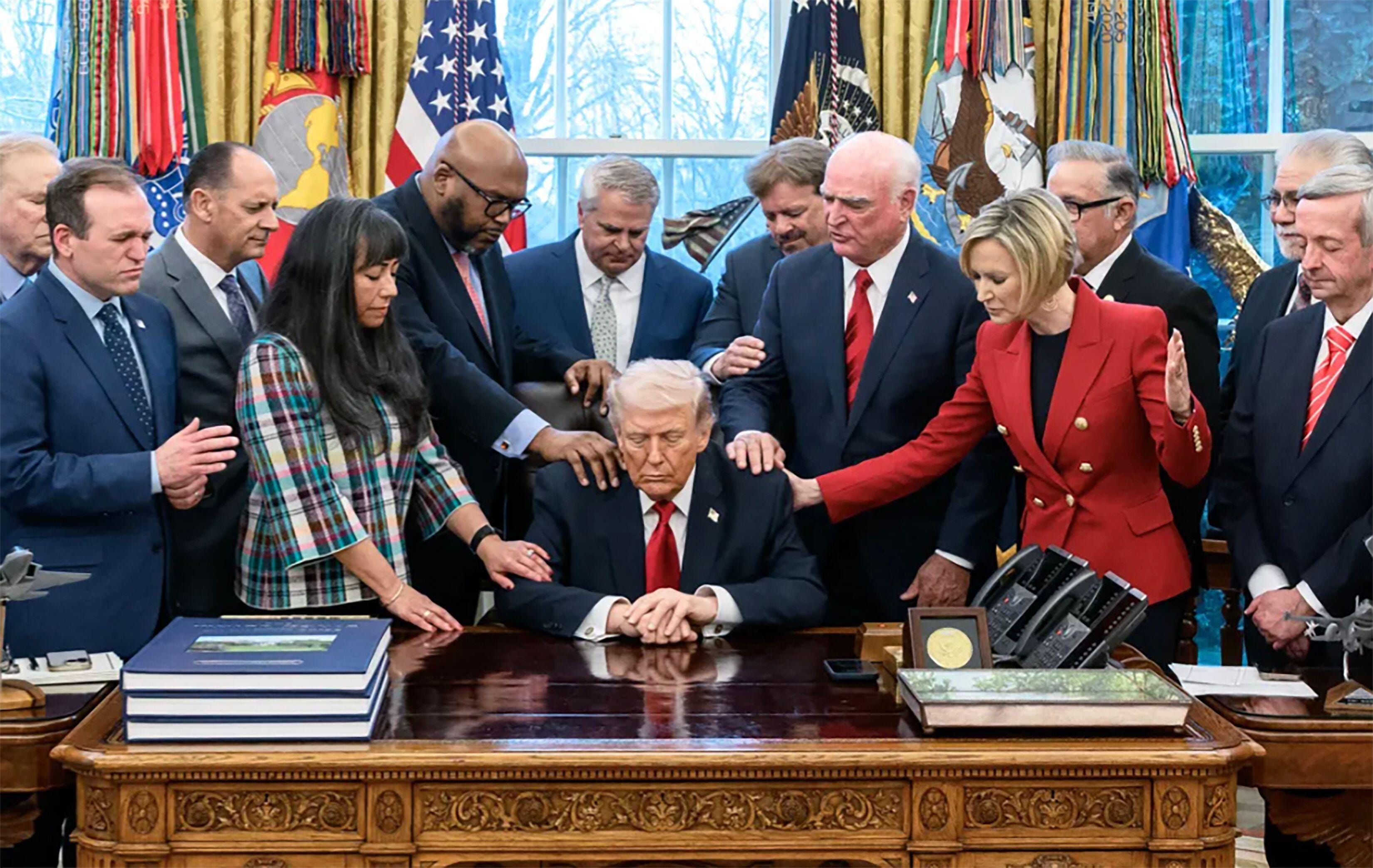

The first time I interviewed Dr Matthew Taylor, based on his book, The Violent Take It By Force, I finally understood the deal that religious leaders had made with Donald Trump and how they sold it to their flocks. The religious scholar explained that Trump was viewed as someone who had conquered mountains – media, business, government, arts and entertainment, among them – and that Christian supremacists felt their objectives could be met by supporting him, regardless of his flagrant un-Christian-like behaviours.
It was a Faustian deal, and quite frankly, Trump delivered. He delivered the judicial coup that led to the overturning of Roe v Wade, denying women bodily autonomy and health care rights – a longtime objective of the religious right. He gave them all they asked for – even moving the US Embassy from Tel Aviv to Jerusalem to satisfy both evangelicals and his orthodox Jewish supporters.
As his Catholic base is forced to do some soul-searching over the fight he’s waging with Pope Leo, his Protestant Christian supporters must grapple with his recent blasphemy.
At Easter, he wrote on his social media site: “Open the fucking strait, you crazy bastards, or you’ll be living in Hell – JUST WATCH! Praise be to Allah,” referring to the Strait of Hormuz that has been closed since the US and Israel launched strikes on Feb 28.
Two days later, he posted that Iran would see its “entire civilisation” destroyed if it did not comply within 48 hours. And then, on Wednesday, he reposted and subsequently deleted an image of himself as Jesus with Satanic iconography in the background.
In a new interview with Matthew Taylor, whose forthcoming book Defying Tyrants: Following Jesus in a World of Christian Antichrists, offers Christian believers an off-ramp to safely turn away from supporting any global tyrants – from Trump to Putin – by explaining that Jesus was radically anti-authoritarian.
Heidi Siegmund Cuda: Before we get into your latest work, can you remind us of your background and the discoveries you made along the way related to Trumpism?
Dr Matthew Taylor: I grew up mainstream evangelical in Southern California. I had a career detour into doing a PhD into religious dialog and working on Muslim-Christian dialog. In recent years, I’ve gotten drawn into studying Christian nationalism and these different forms of Christian supremacy that we see ascendant all around us, and the ways those are intersecting with our politics – this far right, authoritarian shift that we’ve had in our politics and some of the theological forces behind that.
My second book, The Violent Take It By Force: The Christian Movement That Is Threatening Our Democracy, was focused on this movement called the New Apostolic Reformation (NAR) that I argue were the principal theological architects of January 6 and of Christian Trumpism.
These are the folks who were serving as that point of interface between American evangelicalism and the Trump-MAGA movement. And a very important figure in there is Paula White-Cain, who is now the Director of the White House Faith Office – literally the gatekeeper for religious leaders trying to get access to Donald Trump. And the New Apostolic Reformation, this network of leaders, has supplied the theological rationales for evangelicals to support Trump.
These include things like the ‘Seven Mountain Mandate’. This concept of Christian takeover of society through strategic deployment into particular sectors of society – government, education, arts and entertainment, media, etc – is a strategy for enacting Christian supremacy over a society. The NAR conceptualised and popularised this, but it’s spread far beyond traditional NAR circles.
This also includes all these prophecies about Trump, things that we’ve seen in recent weeks. People have been putting forward this idea that Trump is this prophesied saviour of America. I think he’s internalised that narrative in certain ways, especially since the assassination attempt in Butler, Pennsylvania.
Trump has really pivoted into a bigger embrace of this. He doesn’t always understand the religious vocabulary that he uses. I mean, we’re speaking right after he posted this bizarre meme of himself as Jesus, and really overreached and even made some of the NAR people angry, right? So Trump doesn’t always calibrate his use of religious appeal, and I think part of that is for him, even when he makes a move into religion, it’s still about him, right?
He is still the centre of whatever religion he’s doing, where for those folks, at least ostensibly, Jesus or God or Christianity would be at the center of that. So he doesn’t always calibrate his appeals correctly, but those appeals are still rooted in theological frameworks, in prophetic frameworks that are often supplied by the NAR and Paula White-Cain and have become a big chunk of the Christian propaganda that keeps Trump in good standing with a radicalised portion of American evangelicalism.
HSC: Thank you. I think it’s really difficult for people to wrap their head around how so-called Christians can support him, and that was incredibly helpful. Let’s jump right into Defying Tyrants. What a perfect topic for this moment in time.
MT: My previous books have been more in the mode of religious studies, where I’m trying to describe religious phenomena. I identify myself clearly in those books as a Christian, but I’m not trying to speak Christianly, in those books. I’m trying to describe Christian phenomena, or in my first book, Muslim phenomena as well – how theology and identity is operating in modern America, in these communities, and especially in The Violent Take It By Force, where I am sounding a warning about the NAR.
But it is more of a civic warning. I’m trying to say “this is potentially a real threat to our democracy.”
We’ve already seen the ways through January 6, and through the first Trump administration. We can see this corrupting influence of these particular forms of theology on our democracy, the ways that they are polarising and harming our democracy, and even attempting to overturn our democracy to set up this more Christian authoritarian state.
Defying Tyrants is different in that I am trying to speak Christianly. Here, I am trying to use Christian theology. I have training in Christian theology. I can do both of those voices. I’m trying to argue against the worst excesses of these theologies.
Part of my motivation here is I’ve done a lot of work over the last few years of talking to experts and activists who have been opposing religious nationalism around the world.
My colleague Susan Hayward and I – Susie used to work at the United States Institute of Peace – we met in our PhD program. She’s a pastor on the front lines in Minneapolis, and was very involved in the protest there.
We did a podcast series in the Fall of 2025 called American Unexceptionalism, interviewing experts and activists from the front lines of opposing religious nationalism outside the United States.
So we were interviewing activists and scholars who study Buddhist nationalism in Sri Lanka and Myanmar, or Islamic nationalism today in Turkey under Erdogan, or Hindu nationalism with Narendra Modi in India. And we’re trying to glean insights from people who have already been doing this work of protecting democracies against these religious nationalist, far-right authoritarian movements.
And one of the things we just kept hearing over and over in those interviews is just how important theology is for resisting these things. Because if you have a public square where one side of the argument is using theological arguments as saying, “Listen, Donald Trump is the divinely anointed king over America”, and the other side is coming back and saying, “Well, no, we have the rule of law, and we need to protect the Constitution, and we should have checks and balances in our government.” Those are just abstractions for a lot of people. And if one side is speaking using the vocabulary and symbolism of religious tradition, and the other side is trying to do this kind of secular enlightenment, “protect democracy” thing, then there’s a mismatch.
And part of what happens then is the people using religion start to dominate the religious conversation. I think we see that today. It is right-wing, and I would argue even far-right, voices in American Christianity who tend to dominate the conversation today.
I’m trying to intervene in that and say, “Actually, we the people who want to defend democracy, who want to protect the values of pluralism in our society, we can use theology too, and we need to counter these things.”
So the central argument of the book is that Jesus was deeply and profoundly anti-authoritarian. I mean, I think Jesus Christ might have been one of the most anti-authoritarian human beings to ever live. Right? He’s living under the Roman Empire where, literally, the Caesars proclaimed themselves to be gods that everyone has to bow and worship.
And they don’t really care whether you actually believe that they are a god. They want to see you bow, because that tells them that you are in line, that you are submissive.
And Jesus gets in a lot of trouble, because his teachings are pushing back against that and saying, “Actually, we know what a divine human being looks like and Caesar isn’t it”.
Jesus is calling his followers to subvert the logic of empire. And when Jesus talks about the kingdom of God, he’s not saying, “Well, we just need a heavenly empire to come in and take over”. The kingdom of God grows up from people.
This is why he’s always using nature parables. The kingdom of God is the place where the followers of Jesus are supposed to deny themselves, are supposed to take up their crosses, are supposed to serve and care for the people on the margins of society.
And so I think that understanding that kind of anti-authoritarian bent in early Christianity is very, very important.
‘Christian Antichrists’
Then the second sub-argument of that, and this is where the subtitle comes in – “following Jesus in a world of Christian antichrists” – I think we have, throughout the Christian tradition, largely misunderstood and misconstrued this concept of antichrist, even just at a biblical exegetical level.
I think people have just run roughshod over this biblical concept. So the word antichrist only occurs in two small epistles in the New Testament, First and Second John, and in those epistles, it’s as often plural as it is singular.
The very important pivotal passages in First John, chapter two, where the author says “you’ve heard that antichrist is coming, but now many antichrists have come”... and so clearly there’s a plural dimension to this word. And if you read those texts carefully, I argue in the book, the way it’s using this term antichrist is referring to Christians who are abusing power and claiming that they are superior to other people, superior to their fellow Christians, and superior to people outside of the church, and that therefore they are entitled to power. And from the perspective of the other church, this was antithetical to the teachings of Jesus.
And so you have this dynamic of people claiming to be aligned with Jesus, to be following Jesus, but doing the opposite, doing harm in the name of Jesus. And those are the people that get called antichrists in the New Testament. And so I think that’s actually a very valuable concept.
I’m not doing this to be polemical. I’m not doing this to be pejorative. Like, “Oh, we’ve got a new insult to throw around here. Peter Thiel wants to talk about the Antichrist.”
No, I think this is actually a meaningful theological concept that can help us make sense of how awful Christianity has been throughout history, because it’s a mixture of people who genuinely want to follow Jesus and who are doing good in the world, and many people who are there for just the power and the exploitation. And I think that when you use that lens to think about Christian history, I think it gives a new vigour to those of us who want to claim the way of Christ, to lay hold of the gospel and to actually defend the gospel, and not always be defending Christianity, because Christianity is a very mixed bag in its history.
HSC: What I think is so important about this is you are giving people on off ramp.
MT: I think the structure of our media in the United States today really wants to maintain a sort of even keel, and so there’s commonly this practice of what is sometimes pejoratively called ‘sane washing’, right? You’ve got a figure like Pete Hegseth who is undeniably an extremist in his rhetoric, in his ideology. I mean, Pete Hegseth has three tattoos on his body that invoke the Crusades, right, and the Crusades… the Crusades were objectively awful… he (reportedly) took those same images from his tattoos and stamped them on the cover of his Bible that he uses at these Pentagon prayer meetings.
This is a very deep ideology for him. And the Crusades are part of this medieval Antichrist theology that emerges. I argue in the book that this mentality of Christian imperialism, of Christian empire, of Christendom, that says that Christianity can be a tool for world conquest – and we see this pattern throughout Christian history – these things begin in the Crusades, but they also lead to European colonialism. And conquering the world for Jesus and sending out all these armies of missionaries that then subjugate native peoples and enslave Africans.
These things are all wound together around very toxic forms of Christian theology. And I think Pete Hegseth is a carrier of those toxic forms of theology, what I call in the book Antichrist theology. And when you think about somebody that extreme being in the position that he is in, what we worry about is exactly what is happening today. Pete Hegseth is a man who hates Muslims, and I don’t know any other way to put it. It’s there in his book, it’s there in his rhetoric. It’s there in his actions… and that’s the person who is the point of interface between our armed forces, the most lethal military force ever assembled on earth, and the president, who has a Messiah Complex.
Part of what saved American democracy at the end of Trump’s first term in the lead up to January 6, was that we had commanders in our military and secretaries of defense in that role who had a commitment to our Constitution and who, as Trump was trying to weaponize and use and deploy the US military against domestic protesters, they said no. They ruled out the possibility of Trump staging a military coup, and those ideas were percolating, that those ideas were being kicked around by people who were surrounding Trump and advising him, and it was the integrity of our armed services and our Secretary of Defense that stopped that.
Do you think that Pete Hegseth, if that situation arises in 2026 or in 2028, is going to stand on the principles of the Constitution? I have not seen any evidence of him having any commitment to those principles. His commitment is to Holy War, to Crusader ideology, and to this project of Christianization and Christian power. And frankly, of slaughtering and destroying Muslims through civilizational conflict. And so it is extremely concerning…
Trump is susceptible to the people around him. Trump is not ideological. Trump’s ideology is himself, and enriching and empowering himself. But it’s the people around him, the advisors, that he has, and he has surrounded himself with Christian extremists, a variety of kinds of Christian extremists, who don’t always agree.
JD Vance is a Christian extremist who leans more towards this kind of Catholic integralist, often vaguely anti-semitic, anti-Israel, anti-interventionist, Christian nationalism.
Hegseth is more a neo-Crusader ideologist, who just wants to see things blow up, especially Muslims. And then you’ve got the Paula White-Cains, who are in it for Israel and Christian Zionism and their own enrichment. Those are very different strands of Christian supremacy, and yet they are all people who are surrounding and advising Trump, and I think oftentimes, pushing him towards more extreme actions than he would personally be inclined to. Again, because his agenda is himself. They have these other agendas in the world that they are enacting through him.
‘There Are No Oligarchs In the Kingdom of God’
You see Jesus pushing for this egalitarian vision, that in the economy of God, all human beings are equal before God, and there is no hierarchy. There are no oligarchs in the kingdom of God. There are no princes in the kingdom of God. There’s God who is the king, the king who serves, the king who sacrifices, the king who becomes one of us, who walks among us, and then there’s the rest of us who are dignified in God’s presence with us, and who then go and serve each other and care for each other.
So I think all attempts at creating Christian states and Christian governments are deeply, deeply misbegotten, and in fact, are violations of the ways that Jesus talked about and thought about politics and thought about humanity in the world. What we are seeing today is a rebellion against some of the insights of the Enlightenment.
The Founding Fathers, one of their great insights, was this idea of separating church and state. They had watched what happened in Europe through all of these Church State mergers that happened both in the lead up to the Reformation, the Holy Roman Empire, the ways the Catholic Church and the Pope played political games with the different princes and kings of Europe. But also in the aftermath of the Reformation, as you see these different forms of Protestantism, Calvinism, Lutheranism, making these different kinds of Constantinian bargains with the emerging nation states of Europe, and then prosecuting and persecuting the Christians who don’t conform to that. And the Founding Fathers said “we want to get away from that dynamic”.
And the separation of church and state was a very original idea at the end of the 18th century, somewhat inspired by the Enlightenment, but also just by pragmatics. There was no dominant Protestant sect in the United States. And if you empower the Episcopalians, aren’t they going to persecute the Lutherans and the Baptists? If you empower the Lutherans, aren’t they going to persecute the Episcopalians and the Baptists and the Presbyterians? So let’s actually just separate these things out. Let’s not have an official religion of the United States. Instead, let’s make this a space for everyone – that was a brilliant move, but there’s always been a backlash to it throughout American history. I am in favor of the separation of church and state, both because it benefits our government not to have religious extremists trying to capture our government for their extremist ends, but it also benefits the churches.
Religion has flourished in the United States because of the separation of church and state, because you don’t have a single entity at the top dictating American religion.
This is why you see all these varieties of religious expression throughout American history, many of them not even part of Christianity, right? These new religious movements that emerge and spring up within American pluralism. Pluralism benefits everyone except the people who want to dominate others.
What has happened, though, is that those who do want to use their religion to dominate others have gravitated and banded together around Donald Trump. They’ve all seen Trump as a vehicle for enacting their Christian virtues and Christian values and Christian dogmatism on others, and they are all trying to use this administration as a vehicle for that. I think that is deeply against the vision of Jesus and the life of the early church. It’s also incredibly harmful in this world.
I mean Christendom, this idea of the realm of Christian empires that dominate people and that of Christian tyrants, that has been one of the most harmful ideas in world history. That is what gave us the Crusades, that’s what gave us the Inquisition. That is what gave us European colonialism. That is what gave us the enslavement of Africans, right? And I think downstream, it was a huge contributing factor in the Holocaust.
We are still trying to restore some of the equality that existed in the world before the advent of Christian colonialism, and these folks want to bring it back. And I see the war in Iran, I see even Trump’s intervention in Venezuela and kidnapping Nicholas Maduro, as part of this global project of Christian power and Christian domination. You can see the ways that his advisors and even Trump himself, at times, are framing this as an empowerment of Christianity to the disempowerment of everyone else.
HSC: Anywhere I go, I seek out the oldest churches, the oldest cathedrals. Last week in London, I was in a church that was initially built in 1123. And I went to a church that had laid its first stone in 675 AD, and I got to look at a preserved Roman sidewalk and a Roman arch discovered in the Blitz. And I just love feeling close to the history in these really incredible spaces. And never in my lifetime did I think that an American president would pick a fight with the Pope, put out images of himself as Christ, and of course, lie about it. But what I’d like to get a comment from you about is his behavior forces those in his camp who wear the cross, like press secretary Karolyn Levitt, who acts holier than thou, and Speaker Mike Johnson, who acts holier than thou, to have to back him and make sense of his actions and what is wrong with them? Why at the risk of everything that allegedly they may believe, do they get up there and lie for this tyrant that everybody needs to resist, regardless of their faith?
MT: I think for a lot of these Christians, they have made a cynical bargain. The simple way of putting it is, “Trump is not a good man, but he’s God’s man for this moment”. This is the idea behind the kind of Cyrus anointing prophecy that is very popular in NAR circles equating Trump to Cyrus. This is the kind of rationalization that you sometimes hear from the more Calvinist crowd that inspires people like Pete Hegseth, that he’s the Christian Prince – “He is the one who is put atop the society by the hand of God”.
‘Like Pilot Fish Around a Shark’
And so the goal is then to help shape and inspire that Christian Prince towards a particular vision of Christianity. This is nothing new in Christian history, there’s been a long legacy of Christian tyrants, people like Henry VIII, people like Constantine, who have manipulated and claimed religion for the furtherance of their own political ends and personal power. And I think part of what happens when you have a new tyrant emerging, a new Christian tyrant emerging, whether it’s Vladimir Putin, whether it’s Victor Orbán, whether it’s Jair Bolsonaro, whether it’s Donald Trump, is that almost like pilot fish around a shark, there are these theologians who emerge.
They are predators who are symbiotically tied to that tyrant and feel that they need to justify and continue to frame that tyrant as a means to their own power, as a means to their enacting their vision on the world. To put it in the terms that Jesus used, false prophets are making false messiahs out of tyrants, right? That is what we see. That’s the pattern we see throughout Christian history. And I think that those of us who identify as Christians, who identify as followers of Jesus, and I recognise not all of your audience would necessarily identify with that, and that’s fine, but those of us who do identify as Christians, I think it is our theological duty to call this stuff out, to confront this stuff with the gospel of Jesus.
Just to make a quick point, the word ‘gospel’ that we use in Christianity did not come from Christianity. It actually was being used by the Caesars as part of the Imperial cult, as part of the Pax Romana. And we found these inscriptions in the ancient world that say, “Hey, good news, good tidings, you are now dominated by a tyrant. His name is Augustus Caesar, and he is a son of God. He has been sent from God to dominate all the rest of you. And we have peace in the empire because you are dominated, good news”.
And so when Jesus and the other followers of his in the early church pick up this word, ‘gospel’, that is a political move, that is a political statement, and they are saying that is a false message. That is a propagandistic message. Let’s tell you the real good news, that God is not a tyrant, that God is not a dictator, that actually God is the kind of being that walks among us, the kind of being that lowers God’s self to be among the lowest in society to serve and to care and to sacrifice on behalf of others, right?
I think that part of the problem is that so many Christians throughout history have embraced the gospel of Caesar and rejected the Gospel of Jesus while claiming that it was the gospel of Jesus. And that is this Antichrist dynamic that I’m trying to get at in the book.
I think that this is a huge problem today, because, again, it’s not just Trump. We see this happening around Vladimir Putin. There are these Russian Orthodox priests and prelates today who are who are telling the Russian people that Vladimir Putin is God’s man on the throne, and that if you go and fight in Ukraine and go slaughter innocent Ukrainians that we invaded, that is part of a holy war and part of your redemption, using the old logic of the Crusades that is still going on today right now.
It’s a different manifestation, because it’s being filtered through a Russian Orthodox tradition, but it’s the same logic. It’s what we hear from Paula White-Cain and from Pete Hegseth and from JD Vance. And so yes, it is shocking to see a US President beefing with the Pope over theology and over his own megalomania. But it is not new in Christian history. In fact, it fits a very long and old pattern.
HSC: In your forthcoming book Defying Tyrants, you write: “If those of us who choose to follow the narrow path of Jesus Christ are true to our calling, we will incubate an entirely different way of being in the world from the way of being that supremacy offers. If we have no need to dominate, then we are indomitable.”
And that’s what I want to leave people with. I think that’s a beautiful summation of where we should be heading. Jason Stanley, the great political philosopher, who understands very much how fascism works, believes faith leaders have to lead us out of this together. And I think you’ve just made a strong argument for that.
MT: Thank you. I hope so.
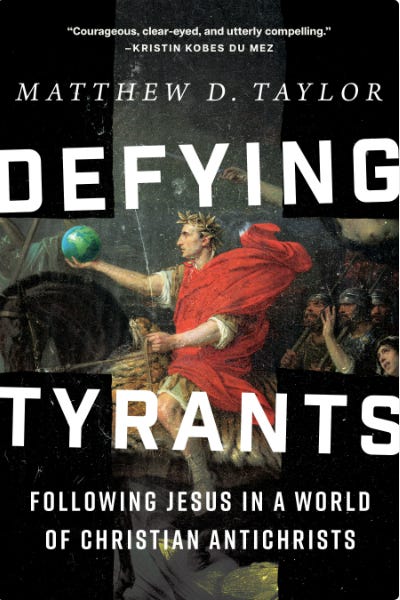
Defying Tyrants: Following Jesus in a World of Christian Antichrists will be published in October 2026 by Broadleaf Books
Dr Matthew D. Taylor is the author of The Violent Take It by Force, Defying Tyrants, and Scripture People, and his work has appeared or been featured in the New York Times, Weekend Edition, On the Media, Rolling Stone, The Bulwark, Politico, Sojourners, and Religion News Service. A religious studies scholar who specialises in American Islam, Christian nationalism, and Christian extremism, he is also the creator of two podcast series: Charismatic Revival Fury and American Unexceptionalism. Taylor holds a PhD from Georgetown University and an MA from Fuller Theological Seminary. He is currently a visiting scholar at the Center on Faith and Justice at Georgetown University.
Emmy award-winning investigative reporter, Heidi Siegmund Cuda is an American correspondent for Byline Times and her Hot Type column runs bimonthly in Byline Times Substack. She is a #1 Amazon bestselling author, the co-host of RADICALIZED Truth Survives podcast, and her Bette Dangerous Substack is read in 99 countries.