


“Watching my country defend itself feels like watching someone fight for their life in slow motion… for us, it is a fight against being erased by Russia. This Government wants to pull us back into a Russian-style ‘grey zone’ where truth does not exist and your future is decided by a billionaire in a glass palace.” – Anni Phridonashvili, arrested student, Tbilisi, Georgia
I wasn’t comfortable with Marci Shore being in Tbilisi.
The intellectual historian and author of The Ukrainian Night: An Intimate History of Revolution, had reached out to me in the days before traveling to the country of Georgia to gauge the risk. We have become friends, allies in the fight for democracy. I turned to colleagues from the Caucasus region on the coast of the Black Sea to see if it’s still safe to travel there. The response was yes, for now, sort of.
Tbilisi has been the site of protests since its October 2024 parliamentary elections, the pro-Russian Georgian Dream party declared victory despite widespread claims that the elections were fraudulent. Protests and legal challenges over the election outcome escalated when the party announced it was suspending the European Union accession process. Police engaged in widespread violence and torture against protestors and journalists. The Georgian regime also passed legislation similar to Russian laws requiring NGOs and media organizations receiving funding from abroad to register as “foreign agents”.
Last year, the European Parliament passed a resolution stating it does not recognize the results of the parliamentary and presidential elections as legitimate, and protests have continued nightly despite grave risks to the participants.
So it was with great relief that I learned that Shore had touched down safely in Toronto last week after giving her talk in Tbilisi. In the run up to Trump 2.0, Shore and her husband Timothy Snyder left their posts at Yale University and she is now the Chair in European Intellectual History at the Munk School of Global Affairs and Public Policy at the University of Toronto.
But her trip to Georgia wasn’t without incident. A 20-year-old student on her way to hear Shore’s lecture was arrested in front of the lecture hall before she could attend.
As Shore explained: “I was in Tbilisi with a group called Dilemma, organized by friends at the Borderland Foundation in Poland, whom l’ve worked with for many years now. Dilemma is a kind of ‘mobile academy’, essentially a group of writers and thinkers from Central Europe, the Balkans and the Caucasus, meeting in different places for week-long series of discussions on different topics.”
Shore has attended Dilemma events in Krasnogruda, Poland; in Uzhhorod, Ukraine; and in Yerevan, Armenia. The topic for the Tbilisi meeting was “The Responsibility of the Rebels” and the event was organized by her colleague Weronika Czyzewska, through connections at Ilia State University.
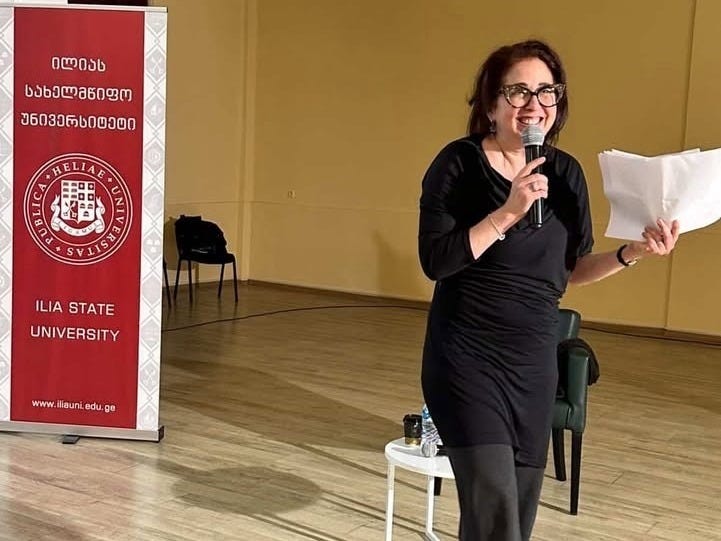
“Weronika explained that the university has been under attack and that the students there have been especially active in the protests, and she asked whether I would give a lecture at the university while we were in Tbilisi. I really have no expertise on Georgia at all — this was my first time there – so I couldn’t talk about the situation in Georgia, per se, so I decided on ‘The Dilemmas of Dissidence: Revisiting Havel’s Greengrocer in Postmodern Times.’”
(I wrote about Václav Havel in my column here just last year.)
“Dilemmas of Dissidence” is a reference to a 1990 article by British-American historian Tony Judt, Shore explained.
“Weronika wanted to do a couple events at the university as a gesture of moral support, and I was happy to take part. Moral support is my main contribution as a universal Jewish mother. I’m neither very brave nor do I have actual practical skills.”
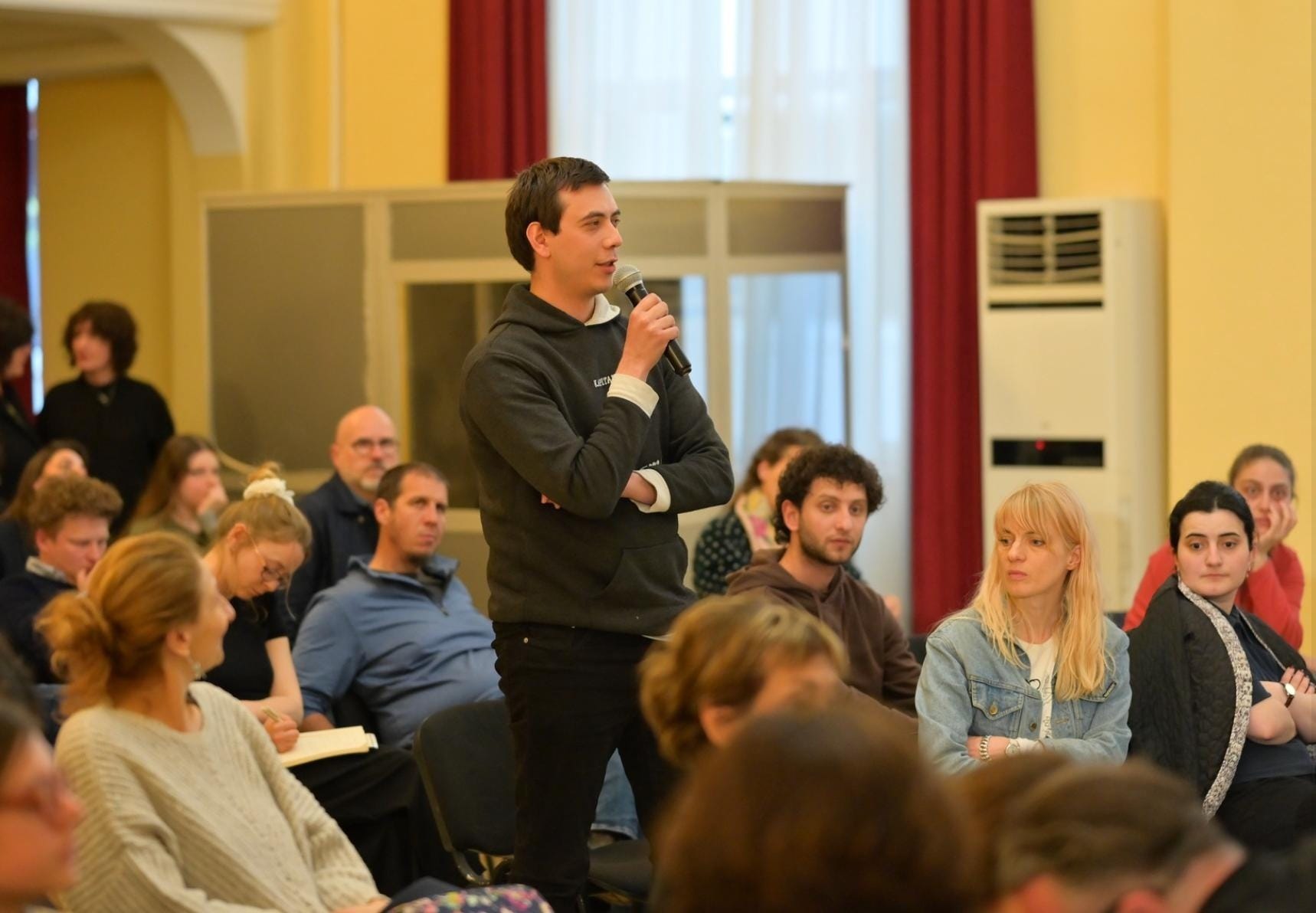
During the question-and-answer discussion following the lecture, she said, a young man took the microphone and said that he and his friends had been planning on coming with another friend, Anni Phridonashvili, but she was arrested outside the university building.
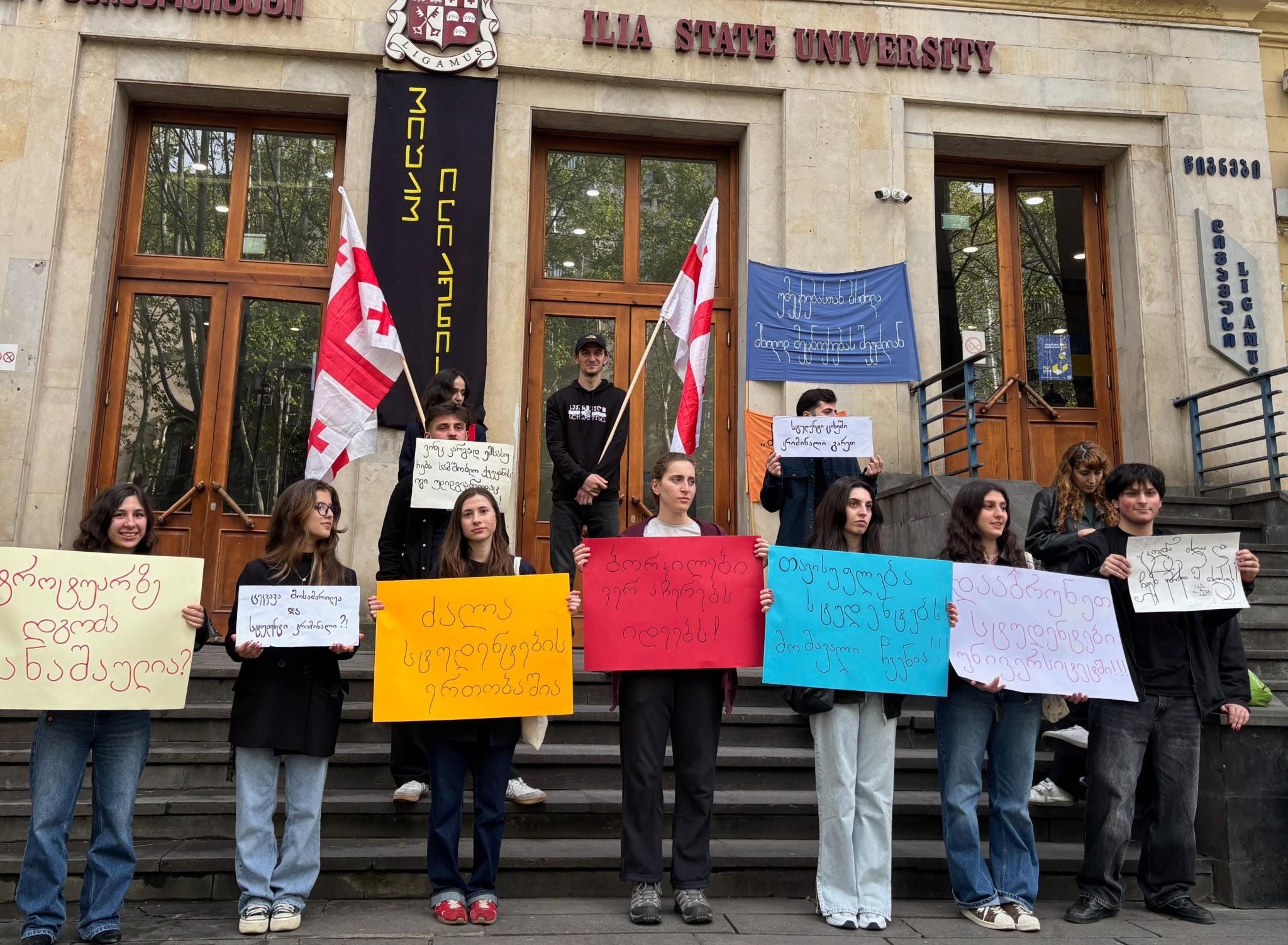
“When we came back to the university the next day, there were students standing on the steps holding signs in solidarity with Anni,” said Shore. “And I talked to them for a while, and they explained that the police coming and detaining their friends for taking part in peaceful protests was an everyday occurrence for them. They were used to it, which of course didn’t make it at all okay.”
Among the slogans carried by the students: “Is standing on the sidewalk a crime?” “Handcuffs can’t stop the ideas.” “Freedom for students, the future is ours.” “Student in prison, Criminal outside.” “Knowledge is power and we’ll fight for this power.”
After her release from jail, I contacted the student, Anni Phridonashvili, so we could hear first-hand what it’s like living in a country that arrests students for standing on the sidewalk.
Raw Reality
Heidi Cuda: Can you tell us a bit about yourself?
Anni Phridonashvili: I am 20 years old and a student in Tbilisi, where I study International Relations and Philosophy. Like most people my age, l have spent the last few years trying to balance the demands of my studies with the raw reality of what is happening on our streets. I care deeply about history and politics, but more than that, I care about the future of my home. While both of my parents are immigrants living in Europe, l am here trying to protect our country from Russian aggression. I am just one of many who have realized that we can no longer afford the luxury of being “apolitical.”
Heidi: How excited were you to see Marci’s talk — and why were you drawn to attend?
Anni: I was looking forward to Marci Shore’s lecture, because I had heard so much about her work. I was drawn to her because I wanted to understand her perspective and how people in the past, like Václav Havel, dealt with the same kind of lies we are seeing today.
When the Government tries to tell you that “black is white,” you look for scholars who can help you find the language to describe what is actually happening. As soon as I heard about her lecture, I put it in my calendar, knowing there was only a 50/50 chance I could attend because the court was making a decision on my (previous arrest) case that same day.
My case is complicated. The “Georgian Dream” Government introduced a law forbidding citizens from protesting even on the sidewalk, where citizens have every constitutional right to stand. I had two court sessions. I attended the first one, listening to their absurd lies about how I was “blocking the road.”
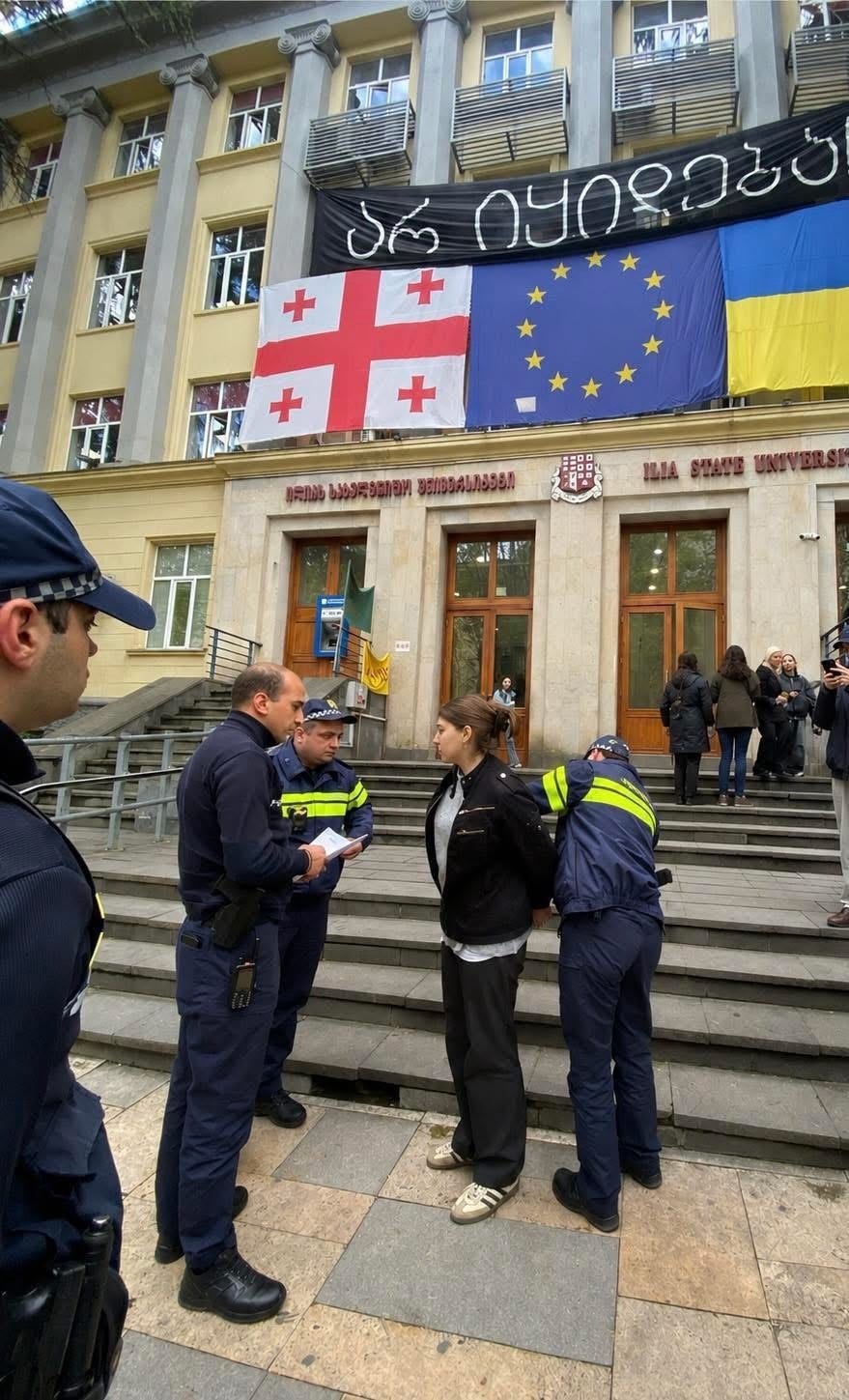
May 6th was the day the judge was set to announce the decision. I had a midterm exam that morning and decided to go to the exam first, then went to my internship in the university administration. When I finally called the court to find out the result, I learned I had been sentenced to two days in jail. Shortly after, the police arrived and took me away.
Heidi: I have been following the bravery of Georgians, protesting at great risk every day for more than 500 days, can you describe what it’s like to be part of that movement? What it’s been like seeing your country defend its democratic rights – what would you like people to know about Georgia in this moment?
Anni: The protest movement turned out to be a very long-term process. It is not like the movies where there is one big “victory” moment; it has been a constant, draining cycle of mobilization since 2024. Watching my country defend itself feels like watching someone fight for their life in slow motion.
There is immense pride in seeing my professors, my friends, and even people I used to disagree with, standing together on Rustaveli Avenue. But there is also fear. We have seen the police use chemicals, we have seen the “titushky” – government-sponsored thugs – attack people in the dark and we have seen the state pass laws that effectively criminalize the simple act of standing on a sidewalk.
This isn’t just a “political disagreement.” For us, it is a fight against being erased by Russia. This Government wants to pull us back into a Russian-style “grey zone” where truth does not exist and your future is decided by a billionaire in a glass palace.
Georgia is a European country, not because of a map, but because of how we think and what we are willing to endure to stay free. We are a small nation that has spent centuries trying to escape an empire, and we won’t let it swallow us again without a fight. We are tired, yes, but we are not finished.
Heidi: What kind of future do you envision for Georgia?
Anni: My vision for Georgia is a future where we don’t have to spend every spring and fall on Rustaveli Avenue just to protect the basics. I envision a country where “European integration” isn’t just a slogan on a flag we carry while being tear-gassed, but a boring, everyday reality.
I want a Georgia where our institutions are stronger than the people who run them, where a billionaire cannot “halt” our history to suit his business interests or his relationship with Moscow.
I see a future where my generation doesn’t have to choose between being “patriotic” and being “free.” I want an education system that teaches us how to think, not what to fear. Ultimately, I want a future where being a “rebel” is no longer a requirement for citizenship. I want us to be a normal, safe, thriving democracy, where the biggest news of the day is mundane, not whether the police will arrest my friend for exercising a fundamental right.
Heidi: What are the next steps for you and your future – your personal path forward?
Anni: My path forward is defined by a single goal: to become the kind of professional my country needs to survive this crisis. I am back in the library now, pouring all my energy into my bachelor’s thesis on illiberal democracies. It is a strange, intense experience to study the theory of how freedom is dismantled during the day and then go out at night to prevent it from happening in real life.
Passion alone isn’t enough to save a country, we need expertise. We need people who understand the mechanics of power, law and truth so deeply that they cannot be manipulated. I will fight for my country. I owe it to the generation before me who dreamed of a free Georgia and to the generation that will come after me, who shouldn’t have to fight this same battle.
My future is simple - I will continue to bridge the gap between the books I read and the reality I live, until the Georgia we envision becomes the Georgia we inhabit. I won’t stop until the truth is no longer a revolutionary act, but the foundation of our home.
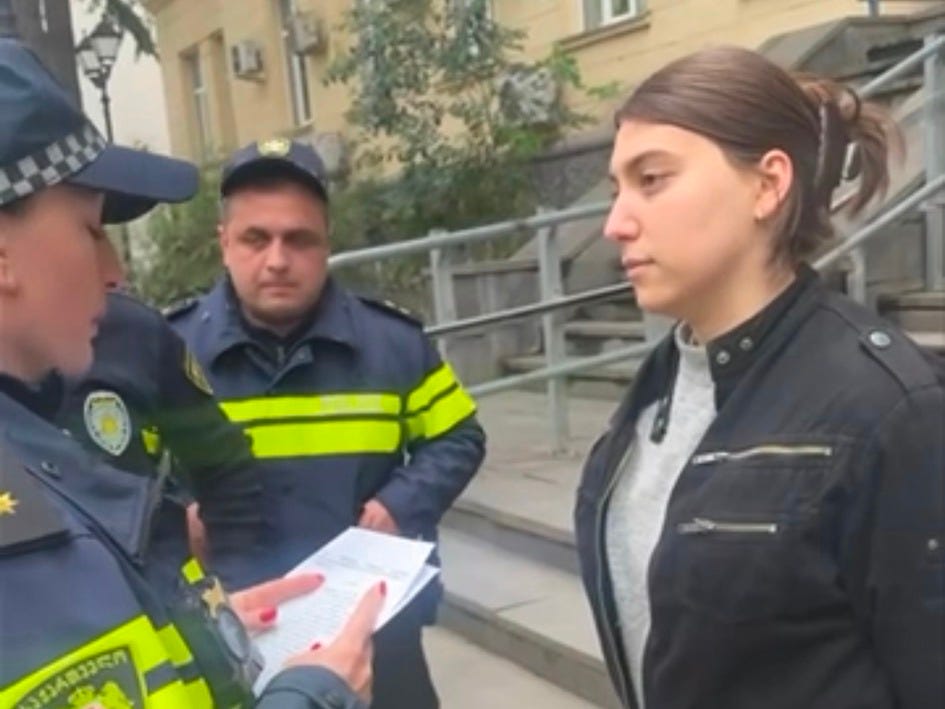
In a video documenting the moments leading up to her arrest, Anni walked down the university steps, receiving hugs from friends who filmed the arrest. Standing tall, shoulders back, she faced the three police officers, who — aware of the camera — calmly handcuffed her and put her in their vehicle. Off camera, you can hear the tears of her friends.
I have often looked at the images from Georgia, of brave people facing riot police and walking into firehoses, every night unfailingly, even after mass arrests, and thought, this is exactly what America needs to be doing.
Not periodic protests, but every day, steadily, like the Georgians, who know what it’s like to be ruled by a brutal empire and don’t want to go back.
Shore said she’s both relieved that Anni has been released from jail, and grateful to the student who informed the audience in real time about her arrest.
“It was a very good thing that he spoke up – we all knew, of course, in general what was happening in Georgia, the nightly protests in front of the parliament going on for more than 500 days, the brutality and arrests.” Shore said. “But what novelists know well is that connection is most effective at the level of the individual, and his standing up and telling us that their friend had just been taken from the street outside the building made us all feel a particular connection to Anni, even though we didn’t know her. It’s the contiguity.
“My Lithuanian philosopher friend Viktoras Bachmetjevas, for instance, was part of our group, and like myself, he felt that she could be any one of our students, and we all have a feeling we should be looking out for our students and drawing attention to their accomplishments, that’s what it means to teach.”
Since Anni missed the lecture, I asked Shore to offer me some words from it to share with her and our readers, and she sent me the abstract:
“In 1978, Vaclav Havel wrote of the ordinary greengrocer in communist Czechoslovakia, who every morning displayed the obligatory sign in the show window saying ‘Workers of the World Unite!’ Havel accused the greengrocer of living in a lie: pretending to the outside world he believed in communism, and pretending to himself that he was powerless to do otherwise. It belongs to the demonic nature of authoritarian regimes that they can take away the space for remaining innocent, creating an abusive society in which everyone is implicated. Normalizing that which should never be made normal becomes a source of both resilience and complicity. In these conditions, what does dissent mean and what does it demand? And what does the distinction between living in a lie and living in truth mean in times of post-truth?”
And as she often does, she shared with me a poem.
This time, it was Try to Praise the Mutilated World, by the Polish poet Adam Zagajewski, as translated by Clare Cavanagh:
Try to praise the mutilated world.
Remember June’s long days,
and wild strawberries, drops of rosé wine.
The nettles that methodically overgrow
the abandoned homesteads of exiles.
You must praise the mutilated world.
You watched the stylish yachts and ships;
one of them had a long trip ahead of it,
while salty oblivion awaited others.
You’ve seen the refugees going nowhere,
you’ve heard the executioners sing joyfully.
You should praise the mutilated world.
Remember the moments when we were together
in a white room and the curtain fluttered.
Return in thought to the concert where music flared.
You gathered acorns in the park in autumn
and leaves eddied over the earth’s scars.
Praise the mutilated world
and the gray feather a thrush lost,
and the gentle light that strays and vanishes
and returns.
Emmy award-winning investigative reporter, Heidi Siegmund Cuda is an American correspondent for Byline Times and her Hot Type column runs bimonthly on Byline Times Substack. She is a #1 Amazon bestselling author, the co-host of RADICALIZED Truth Survives podcast, and her Bette Dangerous Substack is read in 102 countries.