


The Fallacy of the Mean
Peter Jukes – Born 1960
It used to drive me mad. It could have been my Christmas post office job, or summer shifts at a record warehouse or an electronics firm, but I remember on more than one occasion a manager complaining about the quality of job applicants.
What’s wrong with students these days? he’d say, showing me a letter. Look at the handwriting. Standards have slipped! What happened to applications written in beautiful copperplate?
Leaving aside that orthographic flair was the last thing you needed in those poorly paid paper-pushing jobs, this kind of complaint was common in the post-war boom.
As the masses never had it so good, everything was dumbing down. Nostalgia was everywhere, like coal soot.
Think of Van Morrison’s ‘Brown Eyed Girl’, or Elton John’s ‘Crocodile Rock’, or, above all, Don McLean’s ‘American Pie’ (pictured below).

Youth culture was an elegy for youth – the time you used to go down to the old mine with a transistor radio, before the music died, and Suzy went and left you for some foreign guy.
Our bias towards nostalgia is powered by selective amnesia.
Barbra Streisand understood this in the title song of that iconic 1970s movie (full of nostalgia for the 30s and 40s) The Way We Were – “what is too painful to remember/we just try to forget”. Rapid urban growth had the same effect on our urban landscapes – bulldozing over the poverty and dreariness we’d left behind.
As a green belt boy, brought up in the concrete modernism of 60s clinics, shopping centres, and bus stations – when pushing friends around the multi-storey car park in shopping trolleys was considered the height of the weekend – it’s no wonder I fell for the glamour of backwardness.
After a brief gothic and country village phase at university, I looked after my older brother’s cats in his rented Queen Anne house in Twickenham, and wished I’d lived in the 18th Century, with its wit, wigs, and pre-recorded Bach.
The reality of Georgian or Medieval London – its dirtiness, drudgery and disease – had been demolished, gentrified, and erased (until we were left with just a few polished gems to beguile us).
I think I finally realised this in my twenties, when I was refurbishing my first flat, a maisonette in an early Victorian yellow brick terrace in Greenwich.
One night I had a dream that, behind the puce tiles of our 50s gas fire, I’d found an ornate late Victorian fireplace. Pulling it away, excitedly, I’d found another fireplace behind that – a classical Georgian mantlepiece. In the hope that I would find some medieval Inglenook behind, I tore that down too – only to get back to a bedrock of grey breeze blocks.
That’s the brute psychological truth of nostalgia: even if we could time travel back to our preferred era, and somehow overlook the sewers, sexism, and lack of internet bandwidth, we’d still end up banging our heads against the breeze block banality of the everyday.
But there’s a wider, more historical, point here too.
As education and literacy has continued to expand in the last 50 years, this complaint of falling standards is really a form of status anxiety, which I’ve dubbed the ‘fallacy of the mean’.
Take copperplate writing. A century ago, it was drilled into a small literate minority, while many wrote little or not at all. Today, billions write daily – albeit with emojis and to troll people on social media. Though the mean – the average – might appear lower, literacy is winning, and the absolute number of people with excellent handwriting is probably larger than ever.
This paradox of democratisation underpins many cultural laments.
Nobody reads novels any more? Although the novel was the central storytelling device of Victorian culture, it was only for a small educated elite. A smaller percentage of readers might be obsessed with Dickens or Tolstoy or Dostoevsky these days, but there’s absolutely more people reading them.
Classical music? The number of concert halls and performances continues to grow with global access to instruments, recordings, and conservatoires. The opera and the symphony may no longer be the sole province of the haute bourgeoisie, but the absolute stock of world-class performers and informed listeners is rising.
Movies aren’t what they used to be? Go back and look at past Oscar winners in the 40s, 50s or 60s to see how many mediocre, unmemorable films were made in the heyday of Hollywood. The pool of talent in today’s directors, writers, actors, designers is bigger because the ecosystem is larger.
Science and mathematics? Where are today’s Einsteins? Ou sont les Newtons d’antan? It might be harder for single figures to dominate entire fields these days, but only because those fields are now so vast, rich, and populous.
So when commentators complain that ‘nobody does this properly any more’, and that the past was better, remind them of the fallacy of the mean. This is how reaction sets in – turning wider literacy, education, and enfranchisement into a story of decline, and leading to the conclusion that democracy is debasing.
It isn’t. It’s improving. So don’t be mean.
Reclaiming a Social Imagination
Matt Gallagher – Born 1997
As a privileged child, I just assumed things would sort themselves out. As a university student, I thought I was in the pipeline to a principled, stable career. As a young adult in the pandemic-addled restaurant industry with a hard-won but useless social sciences degree, that pipeline seemed to be out of operation.
I did eventually forge an unconventional path – turning my own cynical probing into a vocation – but many weren’t so fortunate.
One of the first things I wrote for Byline Times was about the 2006 film Children of Men. Alfonso Cuarón’s classic spoke to this feeling of decay; society’s building blocks growing withered and hollow.
It portrayed a militarised, infertile Britain in 2027 “soldiering on” despite being out of ideas and out of hope. The government (possibly a democratically elected one) processed its anxiety in two main ways: resorting to extreme exclusion and violence against ‘illegal’ migrants; and hoarding nostalgic artefacts (such as Pink Floyd’s Animals cover) in an ‘Arc of Arts’. Their future got “cancelled”, as the Italian philosopher Franco “Bifo” Berardi puts it, so they turned to the past.
Our own future also seems to be blotted out.
Britain is enduring its longest cost of living squeeze on record, its longest wage stagnation since the Napoleonic era, and an unprecedented crisis of confidence in institutions, media, and politicians.
A majority of young adults anticipate neither home-ownership nor retirement.
The country floats anxiously on the world stage, uneasily tethered to a Trumpian America, while billionaires buy up land, water, news, and influence – all under the shadow of an overheating planet.
Bluntly, it doesn’t feel particularly sustainable.
Despite all of today’s rhetoric about novelty and innovation, says the late music critic Mark Fisher, we have our own ‘Arc of Arts’ of sorts. Our mainstream culture struggles to look forward, brimming with prequels, sequels, and nostalgic remakes – even original movies are often coded to elicit decades past.
This isn’t a terrible time to be alive, exactly, but it is marked by a kind of spiritual indigestion. We’re more isolated, online, and disillusioned than ever.
We move through a world of degraded communities and reduced contact; one that feels at once rigid and precarious. People abscond to increasingly bizarre online sub-cultures and conspiratorial echo-chambers simply to find a sliver of camaraderie and purpose.
The 1970s has always been an important decade for me, and not because I lived then or because I harbour any nostalgic illusions about sending us all back somehow. Relatively speaking, I know it was a time of great prejudice, poverty, and casual brutality.
But I’ve long loved the 1970s for its dissident music and even more so for its unparalleled crop of political science-fiction.
The dusty rebellion of Creedence Clearwater Revival, and the avant-garde shapeshifting of David Bowie, always struck me as a generational reclamation from stodgy elders.
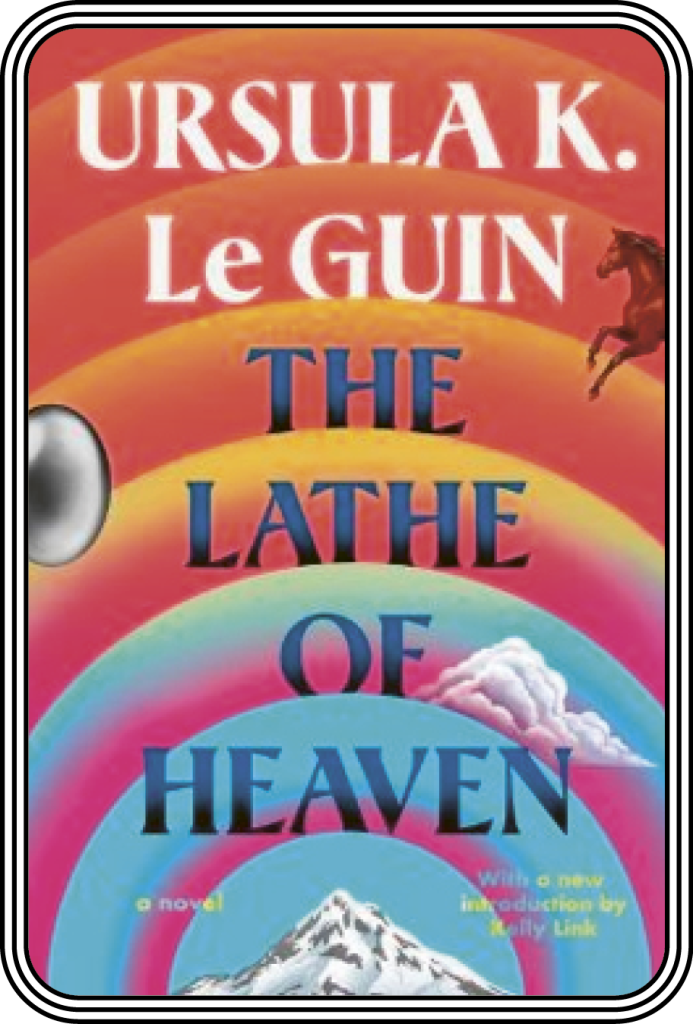
Ursula K Le Guin’s The Dispossessed and The Lathe of Heaven offered other-worldly, psychedelic expressions of a deeply held belief in human potential and structural change.
“Hard times are coming,” Le Guin warned us before her death in 2018, “when we’ll be wanting the voices of writers who can see alternatives to how we live now, can see through our fear-stricken society and its obsessive technologies to other ways of being, and even imagine real grounds for hope. We’ll need writers who can remember freedom – poets, visionaries – realists of a larger reality.”
The 70s had optimism.
If not a time of tolerance, it was a time of radical momentum. There were advancements in women’s rights, discrimination laws, and environmentalism. Although still constrained by often bigoted and cruel traditions, the era seemed to believe in people’s power to remake the world. We reap the benefits of that hope.
The right’s nostalgia feels like a desperate bid to reclaim some perceived lost social or racial status – it’s of no interest to me. I’m far more sympathetic to the nostalgic lefties who seek to reignite that dying flame of social democracy.
But I’d still advise caution: there are countless new challenges – and new opportunities – in this odd time we inhabit. Turn backwards and we might miss them.
The lesson I take from the 1970s, ingesting its culture decades later, is that we should turn our eyes forward: we should imagine new utopias and radical dream worlds.
We should reclaim that social imagination.
Surely there’s more to life than Excel spreadsheets and relentless two-factor authentication codes? Ultimately, we decide if the future is to be cancelled or merely postponed.