


BYLINE TIMES IMPACT: Find out about the changes you made happen
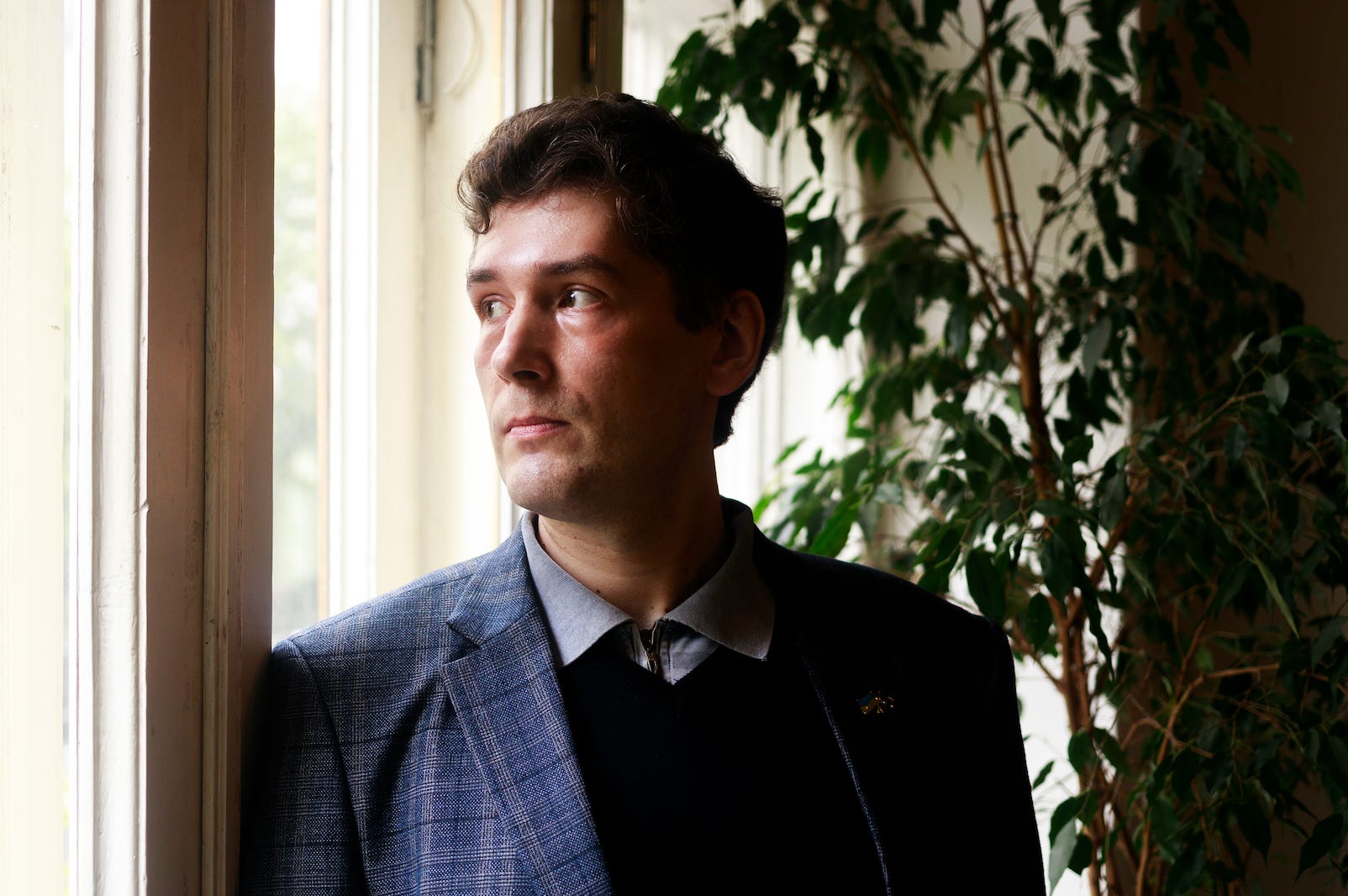
“One of the most terrifying things,” Viacheslav Levytskyi tells me, “is seeing my city erased by black clouds rising from a missile or drone strike.” His office has panoramic views over Kyiv so he will often see the impact of a Russian attack. Viacheslav, who is a poet, translator, literary scholar and member of Ukrainian PEN is one of the Kyiv residents who, sadly, are seeing the destruction of their homeland not for the first time. Russia is also trying to erase the entirety of Ukrainian literature.
The most recent blow to the Ukrainian publishing industry was on the night of 16 August when a missile struck Kyiv’s historic Pochaina book market destroying thousands of books and the stalls. The strike was the latest in a series targeting Ukrainian publishing and comes in the wake of the murders of Ukrainian authors, such as Victoria Amelina and Volodymyr Vakulenko.
It is not the first time that Russia has tried to destroy all or part of Ukrainian literature.
The mass annihilation of books by missiles and drones is a continuation of four centuries of attacks on the Ukrainian language. Ukrainians have coined a new term, knyhotsyd, which can be translated as bibliocide, the genocide of a nation’s books.
So how do Ukrainian authors deal with the Russian assault on their national literature? How much damage have the strikes done to Ukrainian publishing? Viacheslav is planning to entitle his next book of poems, if he manages to publish it, Insomnia, partly because Russian attacks do not let him, or indeed most Ukrainians, sleep. But also because he feels that now is not the time for sleep. There is too much to do in a country fighting for its survival.
“My working day begins and ends,” he says, “with a walk past the office wall hung with memorial plaques for colleagues who have fallen in the Russian-Ukrainian war. It is painful to see photographs of people with whom I recently worked on a document, or discussed a computer glitch with, or just said hello to in the corridor. It’s even more painful to see a fresh obituary in the hallway...”
The staff are also affected, with “quite a few living in an area that is hit frequently”. However, the commute itself is an act of resistance by authors and indeed every inhabitant of Kyiv. Viacheslav told me that “neither the ruins on the walk to the tube station nor the pavilion at the station entrance, which is propped up on plywood sheets, deter any of us. The city lives. There is shattered glass from blasts on the streets, but cafés remain open, literary events are well attended and theatres open, with performers drumming up support for the units their colleagues and friends serve in.”
But the damage to publishing has been immense. On 1 August 2026, a strike destroyed one of Ukraine’s largest book distribution hubs, the RNK-Ranok warehouse in Kharkiv. Publishing houses across the country were affected. This single strike destroyed 400,000 books with losses amounting to approximately £16.4 million. This vast strike was not an isolated instance, according to Oksana Khmelovska of the Chytomo publishing project, 9.5 million Ukrainian books were destroyed by Russian strikes in the first seven months of 2026. This, according to Khmelovska equals a third of the total volume of books produced in Ukraine in 2025.
The publication of the book which Viacheslav edited and co-authored on the subject of Lviv in Ukrainian literature has been delayed due to the losses suffered by his publisher and damage to the infrastructure. He is convinced this is part of a long-term strategy. The Knyholend (Land of Books) bookshop chain in Kharkiv was also attacked on 1 August and in combination with the attack on RNK-Ranok, Russia destroyed 600,000 school textbooks.
“The aggressor state,” Viacheslav says, “obviously wants to ruin the start of the school year in Ukraine. The word ‘denazification’ which Russia uses to justify its invasion is not some malevolent abstraction. It signifies a world where there is no Ukrainian school, where a Ukrainian child cannot study Ukrainian history, borrow a Ukrainian language textbook from the library or laugh at Ukrainian language memes during a break – such a person will be easier to manipulate against Ukraine and Europe. Every ballistic missile that Ukraine has nothing to shoot down with now, and every cheap Russian drone, brings the Russian dream of destroying the ‘memory cards’ of Ukrainians closer.”
Viacheslav considers the parallel with the “era of the Executed Renaissance” – the term refers to a generation of Ukrainian writers destroyed in the 1930s – to be apt, “it is a comparison I use in my lectures and publications. The sense that history is a wheel returning to that point again will not abandon me.”
But he stresses that the current generation of authors creating the new renaissance are out on the frontline, defending their country with weapons. Indeed, I translated two such soldier poets Maksym Kryvtsov and Artem Dovhopolyi for Index on Censorship. However, many are being killed by the occupiers; the same article featured a poem by Volodymyr Vakulenko who was murdered by the occupying Russians in Kharkiv. I was in contact with Victoria Amelina, who died as the result of a missile strike before she could write a blog for the ‘Stanzas for Ukraine’ series at The Poetry School, although the poems she sent were published with her obituary. Russians are murdering Ukrainian authors and destroying Ukrainian books as they have done many times in the past.
Despite this mass destruction of books which recalls Ray Bradbury’s classic dystopian novel, Fahrenheit 451, Viacheslav remains optimistic and stresses that we are not hopeless spectators. “The Ranok site has information about how to help the publishers who have suffered from this Russian bibliocide.”
Stephen Komarnyckyj is a British Ukrainian poet and translator whose latest collection of original poetry Singing Carols for James Mason is available from Caparison Press.
The Lviv Book Forum runs from 9-13 September. Live events will be streamed online in partnership with Hay Festival Global and the Ukrainian Institute London with the support of the British Council.