


BYLINE TIMES IMPACT: Find out about the changes you made happen
Recent reporting has cast Dialog, an invitation-only network founded in 2006 by the Silicon Valley investors Auren Hoffman and Peter Thiel, as a secret society of global elites directed by Thiel. A Byline Times investigation finds something more consequential, if less sensational: a long-running influence network, run by Hoffman and built around light-touch social engineering, that trades on Thiel’s name while operating at arm’s length from him.
Thiel himself is barely there – no hand in running Dialog, rarely present – and the network sits at the loose end of a wider web he backs. Others in that web, working far more directly to place allies in positions of power, have drawn little of the scrutiny now falling on it.
Byline Times contacted multiple former participants and obtained copies of emails sent to invitees. Each contained long lists of names intended to encourage attendance at a range of events, including regular retreats, local dinners, one-off gatherings, and online discussions.
Importantly, while the conference itself is billed as off-the-record, none of those who spoke to Byline Times suggested that attendees were asked to sign a non-disclosure agreement. Furthermore, marketing emails sent to prospective participants (which contained detailed information about participants and programming) carried no explicit expectation of secrecy. While invitations are clearly denoted as non-transferable, Dialog seems to rely on an aura of exclusivity and mutual respect to keep its gatherings on the down-low.
Marietje Schaake, a former member of the European Parliament from the Netherlands, attended the Dialog retreat in 2019 in Venice. She said she was left less than impressed, and found it to be an “in-crowd that wasn’t hers”. She also did not know that Peter Thiel was associated with the group and if she had, she would have “100% been triggered”. Schaake is the author of the 2024 book The Tech Coup: How to Save Democracy from Silicon Valley, and has been a vocal advocate for European digital sovereignty and guardrails for American tech companies.
Kim Scott, the bestselling author of Radical Candor, attended a Dialog dinner held alongside South by Southwest in Austin, Texas in 2024, and other small dinner events in the San Francisco Bay Area. She found them to be interesting and stimulating. Scott had been receiving invitations from Dialog since 2012, and while she had some idea it was connected to Thiel, she has never met him and he was not present at any of the dinners she attended. Scott, too, has been deeply concerned with increasing income inequality and the corrosive effects of Silicon Valley billionaires on democracy globally.
DeRay Mckesson, an author and a prominent organiser in the Black Lives Matter movement, has been invited to Dialog for several years, and declined. He said he was not aware that Thiel was involved, and was nominated by two other ‘Dialogers’ (as they are called by the group) – investor Kanyi Maqubela and social justice entrepreneur Garrett Neiman. Mckesson expressed relief that he had never attended, as he and the Black Lives Matter movement would likely have faced negative scrutiny now had he done so.
Action and Intent
While Dialog is similar in many ways to other exclusive gatherings and conferences, it is also uniquely focused on direct action. A 2014 invitation from Peter Thiel and Auren Hoffman describes the event: “There are no speakers. No panels. All attendees participate in break-out facilitated discussions. And we limit the discussion to only 150 global leaders who can have an impact now, and emerging leaders who can help implement the plans we develop.”
But some sessions lean towards the personal, confessional, and salacious. Marriage, sex, and family are commonly addressed, and most of the retreats include sessions dedicated to heterodox and sensational topics. Given the group’s attendee base, which includes some of the world’s most powerful people, such personal details could easily be used as leverage, whether by Dialog and its sponsors, or by other attendees.
Steve Hassan, an author of multiple books on cult techniques, said Dialog’s sessions reflect techniques used by high-control groups. “Eliciting personal confessions and controversial statements in the context of a group setting can become a powerful weapon if they are misused,” Hassan said in an email. Security analyst Pierluigi Paganini suggests that such personal data could be used by adversarial intelligence agencies to target and manipulate powerful individuals.
According to sources, Dialog does not have a money-making business model. Reporting from Wired suggests that it is methodical about grading participants (A is low-grade; B is mid; C is high-status) and continuously grooms its invitation lists to determine who is in and who is out. It has also promoted dating and matchmaking between participants, presumably as a mechanism for further cementing in-group social ties.
Attendance fees can reach more than $16,000 for those paying full price, but can be heavily discounted for desirable attendees who cannot afford to pay as much. Schaake said she did not recall paying any registration fees, and that her flight and hotel were likely covered as well.
Dialog is run by Stonebrick, LLC, an established entity owned by Auren Hoffman that appears to house his various business concerns. Raffi Grinberg, the group’s executive director, oversees much of its day-to-day operations and leads a team that includes Juliette Levine. Levine is a 2015 graduate of Princeton University. Her senior thesis, titled ‘How to Give Well: Increasing transparency, accountability, and efficiency in NGOs’, explores the application of Effective Altruism concepts in the NGO context.
Byline Times obtained a set of interview questions used in hiring Dialog staff, which ranged from the mundane to the more exotic: “What is a heretical view that you have?” Applicants are also asked to “design your own session”, offering ideas and discussion questions for two Dialog sessions – one topical and one personal, focused on experience-sharing.
Thiel appears to have no operational role in the organisation and seldom attends events. Investor Ian Osborne forwarded a Dialog invitation to Jeffrey Epstein in 2014 with the complaint: “Same sh*t. Peter doesn’t even attend. I will tell him that he should stop them using his name.”
None of those who spoke to Byline Times had met Thiel at any Dialog event, so the assertion that Dialog is operating as a “secret society” personally directed by him (another concept Epstein had brought up with Thiel, in a 2016 email) is not supported by available evidence.
However, Dialog’s operational design (with its lack of a profitable business model and heavy focus on identifying and recruiting powerful individuals with high name-recognition and encouraging them to be vulnerable around each other) is consistent with the hypothesis that it is a well-oiled influence machine.
Relationship With Thiel’s Other Networks
According to organisation materials obtained by Byline Times, Dialog claims to have had more than 2,500 participants in its 20-year history and more than 1,000 paying members, aims to have 1,300 members by the end of 2026, and holds more than 150 dinners per year. However, it is just one network among many backed by Thiel.
Functionally, Dialog is too large to be a ‘secret society’, but some of Thiel’s other networks take on that air. Teneo, founded in 2008 by the Thiel allies Evan Baehr and Josh Hawley (now the Republican Senator for Missouri), is specifically focused on placing conservatives into positions of power across business, government, and culture. Its members include Ted Cruz, the Republican Senator for Texas and a Dialog member, and it is led by Leonard Leo, a member of both Opus Dei and Dialog.
Will Scharf, a member of both Teneo and Dialog, and a former candidate for Attorney General in Missouri, currently serves as White House Staff Secretary. Teneo has said its goal is to “crush liberal dominance”.
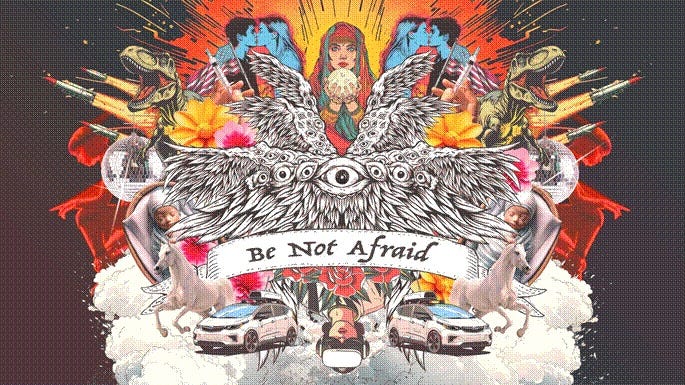
Hereticon, another conference network funded by Thiel and his Founders Fund, expands Dialog’s heterodox sessions into a full-blown conference with a festival-like atmosphere. Announced in 2019 (and delayed by COVID-19), it debuted in January 2022 in Miami and bills itself as “a conference for people banned from other conferences”, “a conference for thoughtcrime”, and convening “persecuted weirdos” on the premise that “dissent is worth protecting”.
Where Dialog’s edginess ends, Hereticon picks up with sessions on UFOs, immortality, doomsday, natalism, parapsychology, genetic modification, “sex, God” – and “existential risk”. Curtis Yarvin, who has gained notoriety for advancing the “neoreactionary” cause, moved from off-programme attendee in 2022 to a featured speaker.
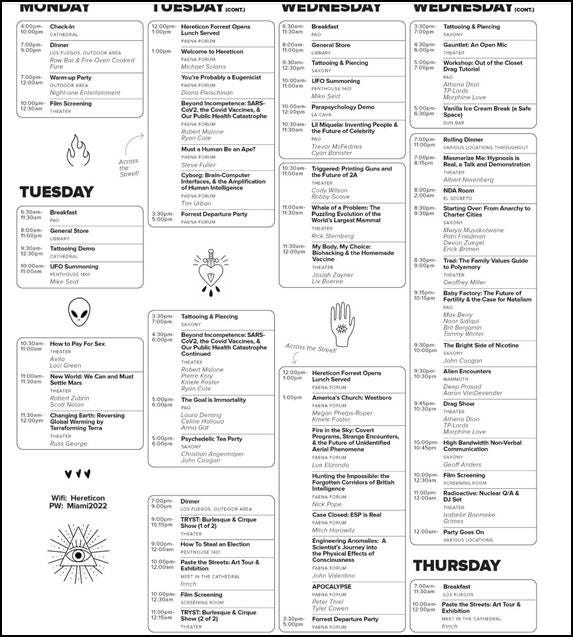
Founders Fund published the 2022 Hereticon programme online. Several Dialog members are Hereticon session leaders. One session was titled ‘How to Steal an Election’. Peter Thiel led a session titled ‘Apocalypse’ with libertarian economist Tyler Cowen. Other Dialog holdovers include life extension advocate Bryan Johnson, psychedelics advocate (and Thiel co-investor) Christian Angermayer, Thiel fellowship co-founder Jim O’Neill, and network state (Próspera) investor Niklas Anzinger. An attendee list has not been published.
Other Thiel networks include (but are not limited to) Thiel Fellows, a programme that encourages young people to skip college in favour of pursuing a startup, Founders Fund (his venture capital investment fund), Thiel Capital (his personal investment instrument), and Per Aspera (a disclosure-free political spending arm which funds aligned candidates).
While many Dialog participants do turn up in Thiel’s other networks, available evidence does not demonstrate a clear linear progression from normie recruit to true believer, moving people from one group to the next, as is often the case with influence networks and high-control groups.
Rather, Dialog seems to be a kind of machine designed to search the realm of power and influence to find candidates who might already be like-minded, and for those who are not, to initiate them into the core network’s worldview, perspective, and goals. The focus on heterodox and confessional topics may accelerate that process, and with Dialog’s minders paying close attention to who clicks with whom, it seems to waste little time on people it considers to have a low return on investment. And taken together, Thiel’s groups seem to function more as a network of networks than as a strict hierarchy.
Justifiable Anger
Powerful private networks have become targets for the resentment and anger people feel over income inequality and lack of accountability by elites. Invitation-only networks such as Dialog draw suspicion because of their stated intent and clubby atmosphere. Dialog, Teneo, and Hereticon seem especially egregious, as they operationalise an agenda set by one powerful man.
And there are many more exclusive conferences, networks, and events spanning sectors – many without specific political intentions. Dialog, which may seem super-secretive at first, is ultimately just one of many networks competing for power and attention. And as more participants are revealed (Byline Times has identified about 635 of approximately 2,500), the bigger and less exclusive it ultimately seems.
Various people who had one-time associations with Dialog are now in the position of having to contextualise and defend their experience. Others have been incorrectly named. Wes Moore, now Governor of Maryland, spoke at a Dialog event in 2013 in support of his book The Other Wes Moore. He denies ever having met Thiel.
Kaja Kallas, currently Vice President of the European Commission, denies having attended, despite having appeared in a leaked Dialog dataset. The actor Joseph Gordon-Levitt has issued a statement saying he never met Thiel, and the actor Josh Brolin said he also did not attend; he was nominated by former Uber chief executive Ryan Graves.
The actress Sophia Bush, who attended a Dialog event to discuss Another Body, her 2023 documentary about deepfake pornography, was blunter. She wrote that Thiel “was not present, was never brought up during my experience there at all, and as I’ve since learned he has not been involved whatsoever in approximately 15 years.”
Ezra Klein, the New York Times columnist, offered a similar account. He confirmed attending Dialog twice, in 2018 and 2022, and said “no one ever asked me to keep it or my presence a secret.” However, many argue that his recent book, Abundance, highlights the kind of fluffy, substance-free proposals that might appear in a Dialog session.
Dialog is an important network and should be monitored. The group has plans to purchase land and build a campus in the Washington DC area, and sources suggest that process is still ongoing. Its upcoming event in August 2026 outside Dublin deserves sunlight. Attendees who choose to participate given the intensity of the scrutiny under which Dialog has now come should have good answers for why this is how they want to spend their time.
But it seems wrongheaded to suggest that everyone who has ever touched this network over the past two decades is complicit with Thiel’s increasingly bizarre eccentricities and anti-democratic goals, especially given that Thiel’s association with the group has been minimal, to the point of barely there.
Ultimately, the most interesting thing about Dialog is where it, and its members, choose to go next.
Kim Scott, the Radical Candor author, also raised a fair point: “Why is Peter Thiel, of all people, the only person convening conservative and liberal people to talk to each other?”
Why, indeed? Maybe it is time for some principled competition.
