


BYLINE TIMES IMPACT: Find out about the changes you made happen
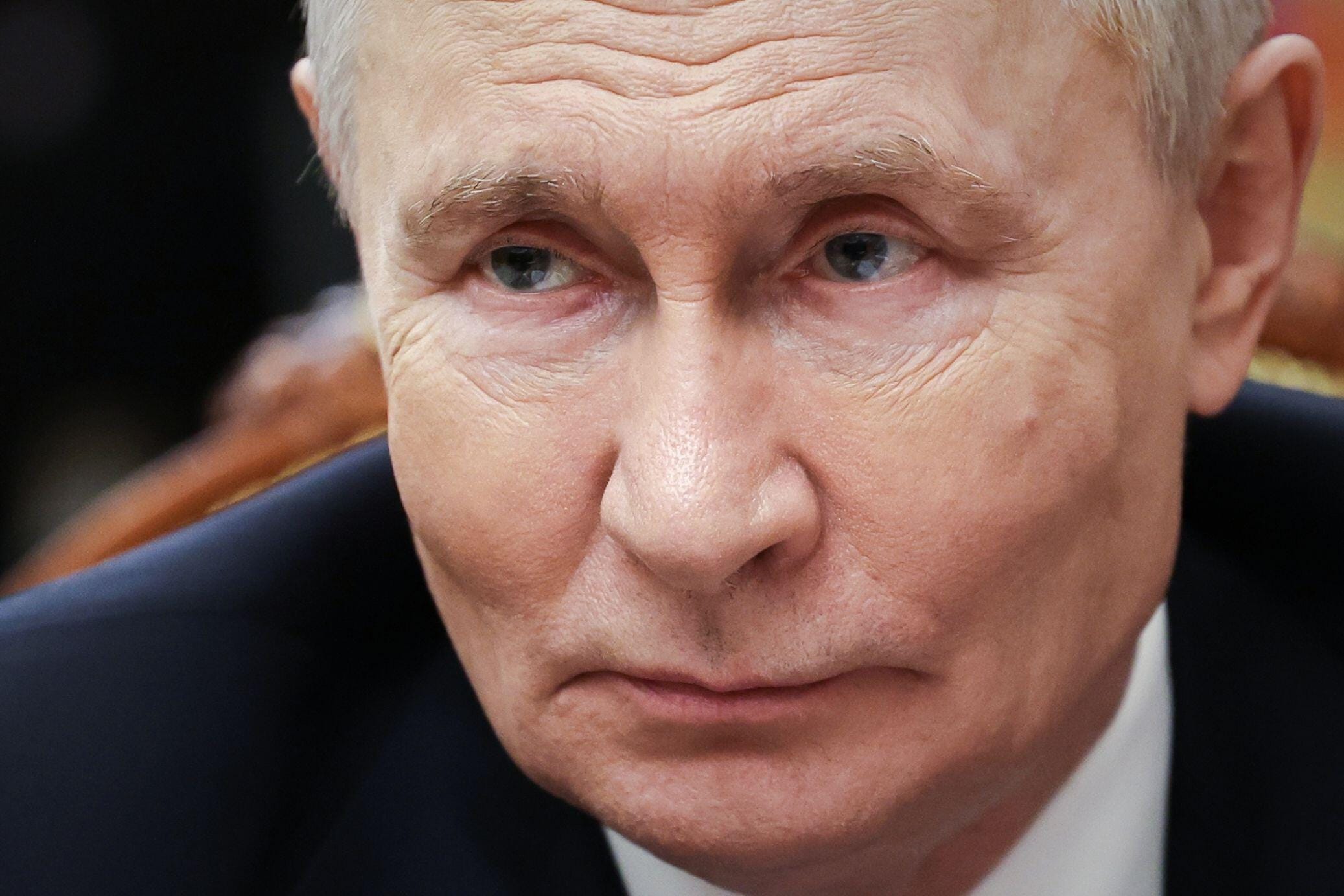
This week, on 7 October, it was the birthday of Russia’s tyrannical leader, Vladimir Putin. One of the best gifts he could possibly hope to receive this year would be to have the funding that Ukraine relies on to defend itself from his war cut off. Shockingly, some political leaders in Europe seem to think that this is what should happen.
“We want the war to end,” they say. “Cut off funding for the war, and then Ukraine will be forced to negotiate,” their twisted logic continues.
Believe me, speaking as someone who woke to the smell of a city just impacted by many missiles on the morning of Putin’s birthday, the people of Ukraine want the war to end. But cutting off military and financial aid to Ukraine is not going to magically open the door to a gift-wrapped peace deal. It would be a gift-wrapped invitation to Putin to go further.
The Problem
The problem with this thinking, which is a common theme from leaders of significant political movements in both France and Germany at the moment, is that the Kremlin has not, and will not, agree that it would end the war under those circumstances. There is not one single occasion when Putin or any of his mouthpieces has indicated that, if Ukraine were to stop fighting, (whether due to financial constraints or anything else,) Russia would then reciprocally end the active phase of the “special military operation.”
In France, a leading contender to win the keys to the Elysée Palace is Marine Le Pen, she argues that France can simply no longer afford to provide financial support for Ukraine. With the country carrying a national debt of €3.6 trillion that populist message may well resonate with many voters. However, the average amount of financial assistance to Ukraine from France runs at around €2 billion.
There are, to put this in perspective, one thousand billions in a trillion. France’s financial lifeline to Ukraine is certainly a significant sum, but when stood up against the problem of the national debt it is in rounding error territory. Ms Le Pen, as is common among populists, is being economical with the truth.
In fact, the candidate for the National Rally is not just engaged in a temporary deception of French voters as a matter of political convenience, her track record of being a supplant for Vladimir Putin is quite a long one. This “financial” objection is just the latest way of deceptively presenting a case that supports the war criminal in the Kremlin.
The problem is not limited to France. In Germany, another powerhouse of the European Union, the far-right Alternative for Germany (AfD) is also surging in the polls. It, too, wants to cut off all deliveries of weapons to Ukraine and cut all financial aid. It has not, I am sure, checked with Moscow to enquire as to whether this changed set of circumstances for Ukraine would in any way motivate Russia to stop fighting in and against Ukraine. The party could, of course, check with Moscow, because at least 9 AfD members of the German parliament have travelled to Russian-occupied parts of Ukraine to play the role of “international observers” for sham “elections” there. They are obviously on good terms with the Russians.
What Binds the Far-Right with Russia?
If we are starting to ask ourselves what it is that binds the far-right across Europe with Russia, we can see a lot more than the shared ideology of being anti-immigrant (racist) and populist (dishonest) and as ever with the standard modus operandi of Putin’s criminal regime, financial ties emerge too.
In the UK, the far-right niche is occupied by the Reform Party of Nigel Farage and their offshoot Restore Party. Farage has a history of claiming that the background of the war in Ukraine comes from “poking the [Russian] bear”, while his former colleague Nathan Gill is spending the next decade in prison for being caught taking Russian money to make the exact same comments in the European Parliament.
As for Restore, they have a policy platform that would cut all foreign aid (without implicitly acknowledging that the greatest casualty in this would be Ukraine) “that does not directly benefit British national security.” That can, on the surface, sound logical.
But let’s play out the hypothetical scenario that aid to Ukraine is cut, and this allows Russia an opportunity to prosecute their war even more brutally against an undefended Ukrainian population. Around 250,000 Ukrainians have sought, and gratefully found, refuge in the UK as they have fled the war since 2022. What would be the impact of another quarter of a million refugees in the UK?
The Costs of Real-Life Scenarios
Here’s where the scenarios get more scary, but they are very real. The fixed part of the equation is that Putin is not going to stop. His war is one of imperial conquest over lands that he believes now – which was not the case 20 years ago, when he was fully OK with Ukraine’s borders as defined by international law – are rightfully his.
The land is one thing, the people who call that land home are another.
It is possible, though not certain, that Putin may be satisfied to take no more than what he refers to as “Novorussia”, which is all of Ukraine east of the Dnipro River. It would include million-strong cities such as Dnipro, Kharkiv, Odesa, and Zaporizhzhia.
The people who currently live in those places will be faced with a stark choice: accept that you are now Russian, or be tortured and even executed for daring to think otherwise. How many more Ukrainian refugees are going to flood across the borders of Europe in that scenario? What would be the cost of absorbing such a vast number of new settlers across Europe? It would certainly be in excess of the amounts being invested today in the defence of Ukraine.
It seems insane to me that French voters could actually elect a President who has been convicted of fraud, but American voters elected Donald Trump for a second time after his 34 felony convictions and a myriad of reported sexual offences.
It seems equally insane, studying their history, that German voters can turn out en-masse for a party that openly backs a regime in Russia that is, by definition, fascist. Nevertheless, the AfD is on the march.
The result of putting them in power and allowing them to follow through on their stance towards Ukraine would be almost an exact mirror image of the circumstances that led to World War II, whereby an angry society incited to hatred through a perverted form of nationalism decides that it wants swathes of the territories of other countries. The resulting millions of casualties or refugees will be the same too.
Trump has already cut off all aid to Ukraine, leaving Europe to pick up fill the resulting funding gap. The National Rally would do the same. The AfD would do the same. In all three cases, these are very long-term investments from the Russian regime that are, or would be, paying dividends.
While there are dividends to the Kremlin, who pays that bill? The cost is not measured only in dollars or euros, but if it were, the investment made in the defence of Ukraine would be a bargain compared to the costs of an undefended Ukraine.
And the part that is not being considered is where will the next war be? Against whom?
Putin has to have war, his regime only exists and persists because he has convinced his population that wars for “Russian greatness” are both their birthright and death rites. Who will he attack next to satiate the need for violence and domination that are the only distinguishable feature of modern Russian society?
