


BYLINE TIMES IMPACT: Find out about the changes you made happen
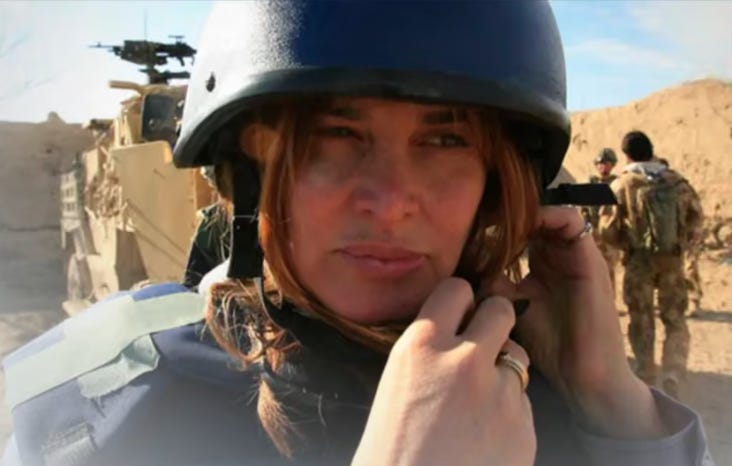
For most of us, experiencing just one war would be enough to last a lifetime, but acclaimed journalist Janine di Giovanni has found herself on the frontline of 18 global conflicts, including Bosnia, Iraq, Chechnya, Afghanistan and Gaza. In an interview with the Byline Times Podcast to launch a new audio series about her human rights organisation The Reckoning Project, she explained it wasn’t a career path she ever envisaged whilst growing up in New Jersey. “I don't think I chose it. I think it chose me. If you had said to me when I was a young girl, or a young woman, or even a very young journalist, ‘your path is to be a war reporter,’ I wouldn't have agreed with you. I wanted to be a writer, full stop. Preferably fiction. I thought that I would probably be an academic and teach at a university, and spend the summers travelling, writing novels and mentoring younger writers; basically having my days free to write.
“Life didn't really work out like that. I went to London to finish an MA in comparative literature, and went to Israel during the first Intifada. I met a Jewish human rights lawyer called Felicia Langer, who had been a Holocaust survivor. She sent me to Gaza in a taxi, and she introduced me to many, many people in the West Bank and Gaza – human rights lawyers, activists, journalists. And she opened up my eyes to [the fact that] people that do not have a voice and do not have access to justice.”
So the young di Giovanni completed her MA but shelved a PhD, and began writing first for The Spectator and later The Times. “Unfortunately for global security, but perhaps fortunately for me as a young journalist, the 1990s were full of terrible wars,” she observes. Unlike many of her male counterparts, though, she was “not turned on by the defence industry.” Nor was she, like some, an “adrenaline junkie.” Instead, “my motives were, above all, the protection of civilians, and it always has been. It is to give a voice to people that do not have a voice, and it is also to try to spread awareness so that, in some way, what we are doing affects policy. I've never become jaded or cynical about the people I talk to. I just got back from Kyiv. I was in South Sudan this year, on the border, taking testimonies from survivors of rape, as young as 10. I'm on my way to the West Bank. It never gets easier, and I’m never cynical or jaded about it. Each story is horrific in its own way. Each story deserves to be recorded.”
It was this relentless quest to document the impact of war – and specifically war crimes – that led di Giovanni to create The Reckoning Project with UK-based disinformation expert Peter Pomerantsev. Their work involves training journalists, lawyers and other researchers to record evidence in a way that will be robust enough to be used in court, but – crucially – without causing additional pain to the victim. She recalls: “I ran a small programme for the UN called Enabling Witnesses, and it was to train Iraqi, Syrian, and Yemeni doctors and healthcare workers how to recognise an atrocity crime; and how to take a testimony that wouldn't re-traumatise the survivor.
“I'll never forget in Iraq, right after the fall of Saddam, seeing an Australian TV journalist thrust a microphone in the face of a child who was in a hospital bed, with third-degree burns all over his body, saying ‘how do you feel?’ Journalists are well-meaning, but often they have their desks back in London or New York or Singapore or wherever hassling them to get a story, get a scoop – and that means they often forget about the people that scoop is about. So, I got tired of seeing scoops in the paper that I knew came from probably good intent, but were gotten in the wrong way.”
Holding war criminals to account is essential to reducing future conflict, di Giovanni believes. She and Pomerantsev launched The Reckoning Project following Russia’s full-scale invasion of Ukraine in 2022, and she says, “if you do not have justice, you are threatening your national security and thus your international global security, because you will have conflict over and over and over again. You'll have people that feel that they did not get justice – therefore they will seek revenge, vengeance, whatever language you want to put that in. And so we felt there was this need to begin a track to justice that would quicken the path, because in conflicts like Bosnia, it took years for the investigators to get on the ground. We are not always successful getting all the cases of all of the victims and survivors to The Hague – or to domestic courts, which is also a goal of ours. But we offer a chance for people that will never have access to justice to at least have hope that they might get there, and that is really important to me.”
Watch Adrian Goldberg’s full interview with Janine Di Giovanni on the Byline Times podcast here – and look out for the next episode of our mini-series with The Reckoning Project which will be released next Friday, 24 September.
New episode: An Introduction To The Reckoning Project.