

A Labour Government in deep trouble. A Conservative Party failing to take advantage. A new anti-Europe, anti-immigration party poaching disillusioned and dispossessed voters from both main parties. Industrial disruption across the public sector. Violence in the streets. Britain, in the late 1970s.
As a young reporter in Bradford, I was inspired to write about all this by what was going on around me. Having left journalism to write for the stage, I wrote a play about the rise of the National Front (not impenetrably disguised as the Nation Forward Party), in order to try and work out how a far-right, racist party could gain purchase in a country which had defeated Hitler less than 30 years before. The play was called Destiny and it was premiered by the Royal Shakespeare Company in Stratford 50 years ago.
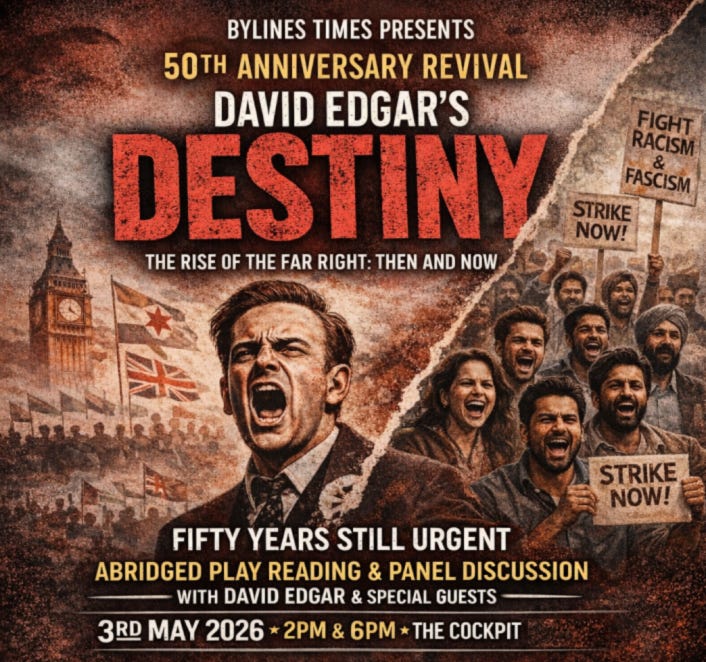
Now, to mark the anniversary, Byline Times is producing readings of key scenes of the play – readers including Roger Allam, Geoffrey Streatfeild and Emma Manton –accompanied by a discussion of the play’s resonance today, on Sunday 3 May at the Cockpit Theatre in London’s Marylebone.
How it Began
For me, Destiny began with a national and a local event. Locally, in Bradford, I had covered meetings of an outfit called the Yorkshire Campaign to Stop Immigration. Its leader was a maverick and rather dapper ex-Conservative councillor, who produced a lurid duplicated newsletter (full of dire warnings of chicken bones lying in fetid rubbish piles and leprosy breaking out in Bradford schools), and presided benignly over chaotic meetings in which microphones fed back and films were shown upside down and without sound.
Later the organisation merged with the National Front. Racist and unpleasant it certainly was. But was clear was that – for its leader and his followers – the Yorkshire Campaign answered many real needs and some real fears.
Nationally, the Edward Heath Government’s correct decision to admit 27,000 British passport holding Asians from Uganda led to a hitherto obscure anti-immigration party, the National Front (NF), saving its deposit in a 1973 by-election in West Bromwich. The NF was thus well positioned to take advantage of the collapse in Conservative morale following its two election losses in 1974. Picking up some Conservative defections, the NF began to gain significant votes in 1976, winning 20% of the vote in Leicester (while the breakaway National Party won two council seats in Blackburn).
By then, Destiny was scheduled for production at the RSC’s small Stratford theatre, the Other Place. It had not been an easy journey to the stage. I’d wanted the play to be performed in a large multicultural city: the first draft - vast and impossible - was presented to and politely shelved by the Nottingham Playhouse. The second – slimmer and better - draft was scheduled by the Artistic Director of the Birmingham Repertory Theatre but vetoed by its Board.
The play then went round the houses, and was finally picked up by a young director at the Royal Shakespeare Company, Ron Daniels, who, despite the company’s earlier rejection of the play persuaded Artistic Director Trevor Nunn to programme it in the then fledgling Other Place, a small tin hut in the middle of rural Warwickshire. Its critical and box office success led the RSC – bravely – to transfer it to the RSC’s West End theatre, the Aldwych, the following spring.
The play hit town at an ominous moment – the National Front had just won 119,000 votes in London local elections. At the Aldwych, we were in repertoire with King Lear during the Queen’s Silver Jubilee, and it gave us some pleasure that the only two shows that didn’t see a dip in audiences during Jubilee week were an old play about a mad king dividing his kingdom, thereby provoking a civil war and a foreign invasion; and a new one warning that Britain was at risk of a fascist takeover.
Less enjoyably, a couple of weeks later, the play was picketed by the National Party, whose union flags echoed the patriotic bunting on the front of the theatre. The scuffles that broke out between the emerging audience and the National Party pickets were pretty small beer, compared to the (by now) regular confrontations between National Front marchers, the Anti-Nazi League and the police. But they demonstrated that the play was touching nerves.
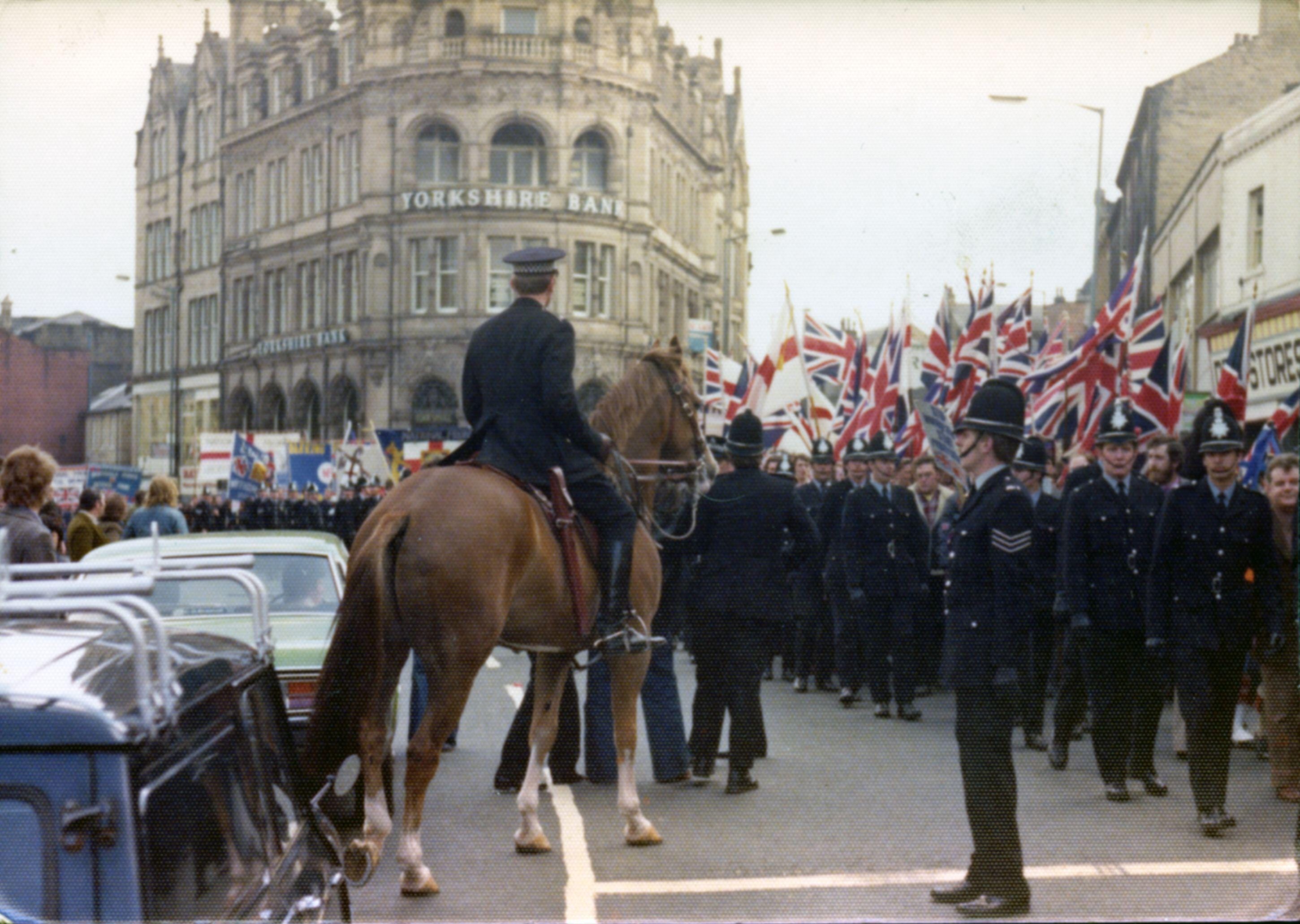
The following January, a television version directed by Mike Newell (later to make Four Weddings and a Funeral and much else) was broadcast as a BBC Play for Today, the day after Margaret Thatcher had sought to see off the NF threat to her vote by assuring a television audience that “people are really rather afraid that this country might be rather swamped by people with a different culture”, a dog-whistle to be blown with increasing desperation by William Hague, David Cameron and Kemi Badenoch, and with greater assurance by Robert Jenrick and his new leader in Reform UK.
Destiny’s aim was put human flesh on the question of whether 1930s Germany was being repeated in 1970s Britain. The play’s opening was inspired by the fact that, the day of Indian independence, Major Enoch Powell had burnt his army uniform.
As Britain settled down to partying in the 1960s, the sudden collapse of the British Empire hung, silently, as a mighty dark cloud over the feast. This spectre was given substance when citizens from the newly-independent commonwealth countries flocked to Britain, in what seemed a taunting reminder of a time when they were Britain’s subject peoples.
The Britain of the 60s was full of the kind of people who had turned to the German Nazis – tradesmen, small businessmen and shopkeepers who felt threatened by conglomerate capital above them and a newly invigorated and confident working class below. It seemed to me that the loss of the Empire produced a similarly bewildered, angry, vengeful sense of defeat and betrayal as the loss of the first world war had in Germany.
From the beginning, I’d decided that the play should be built round a by-election, in which a loosely fictionalised far-right party would field a candidate. Now, I decided that the play should begin in India, on the night of its independence from Britain in August 1947, and establish four characters who would appear, 30 years later, in the same west midlands town: the British Colonel as a dying Conservative MP, the Major as a candidate for the nomination to succeed him, the Sergeant as a candidate for a far-right party and the Indian servant boy as a shop steward in a local foundry. During the by-election, a strike by Asian workers at the foundry becomes an election issue, turns violent, and transforms the election from a cosy English ritual into a bloody battleground. Finally, the Nation Forward party turns to the very ruling class forces that they claimed to oppose for succour and support.
What the Play Got Right and What It Got Wrong.
In its immediate aftermath, the tally was this. The play had been right to assert that the leaders of the National Front had not only been Nazis but remained so, promoting Nazi anti-Semitic conspiracy theories (and holocaust denial) in an increasingly blatant way: in the slogan of the Anti-Nazi League, the National Front was indeed a Nazi Front. (This was by no means an accepted truth in liberal circles who saw an analogy between 1970s anti-immigration activists and 1930s German fascists as a grandiose left-wing fantasy).
The play demonstrated a then emerging split between fascists who wanted to appeal to the working class with left-wing economic policies (the equivalent of the Strasser faction of the German National Socialist Party, purged in the 1934 Night of the Long Knives) and those who supported capitalism – unless it was Jewish. By dramatising this split, Destiny predicted the emergence of the allegedly more moderate, “pinstriped Nazi” BNP leader Nick Griffin in the 1990s.
The most obvious thing the play got wrong was its overestimate of the strength of the National Front, which reached its zenith in 1977 and went down to a humiliating defeat in the 1979 general election, averaging 1.3% of the votes in the 303 seats it contested.
There is debate about the cause of the NF’s collapse: some point to Mrs Thatcher’s swamping statement and the revival of Tory confidence and élan under her leadership; others cite the cruelty of first-past-the-post to small parties; while the left (properly in my view) credits the Anti-Nazi League, Rock against Racism, Searchlight magazine and other organisations that mobilised so successfully against the far-right.
Most of all, the play seemed wrong in proposing that the British ruling class would consider supporting a militant far-right party to protect capitalism from militant trade unions and other left forces, as the German ruling class had done in 1933.
Certainly, there were former army officers (including General Sir Walter Walker and David Stirling, founder of the SAS), and newspaper magnates like the Mirror’s Cecil King, quietly canvassing paramilitary rule against trade union power; clearly, the National Front was trying to move into a growing hinterland between itself and the right-wing of the Conservative Party, including anti-common market organisations, supported by wayward businessmen.
The Conservatives certainly feared it: in December 1976, Thatcher’s ideologue Sir Keith Joseph presented a discussion paper arguing that if a Tory Government did nothing about the unions it risked “being pushed aside by parties to our right with the stomach to resist”. But the idea that British capitalism might consider backing a far-right party in the way that German business bankrolled the Nazis, as the only way to bring political and industrial anarchy under control, was clearly wrong.
So How Do Those Judgements Look Now?
National-populists across the continents have promoted left-wing economic policies in order to attract working-class voters, from Trump’s infrastructure promises via Boris Johnson’s levelling-up to Reform UK’s manifesto commitment to take a national stake in public utilities. (Like national populists in the 1930s, tending to drop the interventionist rhetoric when in or approaching power, as Jon Bloomfield and I point out in our Little Black Book of the Populist Right).
Conspiracy theories about sinister financial manipulators seeking to destroy the economies and cultures of nation-states – sometimes identified as Jewish, sometimes not – have become commonplace in right-wing discourse, and calls for “remigration” of immigrants and their descendants – a policy deemed too extreme by Nick Griffin’s BNP – are mouthed by allegedly mainstream politicians.
And, as Trump’s Republicans and Farage’s Reformers ditch loose talk about state intervention to protect the poor, MAGA militants are edged out of power and influence by the moguls of the US commanding heights, from Elon Musk to Peter Thiel.
Back in the day, Farage described Brexit as a victory over banks and big business; now, the core leadership of his party is dominated by multi-millionaires. Doubtless, it was Tice, Yusuf, Candy and their ilk who encouraged Farage to promise that Reform was “shamelessly pro-business and pro-entrepreneur”.
It’s bad news for democrats and progressives that the chickens which Destiny assessed wrongly are now coming home to roost.
So much of what seemed unthinkable in polite discourse then has elbowed its way into the mainstream now. Yes, of course, US democracy (and ours for that matter) is more robust and resistant than that of 1930s Germany (or Italy or Spain). But the widening of the Overton Window does beg the question that has been asked with ever-greater urgency since Trump’s second inauguration: whether he and other national-populist leaders are fascists in a 1930s mould.
Retrospect is a good servant but a bad master. The thing most people have forgotten about the National Front in the 1970s is that a lot of sensible liberal people thought they weren’t fascists until it was proved by what they said and did that they were. The crimes which defined Hitler’s regime lay (largely) uncommitted during his first year in office. If you weren’t Jewish or a Communist or a trade unionist, how might Hitler have looked in 1933? Might things have looked that much worse than they looked this very January, as masked and armed ICE agents stormed through Minneapolis?
Readings from Destiny will be performed, followed by a panel discussion - speakers include Yasmin Alibhai-Brown, the Observer’s Kenan Malik, former Searchlight editor Andy Bell and Asad Rehman, chaired by Byline’s Hardeep Matharu - at 2.00pm and 6.30pm at the Cockpit Theatre, Marylebone, on Sunday 3 May.
In August the RSC’s long-standing Stratford Summer School will be devoting a day (27 August) to the history and legacy of the Other Place and its founder director Buzz Goodbody, and to the theatrical and political impact of Destiny.
David Edgar is co-author with Jon Bloomfield of The Little Black Book of the Populist Right, published by Byline Books and recently updated.
