

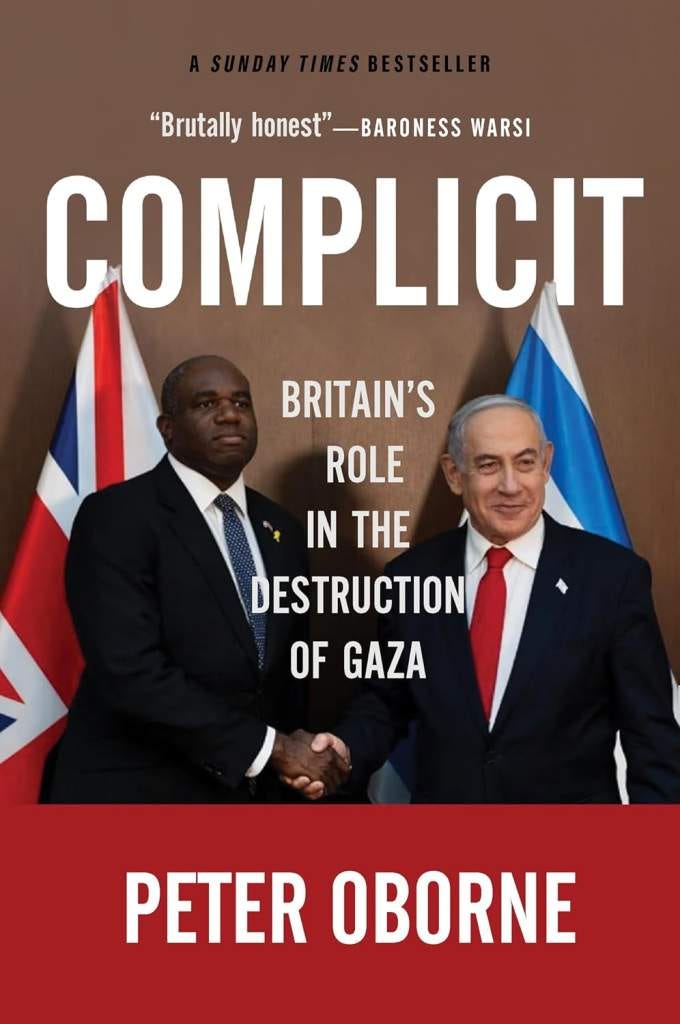
In Complicit: Britain’s Role in the Destruction of Gaza, Peter Oborne assembles a detailed historical catalogue of the evasions, distortions, and decisions made by Britain’s political-media establishment.
The Byline Times and Middle East Eye columnist argues that Israel’s plausible genocide in Gaza was actively abetted by successive Conservative and Labour Governments – and ultimately sustained by what he calls Britain’s “blood-soaked” monopoly media.
“History will salute the Gaza protestors,” Oborne writes, “who turned out month after month to demand an end to mass killing, in defiance of persistent attempts to demonise, marginalise, and criminalise their movement.”
These attempts, Oborne argues, originated from a “parallel world” of power – an insulated ecosystem inhabited by ministers, special advisors, editors, security-state pundits, and well-resourced pro-Israel lobbyists.
Here, a different, manufactured reality has prevailed: Israel framed as an embattled citadel of Western civilisation encircled by a barbaric Islamic frontier; Atlanticism and the ‘Special Relationship’ trumping the rulings of international courts; Palestinian suffering downplayed as collateral damage; and dissenters “reviled and stigmatised as enemies of civilisation itself”.
In light of the International Court of Justice rulings, the record is certainly striking.
There is Rishi Sunak’s “unconditional” support for Israeli Prime Minister Benjamin Netanyahu’s Operation Swords of Iron in 2023. Keir Starmer’s assertion that Israel “does have th[e] right” to withhold food and water from Gazans. And the grim mechanics of continued arms sales and military surveillance support.
Britain is third only behind Israel and the United States, Oborne argues, in its complicity. His argument is rooted in the long-view.
He outlines the UK’s role in Israel’s founding, and its post-war foreign policy built on “smoke and mirrors”.
The core Anglo-American strategy, he argues, has been one of “deliberate inertia” – endlessly touting a two-state solution while doing nothing substantive to halt the settlement expansion that renders it nigh impossible.
This charade, he sets out, has always relied on a domestic media that willingly plays its part.
It has systematically excluded key voices: those of Palestinians, dissident Israeli scholars and international lawyers who have articulated the case against Israeli actions.
It has utterly failed to report the explicit, dehumanising rhetoric of Netanyahu and his ministers, just as it has neglected and distorted the morbid realities unfolding in Gaza.
Oborne searches in vain for a single major newspaper editorial criticising Israel’s brazen refusal to comply with the ICJ’s legally-binding orders.
But beyond sins of omission, particularly in the Murdoch and Telegraph stable (Oborne’s old stomping ground), the press has resorted to lurid fantasy and active incitement.
Pro-Palestine protestors, overwhelmingly peaceful, have been warped by headlines into menacing migrant armies and Islamist brigades occupying British streets.
Comment pages (still) routinely platform denialists peddling disinformation about aid blockades and death counts.
Oborne shows how Spectator magazine Editor Michael Gove, and its Associate Editor, the controversial commentator Douglas Murray, sought to distort the catastrophe into a mythological battle for the very soul of Western civilisation.
Complicit also serves as a lament from an endangered civic-minded conservative. Oborne’s primary allegiance is to the institutions and norms of the post-war international order, set up to “ensure a fair and peaceful world”.
He acknowledges a “dark and terrible irony” that “this order is being dismantled to abet Israel, the state of the Jews, the people whose monumental suffering provided the moral impetus for bringing the post-war order into being”.
Though some of his historical readings can be generous and are open to question – such as his portrayal of Margaret Thatcher as a human rights evangelist – his values-based critique is a necessary antidote to the cynical populism of today’s right.
Since Complicit was first published in July, its thesis has only hardened.
Starmer’s formal recognition of Palestine, though symbolically significant, rings hollow against Britain’s ongoing military support and a long history of rewarding Israeli attempts to undermine peace. As the American writer James Baldwin warned: “I can’t believe what you say, because I see what you do.”
Despite Donald Trump’s ceasefire plan, the structural complicity – and the continued death of Palestinian civilians – remains reality. As Byline Times’ reporting has shown, the stage is being set not for liberation or peace, but for a new era of hi-tech militarisation and surveillance.
Will there be a reckoning?
Oborne believes judgment is inevitable, even if the ICJ’s final verdict on genocide is still years away: “History will condemn the politicians and their lackey journalists who have made Britain complicit in some of the most terrible crimes of the 21st Century.”
His clarion call is to “bring democracy” to that parallel world of insulated elites, restoring trust and public consent to our foreign policy and accountability to our press.
There’s no specific blueprint in Complicit for that reclamation of truth – perhaps that’s too much to ask for in one indispensable book.
Complicit: Britain’s Role in the Destruction of Gaza by Peter Oborne is published in paperback by OR Books