

Ten years ago this month, I spent several weeks working undercover as a domiciliary care worker in Blackpool.
I had gone there while researching a book about low-paid work in Britain and, after answering a few rudimentary questions over the telephone, found it disconcertingly easy to land a job looking after some of the most vulnerable people in the country.
The company was called Carewatch. I had no previous professional experience of social care. I had once helped look after my grandmother’s friend, who had dementia, but otherwise I was a complete novice.
After a short interview, I was invited to attend four days of training, during which we were taught, among other things, how to use a hoist, empty a catheter, administer medication, and what to do if we arrived at somebody’s house and found them lying unconscious on the floor.
There were eight of us when the training began on the Monday. By Friday, two had dropped out.
What struck me most during the weeks that followed was the extraordinary discrepancy between the importance of the work and the conditions under which it was performed.
Care workers form part of the invisible furniture of any civilised society. They are glimpsed darting up garden paths during the working day, identifiable by a flash of uniform before disappearing through somebody’s front door.
Unless you have needed one yourself, or watched a relative become dependent upon them, it is easy to give little thought to what happens once that door closes.
Quite a lot, as it turned out.
A typical visit on my rota was scheduled for 30 minutes. That included the time required to travel from one customer – as we were instructed to call the people in our care – to the next. Once driving time had been deducted, perhaps 20 minutes remained.
In that time, we might have to get somebody out of bed, take them to the toilet, clean them, change an incontinence pad, help them dress, administer their medication, prepare breakfast, and make a cup of tea.
Some visits were shorter still. If one person was unwell, confused, had fallen, or simply required a little more attention than expected, the delay travelled with you for the rest of the day. The only means of recovering the lost time was to take it from somebody else.
I began to understand why some carers developed little tricks for speeding things along.
One colleague described workers asking loaded questions of people who were reluctant to make a fuss: “You don’t need any shopping today, do you?” Or, to somebody who needed changing: “You don’t need your pad doing, do you?”
If the answer was no, 20 minutes might suddenly become 10.
It would be easy to tell this as a story about callous carers. I went into the job half expecting to encounter them. At the time, newspaper exposés of neglect and abuse had made the ‘bad egg’ care worker a familiar figure.
Yet, the longer I spent in the sector, the less adequate that explanation appeared.
Most of the carers I met were decent people doing an extremely difficult job for very little money. The problem was that an employment system built around haste, insecurity, and parsimony had consequences that inevitably travelled downwards until they reached the person sitting in the armchair.
One worker told me she could finish at 11pm and be expected back at seven the following morning. Another held down a second job in a fast-food restaurant and would sometimes leave a late care shift only to begin work there at three in the morning. A male colleague was working about 80 hours a week partly to support his disabled wife.
Travel time was often unpaid or inadequately reimbursed. Zero-hours contracts were widespread. Breaks existed largely on paper.
One experienced carer calculated that, once unpaid gaps and travelling were included, on some days she was in effect earning £4.30 an hour.
None of this remained neatly confined to the employment relationship between a care company and its staff. It shaped the care people received.
That was the thing that stayed with me. I remember elderly people who clearly wanted us to remain for a few minutes once the necessary tasks had been completed. Research at the time suggested that hundreds of thousands of older people could go days without speaking to another person. Sometimes, after we had taken somebody to the toilet, made a drink, and checked their medication, what they really wanted was simply company. You could see the disappointment when we left.
But somewhere else another person was waiting.
A Record of Failure
A decade later, Britain is once again talking about fixing social care.
Andy Burnham has promised to create a National Care Service and has accelerated the commission led by Baroness Louise Casey which is supposed to work out what such a system should eventually look like. Better pay, training, and job security for carers are on the agenda. So too is greater integration between social care and the NHS.
Much of this is welcome.
Some things have improved since I was working in Blackpool. Care workers are better paid in real terms than they were in 2016. The prevalence of zero-hours contracts in domiciliary care has fallen. Staff turnover, while still astonishingly high, has come down.
Yet, much of the system I encountered remains recognisable.
Approximately two in five care workers in non-residential services are still employed on zero-hours contracts. Roughly one job in 10 is vacant. Travel and waiting times are still not invariably paid at a worker’s normal rate. Fifteen-minute care visits, although officially regarded as inappropriate where intimate personal care is required, have not disappeared.
Perhaps most strikingly, the proportion of older people receiving publicly funded long-term care has fallen.
Real consensus would require politicians to acknowledge that good care has a price
In 2015-16, 587,000 people aged over 65 received it. By 2024-25, the figure was approximately 576,000, despite there being considerably more older people.
The problem, in other words, has not simply been ignored. Governments have spent money, raised wages, and repeatedly legislated around the edges of the system.
But they have never resolved the central question hanging over social care: how much of it do we think people should be entitled to, and who should pay?
This is not a new dilemma.
Indeed, the history of social care reform during the past 30 years resembles one of those Greek punishments in which the protagonist is condemned to repeat the same futile task for eternity.
In 1997, Tony Blair’s Government established a royal commission under Sir Stewart Sutherland to examine long-term care. Its central recommendation was that personal care should be provided free according to need, paid for through taxation. The Government rejected it, principally on cost grounds.
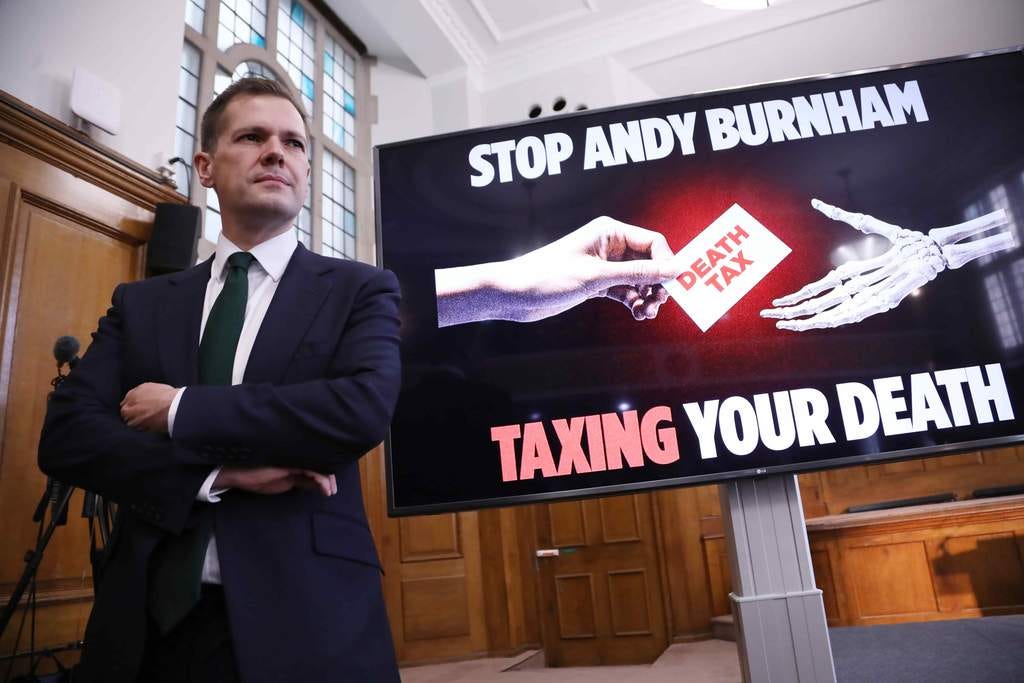
Under Gordon Brown, with Andy Burnham serving as Health Secretary, Labour returned to the idea. Its 2010 plan envisaged a National Care Service and, eventually, comprehensive care, free at the point of use. Various funding mechanisms were discussed, including some form of compulsory contribution. The Conservatives successfully branded one possible estate-based contribution a “death tax”. Labour lost the election.
David Cameron and Nick Clegg then commissioned the economist Andrew Dilnot to find another answer. Dilnot proposed that nobody should face unlimited care costs and recommended a lifetime cap of £35,000. The Coalition Government accepted the principle, albeit with a higher cap of £72,000, and wrote it into law. It was supposed to begin in April 2016. This happened to be the very year I was racing around Blackpool attempting to squeeze care visits into 20-minute windows. By then, the reform had already been postponed.
Theresa May tried again in 2017. Her manifesto proposed allowing people to retain £100,000 of assets while including the value of a person’s home when assessing their ability to pay for care delivered in that home. Payment could be deferred until after death. Labour and others promptly christened the proposal the “dementia tax”. May’s campaign never recovered from the political explosion. She hurriedly promised that there would, after all, be an absolute limit on what anybody would pay, before losing her parliamentary majority.
Then came Boris Johnson. Standing in Downing Street in 2019, he promised to “fix the crisis in social care once and for all”. Two years later, his Government announced an £86,000 lifetime cap on care costs and, unusually, identified a tax with which to pay for its wider health and care programme: a 1.25% rise in National Insurance, later to become a Health and Social Care Levy. Labour opposed the levy, arguing, not unreasonably, that it placed too much of the burden on working people. Then Johnson fell.
Liz Truss abolished the levy.
Rishi Sunak’s Government postponed the care cap.
Labour returned to office in 2024 and cancelled it altogether, arguing that the previous Conservative administration had left the reform unfunded and that abandoning it would save more than £1 billion.
And now here we are again.
Another Labour Government. Another commission. Another National Care Service.
The Politics of Funding
There is a temptation to view this history as evidence that one particular political party has repeatedly betrayed social care. In reality, it tells a more uncomfortable story.
There has been, for decades, something approaching a cross-party consensus about the ends. Politicians of almost every persuasion agree that people should receive dignified care in old age; that families should not face catastrophic and unpredictable bills; that carers deserve better pay; that hospitals should not contain thousands of medically fit patients who cannot be discharged because there is nobody available to look after them at home.
What there has never been is a durable agreement about distributing the cost. Every serious funding proposal creates a constituency with something to lose.
Pay for care through general taxation, and taxpayers must hand over more money. Use National Insurance, and working-age people complain that pensioners have been protected. Draw upon housing wealth, and homeowners fear for the inheritance they intended to leave their children. Require individuals to insure themselves, and those who never require expensive care wonder why they paid. Fund everything from existing departmental budgets, and some other public service has to receive less.
There is no ingenious mechanism that makes the bill disappear.
That has created a peculiar symmetry in British politics: governments edge towards reform, eventually encounter the need to pay for it, and the opposition discovers that denouncing the funding mechanism is electorally easier than proposing one of its own.
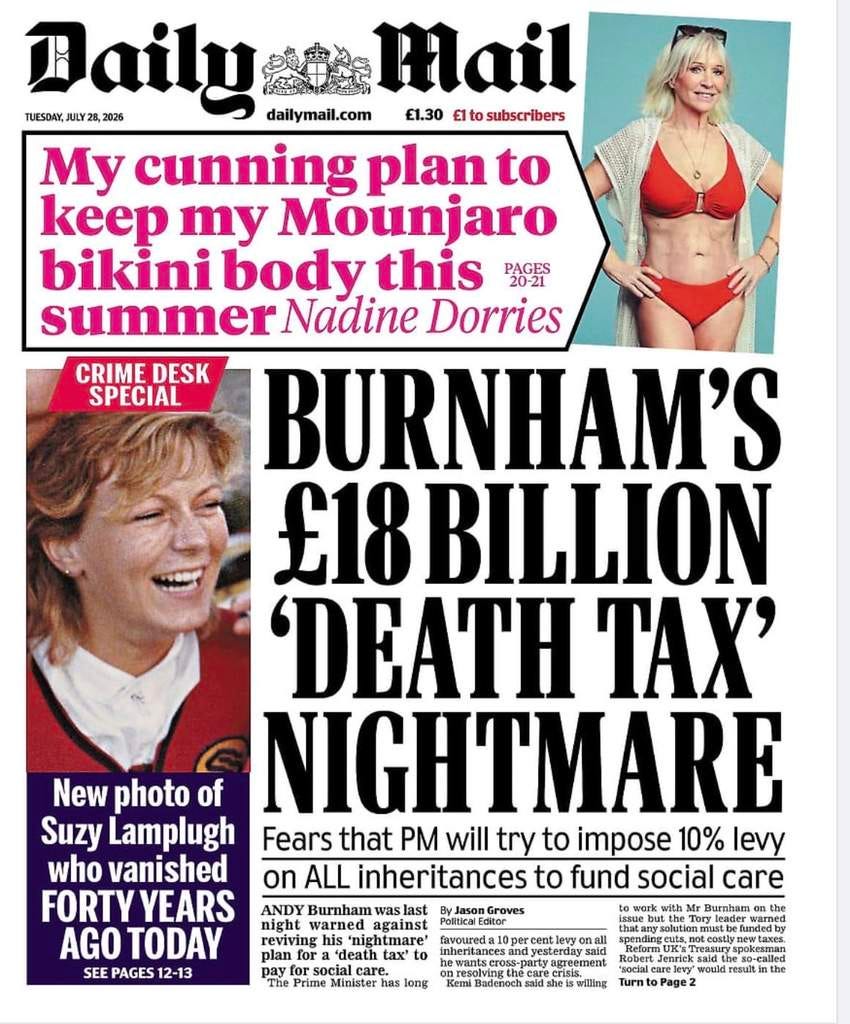
The Conservatives did it to Labour with the “death tax”. Labour and others did it to Theresa May with the “dementia tax”. Labour opposed Johnson’s National Insurance rise.
Governments are also not blameless: once safely returned to office, they frequently discover that the expensive reform they previously favoured can be postponed for another few years. The cycle becomes almost predictable.
This is the political trap Andy Burnham must now escape.
The difficulty is becoming more urgent because the underlying demographics have deteriorated. England had approximately 11.5 million people aged 65 and over in 2025. This is projected to rise to roughly 14.5 million by 2040. Skills for Care estimates that simply keeping the care workforce growing in proportion to demand could require another 470,000 posts by then.
At the same time, the UK has spent the past decade undergoing an increasingly angry argument about immigration. There is an obvious tension here which politicians of every party prefer to glide past.
Domiciliary care has become heavily dependent on migrant workers. Roughly a third of the workforce in home care is now made up of people from outside Britain, most of them from outside the European Union.
There are perfectly legitimate arguments for reducing immigration. But a country cannot simultaneously choose significantly lower migration, resist higher taxes, insist on better wages and conditions for care workers, and promise dramatically expanded social care without explaining how those objectives are to be reconciled.
Something has to give.
One answer is to make care considerably more attractive to British workers. But that means paying people more. Paying people more requires providers to receive more. Providers receiving more requires councils, private individuals, or central government to spend more.
Once again, we arrive at the same place: who pays?
The Reality of Providing Good Care
There is another irony.
Social care is often discussed as though it were a drain on the NHS; an ancillary problem which needs solving to free hospital beds. This gets things almost precisely backwards.
Care is not merely a device for keeping elderly people out of hospital – it is something millions of us will require because living longer, while generally desirable, comes with an obvious consequence: more of us survive long enough to become frail, disabled, or dependent on other people.
The work involved is also peculiarly resistant to many of the productivity improvements politicians like to invoke when discussing public services. A robot may one day remind somebody to take a tablet. Artificial intelligence might schedule a rota more efficiently. But there is an irreducibly human quality to helping a frightened elderly person wash, dressing somebody with dementia, or sitting beside a lonely man while he drinks his tea.
The trouble is that time costs money.
That was the scarce commodity when I worked in Blackpool. The clock was everywhere. Four days in which to absorb the basics of caring for vulnerable people. Thirty minutes allocated for a home visit. Ten minutes spent driving there. Twenty minutes remaining inside. A few minutes lost because somebody had fallen. Another few minutes clawed back by rushing somebody else. The great political argument about social care ultimately filtered all the way down to those minutes.
Towards the end of my time at Carewatch, I came to admire many of the people doing the job. They dealt matter-of-factly with things I initially found difficult: bodily fluids, dementia, serious illness, and death. They did work which was intimate, emotionally draining, and occasionally frightening, usually without glamour and often without much respect.
When things went wrong, it was usually the individual carer whose name appeared in the newspaper. What was harder to see was the machinery behind them: the council trying to stretch a budget, the provider bidding for a contract, the rota being filled, the travelling time squeezed, the worker trying to pay for petrol, and the next elderly person waiting for somebody to arrive.
A decade later, Burnham is right that Britain needs another attempt at reform.
But if this attempt is to be different, cross-party consensus will have to mean something more demanding than politicians agreeing that old people deserve dignity. Everybody already agrees with that.
Real consensus would require politicians to acknowledge that good care has a price, and perhaps even to resist the temptation to turn whichever means of paying for it is eventually chosen into an attack line at the next election.
Otherwise, the commission will report, ministers will promise action, somebody will calculate the cost, and the familiar cycle will begin all over again.
And somewhere, while Westminster debates another National Care Service, a care worker will still be looking at the clock, wondering whether there is enough time to sit down and finish that cup of tea.
James Bloodworth is the author of Hired: Six Months Undercover in Low-Wage Britain and Lost Boys: Undercover in the Manosphere

It's always been true that charging for home care is way more expensive than just providing it for free to people who really need it. The administration of such charges is really inefficient because most "customers" have almost no savings & minimal income, even if they do own a house.
It's also much more efficient for a single organisation to run a single service in an area - they get to know their patch & their team, and they can minimise journey times & cover emergencies &tc. without nearly so much stress. The Dutch system of worker co-ops running schemes like this is really excellent, and you'd think a Labour government would be all for that.
The myths of "customer choice" and "market forces" have to be exploded. Rich people can buy private services if they want - the rest of us do better with something much simpler.
In Scotland we have free Personal Care for all adults. https://moneyscot.co.uk/blog/free-personal-care-scotland
The one thing missing from this is that the government can choose to invest in Care and the NHS without tax rises, cuts or borrowing. It has its own currency and its own bank so it tells the BoE to create the money. Investing in Care and the NHS has a multiplier effect, creating decent well paid jobs and helping people to cope in their own homes, while more investment in Health means many people can get on with their lives sooner after receiving speedy and (hopefully) effective treatment.