


BYLINE TIMES IMPACT: Find out about the changes you made happen
Such is the power of football in our national conversation that Nigel Farage recently made a point of posting a picture of himself raising a glass to England’s World Cup squad in a crowded pub. It didn’t take long for online sleuths to identify that the Reform UK leader had simply rehashed an old image from the 2024 Euros, leading to well-deserved mockery of his wannabe ‘man of the people’ status.
If a similar image of putative Prime Minister Andy Burnham emerges, on the other hand, we can be pretty confident it will be genuine. The new Makerfield MP is a footy fan to his fingertips and, as I’ve been discovering for the Byline Times Podcast, his love of the game provides clues to both his personal and political identity.
Dave Boyle worked alongside Burnham in the late 1990s before he entered Parliament, when they were colleagues on the Football Task Force, a Blair-era commission created to mollify disgruntled football fans, who felt the newly-created Premier League was pricing out the game’s traditional working class base and putting poorer clubs in financial jeopardy.
Boyle recalls that when the Task Force visited lower league Northampton Town, where supporters had rescued the club by buying shares in it, Burnham had an epiphany.
“When they were going around the country speaking to a lot of fans, they were getting a lot of anger and a lot of vituperation, but when they went to meet Brian Lomax at Northampton Town, Brian told them a very different story,” Boyle says. “Fans had been angered and vituperative, but were now involved in the governance of the club; they owned a stake in it, and were building a more productive relationship.”
Supporters Direct
On the advice of the Task Force, the Government established an organisation called Supporters Direct (SD), which built on what Lomax had achieved, by advising supporters on how to take ownership of their own clubs. League One AFC Wimbledon and League Two Exeter City would, arguably, not exist without the assistance of SD, whilst fan-owned Heart of Midlothian – Scottish Premier League runners-up last season – took their inspiration from this movement.
According to Boyle, “Burnham really pushed for Supporters Direct to be created. He was linked up with people in the co-operative movement, and was very proud to have done something to support the growth of new cooperative enterprises for the first time in about 30 years. He worked very hard to get the organisation going.”
After being elected as MP for Leigh in 2001, Burnham then served for four years as Chair of SD, promoting a communitarian alternative to the wealth obsessed Premier League, whose riches had evidently dazzled his boss Tony Blair. Had Burnham and his colleagues on the Task Force been listened to by Blair, the role of Independent Football Regulator, created last July, would have been established more than 25 years earlier.
It remains to be seen how similar ideals might play out in terms of broader policy if/when Burnham becomes Prime Minister, but he has argued for nationalisation of key public assets such as water and parts of the energy sector, whilst during his recent eight year stint as Greater Manchester Mayor, he brought public transport back under local authority ownership.
Those interventionist instincts may mean greater political control from Westminster of areas where market failure can be identified, but Boyle argues that this will be counterbalanced by a policy of ‘Manchesterism’ which could be good news for other provincial cities. Burnham, he says, believes “communities have power to do things, and those communities, if given the right nudges and the right structures can do things quite rapidly. But in the UK, there’s always another tendency, which says ‘no, let’s get some clever chaps in from London to solve all of these problems.’ Whatever ‘Manchesterism’ is, there is a strong decentralising sense that communities in the UK, and specifically in England, have been denuded of political power – and that they have all the resources they need to exercise power in their own name, if they were only given the opportunity.”
Hillsborough
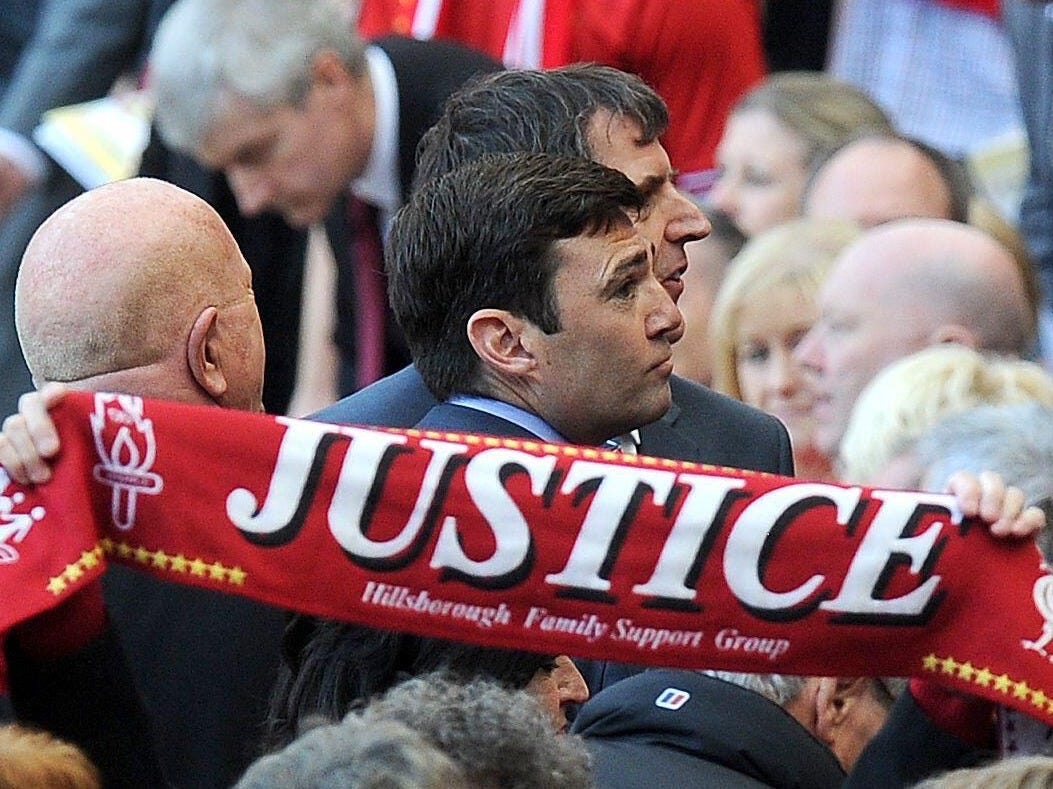
After Burnham’s years at Supporters Direct, football again came to the fore in his political life, when as Culture Secretary, he delivered a speech at Anfield Stadium in April 2009, marking the 20th anniversary of the Hillsborough disaster, in which 97 Liverpool fans died. The crowd heckled and jeered, tired of hearing platitudes.
According to Labour peer Lord Richard Faulkner, who had worked alongside Burnham on the Football Task Force, the incident left Burnham “shattered”, before he returned to Westminster with renewed zeal to secure justice for those who had died. His subsequent intervention, aimed at prising open the lies and secrecy surrounding Hillsborough, was described as “immense” by one long term campaigner. Burnham helped set up an Independent Panel which in turn led to a new inquest. This found that the 97 had been unlawfully killed.
Graham Ennis, who interviewed Burnham for his fanzine ‘When Skies Are Grey’, says that his fellow Evertonian recognised that the tragedy might have been visited upon any other large fan group, such was the dreadful state of policing and lack of concern for football’s paying customers in the late 1980s. That’s why, says Ennis, Burnham took action rather than umbrage after his hostile reception at Anfield. “I think to his great credit, he went away and said, ‘I’m going to do something about it.’ And he did. He delivered.”
With Burnham’s stock rising and his party on the rocks, Burnham attempted to become party leader in 2015, having previously failed in a similar bid five years earlier. He encouraged Ennis’s readers to sign up as registered Labour supporters for just £3, which gave them the right to vote in the leadership ballot. Ironically, this was a move which favoured his rival Jeremy Corbyn, who subsequently became leader. Burnham opted for the not insignificant consolation prize of becoming Greater Manchester Mayor, whilst continuing to support his beloved Everton. He went to his first game at Goodison Park aged 5 or 6, and Ennis says that in the decades that followed, he was “someone who was there, someone who lived it”.
For Dave Boyle, Everton’s tradition of Catholic support ties in with Burnham’s own childhood religion and social conscience. “I think Andy’s got a very moral core to him. I think he’s not so much an ideological person, I think he’s more morally driven. I think when things are wrong, and if he feels that they are wrong, he’ll go on a pursuit of justice for it.”
Listen now to the Byline Times Podcast - Andy Burnham: Forged In Football
Maybe it’s just me, or maybe it’s because I’m Scottish and think England isn’t the only country but already I’m fed up with the fawning over Burnham. There are actually some very important issues facing the UK, one of which the English and their media haven’t noticed yet: the Constitution.