


BYLINE TIMES IMPACT: Find out about the changes you made happen
Forget doomscrolling social media. Prepare to be trolled by the dead.
It’s probably happened to most of us who have lost a relative, friend, or colleague. Out of the blue comes a calendar alert reminding you of a now defunct birthday, an unread message you regret not replying to, or a cheerful photo album montage of the departed – randomly entering your feed like a thoughtless ghost.
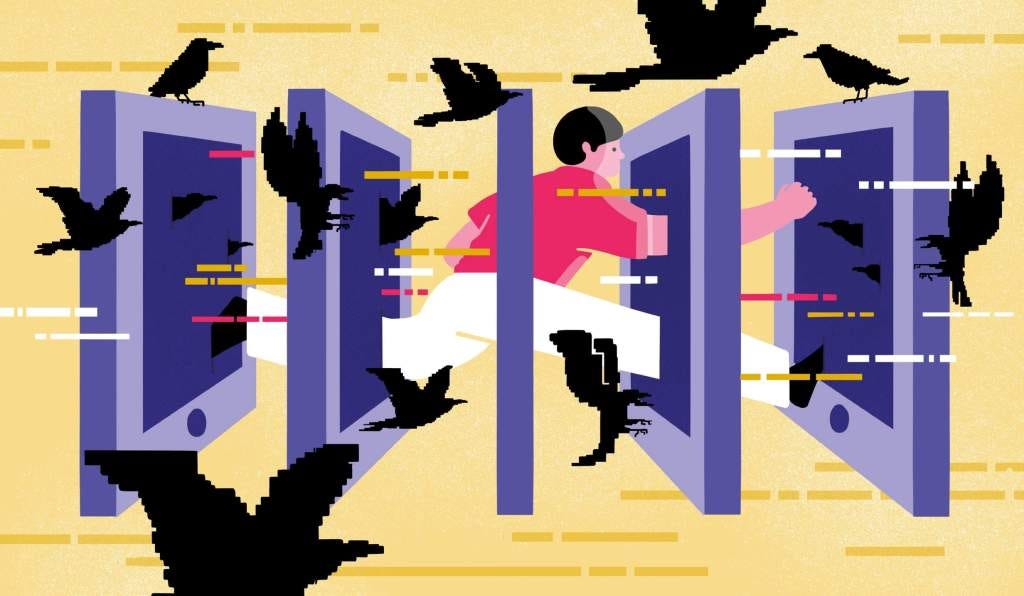
This online haunting is only going to increase as the number of dead occupying cyberspace begins to outnumber the living.
The problem is not new. In 2014, the web developer Eric Meyer was sent a cheerful little montage in his Facebook ‘Year in Review’, framing a photograph of his six-year-old daughter, Rebecca, with cartoon balloons and streamers. She had died that summer.
Meyer called it “inadvertent algorithmic cruelty”, but the automation was not being cruel. It was only doing what it had been told to do. Its programmers had never thought of distinguishing between a good year and the macabre reality of dressing a dead child in party hats.
Never have our legacies and hopes for remembrance been so centralised and commandeered by companies which didn’t even exist a couple of decades ago
Facebook’s executives were also victims.
The following year, Sheryl Sandberg, then its chief operating officer, suddenly lost her husband. Regardless, the machine she had helped build kept on suggesting him as a friend. “There were things that were happening,” Sandberg later said, “that I think were really painful.”
There were a lot of painful things going on that year, as Facebook was a major source of Russian disinformation in the run-up to Donald Trump’s first presidential campaign and the Brexit vote.
But Sandberg’s story shows how, like Elon Musk on X, the tech bros and sisters can be radicalised or victimised by their own social media platforms.
With more than three billion users posting two billion photos a day, Facebook has become the largest repository of personal memory ever assembled. It is also a burial machine. As the problem of the resurfaced dead grew more disturbing, Facebook built a second algorithm in 2019 – one dedicated to catching the birthday reminder before it reached the bereaved parent, or the friend suggestion before it nagged the grieving widow.
These automated ghostbusters are going to be even more important as the Grim Reaper takes his toll on the Boomer generations dominant on Facebook, and transforms it into a mausoleum: Zombiebook.
In 2019, two researchers at the Oxford Internet Institute, Carl Öhman and David Watson, found that on 2018 user levels at least 1.4 billion Facebook members will be dead before 2100 – and the dead could outnumber the living by around 2070.
So what happens to our memories when surrendered to big tech? All those photos and reels on Instagram, iPhone galleries, and TikTok?
At the moment, they sit on the cloud, like angels without harps, but not for eternity. Though they promise eternal relevance and freshness, the digital domain is the most mortal of all.
Forgotten Analogue
I first noted the strange incapacity of digital products to deal with time in an article for the New Statesman in 1992, ‘The Work of Art in the Digital Domain’, timed to commemorate the centenary of Walter Benjamin’s birth and a tribute to his landmark essay, ‘The Work of Art in the Age of Mechanical Reproduction’.
For all their ease of use and interactivity, these startling new digital formats could not cope with human frailty and mortality
More than 30 years ago, it was clear this emerging world of cyberspace could not be likened to an ‘era’ and was more unsettling and discontinuous – a whole new domain. For all their ease of use and interactivity, these startling new digital formats could not cope with human frailty and mortality.
I compared a new CD of one of my mother’s favourite tenors, Beniamino Gigli, singing ‘Mi Par D’Udir Ancora’ from Bizet’s The Pearl Fishers.
I missed her well-worn vinyl with all those scratches that seemed to syncopate with the undertow of the clarinets like waves lapping his boat. For all its pops and hisses, the analogue copy seemed better attuned than the hi-fi version to the sad fisherman haunted by the memory of his muse’s voice.
Meanwhile, as we all soon found out, get a scratch on a CD, and you did not get distance or melancholy – just a redundant disc of plastic, the next best use of which was as a coaster for your coffee mug.
The digital format could not accommodate error, nostalgia, or nuance in the way analogue vinyl or celluloid could. It was binary. The signal was cancelled out entirely by the noise of time.
In the 34 years since, online streaming and MP3 compression means no track will hang mid-legato now. But the innovations required to keep it working have led to a much wider discontinuity and breakage of formats than anyone could have imagined.
They are all gone now. That CD collection in its brittle plastic cases, following the floppy disks into the bin. The CD-ROM; then the DVD; then Blu-ray. Gone, gone, gone into landfill and recycling.
Even if they would still play the artefact, you would have to find the player that could read it. And yet, my mum’s old vinyl record would still play, had I kept it, on the new generation of vinyl turntables.
Most of the products of that early digital age that promised us limitless copies and perpetual access did not just fade gracefully and meaningfully, but just suddenly stopped and disappeared.
Renting Immortality
By the mid-90s, I was so entranced by the possibilities of computer production I was asked to programme some animated poems on Flash. I still remember the joy of combining Baudelaire’s poem with a Cartier-Bresson photo montage, Rilke with the painter Caspar David Friedrich.
But that Flash software was abandoned 20 years ago, and Adobe turned off all the players that could run them in 2020.
Meanwhile, I have lost more than 10 years of emails because I used Microsoft Office from about 1995 to 2008, before I switched to Gmail. I can’t for the life of me find the PST files where they were stored, let alone the computer backups of them on the dozen or so desktops and laptops since.
And let’s not even go there with my first digital cameras. I have no idea how to read the various flash memory cards, and though I did print out many of those photos, there is a clear fall in quality compared with the old analogue ones I took.

We might like to reassure ourselves that we have shored up these souvenirs against our ruin, since every Gmail and iPhone picture is stored in the cloud. But how long will that last?
Alphabet and Apple are charging me for storing my memories, and what guarantee do I have that they won’t change the terms and conditions and – like Adobe Flash – in a flash they’re gone?
Renting immortality is hardly a new thing.
Rich people have always paid for prestigious tombs, and built Taj Mahals for their lamented loved ones. Medieval aristocrats would pay lifetime stipends for people to pray at their chantries to speed up their passage through purgatory.
But never have our legacies been so centralised and commandeered by companies that didn’t exist a couple of decades ago.
Perhaps our peculiar modern anxiety about ‘cancel culture’ stems from this centralisation of memory.
In a world dominated by social media giants and their cryptic and binary decisions, the fear of public shame or private guilt is probably less than the fear of being deleted and having no platform whatsoever.
Back in real life, on a shelf by my bedroom window, is a small collection of programmes and orders of service from a spate of recent funerals. The faces of friends and relatives I will never see again greet me daily, looking younger than when I last saw them, and not ageing like me. But these memorials don’t pretend to live for ever.
If we do not own our own memories, but only have temporary permissions to access them, then we do not own our pasts
The cards are slightly crinkled, having survived in my pocket from memorial services to noisy wakes. Is that a splash of beer or unexpected tears? The faces are slowly degrading in the sunlight.
Maybe I should frame them and put them in a dark protective space, but in this exposed way they are a more fitting tribute to the people I have lost than the avid and evergreen avatars pitching for work on LinkedIn or arguing the toss on X.
Finding meaning in this slow attrition of time has been the role of artefacts and art since cave paintings and hand stencils. In ‘An Arundel Tomb’, Philip Larkin notices how the medieval statues of a husband and wife have been effaced by the “soundless damage” of the air, leaving only their naked hands to hold each other fully intact – “what will survive of us is love”.
Likewise, in Yeats’s poem ‘Lapis Lazuli’, in a sculpture that depicts two Chinese sages ascending a mountain to a halfway house, the carver of the blue stone has turned every fracture and rupture and twisted it into an adventure – the crack becomes a watercourse, a flaw becomes an avalanche.
The Japanese have a craft devoted to turning the fragility of things into a celebration of our common frailty. Kintsugi is the mending of broken ceramics with seams of gold, so that the accidental break is not hidden but made ornamental – an illustration of our haphazard fortunes and misfortunes.
But digital products can’t shatter. They cannot metabolise mortality. They seize up completely. And perhaps this explains the radical break in the past 30 years in how we preserve our memories and narrate our social history.
The Generation Game
Ever wondered why, since the 1990s, we’ve stopped measuring time in decades?
Most Boomers like myself who came of age in the 20th Century can conjure up a pretty precise picture of fashion, music, arts, technology, military adventures, and political crises by the 20s, 30s, 40s, 50s, 60s, 70s, 80s, and 90s.
Eras were once defined by dynasties, empires, or republics. A reign was a span of years that takes its name and its length from a single anointed body – Elizabethan, Victorian, Edwardian – or the ideology of a Han or Ming Dynasty, or a republic in Florence, Venice, or Paris. Each empire had its own clock, and then they began to compete.
The Industrial Revolution extended that relay race across the world, synchronised them with railway timetables, the marine chronometers on gunboats, and telegraph signals.
In the age of mechanical and electronic reproduction – Benjamin’s great subject – it was not only artworks that succumbed to mass manufacture and standardisation, but time itself.
During the rapid globalisation of the 20th Century, whole time zones began to share one synchronised now. That’s what made the decade almost universally nameable. The 20s and 60s have completely different meanings in China than in, say, France, but they still had a common reference – a timetable that cohered around a national tempo moving forward together.
So why don’t we talk in decades any longer?
Obviously, there is the awkwardness of naming the ‘Noughties’ and ‘Teenies’ of the first two decades of the 21st Century, and the problem of confusing them with the 20th. But it’s more than that.
We haven’t given up counting the progression of fashion, mores, and society entirely, but we now do it through cohorts – Millennials, Gen X, Y, Z, Alpha.
Our sense of history has gone from the linear progression of a factory line to something massively parallel, in which every era and its fads are simultaneously available and never really die – like a Spotify playlist.
There are various reasons why this happened in the early 90s. The fall of the Berlin Wall in 1989 and the collapse of the Soviet Union in effect destroyed the socialist model of progress. Part of the reason for its demise was the technological superiority of the West, especially with microchips and computing.
Those very technologies enabled the end of a central broadcast culture and the rise of the World Wide Web. Satellite and cable challenged the collective zeitgeist – whether that was Walter Cronkite reporting on Vietnam or the Morecambe and Wise Christmas Special.
So Francis Fukuyama was broadly right to talk about the ‘end of history’ in this context – or at least the end of a coherent, collective idea of it.
Except for the odd international sporting event or disaster like 9/11, those big national broadcast ‘nows’ have shattered that into 10,000 parallel narrowcasts.
This is when the generation game began.
In 1991, Douglas Coupland published Generation X, and named the thing which would replace the decade: the cohort, a demographic band with no implied direction. The clock of progress stopped, and the living were turned into the native time-unit of the marketing industry.
Notice what actually changes from imperial to industrial to post-industrial digital time.
The reign and the decade are durations: stretches of time that happen once, to a particular kingly body or national idea. But the segmented cohort has no duration at all. It is a permanent tribe, a totemic set defined by commercial proprietary decisions. You could live through and leave the Swinging 60s, but you can never stop being a Gen X looksmaxxer.
The scholastics understood what this categorical imperative leads to.
The great Aristotelian theologian Thomas Aquinas dominated European ideology for centuries with his emphasis on the immutable order of things by their attributes, their quiditas, or ‘whatness’.
One of the few rebels against this totalitarian scheme was the Scottish medieval philosopher Duns Scotus, who emphasised the mutability and singularity of life, its ‘thisness’ or haecceitas – the fact that it is this one, here, once, and no other.
That’s why the Spotify playlist is the true clock of the age. A playlist has no tense, no here and now, no once and for all. Every track is equally present, in any order, retrievable by attribute. Neil Young sits next to South London grime; Dolly Parton next to Frank Sinatra. Is that a mod hit from the 1960s or an Oasis track from the 1990s? Who knows? Who cares?
And that’s the problem with a past randomly shuffled into your timeline, from a subscription that can lapse. If we do not own our own memories, but only have temporary permissions to access them, then we do not own our pasts.
And without owning up to our pasts, it is hard to imagine any better future which – looking back – the dead had always imagined for us. ●
This article appears in the new edition #90 of Byline Times monthly magazine, available now in print and digital.