

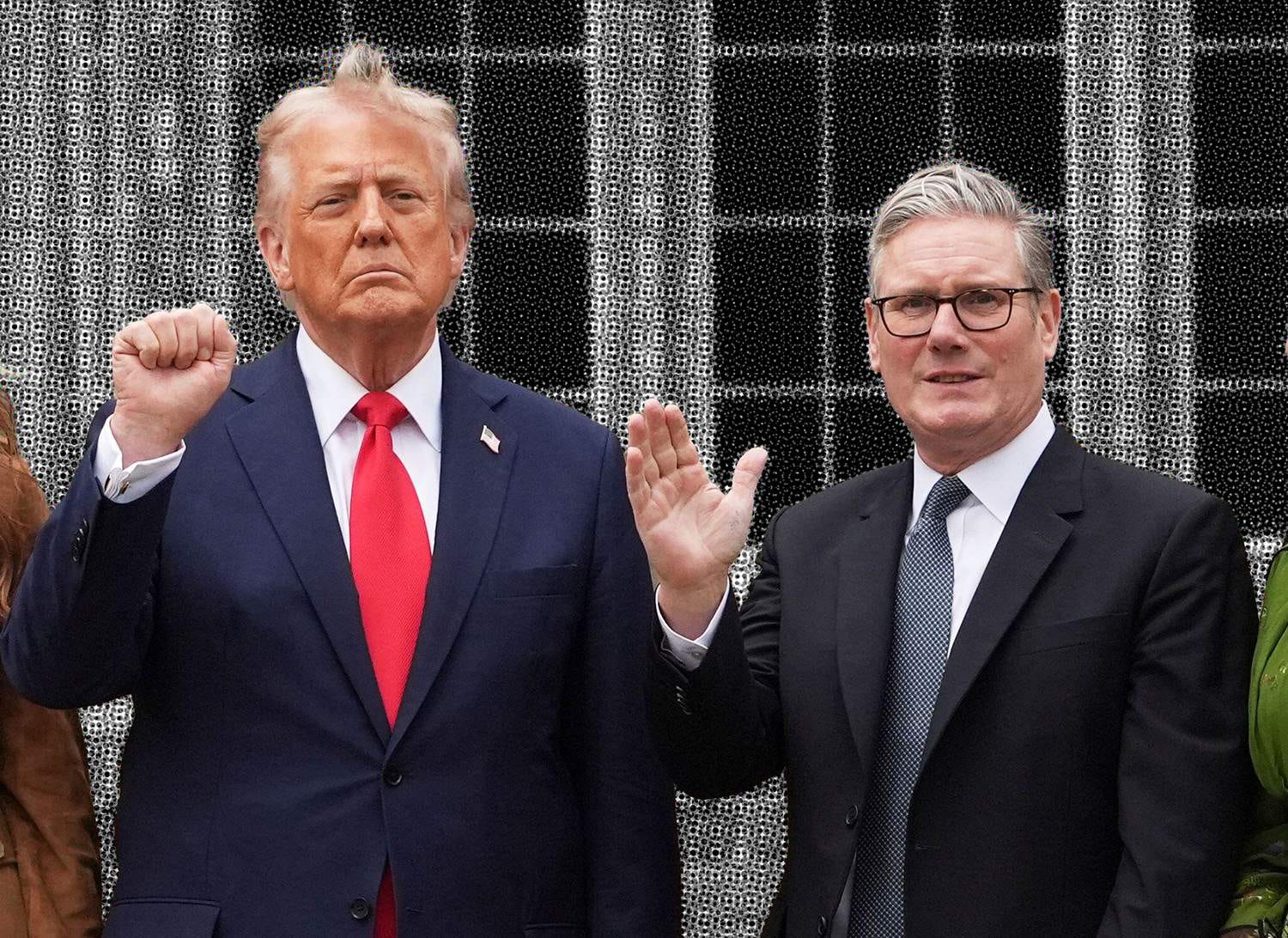

Most British people have grown up with an understanding of the ‘special relationship’ between the UK and the US — a bond which is said to exist through shared military and intelligence interests, but which is also underpinned by a shared language and common cultural values. Politicians and journalists regularly refer to the phenomenon — so much so that it’s now right-wing clickbait to suggest that Sir Keir Starmer’s less than gung-ho support for the US assault on Iran has placed this mutually beneficial friendship in jeopardy.
That’s certainly one way of looking at it, but given Trump’s bullying behaviour, I wonder if we should we now be talking instead about a coercive relationship — a form of domestic abuse outlawed in the UK under the Serious Crime Act in 2015. It’s not always easy to translate the mores of domestic behaviour into the realities of geopolitics, of course, but it’s safe to say that if Trump was the UK’s real-life partner, the CPS wouldn’t struggle to assemble a convincing case for the prosecution.
Has he, for example, engaged in “threats, humiliation and intimidation,” one of the key tests for coercive control set out in law? Undoubtedly. His warning that the US might use its military might to annexe Greenland against the wishes of Britain and other NATO allies, is just one example. Trump also denigrated the contribution of NATO soldiers in the Afghan campaign, suggesting they had avoided the front line — a particularly vile put down when you consider that the UK lost 457 service personnel.
Piling on the insults, the US President belittled the PM’s decision to send aircraft carriers to the Gulf this week, saying “we don’t need people that join wars after we’ve already won!” He has dubbed Starmer “a loser” and said he was “no Churchill”, because of his cautious response to the Iran conflict. To observe that Trump is a bully is, of course, to state the bleeding obvious, but when he facilitates a pile-on by his acolytes in the UK (Nigel Farage, Kemi Badenoch, Tony Blair et al) it becomes more than name-calling. It is a challenge to Starmer’s leadership; one which undermines British sovereignty.
Another key aspect of a coercive relationship is financial abuse, which the US has been all too ready to employ to bring its allies to heel, whether through punitive tariffs or demands for greater spending on defence. The UK, being seen as a ‘good’ ally, was rewarded with a tariff of ‘only’ 10% compared to the 15% levied on the EU, until this was struck down by the Supreme Court.
The UK law on coercive relationships also recognises that abusive partners often seek to prevent their victims from making friends or developing other relationships. This is precisely what Trump and his camp have done by backing Brexit and seeking to sow discord in the European Union, an aim explicitly promoted by the National Security Strategy, which commits the US to supporting nationalist parties abroad.
Winston Churchill first popularised the idea of the ‘special relationship’ in the aftermath of World War Two and in the years that followed it became a Cold War comfort blanket for the UK. Even as Empire slipped away following the (US-inflicted) humiliation of Suez, it offered us the illusion of global power and prestige - we could tell ourselves we were second amongst equals.
It’s a moot point whether the Americans ever saw it this way, but Britain has long been useful in providing political cover for Washington’s international ambitions. Although the Vietnam War proved we could still go our own way, the ‘special relationship’ was rekindled during the Thatcher/Regan years and later reinforced by Tony Blair’s decision to back the disastrous invasion of Iraq in 2003.
It even extended to last year’s historic State visit to the UK by Donald Trump — the first time an elected leader has been given this honour on two occasions. Trump is due to complete his hat-trick in April, despite calls by Lib Dem leader Sir Edward Davey to for the invitation to be withdrawn.
In a conventional relationship, the advice for Starmer would be straightforward — seek help and remove yourself from the abusive situation; but international politics provides no safe house. In the absence of a place of refuge, the PM’s approach necessarily has to be cautious and many observers will feel he has played a tough hand well, largely keeping Trump onside despite the President’s wildly oscillating temperament.
Starmer’s response also underlines how right now, the UK, isolated by Brexit, is bound to remain trapped in this unhappy marriage, without even the respite of a temporary separation. Realpolitik demands that the relationship must be sustained; but special it most certainly isn’t.
Listen now to the Byline Times podcast where Adrian Goldberg discusses the ‘Coercive Relationship’ with Scott Lucas, professor of US and International Relations at UCD Clinton in Dublin.
I find the analysis compelling but not the conclusion. There is an alternative to pandering to Trump’s childish narcissism. First, tell hm to FO as he not a reliable friend of the UK. Second, fast-track a far closer relationship with the EU. And third, in cooperation with European allies speedily develop our own systems so that the UK and Europe create long-term resilience in the face of a capricious US.
We should treat the US under Trump as an unhelpful and possibly hostile actor, potentially threatening European solidarity and security and therefore take things in-house including much of what has been outsourced (for cheapness) to other potentially unreliable and hostile states.
Maybe in the halcyon days of relations between the UK and US there may well have been a special relationship, but not now. Trump has killed that idea stone dead. The imposition of tariffs, the persistent undermining of our government, helped in no due part by nigel farage, who belittles the UK every chance he gets when he's in the states, and the fact that trump sees this country as insignificant and should do everything he says. To claim the special relationship is working is a lie. We are now subject to the whims of a narcissist with fronto temporal dementia whose actions are trying to cause a distraction from the Epstein files. We can no longer rely on the US to have our backs.