

“If the imagination were an animal, it would be the hare. The mercurial hare races quicksilver, like a flash of thought swiftly appearing and instantly gone.”
From cave paintings to fables and children’s books, for thousands of years, animals have shaped human thought and our urge to connect with them has given rise to imaginative art.
“The full imaginative reach of being human needs the animals,” writes Jay in How Animals Heal Us. “We are made of the snort of a horse, a hedgehog bristle, and badger’s teeth. We are wren-sung and swallow-built and seahorse-etched and our imaginations are flecked with turquoise, thanks to the dragonfly. Through the animals we know ourselves.
“In cave paintings, it is animals that are painted. This is so well-known that its importance can be overlooked. The earliest art was inspired by a thrilled, observant and almost certainly shamanistic entrancement with animals.”
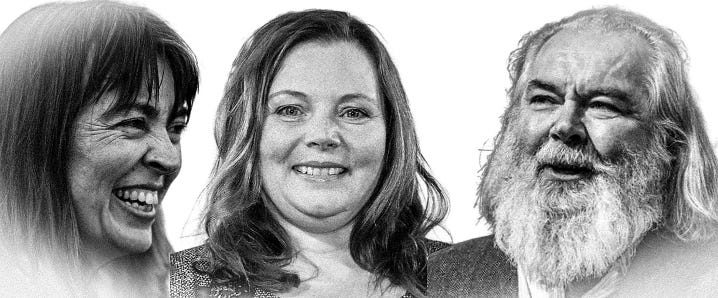
Jay, Joanna and John ask why animals feature so importantly in children’s books and why a love of animals is often seen as childish.
They also discuss how the language of imaginative metaphor can help explain how it feels to experience mental illness.
Jay reads from her book, Tristimania, “Metaphor matters in madness. Matters so much that you could say metaphor is the material of madness, the mothering tongue of the madstruck mind, mater of it all.”
Jay talks about her own experience of manic depression and the metaphor of mountains that helped her to communicate her agony:
“When a person is ill, a metaphor is not a decoration, not a trivial curlicue of Eng. Lit, not a doily on the conversational table, rather it is a desperate attempt to send out an SOS, to give the listener their co-ordinates, because they are losing themselves. I am on Cader Idris, just before the first peak after the path leaves the lake, do you read me? Over. The perilous geography where my psyche was situated. Situated but dis-located, alone and pathless. I had to be meticulously precise in giving the latitude of my madness, the longitude of my scraps of insight. I was lost and urgently needed to be found, to be located by someone who could (as shamans say) send their souls out to find mine. In terms of our culture, one way of doing this is surprisingly simple: listeners need to hear the metaphors and stay with them.
“It is crucial that listeners do not scramble the message or scumble the precision of the image. If the listener can stay within the terrain of the exact metaphor the speaker is using, they will feel more findable, more reachable. (I read you. What’s the mountain weather report? Stay away from the cliff edges...) But if, by contrast, the reply confuses the image (I understand. You’re feeling very low. You’re in a dark pit) then the person in crisis will feel more lost, more isolated, and more endangered.”
You can order any of Jay Griffiths’ books from her online shop on Bookshop.org


